Manufactured in Greater NoidaGenuine Philips UV-C LampsIIT Patna Alumni on Our TeamExporting to 20+ Countries
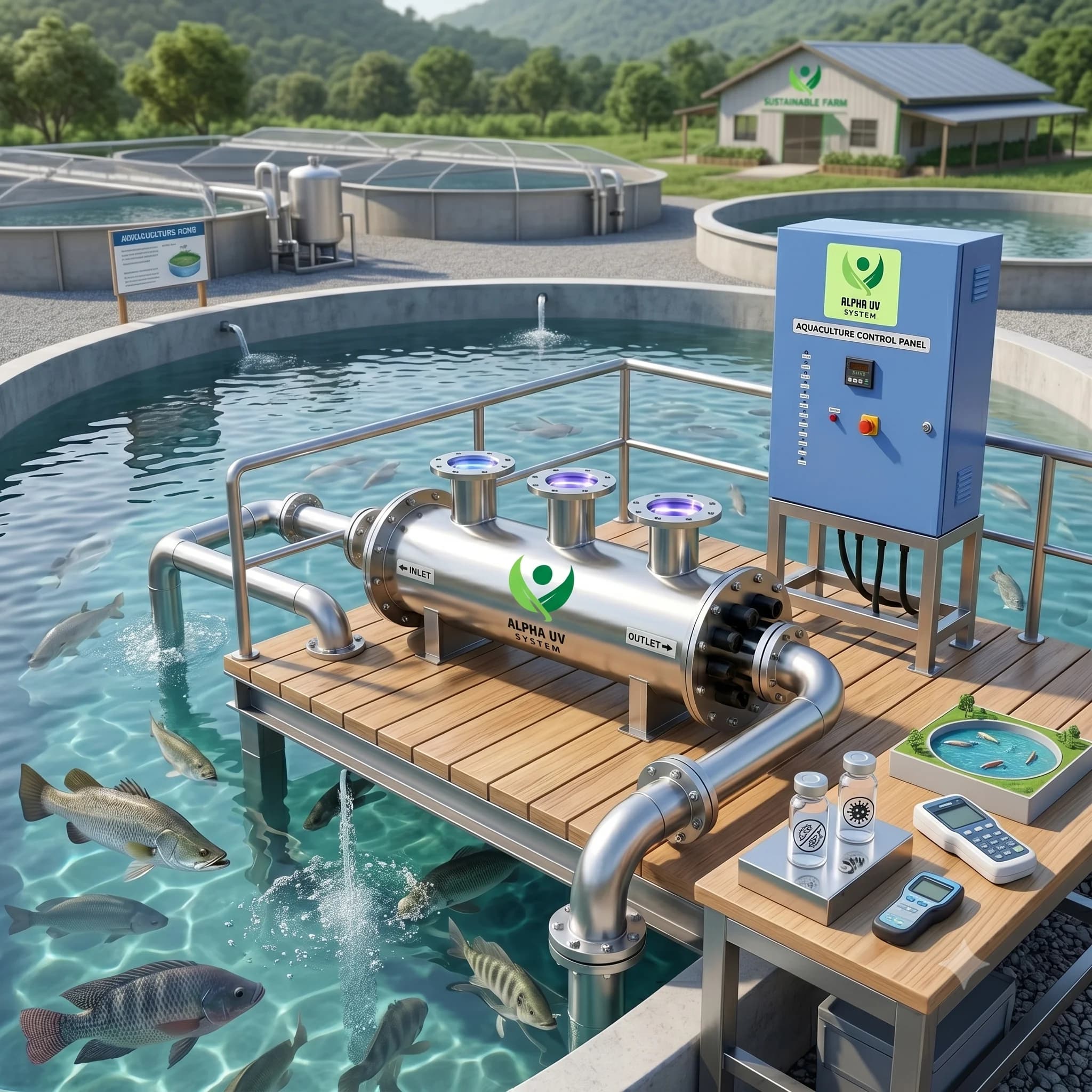
Chemical disinfection in aquaculture is constrained by a fundamental paradox: chlorine, the most common water disinfectant, is acutely toxic to fish and crustaceans at concentrations that are effective against pathogens. Chemical residuals from conventional disinfectants — chlorine, iodine, formalin — accumulate in fish tissue, appear in export test results, and trigger MPEDA rejection of aquaculture export consignments. UV disinfection at 40–100 mJ/cm² controls Vibrio harveyi, Aeromonas hydrophila, Saprolegnia water moulds, and viruses in recirculating aquaculture system (RAS) inlet water without any chemical addition, without fish toxicity risk, and without chemical residuals in fish tissue. Alpha UV System: Philips UV-C, IIT Patna-trained engineers, MPEDA and FAO aquaculture guideline compliance. 5,000–2,00,000 LPH.
UV Dose
40–100 mJ/cm²
Capacity
5,000 – 2,00,000 LPH
Aquaculture is one of the fastest-growing food production sectors in India, driven by export demand for vannamei shrimp, black tiger prawn, tilapia, pangasius, and freshwater fish. The FAO State of World Fisheries and Aquaculture (2022) identifies India as one of the top three global aquaculture producing nations, with the industry generating over Rs 60,000 crore in export revenue annually.
The primary constraint on aquaculture productivity — disease. Vibrio, Aeromonas, Saprolegnia, Ichthyophthirius, and viral pathogens (White Spot Syndrome Virus, Infectious Salmon Anaemia virus, Viral Nervous Necrosis) in rearing water are responsible for mortality events that can destroy 30–80% of a production crop in a matter of days. FAO Fisheries Technical Paper No. 528 — Aquaculture Water Quality (2010) documents that disease-related losses account for approximately 10–20% of global aquaculture production value annually — a figure that represents billions of dollars and, in India's context, thousands of crores of rupees in annual economic losses to aquaculture producers.
The paradox that makes aquaculture water disinfection uniquely challenging is that the most effective water disinfectants — chlorine, iodine, formalin — are acutely toxic to the organisms being raised. Chlorine concentrations effective against Vibrio (1–5 mg/L) are 5–50 times the LC50 for common fish species. Chemical disinfectants that can be used in aquaculture applications are therefore limited to pre-stocking treatment (applying the disinfectant to empty tanks before fish are introduced) or very short-term bath treatments at carefully controlled concentrations.
Vibrio species are the most economically significant aquaculture pathogens in Indian shrimp farming. Vibrio harveyi causes luminescent Vibriosis in shrimp larvae — a disease characterised by glowing larvae, rapid mass mortality, and total hatchery crop losses that have devastated hatchery operations in Andhra Pradesh, Odisha, and Tamil Nadu's shrimp producing states. Vibrio parahaemolyticus causes Early Mortality Syndrome (EMS) / Acute Hepatopancreatic Necrosis Disease (AHPND) in vannamei and black tiger prawn — a disease that emerged in Asia in 2009-2012 and is now the single greatest threat to global shrimp aquaculture.
The Marine Products Export Development Authority (MPEDA) — India's regulatory body for aquaculture export product quality — requires shrimp hatcheries seeking MPEDA certification to demonstrate adequate water treatment for pathogen control, including specific controls for Vibrio. Certified hatcheries must maintain total Vibrio counts in rearing water below MPEDA-specified thresholds throughout the production cycle.
UV disinfection on hatchery make-up seawater — treated before it enters larval rearing tanks — is the internationally accepted method for Vibrio control in shrimp hatcheries. Defoirdt et al. (Aquaculture, 2011) and MPEDA certified hatchery guidelines consistently identify UV as the standard of care for hatchery water Vibrio management. At 40–80 mJ/cm², UV reduces Vibrio counts in seawater from typical environmental levels of 1,000–10,000 CFU/mL to below 50–100 CFU/mL — the MPEDA target for hatchery certification.
Recirculating Aquaculture Systems (RAS) are closed-loop fish production systems that recirculate 95–99% of the water used, using biological filters (nitrification), mechanical filters (solids removal), and disinfection to maintain water quality. RAS technology — detailed in Timmons and Ebeling, Recirculating Aquaculture, 3rd Edition (2013) — enables land-based production of marine species, disease-free controlled production environments, and year-round production independent of weather and season.
UV disinfection in RAS serves two distinct functions: (1) inlet water treatment — disinfecting fresh make-up water entering the system from external sources (well water, municipal supply, or seawater intake) to prevent introduction of pathogens into the controlled RAS environment; and (2) recirculation stream bypass treatment — treating a controlled fraction of the recirculating water on each pass through the UV unit, progressively reducing pathogen load that accumulates from fish excreted material, dead skin cells, and biological filter effluent.
The combined effect maintains total waterborne pathogen counts at levels below disease expression thresholds throughout the production cycle — enabling production of tilapia, salmon, trout, barramundi, vannamei shrimp, and high-value marine species in Indian RAS facilities without the disease-related losses that characterise open pond production systems. Liltved et al. (Aquacultural Engineering, 1995 and 2006) established the UV performance benchmarks for RAS applications that Alpha UV System UV dose calculations are based on.
Indian aquaculture exports face increasingly stringent inspection programmes from the EU, US FDA, and Japan — India's primary export markets. Chemical residues from aquaculture inputs — antibiotics, malachite green, chloramphenicol, nitrofurans, and heavy metal compounds from chemical disinfectants — are the leading cause of Indian shrimp and fish export rejections at destination port inspections.
MPEDA export certification requires aquaculture producers to demonstrate: a HACCP-based production management system; documented pathogen control programme with records; chemical residue testing of final product (EU Reg 37/2010 MRL compliance); and traceability from pond to export consignment. UV disinfection supports MPEDA compliance by providing a documented, chemical-free pathogen control method that leaves zero chemical residues in fish or shrimp tissue — eliminating the residue risk that chemical disinfectant approaches carry.
For Indian aquaculture producers seeking EU market access under EU Regulation 37/2010, UV-treated water systems with documented UV intensity monitoring records provide the water quality management evidence required by EU competent authority inspections of Indian aquaculture facilities. Alpha UV System provides MPEDA-compatible UV disinfection documentation packages for aquaculture producers seeking MPEDA certification and EU/US export market compliance.
Saprolegnia is a water mould (oomycete) that attacks salmonid eggs, trout, catfish, and ornamental fish in freshwater hatcheries. Saprolegnia infections cause significant egg and fry mortality — particularly in salmon and rainbow trout hatcheries where eggs are incubated in flowing fresh water. Until 2002, Saprolegnia in salmonid hatcheries was controlled with malachite green, a synthetic dye with proven Saprolegnia efficacy but strong carcinogenicity and environmental persistence that has led to its global ban in food fish aquaculture.
UV disinfection at 80–100 mJ/cm² achieves 4-log inactivation of Saprolegnia zoospores — the motile infection stage — on incoming hatchery water. This prevents the introduction of Saprolegnia zoospores from the water source into the incubation trays where eggs are vulnerable. UV cannot treat Saprolegnia that has already established on egg surfaces, but by keeping incoming water Saprolegnia-free, it prevents the primary exposure event that initiates hatchery outbreaks.
Alpha UV System designs high-dose (80–100 mJ/cm²) UV systems for freshwater fish hatchery make-up water in salmonid, catfish, and ornamental fish applications where Saprolegnia risk is elevated. These systems use multiple-lamp configurations to achieve the higher dose requirement while maintaining practical flow rates for hatchery operations.
Aquaculture UV system design has specific requirements that differ from municipal or industrial water treatment:
Variable UV Transmittance (UVT): Seawater typically has UVT of 70–85% — lower than the 90–95% UVT of clean fresh water used in municipal treatment. This means aquaculture UV systems must be sized for lower UVT conditions, requiring higher UV-C intensity to deliver the same dose at the reduced transmittance. Surface water from ponds or rivers used in some freshwater aquaculture systems may have UVT as low as 50–60%, requiring pre-filtration (sand filter, multimedia filter) to raise UVT before UV treatment.
Continuous vs batch treatment: RAS systems require continuous UV operation 24/7 throughout the production cycle — any UV downtime during production represents uncontrolled pathogen exposure risk. Alpha UV System industrial UV units for aquaculture are designed for continuous operation with UV intensity alarm outputs and readily available Philips UV-C lamp spares to minimise downtime.
Corrosion resistance for seawater: UV chambers for seawater aquaculture applications must be constructed from SS316L (not SS304) or titanium — standard SS304 corrodes rapidly in salt water environments. Alpha UV System supplies SS316L UV chambers as standard for all marine aquaculture applications.
High flow rate capacity: Commercial prawn farms and marine fish farms with large pond areas require very high make-up water flow rates — 50,000–2,00,000 LPH — that require industrial UV units or multiple parallel UV units. Alpha UV System supplies multi-unit UV systems for very large aquaculture applications with individual UV intensity monitoring on each unit.
Contact Alpha UV System on WhatsApp at 9318305878 or call 9599500580 for aquaculture UV system specifications, MPEDA compliance documentation, and quotation within 24–48 hours. IIT Patna-trained engineers. MSME Udyam registered.
Alpha UV System aquaculture UV systems are designed to FAO Fisheries Technical Paper No. 528 (2010) aquaculture water quality guidelines, MPEDA hatchery certification requirements, and HACCP food safety principles for aquaculture production. UV dose-response data for aquaculture pathogens is sourced from Hijnen et al. (Water Research, 2006), Liltved et al. (Aquacultural Engineering, 1995 and 2006), and ASBC/EBC equivalent publications in the aquaculture science literature.
For MPEDA export compliance, Alpha UV System documentation follows MPEDA quality control and inspection standards for aquaculture products and the EU Reg 37/2010 / US FDA HACCP guidance for aquaculture imports. For RAS system design, Timmons and Ebeling's Recirculating Aquaculture (3rd Edition, 2013) provides the primary engineering reference for UV system positioning and dose requirements within the RAS water treatment train.
All Alpha UV System aquaculture UV systems are supplied with genuine Philips UV-C lamps with certificates of authenticity. Philips UV-C lamps provide consistent and validated UV-C output throughout the 9,000-hour rated life — essential for aquaculture applications where UV dose continuity is critical during vulnerable production stages such as larval rearing and early grow-out. Unpredictable UV output from counterfeit or substitute lamps poses unacceptable risk in hatchery water treatment, where even brief under-dosing events can enable Vibrio population growth to disease-threshold levels.
Recommended Products
IIT Patna engineers recommend these systems for aquaculture uv applications based on flow rate, required UV dose, and compliance standard. Both systems use genuine Philips UV-C lamps and ship with complete compliance documentation.
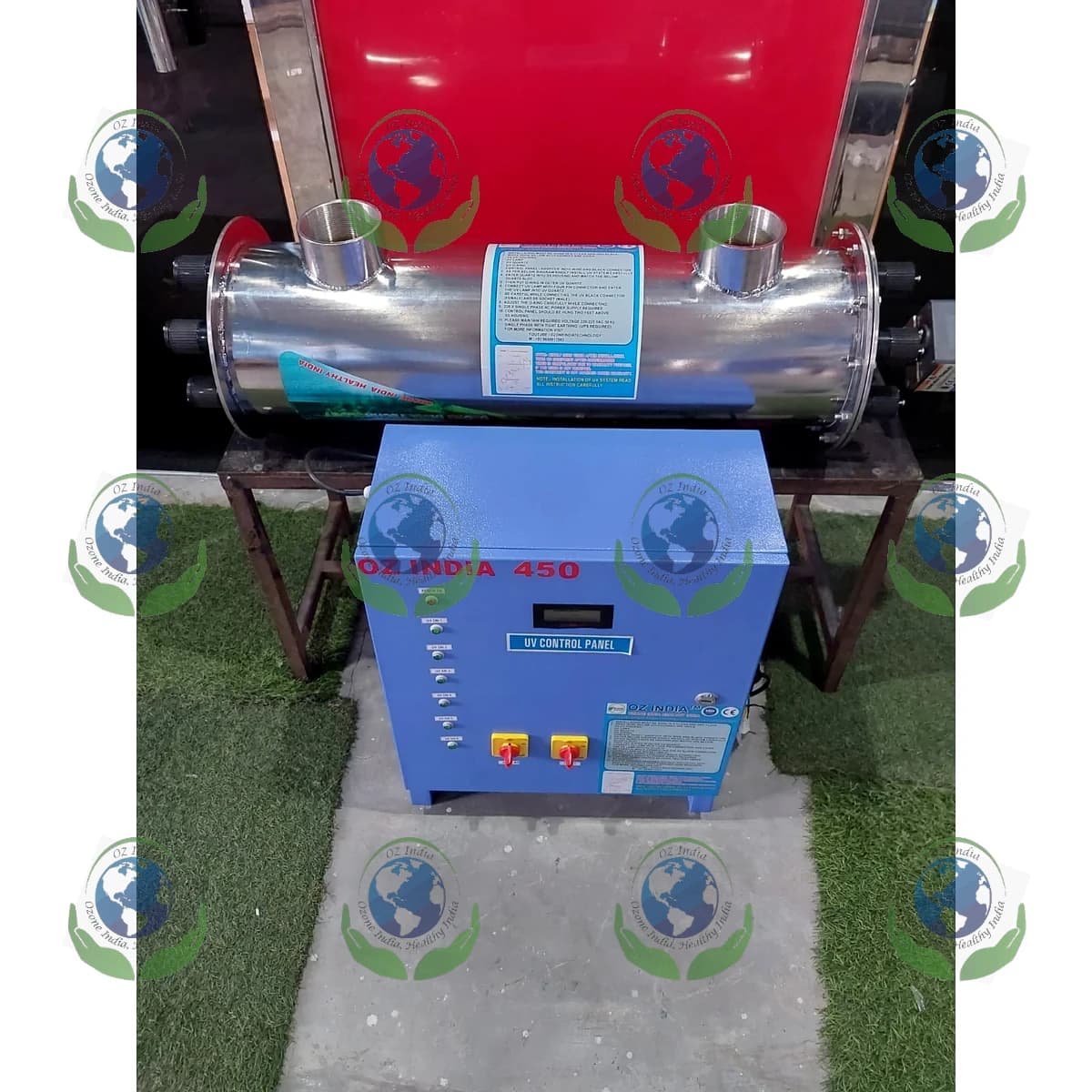
High-flow UV water treatment for pharmaceutical WFI, food & beverage process water, and industrial applications. Revised Schedule M 2025, HACCP, and FSSAI compliant. IQ/OQ/PQ documentation.
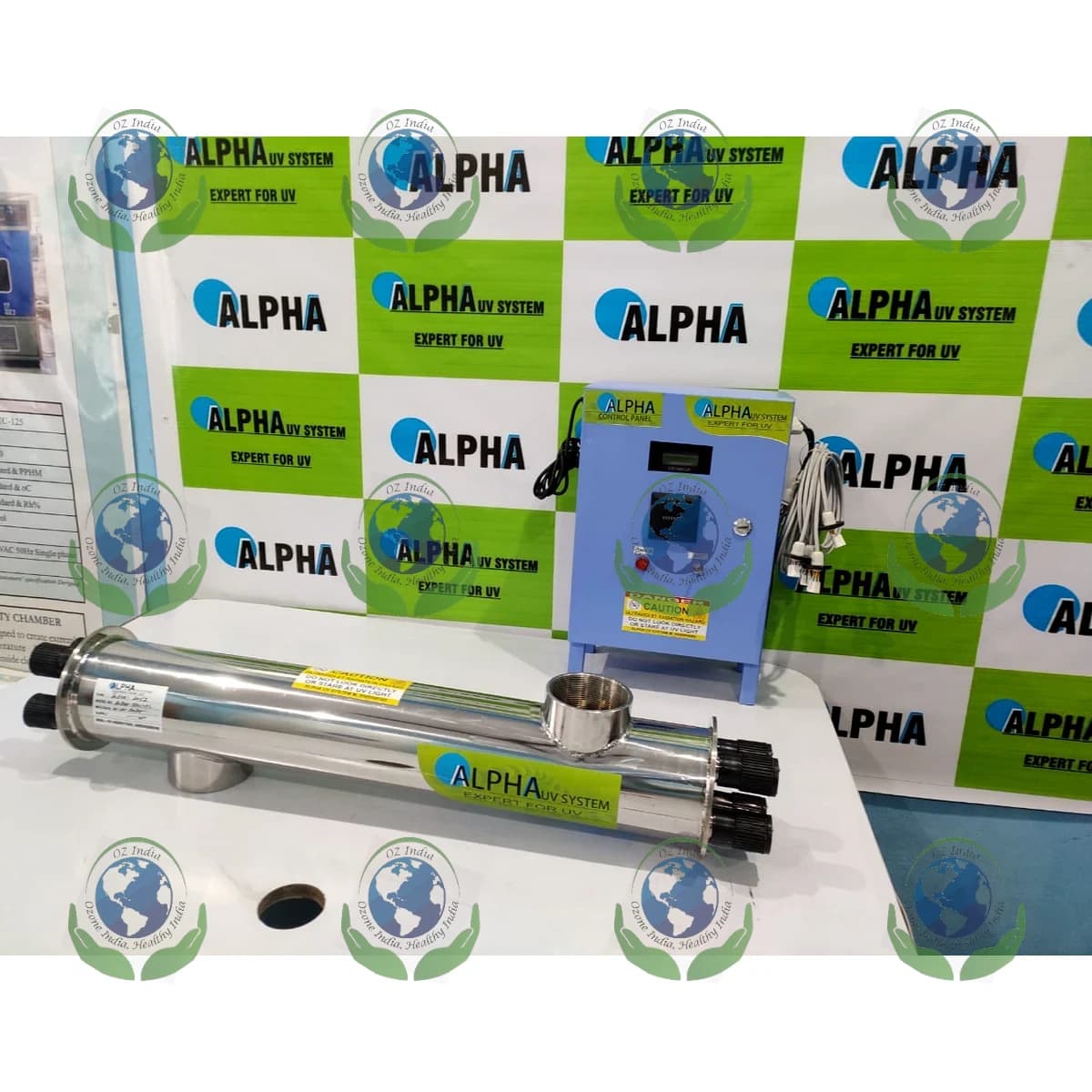
UV-C chloramine destruction for swimming pools. Philips medium-pressure UV-C lamps. Reduces chlorine consumption by 50–80%. Eliminates eye irritation. Kills Crypto — which chlorine alone cannot. For hotels, resorts, clubs, and water parks.
IIT Patna Engineering
Alpha UV System IIT Patna engineers calculate UV dose from your actual water quality parameters — measured UVT, flow rate, target log reduction, and the specific compliance standard that governs your facility. Not from catalogue sizing tables or generic assumptions. Every system ships with a signed UV dose calculation report, a Philips certificate of authenticity, and compliance documentation prepared for the regulatory framework applicable to aquaculture uv operations.
From measured UVT, flow rate, and target log-reduction. Signed by IIT Patna engineer.
MPEDA · BIS · FAO Aquaculture Guidelines · HACCP — documentation prepared to the audit checklist, not generic templates.
WhatsApp your flow rate, water quality, and compliance requirement — engineering-backed quote in 2 hours.
Mon–Sat · 9 AM–6 PM IST · IIT Patna alumni on call
Send us your flow rate and compliance requirement — quote with engineering rationale in 2 hours.
+91 93183 05878
Get Quote →
Call Direct
+91 95995 00580
Tap to Call →
Send Enquiry
Detailed specifications form
Open Form →
