Manufactured in Greater NoidaGenuine Philips UV-C LampsIIT Patna Alumni on Our TeamExporting to 20+ Countries
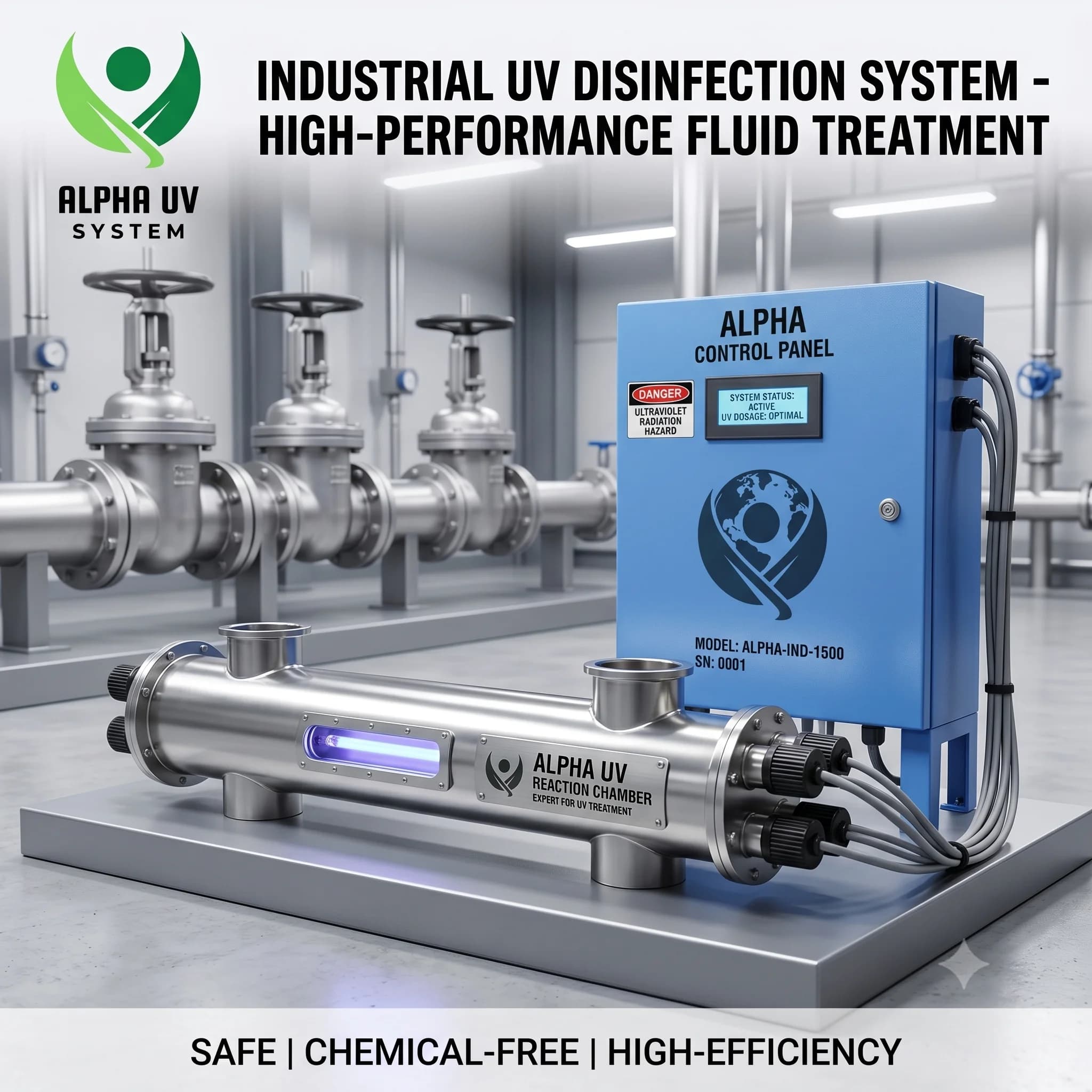
Industrial water quality failures — Legionella in cooling towers, microbiologically influenced corrosion (MIC) in boiler feed, biofilm in process water systems, and biological fouling in ZLD circuits — cost Indian manufacturing facilities crores in lost production, equipment damage, and regulatory penalties annually. Alpha UV System industrial UV disinfection systems deliver 40–80 mJ/cm² continuous pathogen control for the full range of industrial water streams: cooling water, boiler feed, process make-up, CIP water, and ETP final treated discharge. Philips UV-C technology. IIT Patna-trained engineers. 5,000–50,000 LPH standard range.
UV Dose
40–80 mJ/cm²
Capacity
5,000 – 50,000 LPH
Industrial process water quality directly affects manufacturing yields, equipment longevity, product quality, and regulatory compliance. Unlike municipal or commercial water users, industrial facilities often manage multiple water streams simultaneously — incoming municipal or borewell supply, process make-up water, cooling water recirculation, boiler feed, CIP rinse water, and effluent treatment plant discharge — each with different quality requirements and different UV disinfection design considerations.
The AWWA Manual M68: UV Disinfection (2012) and the USEPA Ultraviolet Disinfection Guidance Manual (UVDGM, 2006) together define the engineering basis for industrial UV system design: dose calculation methodology, hydraulic modelling, lamp output verification, and performance monitoring requirements. Alpha UV System's IIT Patna-trained engineers apply these validated methodologies to industrial UV system design across all manufacturing sectors.
Microbiologically influenced corrosion (MIC) alone costs Indian industry an estimated Rs 20,000–30,000 crore annually in equipment replacement, production losses, and maintenance — based on NACE International global MIC cost models adjusted for Indian industrial infrastructure scale. Legionella outbreaks at industrial cooling towers result in significant workforce health impacts and regulatory investigations. Biological fouling of heat exchangers reduces thermal efficiency and drives energy costs upward. UV disinfection on industrial water streams addresses these costs systematically, at a fraction of the cost of post-event remediation.
Cooling towers are the highest-risk Legionella source in industrial facilities. Warm water at 25–40°C, aerosolisation of droplets, and organic nutrients from make-up water create ideal Legionella growth conditions. ASHRAE Standard 188-2018: Legionellosis Risk Management for Building Water Systems applies to industrial as well as commercial facilities and requires a documented Water Management Plan (WMP) with engineering controls at identified Legionella growth points.
In India, state pollution control boards — including Delhi Pollution Control Committee (DPCC) and Maharashtra Pollution Control Board (MPCB) — have issued draft guidelines for cooling tower Legionella management following disease cluster investigations linked to industrial facilities. Industrial facilities in metro areas face increasing regulatory pressure to demonstrate documented Legionella control programmes as part of environmental and occupational health compliance submissions.
UV on the cooling tower make-up water line provides continuous Legionella and biofouling organism control on fresh water entering the cooling circuit. At 40 mJ/cm², UV delivers 5-log inactivation of Legionella in the incoming water — preventing seeding of Legionella into the cooling tower basin. Combined with biocide treatment at reduced frequency, UV provides a sustainable and documentable Legionella control programme that satisfies ASHRAE 188 WMP requirements and ISO 14001 environmental management chemical minimisation objectives.
Biofouling of cooling water heat exchangers — caused by bacteria, algae, and biofilm forming organisms in the recirculating water — reduces heat transfer efficiency by 10–30%, increasing chiller compressor energy consumption and reducing production throughput in temperature-sensitive manufacturing processes. UV on cooling water make-up reduces the rate of biofilm development on heat exchanger tube surfaces, helping maintain heat exchanger performance between cleaning cycles.
Microbiologically influenced corrosion (MIC) in boiler feed water systems is caused by sulphate-reducing bacteria (SRB), iron-oxidising bacteria, and acid-producing bacteria that colonise internal surfaces of pre-treatment equipment, demineralisation columns, and feed water storage tanks. NACE International Technical Report TM0194 (2014) and Little and Lee's Microbiologically Influenced Corrosion (Wiley, 2007) document the mechanisms by which these organisms produce hydrogen sulphide, organic acids, and localised electrochemical cells that drive pitting corrosion in carbon steel boiler feed lines and storage tanks.
UV disinfection on boiler feed water pre-treatment — installed upstream of the DM plant or RO system — controls planktonic bacterial populations entering the treatment train, reducing MIC risk and protecting DM resin beds from biological fouling that degrades ion exchange capacity over time. The UV dose for effective SRB control is higher than for general potable water pathogens (30–40 mJ/cm² for planktonic SRB), and Alpha UV System specifies conservative dose margins — 40 mJ/cm² minimum — for boiler feed applications.
For existing MIC-affected boiler systems, the recommended remediation sequence is: (1) piping inspection and isolation of severely corroded sections; (2) biocide shock treatment to disrupt established biofilm; (3) UV system installation on the make-up supply; (4) ongoing quarterly SRB testing to verify control effectiveness. This approach follows the NACE TM0194 monitoring protocol for biological control programme verification.
Indian manufacturing industries requiring high-quality process water — pharmaceutical, food and beverage, semiconductor electronics, cosmetics, and chemical manufacturing — face regulatory requirements mandating documented water quality management systems. Schedule M 2025 (Drugs and Cosmetics Act revised 2023, effective 2025) and WHO GMP Annex 2 require pharmaceutical manufacturers to maintain bioburden records for all water grades used in manufacturing. HACCP and FSSAI regulations require food manufacturers to treat process water as a Critical Control Point with continuous monitoring.
UV disinfection is the preferred final disinfection technology for industrial process water because it adds no chemical residuals that could contaminate the product or affect water quality parameters such as conductivity, TOC, or pH; it provides 4-log inactivation of process water pathogens at 40 mJ/cm²; and it can be documented with real-time UV intensity monitoring that satisfies CCP monitoring requirements under HACCP.
For Schedule M 2025 pharmaceutical purified water and WFI applications, Alpha UV System provides SS316L electropolished UV chambers, dual-wavelength (185+254 nm) options for TOC reduction, and complete IQ/OQ documentation packages. For food and beverage process water, the UV chamber is SS316L with tri-clamp sanitary connections and CIP compatibility rated to 85°C — meeting food-grade construction requirements for HACCP, BRC, and ISO 22000 compliance.
Industrial applications across India served by Alpha UV System include: pharmaceutical API manufacturing (Schedule M 2025), food processing (FSSAI/HACCP), dairy (IS 1479), brewery and distillery (FSSAI), textile (ZLD final stage), and chemical manufacturing (ISO 14001 environmental management).
The Ministry of Environment, Forests and Climate Change (MoEFCC) has mandated Zero Liquid Discharge (ZLD) for 17 categories of heavily polluting industries — including textile dyeing, sugar, distillery, tannery, and pulp and paper manufacturing. ZLD systems treat effluent to a quality level enabling reuse within the facility. The final treated water from a ZLD system must meet CPCB discharge standards for microbiological parameters.
UV disinfection is the preferred final disinfection technology for ZLD effluent treatment because chlorination of industrial effluent — often containing organic compounds, pharmaceutical residuals, or chemical by-products — generates toxic trihalomethanes (THMs), chlorinated phenols, and other disinfection by-products that are themselves regulated pollutants under MoEFCC environmental norms. UV at 40 mJ/cm² achieves the required microbiological kill without any chemical addition, avoiding DBP formation and satisfying both the CPCB microbiological discharge standard and the ISO 14001 requirement to minimise chemical use and hazardous waste generation.
Alpha UV System has supplied UV systems for ETP final stage disinfection across textile, pharmaceutical, food processing, and chemical manufacturing ZLD installations in India. Capacities range from 10,000 to 50,000 LPH for standard industrial ETP flows, with multi-unit parallel configurations for very high-flow applications.
Alpha UV System industrial UV systems are engineered for continuous heavy-duty operation with the following standard features on the industrial range:
High-output Philips UV-C lamps: Industrial systems use Philips high-output UV-C lamps rated for 9,000–16,000 hours of continuous operation, providing the UV-C intensity needed for high-flow industrial chambers without requiring a large number of lamp elements.
SS304 / SS316L chamber construction: Standard industrial chambers are SS304; food, pharmaceutical, and corrosive chemical process water applications are specified in SS316L with passivation per ASTM A967. For highly corrosive industrial waters (low pH, high chloride), duplex stainless steel options are available.
SCADA integration: Industrial UV systems include 4–20 mA intensity signal and Modbus RTU/TCP communication protocol for integration with factory SCADA and DCS control systems. Flow rate input enables real-time UV dose calculation and display on the facility's SCADA HMI.
Flanged connections: Industrial systems use PN16 flanged inlet/outlet connections (ANSI 150 lbs available on request), suitable for industrial piping systems with full-bore isolation valves.
IP66/NEMA 4X control panel: Industrial UV control panels are rated for outdoor or wash-down environments. SS316L enclosure available for coastal or corrosive atmosphere locations.
Contact Alpha UV System by WhatsApp at 9318305878 or call 9599500580 for industrial UV system specifications, IIT Patna-trained engineering support, and quotation within 24–48 hours. MSME Udyam registered with GST invoice for all industrial supply.
All Alpha UV System industrial UV systems are designed to deliver validated UV doses aligned with internationally recognised standards. AWWA Manual M68 (UV Disinfection, 2012) provides the hydraulic dose modelling methodology. USEPA UVDGM (2006) provides dose-response data for industrial water pathogens. NACE International guidelines inform MIC prevention dosing requirements. ASHRAE Standard 188-2018 governs cooling tower Legionella control programme design. ISO 14001:2015 Environmental Management System requirements for chemical minimisation are addressed by UV's zero-chemical-addition operating profile.
The WHO Technical Report Series No. 970 (WHO GMP Annex 2, 2012) covers UV disinfection in pharmaceutical industrial water. India's CPCB discharge standards and MoEFCC ZLD notifications define the regulatory framework for industrial ETP UV disinfection. Alpha UV System's IIT Patna-trained engineering team maintains current reference to all applicable standards and provides industrial customers with compliance-mapped UV system design documentation.
For a UV system engineered to the specific demands of your industrial water application — with Philips UV-C lamps, IIT Patna-trained engineering support, and full compliance documentation — contact Alpha UV System on WhatsApp at 9318305878 or call 9599500580. Response within 24–48 hours for all industrial enquiries.
Recommended Products
IIT Patna engineers recommend these systems for industrial uv applications based on flow rate, required UV dose, and compliance standard. Both systems use genuine Philips UV-C lamps and ship with complete compliance documentation.
IIT Patna Engineering
Alpha UV System IIT Patna engineers calculate UV dose from your actual water quality parameters — measured UVT, flow rate, target log reduction, and the specific compliance standard that governs your facility. Not from catalogue sizing tables or generic assumptions. Every system ships with a signed UV dose calculation report, a Philips certificate of authenticity, and compliance documentation prepared for the regulatory framework applicable to industrial uv operations.
From measured UVT, flow rate, and target log-reduction. Signed by IIT Patna engineer.
Schedule M 2025 · HACCP · BIS · ISO 14001 — documentation prepared to the audit checklist, not generic templates.
WhatsApp your flow rate, water quality, and compliance requirement — engineering-backed quote in 2 hours.
Mon–Sat · 9 AM–6 PM IST · IIT Patna alumni on call
Send us your flow rate and compliance requirement — quote with engineering rationale in 2 hours.
+91 93183 05878
Get Quote →
Call Direct
+91 95995 00580
Tap to Call →
Send Enquiry
Detailed specifications form
Open Form →