Manufactured in Greater NoidaGenuine Philips UV-C LampsIIT Patna Alumni on Our TeamExporting to 20+ Countries
Large-scale UV disinfection for town and city water supply — BIS IS 10500 and CPCB compliant. Open-channel and closed-vessel reactors engineered by IIT Patna specialists. Philips UV-C lamps. MSME registered. 50,000 to 5,00,000 LPH.
UV Dose
40 mJ/cm²
Capacity
50,000 – 5,00,000 LPH
India operates the world's second-largest municipal water infrastructure, serving 1.4 billion people through 4,000+ municipal bodies, 28,000+ gram panchayats, and under the ongoing Jal Jeevan Mission (JJM) which aims to provide piped drinking water to every rural household by 2024. The WHO/UNICEF Joint Monitoring Programme 2023 report estimates that 163 million Indians still lack safely managed drinking water — the highest in any country globally.
Disinfection is the final and most critical barrier in the municipal water treatment chain. Conventional municipal treatment — coagulation, flocculation, sedimentation, rapid sand filtration — removes turbidity, suspended solids, and reduces pathogen load by 2–3 log. Final disinfection must achieve the remaining 1–2 log reduction needed to meet BIS IS 10500:2012's requirement that E. coli be absent in 100 mL and Vibrio cholerae be undetectable — the standard that prevents waterborne disease outbreaks in public supply.
Chlorination has dominated Indian municipal disinfection since the 1920s. Its advantage — a distributable residual that protects water in distribution mains — remains relevant for large city networks. But as CPHEEO Manual on Water Supply and Treatment (3rd Ed., 2013) acknowledges, chlorination produces trihalomethanes and haloacetic acids when applied to surface water with natural organic matter, and is completely ineffective against Cryptosporidium and Giardia at practical dose levels. UV disinfection addresses both limitations.
Municipal UV reactors are installed as the final treatment step after conventional treatment has reduced turbidity to below 1 NTU and UV transmittance to above 75%. This position in the treatment train mirrors the approach specified in the USEPA Long-Term 2 Enhanced Surface Water Treatment Rule (LT2ESWTR), which mandated UV disinfection for all large US surface water systems as the primary tool for Cryptosporidium control.
In India, the Central Public Health and Environmental Engineering Organisation (CPHEEO) has increasingly specified UV in addition to or as an alternative to chlorination for municipal plants serving populations between 10,000 and 5,00,000. The Jal Jeevan Mission technical guidelines issued by the Ministry of Jal Shakti in 2020 include UV reactors in the approved treatment options for piped water supply schemes.
Two reactor configurations are used in municipal applications:
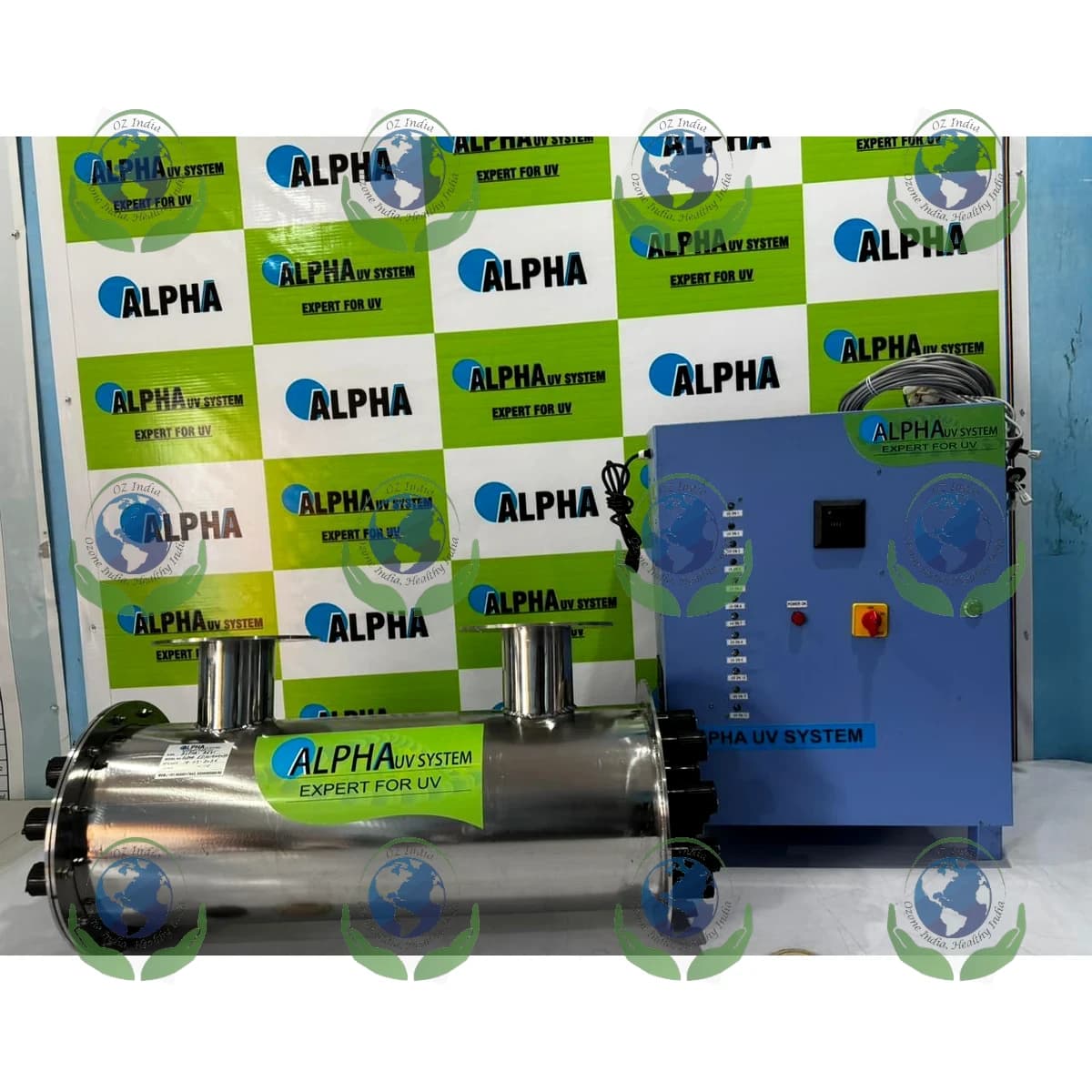
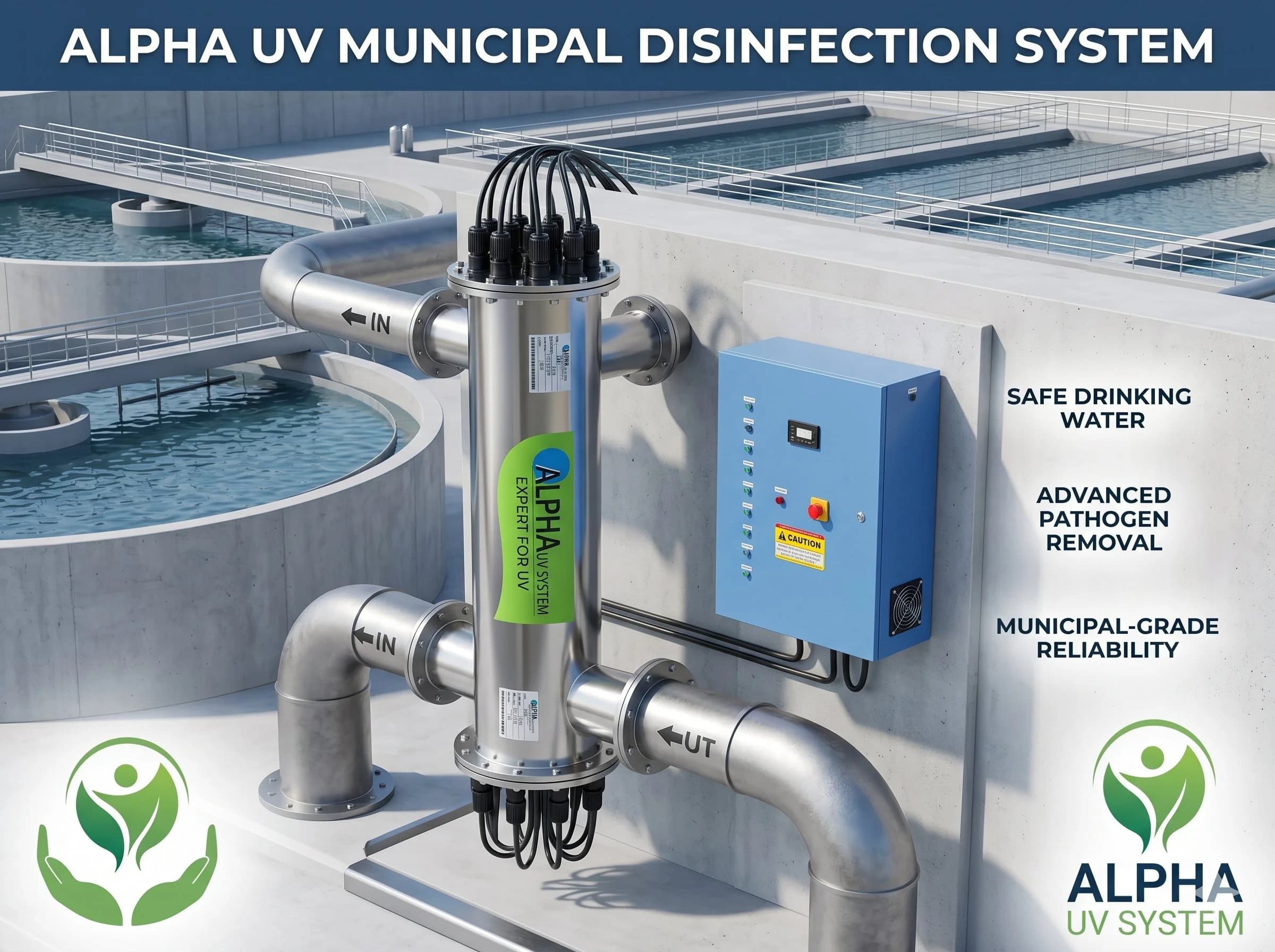
Closed-vessel reactors (also called pressure-vessel or in-line reactors) contain one or more UV lamps in a stainless steel pressure chamber installed in-line with the supply main. Flow rates typically range from 10,000 to 3,00,000 LPH per vessel, with multiple vessels installed in parallel for higher capacity. These are preferred for retrofit installations, pumped systems without open channels, and flows below 3 MLD.
Open-channel reactors position UV lamp arrays across a gravity flow channel or open canal. For large municipal plants with existing open-channel infrastructure, this configuration avoids major civil modifications, minimises head loss, and provides easy lamp access for maintenance. Open-channel systems are the standard configuration for plants above 3 MLD and are the format specified in most Indian state water board tender documents for large municipal schemes.
The CPHEEO Manual's per capita water consumption norms establish the foundation for municipal UV system sizing:
To these average daily flows, IS 1172 applies a peak factor of 1.5–3.0 depending on town size and supply duration. A UV system sized for average daily flow will be under-capacity during peak demand periods — the highest contamination risk windows in any water supply system.
Worked example: A Class I town of 50,000 population at 135 LPCD generates 6.75 MLD average daily demand. At a 2.5x peak factor over a 16-hour supply period: (6,75,000 L/day × 2.5) ÷ 16 hours = 1,05,469 LPH peak flow. The UV system must be rated for at minimum 1,10,000 LPH.
Alpha UV System engineers provide free population-based sizing calculations for any municipal scheme. Submitting the service area population, supply duration (hours per day), and source water UVT report is sufficient for an engineered recommendation within 24–48 hours.
The WHO GDWQ 4th Edition (2017) Chapter 7 on water treatment presents UV and chlorination as complementary rather than competing technologies. For primary disinfection at the treatment plant, UV has decisive advantages in three areas:
Protozoan inactivation: Cryptosporidium oocysts require over 80 mg/L·min of chlorine CT to achieve 3-log inactivation — a concentration-time product achievable only with extremely high chlorine doses and contact times that are impractical in most treatment plants. UV achieves the same 3-log inactivation at just 3–4 mJ/cm² — less than one-tenth of the design dose. A 2006 meta-analysis by Hijnen, Beerendonk, and Medema in Water Research covering 3,500 UV inactivation data points confirmed that UV is consistently effective against protozoa across all treatment conditions where chlorination fails.
Disinfection byproducts: THM and HAA formation from chlorination of Indian surface water is a documented public health concern. Singh et al. (2019) in Chemosphere measured THM concentrations in Indian municipal drinking water ranging from 12 to 180 µg/L — the higher end exceeding WHO guideline values for chloroform. UV generates no halogenated DBPs whatsoever.
Operational safety: Chlorine gas is a Schedule 2 chemical under India's Chemical Accidents (Emergency Planning, Preparedness and Response) Rules. On-site chlorine storage requires statutory safety measures, licensed storage, and emergency response planning. UV systems require no chemical storage, no transport permits, and no emergency release protocols.
Indian municipal water sources — primarily rivers and reservoirs — undergo significant seasonal quality variation. Monsoon periods bring elevated turbidity (50–200 NTU at intake, reduced to 1–5 NTU after conventional treatment), coloured runoff, and increased coliform loading. Post-monsoon receding water often has the highest organic carbon levels and lowest UVT values of the year.
The UV system design condition must be the worst-case seasonal UVT — not the annual average. For most Indian river-source plants, this means designing for UVT 75–80% (post-monsoon surface water after treatment) even if the annual average is 87–90%. The USEPA UVDGM methodology explicitly requires this: dose validation must occur at the minimum UVT encountered during 90th-percentile operating conditions.
Alpha UV System installs online UV intensity monitoring on all municipal systems — a sensor that continuously measures the UV-C intensity at the reactor wall and calculates effective dose in real time. An audible/visual alarm triggers when dose drops below the setpoint, alerting the operator to increase pre-treatment, reduce flow rate, or check lamp condition before a compliance event occurs.
The choice between open-channel and closed-vessel UV systems depends primarily on the existing plant infrastructure and flow rate:
Closed-vessel systems (pressure reactors):
Open-channel systems (gravity reactors):
For Jal Jeevan Mission rural piped water schemes — where flows are typically 2,000 to 50,000 LPH — compact closed-vessel UV systems with remote SCADA monitoring are the standard configuration specified in JJM technical guidelines.
Every Alpha UV System municipal reactor is validated using Computational Fluid Dynamics (CFD) simulation at IIT Patna. The CFD model, built in ANSYS Fluent, simulates:
This approach — the Computational Fluid Dynamics-based Discrete Ordinate (CFD-DO) method described in the USEPA UVDGM — is the same methodology used by large US and European municipal UV system manufacturers and is the basis for NSF/ANSI 55 Class A validation.
The output is a Red Equivalent Method dose-response curve that documents the minimum dose delivered to any water parcel through the reactor — not the average dose. For BIS IS 10500 and government audit purposes, this report establishes the engineering basis for the UV dose claim and satisfies the documentary requirements of CPHEEO and state PHE departments.
Alpha UV System systems carry MSME Udyam registration and are eligible for MSME preference in government tenders under the Public Procurement Policy for MSMEs.
Alpha UV System provides end-to-end project support for municipal UV installations:
Contact Alpha UV System's municipal team for scheme-specific sizing, tender support, and budget estimates within 24–48 hours.
Recommended Products
IIT Patna engineers recommend these systems for municipal uv applications based on flow rate, required UV dose, and compliance standard. Both systems use genuine Philips UV-C lamps and ship with complete compliance documentation.
IIT Patna Engineering
Alpha UV System IIT Patna engineers calculate UV dose from your actual water quality parameters — measured UVT, flow rate, target log reduction, and the specific compliance standard that governs your facility. Not from catalogue sizing tables or generic assumptions. Every system ships with a signed UV dose calculation report, a Philips certificate of authenticity, and compliance documentation prepared for the regulatory framework applicable to municipal uv operations.
From measured UVT, flow rate, and target log-reduction. Signed by IIT Patna engineer.
BIS IS 10500:2012 · CPCB Discharge Norms · Open-Channel Available · MSME Registered — documentation prepared to the audit checklist, not generic templates.
WhatsApp your flow rate, water quality, and compliance requirement — engineering-backed quote in 2 hours.
Mon–Sat · 9 AM–6 PM IST · IIT Patna alumni on call
Send us your flow rate and compliance requirement — quote with engineering rationale in 2 hours.
+91 93183 05878
Get Quote →
Call Direct
+91 95995 00580
Tap to Call →
Send Enquiry
Detailed specifications form
Open Form →