Manufactured in Greater NoidaGenuine Philips UV-C LampsIIT Patna Alumni on Our TeamExporting to 20+ Countries
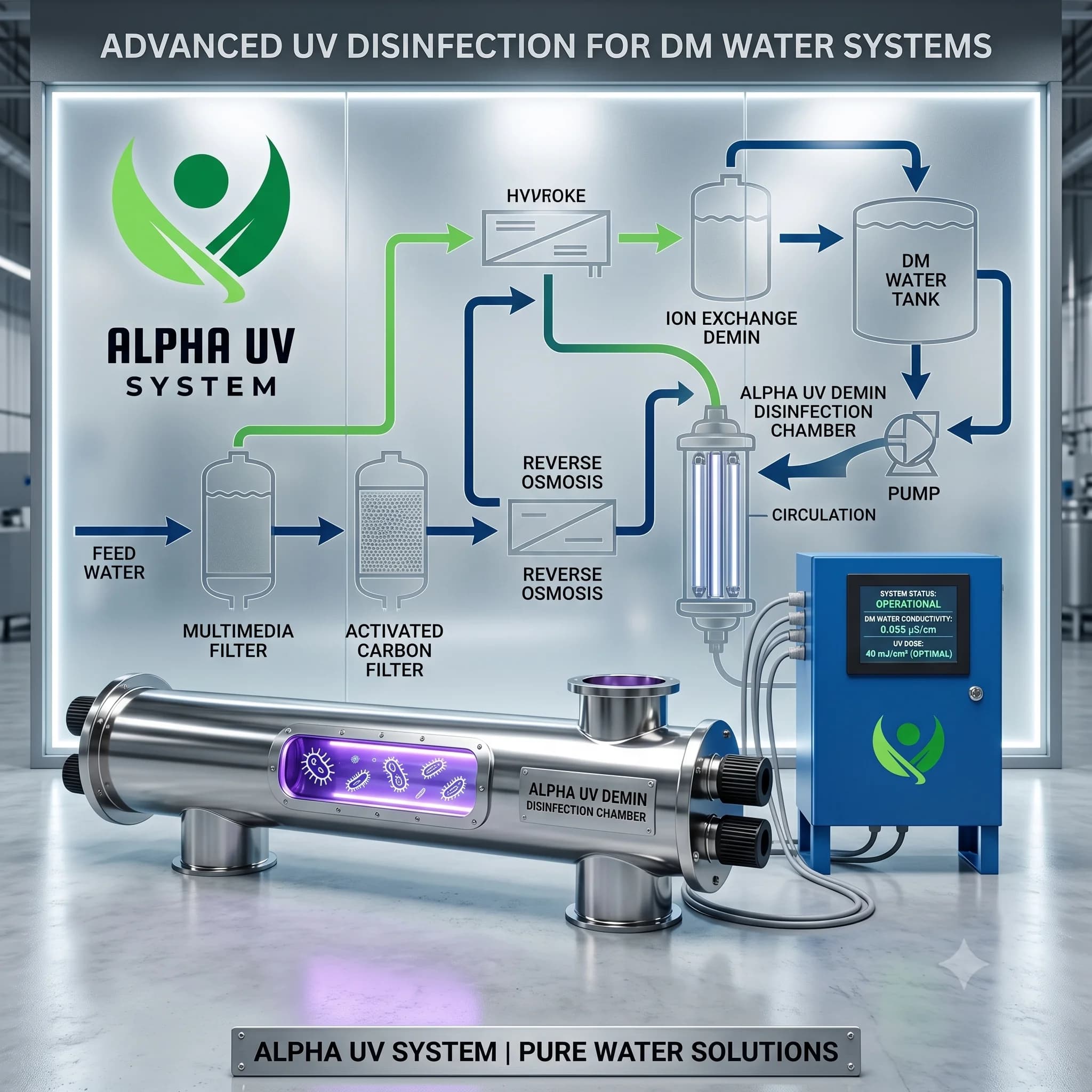
Demineralized water is a critical utility in power generation, pharmaceutical manufacturing, chemical processing, and precision electronics — yet it is paradoxically one of the most challenging water systems to keep microbiologically clean. DM water's lack of dissolved minerals eliminates the natural competitive inhibition that restricts bacterial growth in ordinary water, allowing oligotrophic organisms like Ralstonia, Pseudomonas, and Sphingomonas to thrive at TOC concentrations below 100 ppb. UV disinfection at 40–80 mJ/cm² protects ion-exchange resin beds from bacterial colonisation, prevents biofilm formation in DM water distribution loops, and ensures that DM water quality meets ASTM D1193, IS 1070, and ASME boiler standards. Alpha UV System supplies DM plant UV systems from 500 to 50,000 LPH.
UV Dose
40–80 mJ/cm²
Capacity
500 – 50,000 LPH
Demineralized water is often assumed to be microbiologically clean because it has been processed through ion exchange, reverse osmosis, or electro-deionisation — steps that also remove many bacteria by physical filtration or rejection. In practice, DM water systems face a paradoxical vulnerability: the removal of dissolved minerals eliminates the mild competitive inhibition effects that restrict bacterial growth in ordinary water, while the nutrient-absorbing properties of highly purified water scavenge trace organics from piping, storage vessels, and ion-exchange resin, providing a nutrient source for extraordinarily efficient oligotrophic bacteria.
Organisms such as Ralstonia pickettii, Pseudomonas putida, and Sphingomonas paucimobilis are classified as oligotrophic bacteria — they survive and grow in environments with TOC below 100 ppb, where ordinary bacteria cannot function. ISPE Pharmaceutical Water Systems documentation (Good Practice Guide, 2nd Ed., 2019) specifically identifies these species as the characteristic contaminants of pharmaceutical DM and purified water systems. In warm-climate installations (such as most of India), these organisms can double their populations in 1–4 hours under optimal conditions, meaning a DM water storage tank contaminated with even a few Ralstonia cells can reach unacceptable counts within hours without continuous UV loop treatment.
The practical consequence is that DM water quality requires active, continuous microbiological control — not just good manufacturing practices and periodic sanitisation. UV disinfection on the DM water distribution loop return is the most effective and lowest-cost method of providing this continuous control.
Effective UV protection of a DM water system requires careful consideration of where bacterial contamination occurs and where UV is most effectively applied. Three positions are standard in a well-designed DM water UV protection scheme:
Position 1 — Feed Water UV (Before RO or Ion Exchange): Treats incoming municipal or borewell water before it contacts ion-exchange resin. Municipal water contains 10³–10⁵ CFU/mL; borewell water can contain even higher counts. Activated carbon filtration (required to remove chlorine before ion exchange) removes chlorine that previously inhibited bacterial growth, so post-carbon filter water supports very rapid bacterial growth in the warm conditions typical of Indian industrial sites. UV at Position 1 reduces the bacterial load to <10 CFU/mL before the water enters the resin bed, dramatically slowing resin colonisation and extending service cycle length.
Position 2 — Product Water UV (After DM Plant, Before Storage): Treats DM water produced by the plant before it enters the storage tank. This eliminates any bacteria that have passed through the resin bed or been introduced by contaminated regeneration chemicals, and ensures that bacteria do not accumulate in the storage tank over successive production cycles.
Position 3 — Loop Return UV (On Distribution Loop): Treats recirculated DM water continuously as it returns from the distribution system to the storage tank, preventing biofilm formation in distribution pipework and ensuring that all points of use receive consistently low-TPC water regardless of loop residence time.
Thermal power plants are among the largest users of demineralized water in India, with a 500 MW coal-fired plant requiring 20,000–50,000 LPH of high-purity DM water for continuous boiler feed. CEA Technical Standards for Construction and Operation of Steam Generators (2013) and ASME Boiler and Pressure Vessel Code Section I define boiler feed water quality requirements that become more stringent as boiler operating pressure increases.
For high-pressure boilers above 100 bar (common in modern 500 MW and above power plants), boiler feed water must maintain conductivity below 0.2 µS/cm, dissolved oxygen below 7 ppb, and silica below 20 ppb. Microbiological quality is not explicitly specified in most boiler water standards, but the operational consequences of microbial contamination are severe: sulfate-reducing bacteria (SRB) in boiler feed water colonise low-temperature sections of the boiler circuit (deaerators, economisers, feed heaters) and produce hydrogen sulfide that causes accelerated under-deposit corrosion of carbon steel components. Even at counts of 10–100 CFU/mL in the DM water (well below any pharmacopoeial limit), SRB can establish biofilm colonies in cooler sections of the feed circuit given weeks of operation without UV protection. SRB-caused boiler tube failures are a significant cause of unplanned outages in Indian thermal power plants, with each outage event costing ₹1–5 crore in lost generation, tube replacement, and restart costs.
ASTM D1193 (Standard Specification for Reagent Water) defines four grades of laboratory and industrial high-purity water based on conductivity, TOC, and other parameters. Type I (the highest purity, required for chromatography, cell culture, and molecular biology) specifies conductivity <0.056 µS/cm (18 MΩ·cm resistivity), TOC <10 ppb, and bacteria <0.01 CFU/mL. Type II (for general laboratory use) specifies conductivity <1 µS/cm and TOC <50 ppb. Type III (for glassware washing, media preparation) specifies conductivity <0.25 µS/cm. These grades are referenced in Indian standards IS 1070:2015 (Reagent Grade Water — Specification).
UV disinfection at 254 nm handles the bacterial component of all ASTM D1193 grades — achieving the <0.01 CFU/mL requirement of Type I and the <0.1 CFU/mL of Type II is within the capability of UV at 40–80 mJ/cm² in clear DM water with UVT >92%. For TOC requirements (particularly Type I <10 ppb), 185+254 nm dual-wavelength UV provides photo-oxidation that reduces TOC by 50–80% in a single pass through clear RO-permeate or DM water, enabling Type I or Type II TOC specifications when combined with downstream mixed-bed DI or EDI polishing.
Pharmaceutical manufacturers using DM water as feed for purified water (PW) or water for injection (WFI) systems face the most demanding microbiological quality requirements. CDSCO's revised Schedule M (2023) GMP requirements, aligned with WHO Technical Report Series 970 Annex 2 (Water for Pharmaceutical Use, 2012) and Ph. Eur./USP pharmacopoeial water monographs, require that pharmaceutical water systems be validated, continuously monitored, and managed under change-control procedures.
Purified Water per Indian Pharmacopoeia must meet: conductivity <4.3 µS/cm at 20°C, TOC <500 ppb, and TPC <100 CFU/mL at the point of use. The DM water plant feeding the PW system must maintain these parameters consistently. CDSCO Schedule M Section 6 (Water Systems) requires written procedures for water system operation, maintenance, monitoring, and change control. UV disinfection on both the DM plant feed water and the PW distribution loop provides:
Alpha UV System provides IQ/OQ/PQ documentation packages for pharmaceutical DM water UV installations, formatted specifically for Schedule M GMP submissions and CDSCO audit preparation.
The economic case for feed water UV in DM plants is primarily driven by ion-exchange resin protection. Contaminated resin beds require more frequent regeneration (higher acid and caustic chemical consumption), develop channelling that reduces separation efficiency (higher conductivity breakthrough risk), and require earlier replacement (contaminated resin is replaced at 2–3 years vs 5–7 years for UV-protected resin in comparable service).
For a pharmaceutical DM plant producing 3,000 LPH purified water feed, Alpha UV System field data from comparable installations indicates:
UV system installed cost for a 3,000 LPH DM plant: ₹2–4 lakh. Payback from regeneration chemical savings alone: under 12 months.
Alpha UV System supplies DM water UV units with specifications tailored to the purity demands of high-quality DM water production:
Chamber Construction: 316L electropolished stainless steel (not standard 304 SS) for minimum metallic leaching into high-purity water. Surface roughness Ra <0.8 µm on wetted surfaces.
Seals and Wetted Polymer Parts: PTFE or EPDM seals (not NBR) for minimum organic extractables. PVDF or PTFE for any polymer components in the wetted flow path.
Quartz Sleeves: High-transmission quartz for 254 nm UV. For 185+254 nm TOC-reduction applications, synthetic fused silica sleeves transmitting 185 nm are required.
UV Intensity Monitoring: Continuous intensity sensor with 4–20 mA signal output for SCADA/DCS integration, low-intensity alarm, and data-logging capability for GMP records.
Connections: Tri-clamp (sanitary) or orbital-weld-ready connections for pharmaceutical DM water applications. Flange connections for power plant DM water applications.
For power plant DM water applications requiring very large flows (20,000–50,000 LPH), multi-lamp industrial UV chambers with redundant UV banks are standard, ensuring continued operation during planned lamp replacement without system shutdown.
Contact Alpha UV System via WhatsApp 9318305878 for DM water UV specifications matched to your plant capacity, water quality, and regulatory requirements. Our IIT Patna-trained engineers provide 24–48 hour response on technical enquiries.
Recommended Products
IIT Patna engineers recommend these systems for dm water uv applications based on flow rate, required UV dose, and compliance standard. Both systems use genuine Philips UV-C lamps and ship with complete compliance documentation.
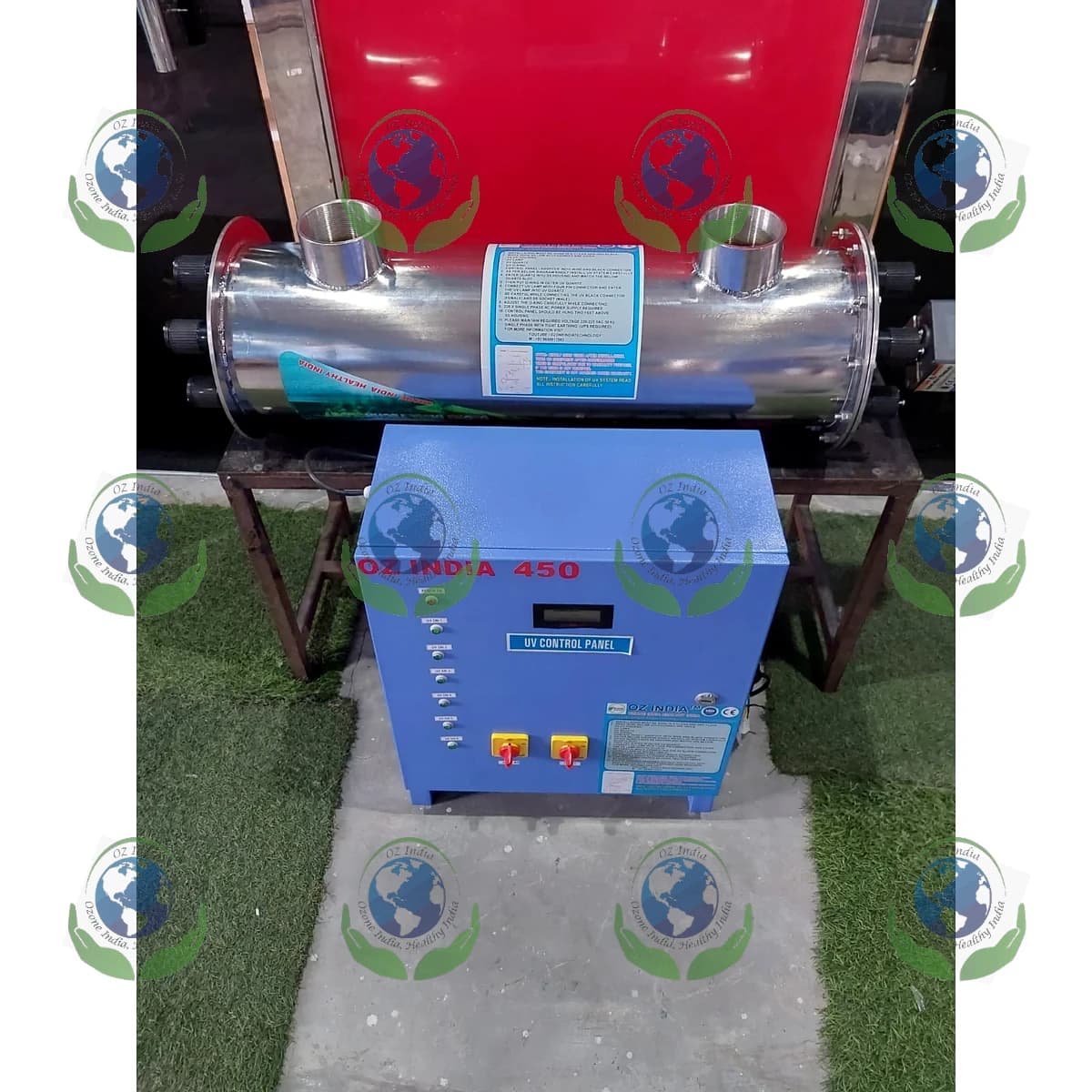
High-flow UV water treatment for pharmaceutical WFI, food & beverage process water, and industrial applications. Revised Schedule M 2025, HACCP, and FSSAI compliant. IQ/OQ/PQ documentation.
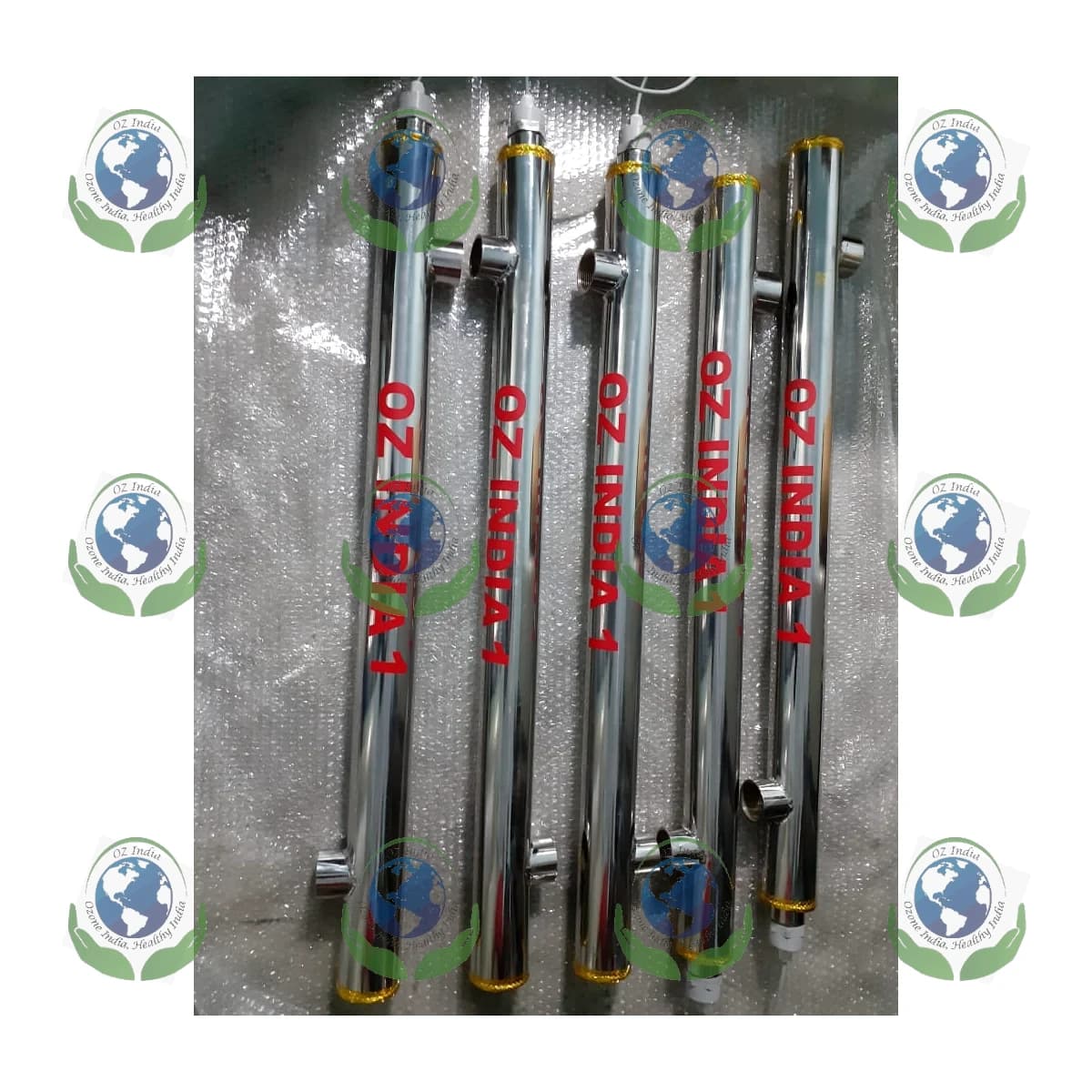
UV water disinfection for hotels, restaurants, offices, and educational institutions. HACCP and FSSAI compliant documentation. Trusted by Taj Hotels, McDonald's India, and IIT Kanpur.
IIT Patna Engineering
Alpha UV System IIT Patna engineers calculate UV dose from your actual water quality parameters — measured UVT, flow rate, target log reduction, and the specific compliance standard that governs your facility. Not from catalogue sizing tables or generic assumptions. Every system ships with a signed UV dose calculation report, a Philips certificate of authenticity, and compliance documentation prepared for the regulatory framework applicable to dm water uv operations.
From measured UVT, flow rate, and target log-reduction. Signed by IIT Patna engineer.
ASTM D1193 · IS 1070 · BIS · ASME Boiler Standards — documentation prepared to the audit checklist, not generic templates.
WhatsApp your flow rate, water quality, and compliance requirement — engineering-backed quote in 2 hours.
Mon–Sat · 9 AM–6 PM IST · IIT Patna alumni on call
Send us your flow rate and compliance requirement — quote with engineering rationale in 2 hours.
+91 93183 05878
Get Quote →
Call Direct
+91 95995 00580
Tap to Call →
Send Enquiry
Detailed specifications form
Open Form →
