Manufactured in Greater NoidaGenuine Philips UV-C LampsIIT Patna Alumni on Our TeamExporting to 20+ Countries
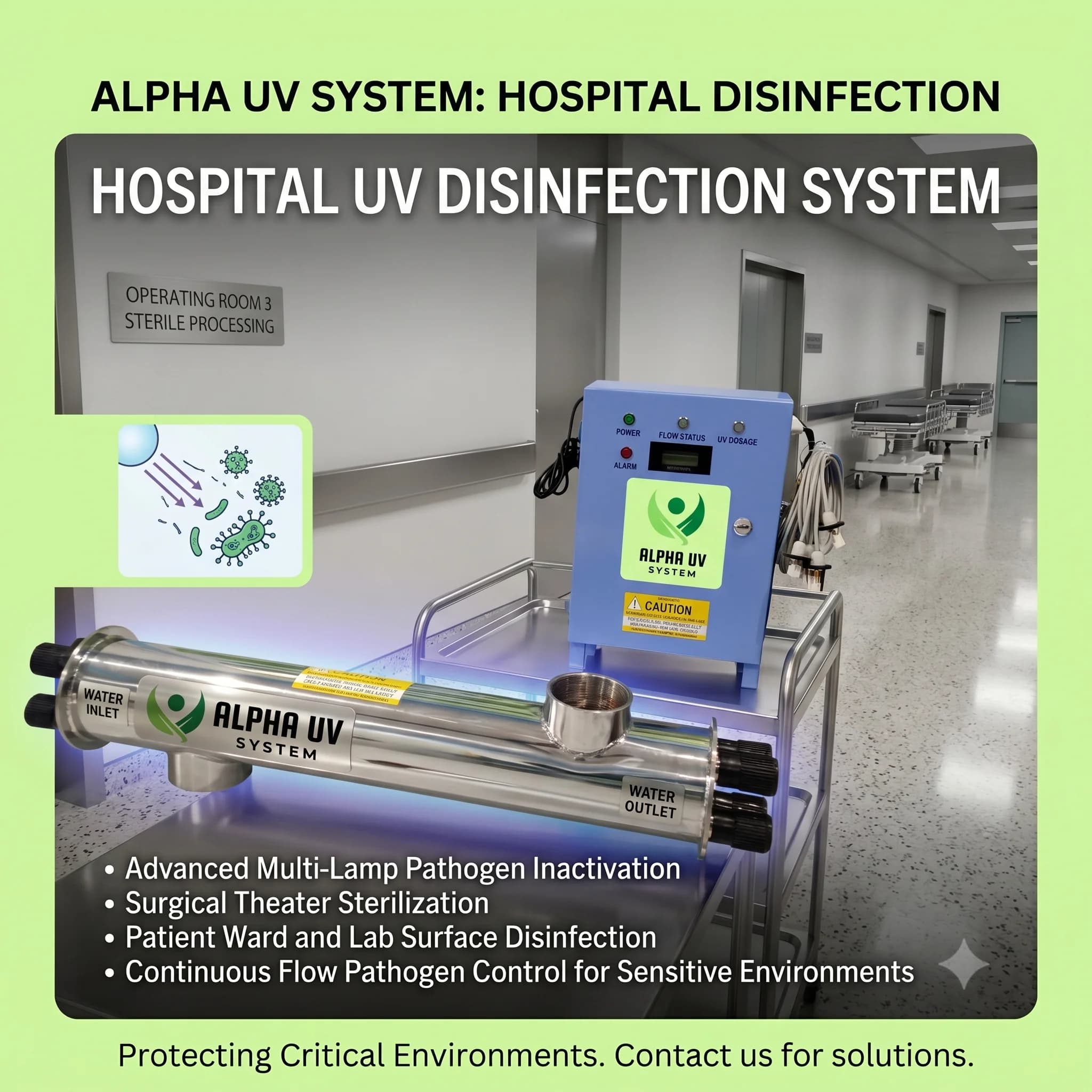
Hospital water distribution systems — hot water loops, cooling towers, ICU taps, and endoscope reprocessing lines — are the primary reservoir for Legionella pneumophila, Pseudomonas aeruginosa, and non-tuberculous mycobacteria in healthcare settings. WHO's Water Safety in Healthcare Facilities (2020) estimates that healthcare-associated infections (HAIs) from water account for a substantial proportion of preventable hospital deaths globally. Alpha UV System's hospital-grade UV disinfection systems are engineered for 24/7 continuous operation, NABH Water Management Plan compliance, ASHRAE 188 Legionellosis Risk Management documentation, and duty/standby redundancy for critical water supply points.
UV Dose
40–80 mJ/cm²
Capacity
500 – 50,000 LPH
Hospital water distribution systems represent one of the most demanding environments for UV disinfection — and one where the consequences of failure are measured in patient lives rather than regulatory fines. Hot water pipelines, cold water distribution mains, shower heads, ice machines, endoscope reprocessing units, and bedside water points are all documented sources of healthcare-associated infections (HAIs) caused by waterborne nosocomial pathogens.
The World Health Organization's Water Safety in Healthcare Facilities (2020) identifies waterborne HAIs as a preventable patient safety crisis, noting that Legionella pneumophila, Pseudomonas aeruginosa, non-tuberculous mycobacteria, and Stenotrophomonas maltophilia are the primary organisms responsible for water-transmitted HAI events globally. In India, the combination of ageing hospital plumbing infrastructure, municipal water supply with variable residual chlorine, and overhead tank storage — all of which create conditions favourable for Legionella and Pseudomonas growth — makes hospital water safety a pressing clinical engineering challenge.
Legionella pneumophila causes Legionnaires' disease, a severe pneumonia with case fatality rates of 10–30% in hospitalised patients and 40–80% in immunocompromised individuals. Pseudomonas aeruginosa is the leading cause of ventilator-associated pneumonia (VAP), catheter-associated urinary tract infections (CAUTI), and post-surgical wound infections in ICU patients — with multidrug-resistant (MDR) strains increasingly prevalent in Indian hospital water systems. Non-tuberculous mycobacteria (NTM) colonise hospital water distribution systems and cause pulmonary infections in patients with compromised immune function, requiring UV doses of 60 mJ/cm² or higher for 4-log inactivation.
ASHRAE Standard 188-2018: Legionellosis Risk Management for Building Water Systems is the internationally recognised engineering standard for Legionella risk management. ASHRAE 188 requires facilities to develop and implement a Water Management Plan (WMP) that: identifies water systems with Legionella growth potential; specifies engineering controls at each hazardous point; establishes monitoring protocols with defined corrective action triggers; and maintains documentation of all control and monitoring activities.
In India, NABH (National Accreditation Board for Hospitals & Healthcare Providers) hospital accreditation standards — 5th Edition — include infrastructure and safety requirements for water quality management that align with ASHRAE 188 and WHO Healthcare Water Safety Plan principles. NABH-accredited hospitals are expected to demonstrate documented water quality controls, and a hospital that cannot show evidence of systematic Legionella and nosocomial pathogen management faces significant risk during accreditation surveys.
UV disinfection is a Tier 1 engineering control within the ASHRAE 188 framework and a recognised technology in the WHO Healthcare Water Safety Plan. Unlike thermal shock treatments — which must be scheduled, cause operational disruption, are only partially effective against biofilm-protected organisms, and provide no ongoing protection between treatments — UV operates continuously, 24 hours a day, treating every litre of water that flows through the distribution system.
Hospital UV system engineering requires an understanding of the specific hydraulic and thermal conditions in healthcare water distribution systems. Hot water recirculation loops — which circulate water continuously at 50–60°C from the calorifier through the building and back — maintain temperature above Legionella's optimal growth range (25–45°C). However, Legionella survives at 50–60°C with reduced but measurable viability, and temperature drops in dead legs, mixing valves, and remote outlets create localised growth conditions even in buildings with functional thermal control.
Alpha UV System installs in-line UV disinfection units on the hot water recirculation return line — the point where all recirculating water passes before re-entering the calorifier — so that every litre of recirculated hot water receives a minimum 40 mJ/cm² UV dose in each pass through the distribution circuit. For cold water supply, UV is installed on the cold water main immediately downstream of the overhead tank outlet or municipal connection, treating all incoming water before it enters the building distribution system.
For high-risk zones — ICU, bone marrow transplant units, oncology wards, neonatal ICUs, and operating theatres — additional point-of-use UV units or 0.2 µm filters are installed at individual outlets. WHO Water Safety in Healthcare Facilities (2020) and ECDC Technical Document on Legionella in Healthcare Facilities (2017) both recommend point-of-use water treatment as a last-resort barrier for patients with severe immunocompromise where even trace levels of Legionella or Pseudomonas represent unacceptable clinical risk.
Hospital UV water systems have engineering requirements that differ significantly from commercial or industrial UV systems. The key differentiators are:
SS316L wetted surfaces: Hospitals require SS316L (not SS304) for all surfaces in contact with potable water, as the higher molybdenum content of 316L provides superior resistance to the chloride stress corrosion that affects SS304 in high-residual-chlorine municipal water. All Alpha UV System hospital units are fabricated from SS316L as standard.
Duty/standby redundancy: Critical water supply points — hot water recirculation, ICU feeds — require two UV systems installed in parallel with automatic changeover valves. If the duty UV lamp fails (detected by the UV intensity sensor dropping below the alarm setpoint), the control panel automatically opens the standby unit's isolation valve and closes the duty unit, ensuring uninterrupted UV-treated water supply. Alpha UV System supplies complete duty/standby UV packages as a pre-engineered assembly including changeover valve manifold, control panel, and BMS alarm output.
BMS integration: Hospital building management systems (BMS) must receive a UV system alarm signal — typically a volt-free contact output and/or 4–20 mA intensity signal — so that maintenance engineers are notified of lamp failure without relying on manual inspection. Alpha UV System UV systems include both BMS relay alarm output and 4–20 mA intensity transmitter as standard on hospital-specification units.
IQ/OQ commissioning documentation: NABH accreditation and ASHRAE 188 Water Management Plan requirements both call for documented commissioning of water treatment systems. Alpha UV System provides Installation Qualification (IQ) and Operational Qualification (OQ) records for all hospital installations — including UV dose calculation report, Philips lamp certificate, UV intensity calibration record, and a pre-written maintenance log formatted to NABH water quality audit requirements.
The Bartram et al., WHO Technical Publication: Legionella and the Prevention of Legionellosis (2007) established the risk-based framework for Legionella management that underlies ASHRAE 188 and WHO Healthcare Facility Water Safety Plans. This framework identifies the following control points as essential:
Elimination of Legionella growth conditions: Temperature management (keep hot water above 55°C, cold water below 20°C), elimination of dead legs, and disinfection of the water supply. UV addresses the disinfection component continuously, complementing temperature management controls.
Monitoring with defined trigger levels: ASHRAE 188 requires monitoring at defined frequencies with corrective actions when trigger levels are exceeded. UV intensity monitoring provides a real-time proxy for disinfection performance, with alarm outputs triggering corrective action (lamp replacement) before microbiological testing can even be completed.
Documentation and auditability: All control activities must be documented with dates, responsible persons, and corrective actions taken. Alpha UV System's UV intensity data logger provides automatic time-stamped records of UV system performance — records that form part of the hospital's NABH and ASHRAE 188 WMP documentation.
For hospitals that are implementing a Legionella WMP for the first time — typically in response to NABH accreditation requirements or a clinical Legionella incident — Alpha UV System's IIT Patna-trained engineers provide support in integrating the UV system into the WMP framework, including point-of-use risk assessment, control point identification, and documentation structure that satisfies NABH audit requirements.
The most vulnerable patients in any hospital — those undergoing chemotherapy, bone marrow transplantation, organ transplantation, or intensive care for multi-organ failure — face the highest risk from waterborne nosocomial pathogens. For these patients, Pseudomonas aeruginosa from a contaminated tap water outlet or Aspergillus fumigatus from a water aerosol can be life-threatening even at exposure levels that would be clinically insignificant in a healthy individual.
WHO Water Safety in Healthcare Facilities (2020) recommends a layered protection approach for high-risk patient areas: (1) centralised water treatment (UV on the hot and cold water mains) to reduce pathogen load entering the distribution system; (2) temperature management to prevent Legionella growth in the distribution system; (3) point-of-use UV or 0.2 µm sterile filtration at outlets serving immunocompromised patients; and (4) regular microbiological monitoring at high-risk outlets.
Alpha UV System supplies compact point-of-use UV units suitable for installation under-sink in ICU and transplant ward utility areas. These units treat water at the final outlet — the last line of defence before water reaches the patient — independently of the centralised UV system. Combined with regular outlet flushing protocols and quarterly microbiological sampling, point-of-use UV provides the level of bedside water safety that WHO and NABH standards require for the highest-risk patient populations.
The healthcare-associated infection cost burden in India is substantial. Research published in the Indian Journal of Medical Research indicates that a single HAI episode adds Rs 1–5 lakh to a patient's hospital bill, extends length of stay by 5–10 days, and in severe cases results in mortality that generates significant medicolegal liability for the treating institution. For NABH-accredited hospitals, a water-related HAI outbreak also risks accreditation suspension — which directly affects a hospital's ability to charge at private-hospital rates.
Hospital UV system maintenance must be integrated into the hospital's infection control programme, not treated as routine mechanical equipment servicing. Alpha UV System designs hospital UV maintenance programmes with the following elements:
Annual lamp replacement: Philips UV-C lamps are rated for 9,000 hours of continuous operation (approximately 12–15 months in a hospital with continuous flow). Alpha UV System supplies only genuine Philips UV-C replacement lamps with certificates of authenticity — essential for NABH and ASHRAE 188 audit compliance, since counterfeit or substitute lamps have lower and unpredictable UV-C output.
Quartz sleeve inspection: The quartz sleeve between the UV lamp and the water stream must be inspected for calcium and iron deposits annually and cleaned or replaced as needed. Deposits on the quartz sleeve reduce UV transmission into the water and therefore reduce effective UV dose. Alpha UV System provides quartz sleeve cleaning kits and replacement sleeves for all hospital UV models.
UV intensity sensor calibration: The UV intensity sensor that monitors and logs UV system performance should be calibrated annually against a NABL-accredited calibration standard. Alpha UV System provides calibration service and calibration certificates for all hospital UV installations — the certificate forms part of the NABH maintenance documentation record.
Response time: Alpha UV System provides 24–48 hour response nationwide for hospital UV system service requirements, with WhatsApp support at 9318305878 and dedicated phone line at 9599500580 for hospital engineering teams needing urgent technical guidance on lamp failure response procedures.
For new hospital projects or NABH accreditation preparation, contact Alpha UV System for a complete hospital water safety UV solution — IIT Patna-trained engineers, ASHRAE 188 Water Management Plan documentation, and Philips UV-C technology with full certification support delivered within 24–48 hours of inquiry.
Recommended Products
IIT Patna engineers recommend these systems for hospital uv applications based on flow rate, required UV dose, and compliance standard. Both systems use genuine Philips UV-C lamps and ship with complete compliance documentation.
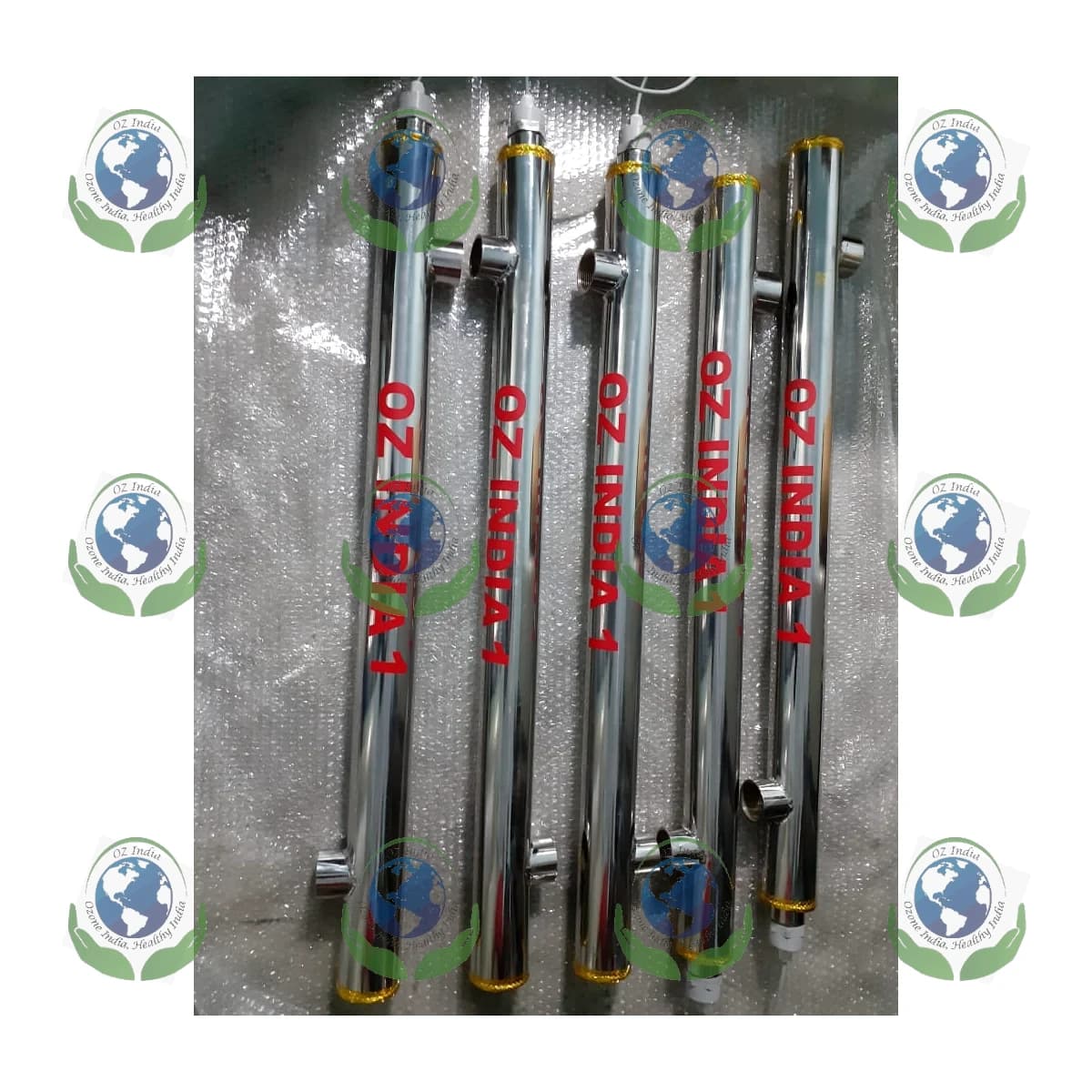
UV water disinfection for hotels, restaurants, offices, and educational institutions. HACCP and FSSAI compliant documentation. Trusted by Taj Hotels, McDonald's India, and IIT Kanpur.
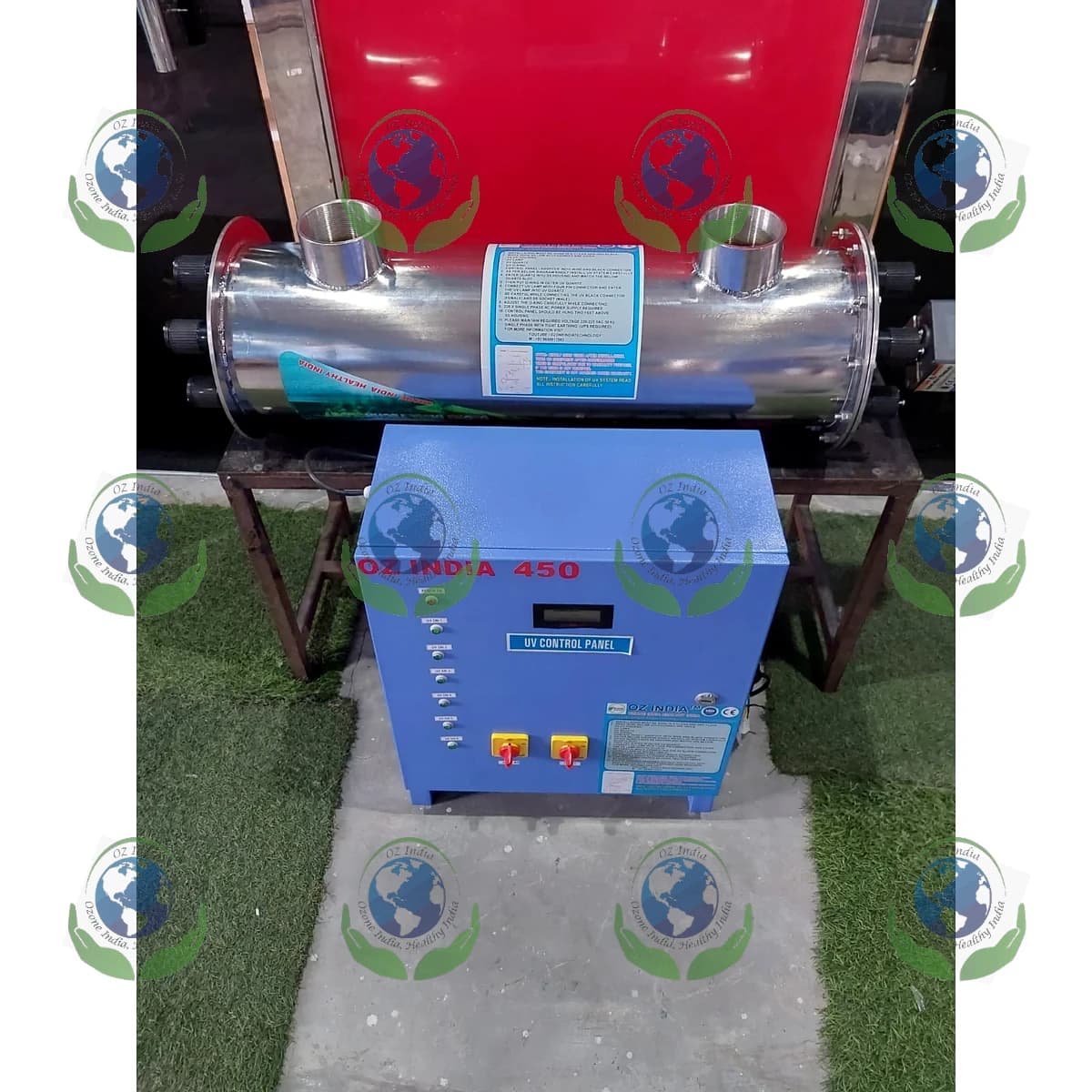
High-flow UV water treatment for pharmaceutical WFI, food & beverage process water, and industrial applications. Revised Schedule M 2025, HACCP, and FSSAI compliant. IQ/OQ/PQ documentation.
IIT Patna Engineering
Alpha UV System IIT Patna engineers calculate UV dose from your actual water quality parameters — measured UVT, flow rate, target log reduction, and the specific compliance standard that governs your facility. Not from catalogue sizing tables or generic assumptions. Every system ships with a signed UV dose calculation report, a Philips certificate of authenticity, and compliance documentation prepared for the regulatory framework applicable to hospital uv operations.
From measured UVT, flow rate, and target log-reduction. Signed by IIT Patna engineer.
WHO Healthcare Water Safety · NABH · ASHRAE 188 · IS 10500 — documentation prepared to the audit checklist, not generic templates.
WhatsApp your flow rate, water quality, and compliance requirement — engineering-backed quote in 2 hours.
Mon–Sat · 9 AM–6 PM IST · IIT Patna alumni on call
Send us your flow rate and compliance requirement — quote with engineering rationale in 2 hours.
+91 93183 05878
Get Quote →
Call Direct
+91 95995 00580
Tap to Call →
Send Enquiry
Detailed specifications form
Open Form →
