Manufactured in Greater NoidaGenuine Philips UV-C LampsIIT Patna Alumni on Our TeamExporting to 20+ Countries
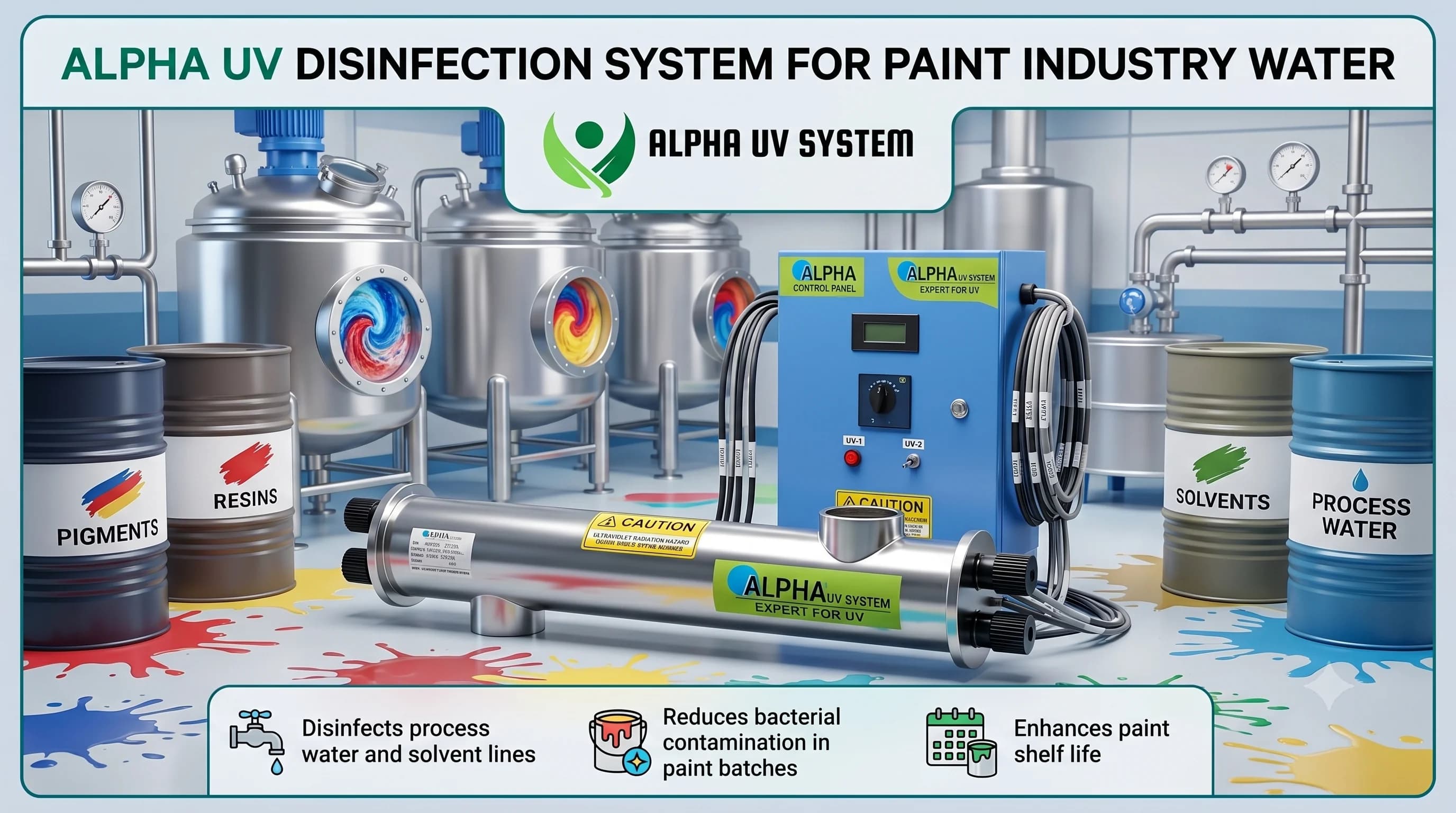
Paint manufacturing is one of the most microbially sensitive industrial processes in the chemical sector. Water-based paint formulations — latex emulsions, acrylic dispersions, and water-reducible alkyd paints — provide an ideal growth medium for bacteria and fungi during production, filling, and storage. Contamination of process water with Pseudomonas, Enterobacter, or Aspergillus causes viscosity collapse, gassing, pH drift, and surface mould on dried paint films — defects that can destroy an entire production batch worth lakhs of rupees. Traditional countermeasures — isothiazolinone in-can preservatives and chlorine-based biocides in process water — face growing regulatory pressure under REACH (EU Biocidal Products Regulation) and CPCB effluent limits. UV disinfection of paint process water eliminates bacteria and fungi from the water supply before it contacts the formulation, with zero chemical residual in the product, zero regulatory registration burden, and operating costs below ₹20,000 per year for most paint plant sizes. Alpha UV System paint industry UV systems are designed for the SS316L construction and chemical-resistant seals demanded by paint plant utility environments.
UV Dose
40–80 mJ/cm²
Capacity
2,000 – 50,000 LPH
The shift from solvent-based to water-based paint formulations over the past three decades — driven by VOC reduction mandates under ISO 11890 and environmental regulations globally — has created a critical microbiological challenge. Aqueous systems that replace solvents provide a nutrient-rich growth medium for a wide range of bacteria and fungi. The emulsion polymers, dispersants, thickeners, and biocidal stabilisers in modern water-based paints are all metabolisable substrates for microorganisms that enter via contaminated process water.
In a large paint manufacturing plant producing 500 tonnes per month of water-based emulsion paint, the process water consumption for pigment grinding, thinning, and equipment washing may exceed 100,000 litres per day. If that water arrives from a municipal supply or borewell with a bacterial count of 1,000–10,000 CFU/mL — typical for untreated water — the plant introduces 10⁸–10⁹ organisms into its production system every day. The consequences are predictable: spoilage incidents, in-can preservative over-dosing to compensate for high microbial input, and periodic catastrophic batch losses when contamination exceeds the in-can preservative's capacity to control it.
UV disinfection of process water at the point of entry to the production system — before the water contacts any paint formulation ingredient — eliminates this primary contamination route. Water leaving a properly designed Alpha UV System UV unit at 40 mJ/cm² has zero detectable Pseudomonas, Enterobacter, and other paint-spoilage bacteria. This does not eliminate the need for in-can preservatives entirely (contamination can also enter from raw materials, equipment surfaces, and personnel) but it dramatically reduces the microbial load that the in-can preservative must control, allowing significant reduction in preservative dosing levels.
The UV inactivation dose varies significantly across the organisms that cause paint spoilage. Pseudomonas aeruginosa and Enterobacter cloacae — the most common and most damaging bacterial contaminants in water-based paint — require only 8–10.5 mJ/cm² for 4-log inactivation. At the standard Alpha UV System design dose of 40 mJ/cm² for process water, these organisms are inactivated with a safety factor of 4–5× above their 4-log dose. Desulfovibrio sulphate-reducing bacteria, which cause the characteristic rotten-egg odour and black staining defects in oil-containing formulations, require approximately 15 mJ/cm² — also well within the 40 mJ/cm² design dose.
Fungal spores present a different challenge. Aspergillus niger spores require approximately 49 mJ/cm² for 4-log inactivation at 254 nm, and Bacillus subtilis spores require 82 mJ/cm². At the standard 40 mJ/cm² process water dose, spore inactivation is incomplete. However, the primary source of fungal spore contamination in paint manufacturing is airborne — Aspergillus spores enter paint from the manufacturing environment, not primarily from process water. UV treatment at 40 mJ/cm² eliminates all vegetative forms (the primary waterborne contamination) while airborne spore contamination is controlled by environmental hygiene measures. For plants with documented water-borne spore contamination issues, UV dose can be increased to 80 mJ/cm² by reducing flow rate or adding a second UV chamber in series.
The EU Biocidal Products Regulation (REACH BPR) has implemented progressive restrictions on the isothiazolinone class of in-can preservatives that form the backbone of water-based paint preservation. Methylisothiazolinone (MIT) is prohibited from consumer products in the EU above 0.0015% concentration. Chloromethylisothiazolinone/Methylisothiazolinone (CMIT/MIT) mixtures face equivalent restrictions. These restrictions apply to products sold in the EU and — increasingly via buyer requirements — to products manufactured in India for international supply chains.
Indian paint manufacturers supplying architectural, decorative, and industrial coatings to export markets face a dual pressure: the cost of continuing to use REACH-restricted biocides (including regulatory risk, reformulation cost, and supply chain complexity) versus the cost of implementing UV process water treatment to reduce biocide input loading. UV treatment at the water supply level does not eliminate the need for in-can preservation but reduces the in-can preservative dose required to control the residual microbial contamination from other sources. This allows many manufacturers to reformulate to lower preservative concentrations that comply with current and anticipated future regulatory limits, securing market access without fully redesigning formulations.
Validating the performance of a UV system on paint process water requires measuring the bioburden before and after UV treatment at commissioning, and monitoring at defined intervals during operation. Alpha UV System provides a commissioning report for each paint industry installation showing inlet and outlet bioburden (by heterotrophic plate count), UV intensity at commissioning flow rate, and verification that the UV dose meets or exceeds the 40 mJ/cm² design specification.
Ongoing monitoring for paint process water UV systems should include monthly heterotrophic plate count of the UV outlet water (target: below 100 CFU/mL), weekly visual inspection of the UV intensity display, and annual lamp replacement. The UV intensity monitor in each Alpha UV System unit provides a 4–20 mA output that can be connected to the plant's SCADA or data historian, creating an auditable record of UV system performance for ISO 9001 quality management system purposes. For plants supplying FMCG or retail paint brands that conduct supplier audits, this documentation demonstrates process control at the water treatment stage.
Paint manufacturing effluent treatment plants (ETPs) treat equipment wash water, floor wash, and process waste containing pigments, polymer binders, surfactants, and solvents. After coagulation, flocculation, and biological treatment, the final ETP effluent must meet State PCB discharge norms before release to water bodies or sewers. The CPCB General Standard for discharge of environmental pollutants specifies that ETP effluent discharged to inland surface waters must have total coliforms below 1,000 MPN/100 mL, and many State PCB consents impose tighter limits. UV disinfection as the final ETP treatment step provides consistent coliform compliance without adding chlorine residuals that would violate the effluent's chemical limits.
Paint plant ETP effluent after biological treatment typically has UV transmittance (UVT) of 50–65% — substantially lower than process water — due to dissolved organic colour from pigment residuals and polymer breakdown products. UV systems for ETP duty must be designed for this lower UVT: medium-pressure UV-C lamps that emit across a broader spectrum are more effective in low-UVT effluent than the narrow-spectrum low-pressure lamps used for clear process water. Alpha UV System sizes ETP UV systems from measured effluent UVT data, not generic assumptions, to ensure the installed system delivers the validated dose at actual ETP operating conditions.
The economic case for UV over biocide dosing in paint process water is compelling. Isothiazolinone biocides for process water treatment cost ₹3.5–4.5 lakh per year for a medium-scale paint plant consuming 10,000 LPH of process water. A UV system for the same duty has an annual operating cost of ₹18,000–25,000 — lamps, electricity, and quartz sleeve replacement. The UV system capital cost of ₹2–4 lakh for a 10,000 LPH system is typically recovered within 3–6 months of biocide cost savings.
Additional savings include: reduced in-can preservative consumption (as lower-bioburden process water requires less in-can protection), fewer batch rejections and batch destruction costs, reduced ETP operating costs (biocide-free process water reduces the chemical oxygen demand load on the ETP biological stage), and elimination of HAZMAT storage and handling requirements for biocide chemicals. For large paint manufacturers producing above 500 tonnes per month, the aggregate UV cost advantage versus biocide programmes exceeds ₹50 lakh per year. IIT Patna-trained engineers from Alpha UV System will provide a site-specific cost analysis with each system proposal.
Contact Alpha UV System at WhatsApp 9318305878 for a paint industry UV system proposal. Our team responds within 24–48 hours with a system specification, pre-treatment requirements, compliance documentation, and operating cost analysis tailored to your plant's water usage and effluent profile.
Recommended Products
IIT Patna engineers recommend these systems for paint industry uv applications based on flow rate, required UV dose, and compliance standard. Both systems use genuine Philips UV-C lamps and ship with complete compliance documentation.
IIT Patna Engineering
Alpha UV System IIT Patna engineers calculate UV dose from your actual water quality parameters — measured UVT, flow rate, target log reduction, and the specific compliance standard that governs your facility. Not from catalogue sizing tables or generic assumptions. Every system ships with a signed UV dose calculation report, a Philips certificate of authenticity, and compliance documentation prepared for the regulatory framework applicable to paint industry uv operations.
From measured UVT, flow rate, and target log-reduction. Signed by IIT Patna engineer.
ISO 11890 · REACH · IS 10500 · CPCB ETP — documentation prepared to the audit checklist, not generic templates.
WhatsApp your flow rate, water quality, and compliance requirement — engineering-backed quote in 2 hours.
Mon–Sat · 9 AM–6 PM IST · IIT Patna alumni on call
Send us your flow rate and compliance requirement — quote with engineering rationale in 2 hours.
+91 93183 05878
Get Quote →
Call Direct
+91 95995 00580
Tap to Call →
Send Enquiry
Detailed specifications form
Open Form →