Manufactured in Greater NoidaGenuine Philips UV-C LampsIIT Patna Alumni on Our TeamExporting to 20+ Countries
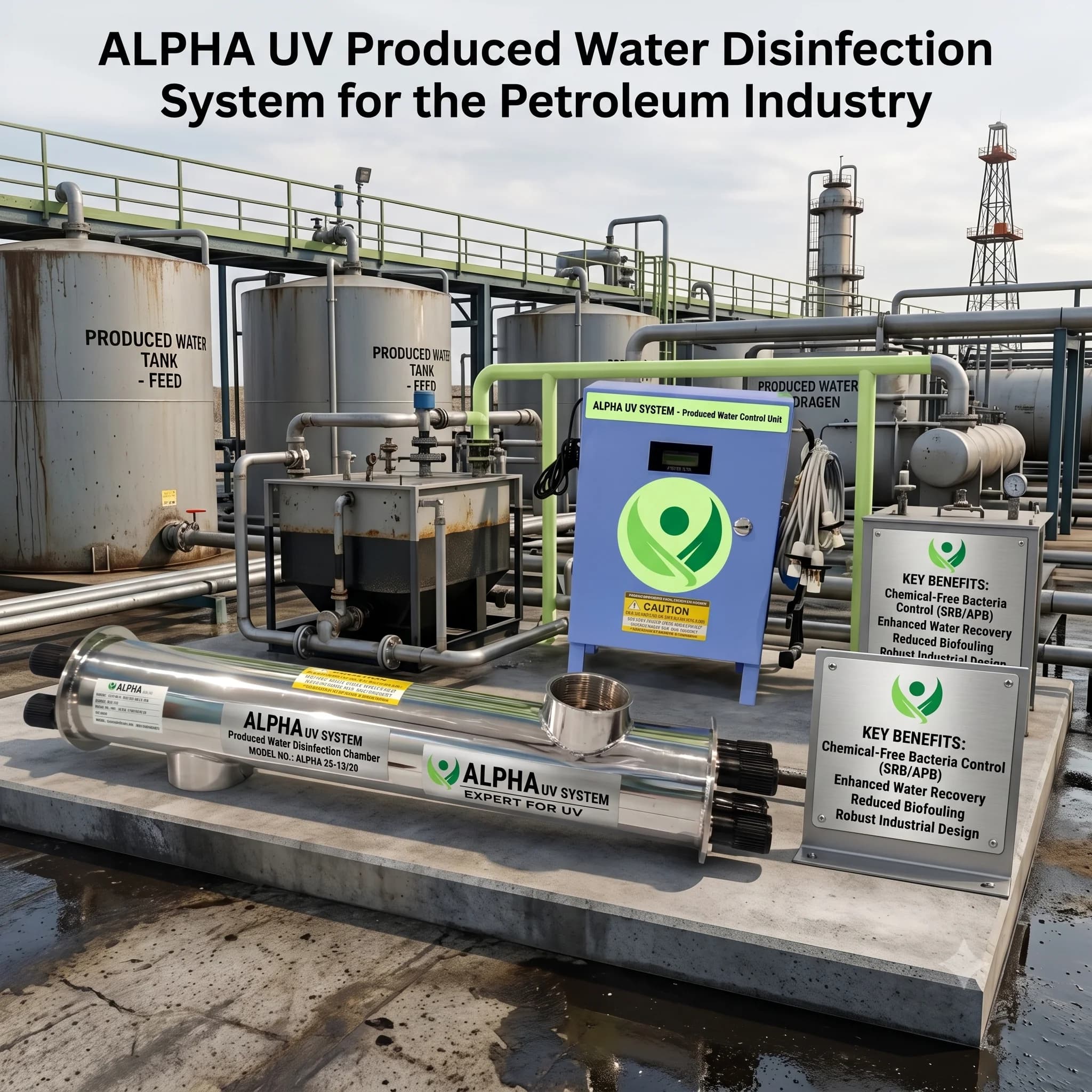
Petroleum refineries and petrochemical complexes face a water treatment challenge that is simultaneously an efficiency problem, a corrosion problem, and a regulatory compliance problem. Microbiologically Influenced Corrosion (MIC) caused by sulphate-reducing bacteria (SRB) and acid-producing bacteria costs the global petroleum industry over USD 2 billion annually in pipe replacement, equipment failure, and forced shutdowns. Biofouling of cooling water heat exchangers reduces heat transfer efficiency and increases fuel consumption. Legionella in cooling tower aerosols creates occupational health liability. And the final ETP effluent must meet CPCB discharge standards before release to water bodies under NGT and MoEF monitoring. UV disinfection addresses all four challenges simultaneously: it eliminates SRB and MIC-causing organisms from cooling water and process streams, controls biofouling and Legionella in cooling towers, and provides the final coliform kill step in ETP discharge polishing — without adding chemicals that complicate the already complex chemistry of petroleum effluent treatment. Alpha UV System petroleum industry UV systems are rated for continuous outdoor duty in high-temperature, chemical-vapour environments at flows from 10,000 to 5,00,000 LPH.
UV Dose
40–100 mJ/cm²
Capacity
10,000 – 5,00,000 LPH
Microbiologically Influenced Corrosion (MIC) is the single most costly water-related problem in the petroleum industry. NACE International estimates that MIC accounts for 20–40% of all internal corrosion failures in oil and gas infrastructure globally — pipelines, storage tanks, heat exchangers, and process vessels. In Indian petroleum refineries and petrochemical complexes, MIC-related forced shutdowns, emergency pipe replacements, and heat exchanger tube bundle failures represent hundreds of crores in direct and indirect costs annually.
The primary MIC organisms are sulphate-reducing bacteria (SRB) — anaerobic organisms belonging to genera such as Desulfovibrio, Desulfotomaculum, and Desulfobacter — which reduce sulphate ions to hydrogen sulphide under the anoxic conditions created by aerobic biofilm matrices. The H₂S produced directly attacks ferrous pipe materials, producing iron sulphide corrosion products that are weakly protective and allow continued corrosion. The corrosion pits created by SRB activity are characteristically smooth-bottomed, which differentiates MIC from the rough-bottomed pits characteristic of electrochemical corrosion.
UV disinfection applied to cooling water makeup lines and injection water streams eliminates SRB and the aerobic biofilm-forming bacteria that create their microenvironmental habitat. At the standard design dose of 40 mJ/cm², Alpha UV System's cooling water UV units achieve greater than 2.7× safety factor above the 4-log inactivation dose for Desulfovibrio — meaning the UV system is operating with a substantial performance margin against the primary MIC organism. For injection water used for enhanced oil recovery, UV disinfection on the injection water supply prevents SRB from being injected into the reservoir formation, where they can cause reservoir souring, H₂S production, and corrosion of wellbore tubulars.
Petroleum refinery cooling towers are among the world's largest industrial water users. A complex refinery processing 10 million tonnes per year of crude oil may circulate 50,000–2,00,000 m³/day of cooling water through its process heat exchangers. Without effective microbial control, the warm (35–45°C), nutrient-rich cooling water develops algae blooms, biofilm, and Legionella colonies within weeks of commissioning or after seasonal biocide treatment lapses.
Biofilm accumulation on heat exchanger tube surfaces is the primary efficiency consequence of uncontrolled cooling water microbiology. The thermal conductivity of a bacterial biofilm (approximately 0.6 W/m·K) is similar to that of water but vastly lower than the metal tube material (stainless steel: 15 W/m·K; admiralty brass: 100 W/m·K). A biofilm of just 0.1 mm thickness on the cooling water side of a heat exchanger can reduce heat transfer by 20–25%, requiring the refinery to operate crude distillation units at higher fuel consumption to achieve the same throughput — a direct operating cost impact of ₹2–5 crore per year for a major refinery.
UV disinfection of cooling tower makeup water eliminates incoming organisms before they can establish biofilm in the tower basin and heat exchangers. Combined with reduced-frequency biocide dosing for surface biofilm maintenance, UV treatment delivers measurably lower heat exchanger fouling rates compared to chemical-only biocide programmes — as confirmed by heat exchanger tube bundle inspection data from refinery installations.
The dominant biocide technologies for petroleum cooling water — chlorine gas and high-strength sodium hypochlorite — are among the most hazardous chemicals handled on refinery sites. Chlorine gas (used at some older Indian refineries) is classified as a Toxic Industrial Hazard (TIH) under OSHA 29 CFR 1910.119 Process Safety Management regulations, requiring formal PSM documentation, emergency response plans, and specialised handling infrastructure. A single chlorine gas leak event can trigger evacuation of an entire refinery section, with regulatory, operational, and reputational consequences far exceeding the cost of the chemical programme itself.
UV disinfection eliminates chemical hazard entirely from the cooling water disinfection step. There are no chemicals to store, no hazardous material safety data sheets to maintain for disinfection chemicals, no HAZMAT training requirements, and no emergency response plan requirements associated with the UV system. For Indian refineries pursuing ISO 14001 environmental management and OHSAS 18001 occupational health certification, removing a major HAZMAT element from site operations simplifies the management system and reduces audit findings. The regulatory trend in India under MoEF and NGT oversight is also towards reduced chemical discharges to water bodies — UV disinfection of ETP effluent (replacing chlorination) eliminates chlorinated disinfection by-products from refinery discharge streams.
Sulphate-reducing bacteria are the primary target organism for MIC control in petroleum cooling water systems, but the full MIC consortium includes acid-producing bacteria (APB), iron-oxidising bacteria, and biofilm-forming aerobes. UV at the standard 40 mJ/cm² design dose for cooling water treatment achieves 4-log inactivation of all these organism classes, with safety factors ranging from 1.8× (for Clostridium spore formers) to 3.8× (for Pseudomonas) above their respective 4-log doses.
NACE Standard SP0116 (Microbiologically Influenced Corrosion) defines the target for effective MIC control as maintaining SRB counts in cooling water below 100 CFU/mL. UV at 40 mJ/cm² on the makeup water, combined with a minimal biocide dose for tower internal biofilm control, consistently achieves SRB counts below 30 CFU/mL in the makeup water stream — well within the NACE SP0116 target. For existing systems with established MIC biofilm, UV installation should be preceded by a biocide shock-treatment programme to disrupt existing biofilm, with UV then maintaining the low-count condition achieved by the shock treatment.
Petroleum refinery ETPs receive cooling tower blowdown, boiler blowdown, process wastewater, and oily water separator effluent — streams with widely varying UVT depending on their organic loading. After primary treatment (DAF, oil-water separation) and secondary biological treatment, the combined ETP effluent must meet CPCB standards for discharge to inland water bodies: total coliforms below 100 MPN/100 mL in the applicable consent conditions for most refinery ETPs.
ETP effluent UV transmittance in petroleum refineries typically ranges from 50–65% after biological treatment, reflecting the residual dissolved organic colour from petroleum-derived compounds. UV systems for refinery ETP duty use medium-pressure UV-C lamps that are more effective in low-UVT water than narrow-spectrum low-pressure lamps. Alpha UV System designs ETP UV systems from measured effluent UVT data — a sampling and testing service provided at no charge for customer sites under evaluation. For refineries discharging to sensitive river systems under NGT monitoring or Green Tribunal compliance orders, UV-treated effluent with zero chemical residual is the regulatory-preferred approach versus chlorinated effluent.
The economic case for UV in petroleum cooling water treatment is driven by the scale of biocide cost at large refinery cooling tower systems. A refinery with 10,000 m³/day of cooling tower makeup water may spend ₹4.5–6 crore per year on oxidising and non-oxidising biocides under a full chemical programme — a cost that the UV system replaces with ₹15–25 lakh per year of residual reduced-dose biocide supplementation and UV operating costs.
The 5-year cumulative cost differential between a UV-supplemented biocide programme and a chemical-only programme, for a 10,000 m³/day cooling makeup flow, exceeds ₹20 crore — a return on the UV capital investment that no other cooling water technology matches at comparable scale. For large integrated refinery complexes with multiple cooling circuits, a site-wide UV installation programme can deliver annual biocide cost savings of ₹10–25 crore while simultaneously improving corrosion control metrics and eliminating the largest HAZMAT chemical storage requirements on site.
IIT Patna-trained engineers from Alpha UV System provide detailed MIC control and biofouling reduction proposals for petroleum industry clients. Contact Alpha UV System at WhatsApp 9318305878 for a petroleum industry UV system proposal — our team responds within 24–48 hours with technical specifications, cost analysis, and regulatory compliance documentation.
Recommended Products
IIT Patna engineers recommend these systems for petroleum uv applications based on flow rate, required UV dose, and compliance standard. Both systems use genuine Philips UV-C lamps and ship with complete compliance documentation.
IIT Patna Engineering
Alpha UV System IIT Patna engineers calculate UV dose from your actual water quality parameters — measured UVT, flow rate, target log reduction, and the specific compliance standard that governs your facility. Not from catalogue sizing tables or generic assumptions. Every system ships with a signed UV dose calculation report, a Philips certificate of authenticity, and compliance documentation prepared for the regulatory framework applicable to petroleum uv operations.
From measured UVT, flow rate, and target log-reduction. Signed by IIT Patna engineer.
NACE SP0116 · CPCB ETP · IS 10500 · ISO 14001 · OSHA — documentation prepared to the audit checklist, not generic templates.
WhatsApp your flow rate, water quality, and compliance requirement — engineering-backed quote in 2 hours.
Mon–Sat · 9 AM–6 PM IST · IIT Patna alumni on call
Send us your flow rate and compliance requirement — quote with engineering rationale in 2 hours.
+91 93183 05878
Get Quote →
Call Direct
+91 95995 00580
Tap to Call →
Send Enquiry
Detailed specifications form
Open Form →