Manufactured in Greater NoidaGenuine Philips UV-C LampsIIT Patna Alumni on Our TeamExporting to 20+ Countries
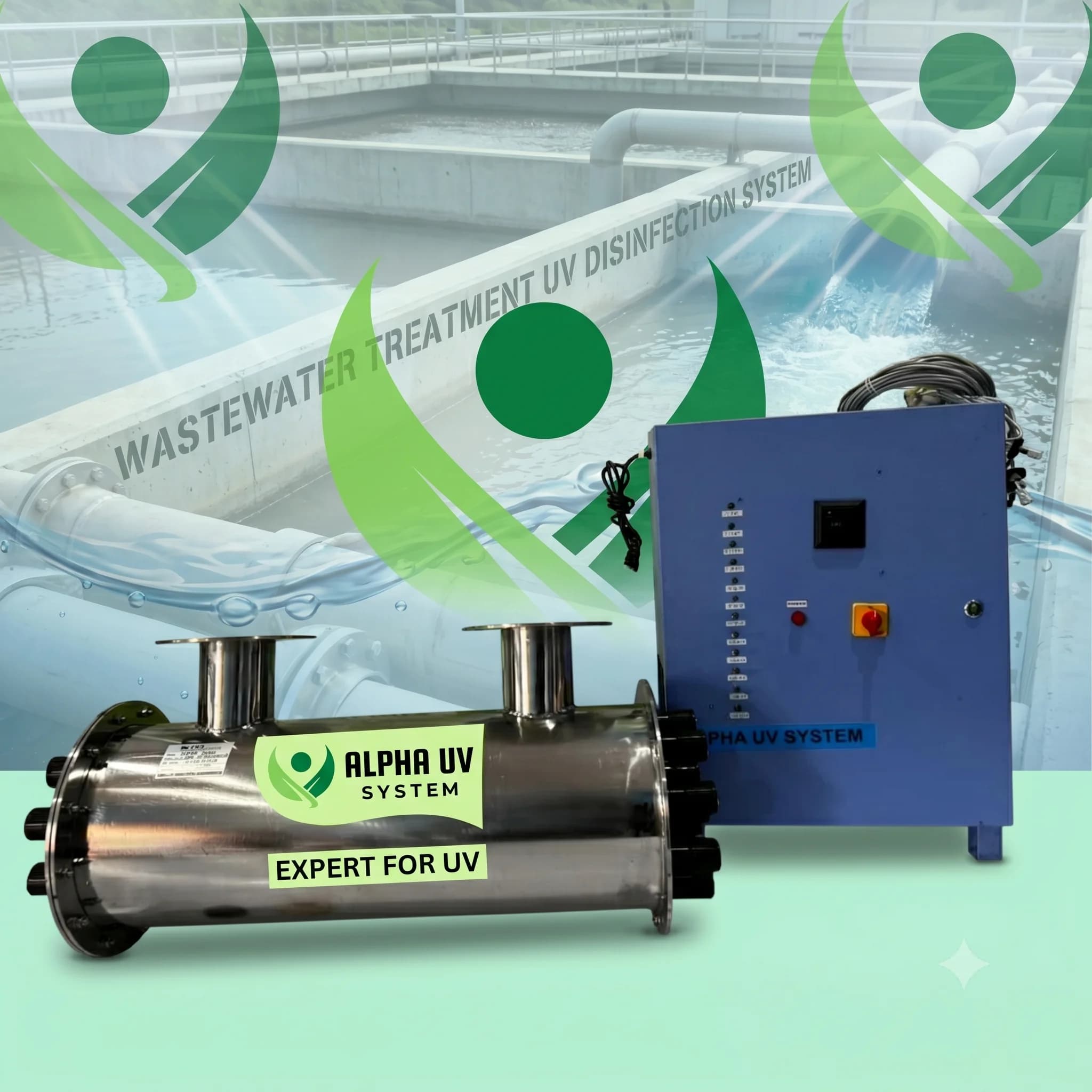
Sewage treatment plants (STPs) and effluent treatment plants (ETPs) in India must meet CPCB 2017 discharge norms before releasing treated water to surface water bodies, land irrigation, or recycling to non-potable uses. The most critical parameter in CPCB compliance is total coliform, limited to less than 100 MPN per 100 mL — a standard that secondary-treated wastewater routinely fails without a dedicated tertiary disinfection step. UV disinfection is the preferred final treatment technology because it adds no chlorine residual that would harm aquatic life in receiving water bodies, leaves no chemical in the discharged water, and — when designed correctly for low-UV-transmittance wastewater — consistently achieves 3–4 log reduction of fecal coliform in a single pass. Alpha UV System wastewater UV systems use Philips UV-C lamps, the only lamp technology specifically rated for the elevated turbidity and colour of secondary-treated effluent.
UV Dose
25–40 mJ/cm²
Capacity
10,000 – 2,00,000 LPH
Chlorine dosing has been the default STP disinfection method for decades in India, but it is increasingly failing compliance audits for two reasons. First, chlorine reacts with the residual organic matter in secondary effluent to form trihalomethanes (THMs) and haloacetic acids (HAAs) — regulated disinfection byproducts that create a secondary pollution problem at the point of discharge. Second, the chlorine residual itself is toxic to aquatic life in receiving water bodies; the National Green Tribunal (NGT) has fined multiple STP operators for discharging chlorinated effluent to rivers that subsequently suffered fish kills. UV disinfection eliminates both problems: UV-C inactivates pathogens without chemical addition, leaves zero residual in the effluent, and produces no disinfection byproducts. The challenge with wastewater UV is the low UV transmittance (UVT) of secondary effluent — typically 40–60% compared to 90–98% for drinking water. This means the UV system must be designed with higher lamp wattage, different lamp spacing, and correct hydraulic modelling. Alpha UV System engineers use actual measured UVT values from effluent samples (not literature averages) as the basis for system sizing.
The Central Pollution Control Board's 2017 notification on STP effluent standards tightened the coliform limit from the previous standard, effectively requiring all STPs above a certain capacity to install tertiary disinfection. CPCB specifies total coliform less than 100 MPN/100 mL and fecal coliform less than 10 MPN/100 mL for Class A reuse (toilet flushing and gardening) and Class B reuse (irrigation of non-food crops). Meeting these standards consistently across varying flow rates and effluent quality conditions — not just during the annual compliance monitoring visit — requires a UV system designed with safety factors for worst-case conditions. Alpha UV System STP/ETP systems are designed to deliver 40 mJ/cm² at the 90th percentile effluent UVT (i.e., the UV dose is verified against the worst 10% of effluent quality measurements, not average conditions). This approach means the system passes compliance monitoring even on days when effluent quality is below average due to upstream upset conditions. Our documentation package for CPCB compliance includes the UV dose calculation report, effluent UVT measurement data, and a performance test record demonstrating coliform reduction.
Large STPs — above 1 MLD (1,000 m³/day) — increasingly use open-channel UV systems, where UV lamp modules are submerged in concrete channels through which the effluent flows under gravity. Open-channel UV eliminates the pressure drop and pumping energy associated with closed-vessel systems and is significantly more maintainable at high flow rates (lamp modules can be raised and replaced without draining the channel). Alpha UV System designs open-channel systems with Philips UV-C lamp modules rated for continuous submersion, with automatic lamp-wiping mechanisms to prevent quartz sleeve fouling from wastewater biofilm. For STPs below 1 MLD, closed-vessel UV systems offer the advantage of compact footprint and simpler operation — a standard pipe-and-flange installation that maintenance staff can operate without specialist training. Both configurations are available from Alpha UV System, with sizing based on CPCB-specified design criteria including peak hydraulic flow rate, minimum UVT, and effluent suspended solids.
Standard low-pressure mercury UV lamps lose efficiency rapidly as UV transmittance falls below 70%. Secondary-treated STP effluent typically has UVT of 40–65%, and tertiary-treated effluent (after sand filtration) has UVT of 55–75%. In this range, low-pressure lamps require large numbers of closely spaced lamps to achieve the required dose — significantly increasing capital and operating cost. Philips UV-C lamps address this by generating higher UV-C output per lamp watt than standard low-pressure lamps, and maintaining consistent output across a wider UVT range. They also operate at higher temperatures, making them suitable for outdoor installations where ambient temperature variation would compromise standard lamp output. Alpha UV System uses Philips UV-C lamps exclusively for wastewater applications, with the selection between lamp types (low-pressure vs UV-C) documented in the system design report based on the customer's actual effluent UVT measurement.
Modern STPs in India — particularly those serving housing societies, commercial complexes, and industrial parks — are increasingly equipped with SCADA or BMS control systems. Alpha UV System STP UV systems include a PLC-based control panel with 4–20 mA UV intensity output and Modbus RTU communication for integration with site SCADA. The system can be configured to log UV intensity, lamp operating hours, and alarm events to the site data historian, providing the continuous monitoring record that CPCB compliance requires. For simpler installations without central control, a standalone control panel with UV intensity display, lamp-hours counter, and dry-contact alarm output (for connection to a site panel lamp or SMS dialler) is the standard supply. Both configurations support the same Philips UV-C UV lamp module, ensuring that lamp replacement procedures and spare parts are identical regardless of control system configuration.
Recommended Products
IIT Patna engineers recommend these systems for waste water treatment applications based on flow rate, required UV dose, and compliance standard. Both systems use genuine Philips UV-C lamps and ship with complete compliance documentation.
IIT Patna Engineering
Alpha UV System IIT Patna engineers calculate UV dose from your actual water quality parameters — measured UVT, flow rate, target log reduction, and the specific compliance standard that governs your facility. Not from catalogue sizing tables or generic assumptions. Every system ships with a signed UV dose calculation report, a Philips certificate of authenticity, and compliance documentation prepared for the regulatory framework applicable to waste water treatment operations.
From measured UVT, flow rate, and target log-reduction. Signed by IIT Patna engineer.
CPCB 2017 · NGT norms · State PCB discharge — documentation prepared to the audit checklist, not generic templates.
WhatsApp your flow rate, water quality, and compliance requirement — engineering-backed quote in 2 hours.
Mon–Sat · 9 AM–6 PM IST · IIT Patna alumni on call
Send us your flow rate and compliance requirement — quote with engineering rationale in 2 hours.
+91 93183 05878
Get Quote →
Call Direct
+91 95995 00580
Tap to Call →
Send Enquiry
Detailed specifications form
Open Form →