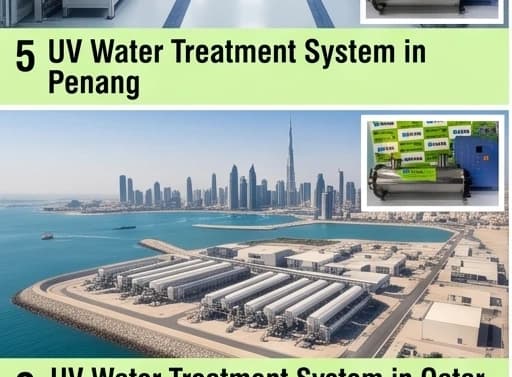
UV water treatment Qatar installations require a minimum 40 mJ/cm² delivered dose for drinking water and 60 mJ/cm² for food contact and healthcare applications. Qatar's SWRO-desalinated supply has UVT of 95–98% at 254 nm — among the highest globally — making UV exceptionally efficient. Qatar Chemical Standards (QCS) align with WHO GDWQ for drinking water microbiological limits. Alpha UV System ships CE-certified UV systems from India to Hamad Port (Doha) in 14–16 days.
Qatar's Water Supply: 100% Desalination, High-Stakes Microbiological Risk
Qatar has the world's highest per-capita water consumption and the world's near-total dependence on desalination — over 99% of Qatar's potable water originates from KAHRAMAA's seawater reverse osmosis (SWRO) and multi-stage flash (MSF) plants along the Arabian Gulf coast. With no significant groundwater or surface water resources and annual rainfall averaging just 74 mm, the Qatar General Electricity and Water Corporation (KAHRAMAA) operates one of the Middle East's largest desalination portfolios from facilities at Ras Abu Fontas and Dukhan.
Qatar's extreme summer heat — air temperatures regularly exceed 45°C between June and September — creates severe downstream water quality challenges. Distribution pipework, building risers, and rooftop storage tanks reach temperatures that dramatically accelerate bacterial regrowth, particularly Legionella pneumophila and HPC organisms. The mega-scale hospitality, stadia, and commercial infrastructure built for the 2022 FIFA World Cup introduced tens of thousands of kilometres of new building water systems — all of which require robust point-of-entry and point-of-use disinfection. UV water treatment Qatar procurement has risen sharply since 2021 as FIFA legacy facilities operationalise and Qatar's Ministry of Public Health (MoPH) tightens food facility water standards.
Qatar's Chemical Standards (QCS) — published by Qatar's Standards, Metrology and Testing Department (SMD) — reference WHO GDWQ (4th edition) microbiological limits: zero E. coli per 100 mL, zero enterococci per 100 mL, and HPC <100 CFU/mL at the consumer tap. For food facilities regulated by MoPH's Public Health Directorate, water in contact with food must meet food-grade standards demonstrated through documented treatment — positioning UV water treatment Qatar operators as their preferred chemical-free compliance solution.
UV Dose Requirements and UVT Advantages in Qatar
Qatar's SWRO-desalinated water offers outstanding UV performance characteristics. The RO membrane process removes virtually all dissolved organics, colour-causing compounds, and particulate matter, yielding UVT values of 95–98% at 254 nm in distribution. This is among the highest UVT of any public water supply globally, and it means UV reactors in Qatar operate at near-theoretical efficiency — a reactor sized for 75% UVT (the standard international design basis) is significantly over-specified for Qatar's water, enabling smaller, lower-power installations without sacrificing dose delivery.
| Pathogen | 3-log Inactivation (mJ/cm²) | 4-log Inactivation (mJ/cm²) | Priority Sector in Qatar |
|---|---|---|---|
| E. coli / total coliforms | 6.9 | 11.0 | Hotels, stadia, food processing |
| Legionella pneumophila | 5.5 | 12.0 | FIFA legacy cooling towers, hot water loops |
| Cryptosporidium parvum | 2.5 | 5.8 | Hospital and healthcare water |
| Norovirus | 39.0 | N/A | Food processing, catering |
| Adenovirus | 100+ | N/A | Pharmaceutical / WFI pre-treatment |
Standard UV water treatment Qatar drinking water designs deliver 40 mJ/cm² — providing >4-log bacterial reduction and a substantial margin against protozoan contamination. Qatar's large-scale catering and food production sector (serving Qatar's construction workforce, airline catering at HIA, and the FIFA venue network) specifies 60 mJ/cm² as minimum. Pharmaceutical clients at Qatar Science and Technology Park and Mesaieed Industrial City specify 80 mJ/cm² for WFI pre-treatment and cleanroom water loops.
CFD-Validated Reactors for Qatar's Large-Scale Buildings
Qatar's built environment is characterised by extremely large buildings — skyscrapers in West Bay, mega-malls at The Pearl and Mall of Qatar, and the FIFA stadia themselves — that require UV water treatment Qatar systems sized for 50–500 m³/hour. At these flow rates, ensuring every parcel of water receives the full design dose requires careful hydraulic engineering of the UV reactor chamber.
Alpha UV System uses computational fluid dynamics (CFD) simulation in ANSYS Fluent to model flow velocity profiles, turbulence intensity, and UV dose distribution inside every commercial and industrial reactor before manufacture. CFD analysis identifies low-dose zones created by short-circuit flow paths and dead zones near reactor end caps. Our Qatar-specification reactors achieve a Reduction Equivalent Dose efficiency (EFF) >0.90, validated by third-party biodosimetry testing using MS2 coliphage as a performance surrogate — the gold standard accepted by Qatar's MoPH Environmental Health Directorate and QCS food safety auditors.
Key Industry Sectors: UV Water Treatment Qatar Applications
| Sector | Primary Application | Typical Flow Rate | Required UV Dose | Compliance Standard |
|---|---|---|---|---|
| FIFA Legacy Hotels and Stadia | Building water, cooling towers, Legionella control | 20–200 m³/h | 40 mJ/cm² | MoPH / KAHRAMAA |
| Food Processing and Catering | Process water, CIP rinse, beverage production | 10–150 m³/h | 60 mJ/cm² | MoPH Food Safety |
| Healthcare and Hospitals | Sterile water, dialysis, Legionella | 5–40 m³/h | 60–80 mJ/cm² | MoPH hospital accreditation |
| Petrochemical / LNG | Cooling water, boiler feed, process water | 200–2000 m³/h | 30–40 mJ/cm² | Qatar Energy / Qatargas process specs |
FIFA legacy infrastructure is the defining UV water treatment Qatar procurement driver for 2025–2028. The eight FIFA 2022 World Cup stadia — Lusail Iconic, Al Bayt, Education City, Ahmad Bin Ali, and others — and their associated hotel, hospitality, and media complexes all require ongoing Legionella management programmes. ASHRAE Guideline 12-2000 (Minimising the Risk of Legionellosis) specifies UV as a primary or supplementary control measure in cooling tower and hot water recirculation systems. Property managers across Qatar's 120,000+ new hospitality rooms are rolling out UV systems for MoPH compliance and international brand standard adherence.
Qatar's airline catering sector — anchored by Qatar Airways Group's catering operations at Hamad International Airport — represents one of the region's most demanding food water treatment environments. HACCP plans for inflight food production mandate 60 mJ/cm² UV treatment of all food contact water. UV water treatment Qatar catering facilities prefer over chemical treatment as it eliminates risk of disinfection by-product (DBP) contamination in food products.
Importing UV Systems from India to Qatar
Alpha UV System ships UV water treatment Qatar orders from JNPT (Mumbai). Sea freight to Hamad Port (Doha) — Qatar's state-of-the-art deep-water port in Mesaieed — takes 14–16 days. Air freight via Hamad International Airport handles urgent replacement lamps and controllers in 3–5 days. Qatar Customs (General Authority of Customs) processes imports efficiently at Hamad Port through the Customs Integrated System (CIS).
| Document | Purpose | Notes for Qatar |
|---|---|---|
| Commercial Invoice (Arabic + English) | Customs valuation, HS 8421.29.90 | Arabic translation strongly recommended for faster clearance |
| Packing List | Itemised contents | Include serial numbers for UV controllers and lamps |
| Bill of Lading / AWB | Title document | Consign to Qatar-registered importer |
| Certificate of Origin (Form A) | GCC preferential duty | 5% GCC tariff standard; Form A may allow reduction |
| CE Declaration of Conformity | KAHRAMAA and MoPH electrical compliance | Mandatory — QCS references CE for electrical equipment |
| NSF/ANSI 55 Class A Test Report | Food and potable water performance | MoPH Food Safety audit requirement |
| Biodosimetry Validation Report | Delivered UV dose evidence | Required for FIFA-legacy hotel and stadia approvals |
Qatar levies 5% import duty under the GCC Unified Customs Tariff. Qatar does not impose VAT on goods (as of 2026, VAT legislation has not been enacted in Qatar), making it one of the Gulf's most straightforward import destinations for UV water treatment equipment. Landed cost to Hamad Port is approximately CIF value × 1.05 plus customs clearance agent fees.
Qatar Standards and Certification Requirements
Qatar's SMD and MoPH accept the following certification credentials for UV water treatment Qatar system procurement:
- CE Marking (LVD + EMC Directives): required for all electrical equipment; KAHRAMAA inspectors verify CE compliance during building commissioning sign-off
- NSF/ANSI 55 Class A: MoPH Food Safety Directorate requires this for food facility water treatment — confirms 40 mJ/cm² at rated flow against NSF's standard challenge protocol
- QCS 2 (Qatar Chemical Standards for Water): drinking water microbiological limits aligned with WHO GDWQ — UV system performance must demonstrate compliance
- ISO 9001:2015: quality management certification of manufacturer — a standard procurement requirement in Qatar's government and quasi-government sector
- ASHRAE Guideline 12 / HTM 04-01: Legionella management specifications used by Qatar's international hotel brands and NHS-standard hospitals (Hamad Medical Corporation)
Sizing Guide: Alpha UV Systems for Qatar
| Application | Flow Rate | UV Dose | Alpha UV Series | Power Requirement |
|---|---|---|---|---|
| Villa / residential unit | 1–3 m³/h | 40 mJ/cm² | Residential | 25–55 W / 230V |
| Restaurant / hotel outlet | 3–10 m³/h | 60 mJ/cm² | Commercial | 150–300 W / 230V |
| Hotel (150–500 rooms) | 30–100 m³/h | 40 mJ/cm² | Commercial / Industrial | 1–4 kW / 415V 3-ph |
| Stadium / arena | 100–400 m³/h | 40 mJ/cm² | Industrial | 5–20 kW / 415V 3-ph |
| Food processing / catering | 20–200 m³/h | 60 mJ/cm² | Industrial | 2–15 kW / 415V 3-ph |
| LNG / petrochemical | 200–2000 m³/h | 30 mJ/cm² | Industrial (multi-lamp) | 15–100 kW |
Alpha UV System IIT-trained engineers design every UV water treatment Qatar installation to actual local UVT, water temperature (which affects lamp output), and flow rate profile — not generic catalogue sizing. Our controllers feature integrated UVT sensors that automatically compensate lamp power output for seasonal water quality variations, maintaining compliant dose delivery year-round.
Frequently Asked Questions — UV Water Treatment Qatar
Do FIFA World Cup legacy stadia in Qatar need UV systems?
Yes. Qatar's FIFA 2022 legacy facilities — stadia, hotels, media centres, and transport hubs — have Legionella Water Safety Plans (WSPs) as a condition of ongoing MoPH operating licences. UV water treatment Qatar stadia installations are typically on hot water recirculation loops (supplementing 60°C thermal management) and cooling tower make-up water systems. ASHRAE Guideline 12-2000 and the Qatar-adopted HTM 04-01 (Healthcare) Legionella guidelines both specify UV as a recognised control technology. Alpha UV System has supplied similar stadia-grade UV systems for large-venue applications in India and the GCC.
How does Qatar's no-VAT status affect UV system import costs?
As of 2026, Qatar has not enacted VAT legislation. This means UV water treatment Qatar imports are subject only to the 5% GCC Unified Customs Tariff import duty (HS 8421.29.90) — no additional VAT layer. Compared to Oman (5% duty + 5% VAT) or Saudi Arabia (5% duty + 15% VAT), Qatar offers the lowest import tax burden in the GCC for UV equipment. Total landed cost is CIF Hamad Port × 1.05 plus customs clearance agent fees.
What is KAHRAMAA's requirement for building water treatment in Qatar?
KAHRAMAA's Building Code of Qatar (QCS 2014 Section 20) specifies that all building water systems must maintain safe microbiological water quality at the point of supply. For buildings with centralised storage tanks (the norm in Qatar's high-rise developments), point-of-entry UV treatment after the tank is the most practical compliance approach. UV water treatment Qatar building installations must be sized to treat peak building demand flow, with a minimum delivered dose of 40 mJ/cm² for domestic supply. KAHRAMAA inspectors may request UV intensity sensor logs as part of building handover documentation.
Can Alpha UV System supply UV systems for Qatar Petroleum / Qatar Energy offshore facilities?
Yes. Alpha UV System's Industrial series UV reactors are designed for offshore and petrochemical process environments — 316L stainless steel bodies, ATEX-rated options, IP66-rated controllers, and skid-mounted configurations with isolation valves and bypass piping. Qatar Energy (formerly Qatar Petroleum) and its JV partners (Shell, TotalEnergies, ExxonMobil, ConocoPhillips) specify UV for cooling tower make-up and boiler feed pre-treatment at LNG trains and onshore gas processing facilities. Alpha UV System can supply complete packaged UV skids with all documentation to Qatar Energy's COMPANY MINIMUM REQUIREMENTS (CMR) standards.
Is Arabic labelling required on UV systems sold in Qatar?
Arabic labelling is not mandated by QCS for UV equipment but is strongly recommended for operator-interface panels in facilities where Qatari or Arabic-speaking technicians operate the system. Alpha UV System supplies bilingual English/Arabic control panel overlays and maintenance instruction booklets on request at no additional charge. MoPH food facility auditors appreciate Arabic-language operating manuals as part of HACCP documentation submissions for UV water treatment Qatar food processing sites.
Recommended UV Systems
Alpha UV System products for this application — powered by genuine Philips UV-C lamps.
Commercial UV Water Purification System
500 – 5,000 LPH
HACCP-compliant UV water purification for hotels, restaurants, and offices
Industrial UV Water Treatment System
5,000 – 50,000 LPH
Schedule M 2025 and HACCP compliant UV for pharma, food & beverage, and process water
Not sure which system suits your application? WhatsApp our engineers for a free recommendation →
Related solutions
See how Alpha UV System applies this to your industry or city.
Need a UV system?
Talk to our UV engineers — WhatsApp for a quote in 2 hours, or browse the full catalog on IndiaMART.