Quick Answer: Why African Water Projects Source UV Systems from India
UV systems export India Africa water treatment procurement has accelerated significantly since 2023. African buyers — spanning municipal water authorities, NGOs, development bank-funded contractors, and private industrial operators — are increasingly specifying Indian-manufactured UV disinfection equipment for three interconnected reasons: the price differential relative to European UV suppliers is substantial (typically 35–55% lower delivered cost for equivalent flow rates and UV doses); Indian UV manufacturers have two-plus decades of documented performance in tropical climates directly comparable to Sub-Saharan African conditions; and leading Indian UV system exporters now hold the CE certification and ISO 9001 quality credentials required for multilateral development bank (MDB) procurement compliance.
Alpha UV System, based in Greater Noida, exports UV water treatment systems to Kenya, Nigeria, Tanzania, and Angola. Our systems are specified to deliver a minimum 40 mJ/cm² UV dose — the threshold required to achieve WHO Guideline-compliant E. coli reduction in drinking water — and are available with universal-voltage electronic ballasts rated for the variable power infrastructure found across Sub-Saharan Africa.
This guide covers every dimension of UV systems export India Africa water treatment procurement: national water quality standards, country-specific regulatory bodies, technical specifications, CE and MDB documentation requirements, JNPT shipping routes to Mombasa, Lagos, Dar es Salaam, and Luanda, import documentation, and Alpha UV System's spare parts programme for African operators.
Sub-Saharan Africa Water Crisis: The Context for UV Disinfection
Sub-Saharan Africa carries a disproportionate share of the global waterborne disease burden. WHO and UNICEF Joint Monitoring Programme (JMP) data indicate that approximately 400 million people in the region lack access to safely managed drinking water services. Waterborne pathogens — including E. coli, Vibrio cholerae, and rotavirus — remain leading causes of preventable mortality, particularly in children under five. The WHO estimates that unsafe water, sanitation, and hygiene account for over 800,000 deaths per year globally, with Sub-Saharan Africa accounting for a significant proportion of that toll.
Infrastructure gaps compound the microbiological risk. Many municipal water treatment facilities in the region rely on chlorination alone — a process that is effective against bacteria but less reliable against protozoan cysts such as Cryptosporidium and Giardia, and that produces disinfection byproducts (trihalomethanes) at elevated concentrations when applied to high-turbidity source water. UV disinfection, deployed as a final barrier or in combination with filtration, addresses both limitations: it achieves reliable inactivation across a broad pathogen spectrum and produces no chemical residuals.
UV disinfection Sub-Saharan Africa deployment has accelerated through three project types: World Bank and African Development Bank (AfDB) funded municipal water supply upgrades; USAID and bilateral donor-funded NGO water and sanitation programmes; and private sector industrial and hospitality water treatment installations in cities including Nairobi, Lagos, Dar es Salaam, and Luanda.
For all three project types, the sourcing question consistently returns to the same shortlist: European UV systems (WEDECO, Trojan UV, Xylem Wedeco), North American systems (Atlantic Ultraviolet), or Indian UV system export Africa manufacturers offering CE-certified equipment at a competitive cost relative to European suppliers. Indian manufacturers have gained significant ground in the NGO and MDB procurement segment over the past five years.
Why Indian UV Systems Are Suited to African Water Projects
Proven Tropical Climate Performance
India's own UV water treatment market spans climates from semi-arid Rajasthan to tropical Kerala and humid Bengal — ambient temperature ranges of 15°C to 48°C, with humidity conditions directly comparable to coastal East Africa (Mombasa, Dar es Salaam) and West Africa (Lagos). Alpha UV System's UV systems are rated for ambient operating temperatures up to 50°C and are designed with ventilated control panel enclosures appropriate for tropical humidity. This is not an engineering concession added for export — it reflects the domestic Indian market conditions our systems are built to serve.
Competitive Cost Relative to European Suppliers
For development-funded water projects operating under tight budgets — whether World Bank infrastructure loans, USAID grants, or bilateral donor programmes — the cost differential between Indian and European UV water treatment systems is operationally significant. A CE certified UV system Africa installation sourced from India typically delivers equivalent hydraulic capacity and UV dose performance at a delivered cost 35–55% below comparable European-branded equipment, inclusive of sea freight from JNPT (Jawaharlal Nehru Port Trust, Mumbai/Nhava Sheva) to African destination ports.
This differential enables project budgets to extend coverage: the same budget that would install one European-specification UV system for a municipal feed point can cover two to three Indian-manufactured UV disinfection units for decentralised community water points — a deployment model favoured by UNICEF and WHO field programmes in rural Sub-Saharan Africa.
CE Certification and WHO Water Quality Compliance
Alpha UV System holds CE marking under the relevant EU machinery and low-voltage directives. CE certified UV system Africa procurement is the baseline requirement for equipment imported under MDB-funded projects, bilateral donor procurement frameworks, and an increasing number of African national government tenders that reference EU conformity standards.
Our UV systems are specified to deliver a minimum 40 mJ/cm² UV dose at validated flow rates — the WHO water quality Africa UV threshold for reliable E. coli, Enterococcus, and MS2 coliphage inactivation in drinking water applications. Validated dose calculations and test certificates are supplied with each export order.
Country-by-Country Standards Guide
The table below summarises the national regulatory framework, applicable UV dose requirement, and microbiological coliform limit for each of Alpha UV System's four primary African export markets.
| Country | National Standard / Regulator | Min. UV Dose (Drinking Water) | Coliform Limit (Drinking Water) | Notes |
|---|---|---|---|---|
| Kenya | Water Quality Regulations, Legal Notice No. 120; KEWI oversight | 40 mJ/cm² (WHO alignment) | 0 E. coli / 100 ml | Effluent standards under NEMA also apply for STP applications |
| Nigeria | NESREA; NAFDAC for drinking water products | 40 mJ/cm² (WHO alignment) | 0 E. coli / 100 ml (drinking); <10 TC / 100 ml (treated effluent) | Lagos State Water Corporation references WHO Guidelines directly |
| Tanzania | EWURA (Energy and Water Utilities Regulatory Authority); TBS | 40 mJ/cm² (WHO alignment) | 0 E. coli / 100 ml | DAWASA (Dar es Salaam) uses WHO 4th Edition as primary reference |
| Angola | MINEA (Ministry of Energy and Water); DNA standards | 40 mJ/cm² (WHO alignment) | 0 E. coli / 100 ml | Portuguese-language documentation required for MINEA submissions |
All four countries align drinking water microbiological standards with WHO Guidelines for Drinking-water Quality. The 40 mJ/cm² UV dose specification used by Alpha UV System provides a validated margin above the minimum required for 4-log (99.99%) E. coli inactivation — delivering compliance headroom for source water quality variation typical of African surface and groundwater sources.
Kenya: Water Quality Regulations, KEWI, and Institutional Applications
Kenya represents one of the most active markets for UV water treatment Kenya procurement from Indian suppliers. The Kenya Water Institute (KEWI) under the Water Act 2016 provides training and standards support for water supply utilities across the country. The Water Quality Regulations (Legal Notice No. 120 of 2007, revised under subsequent Water Act provisions) establish the microbiological standards that UV disinfection systems must demonstrably achieve.
Nairobi's water infrastructure, managed through Nairobi City Water and Sewerage Company, has seen significant UV disinfection deployment at municipal and institutional levels. Outside Nairobi, coastal utilities in Mombasa (managed by Coast Water and Sewerage Company) face specific microbiological challenges from shallow coastal aquifer sources with elevated coliform loads — making UV disinfection Sub-Saharan Africa deployment at the point of abstraction particularly effective.
Alpha UV System UV systems are deployed across the following institutional sectors in Kenya:
| Sector | Typical Flow Capacity (m³/hr) | Applicable Regulation | Common Application Point |
|---|---|---|---|
| Hospitality (hotels, lodges) | 1 – 10 | Water Quality Regulations, Legal Notice No. 120 | Main supply, swimming pool top-up, RO permeate |
| Bottled / packaged water | 2 – 15 | KEBS KS 459; KEBS KS EAS 12 | Post-filtration final barrier |
| Municipal borehole schemes | 10 – 100 | Water Act 2016; KEWI guidelines | Inline post-filtration at pump station |
| NGO community water points | 0.5 – 5 | WHO Guidelines 4th Ed. (donor reference) | Solar-powered kiosk systems, gravity-fed schemes |
| Food processing | 5 – 30 | KEBS; HACCP programme requirements | Process water, CIP water, wash water |
For Kenya export orders, Alpha UV System provides a Certificate of Origin issued by the Greater Noida Chamber of Commerce, CE Declaration of Conformity, and ISO 9001:2015 certificate — the standard documentation package required by Kenya Revenue Authority (KRA) for import clearance and by procurement agencies for tender compliance.
Nigeria: NESREA Standards and Industrial Applications
Nigeria is Sub-Saharan Africa's largest economy and represents a significant market for UV water Nigeria UV treatment systems across both industrial and municipal sectors. The National Environmental Standards and Regulations Enforcement Agency (NESREA) governs effluent discharge standards under the National Environmental Protection (Effluent Limitation) Regulations. NAFDAC (National Agency for Food and Drug Administration and Control) oversees drinking water product standards.
Lagos — West Africa's commercial capital — is the primary entry point for Indian UV system export Africa equipment destined for the Nigerian market. Port operations at Apapa and Tin Can Island handle containerised imports; UV systems from JNPT typically transit via Jebel Ali (UAE) before final routing to Lagos, with total transit times of 28–38 days depending on vessel schedule and port congestion.
Nigerian industrial applications for UV disinfection UV water treatment Nigeria include:
- Brewery and beverage manufacturing: Process water treatment and CIP (clean-in-place) water disinfection at Lagos and Kano facilities. NESREA effluent standards and international brand quality protocols drive UV adoption in this sector.
- Pharmaceutical manufacturing: Purified water (PW) and Water for Injection (WFI) preparatory treatment. Lagos pharmaceutical clusters reference BP and USP water standards.
- Oil and gas produced water: Offshore and onshore produced water treatment, where UV disinfection is combined with hydrocyclone separation and advanced oxidation processes.
- Municipal water supply: Lagos State Water Corporation and smaller state water boards increasingly specify UV as a final disinfection barrier following conventional coagulation-flocculation-filtration treatment trains.
- Hotels and commercial real estate: Legionella control in cooling towers and domestic hot/cold water systems at Lagos and Abuja commercial properties.
CE certified UV system Africa documentation is particularly important for Nigerian industrial procurement: EPC contractors managing World Bank and AfDB-funded water projects in Nigeria require CE marking, ISO 9001 certification, and factory acceptance test (FAT) certificates for all major process equipment including UV disinfection systems.
Tanzania: EWURA Standards and NGO Development Projects
Tanzania's water sector is regulated by EWURA (Energy and Water Utilities Regulatory Authority) under the Water Supply and Sanitation Act. The Tanzania Bureau of Standards (TBS) maintains drinking water quality standards aligned with WHO Guidelines. Dar es Salaam Water and Sewerage Authority (DAWASA) is the primary urban utility, serving Tanzania's commercial capital and primary Indian Ocean port city.
UV disinfection Sub-Saharan Africa deployment in Tanzania has been driven substantially by NGO and development bank projects targeting rural and peri-urban water supply. Organisations including Water.org, WaterAid, and UNICEF Tanzania have specified UV disinfection for community water kiosk schemes in regions including Dodoma, Mwanza, and Arusha — supplementing chlorination where chlorine taste acceptability is low and point-of-use treatment is preferred.
The Dar es Salaam port (Port of Dar es Salaam, managed by TPA — Tanzania Ports Authority) handles containerised Indian UV system export Africa shipments from JNPT. Transit time is typically 22–28 days. Customs clearance in Tanzania requires the following documentation from Indian exporters: Commercial invoice, packing list, Bill of Lading, Certificate of Origin, CE Declaration of Conformity, and ISO 9001 certificate.
For World Bank-funded water projects in Tanzania — which have included significant investment in urban water supply infrastructure under the Tanzania Urban Water Supply and Sanitation Project (TUWSP) — procurement specifications reference World Bank Procurement Regulations for IPF Borrowers (July 2016, revised 2020). These regulations require CE marking or equivalent national standard conformity for imported mechanical and electrical equipment, making CE certified UV system Africa sourcing from India straightforwardly compliant.
UV system NGO water project Africa procurement in Tanzania often involves structured annual supply agreements: NGO programme managers prefer predictable lamp replacement schedules and guaranteed spare parts availability over reactive procurement, given the logistics challenges of rural Tanzania. Alpha UV System's annual spare parts programme is specifically structured to serve this requirement.
Angola: Post-Conflict Infrastructure Rebuild and MINEA Water Projects
Angola's water sector is undergoing substantial rebuilding following decades of civil conflict that ended in 2002. The Ministry of Energy and Water (MINEA) oversees national water supply policy and infrastructure investment. The National Directorate of Water (DNA) under MINEA manages water quality standards. Angola's drinking water standards align with WHO Guidelines, with Portuguese-language documentation required for official submissions to MINEA and DNA.
Luanda, Angola's capital and primary port city, is the centre of water infrastructure investment. The Luanda Water Supply Rehabilitation Project and related infrastructure programmes funded by the World Bank, African Development Bank, and Chinese development finance institutions have driven significant procurement of water treatment equipment including UV disinfection systems. Indian UV system export Africa suppliers have participated in this market through EPC contractors and local trading partners based in Luanda.
The Port of Luanda (Porto de Luanda) handles imported water treatment equipment. Transit from JNPT to Luanda is typically 30–40 days, with routing via Cape Town or Durban for most vessel services. Some shipments route via Jebel Ali (UAE) on feeder services connecting to the West Africa coast. Customs clearance in Angola requires documentation in Portuguese — Alpha UV System supplies CE Declaration of Conformity and product documentation in English with professional Portuguese translation for Angola orders.
IP65-rated enclosures for UV system control panels are particularly important for Angolan installations, where outdoor installation at pump stations in coastal humidity conditions (Luanda's coastal climate is influenced by the cold Benguela Current, but ambient humidity is significant) demands weatherproof electrical enclosures as standard.
Technical Specification for African Deployment
Alpha UV System's Africa export-specification UV water treatment systems incorporate the following technical features, selected based on feedback from UV systems export India Africa water treatment projects since our first African shipment:
| Parameter | Africa Export Specification | Rationale |
|---|---|---|
| Input voltage range | 85–265V AC universal | Covers the full voltage variation spectrum of African municipal power supplies |
| Frequency | 50/60 Hz (auto-sensing) | Compatible with both 50Hz (most of Africa) and 60Hz systems |
| Control panel enclosure | IP65 rated | Dust and jet-water ingress protection for outdoor pump station installation |
| Ambient temperature rating | Up to 50°C operating | Covers peak ambient temperatures in West and East African locations |
| UV lamp | Philips TUV low-pressure or Philips UV-C high-output | Global lamp supply chain — replacement lamps available in-country or via air freight |
| UV dose | Minimum 40 mJ/cm² at rated flow | WHO 4th Edition drinking water compliance threshold |
| UV transmittance design point | 75% UVT (configurable to 85% for higher-clarity sources) | Accounts for typical African surface water and shallow groundwater UVT range |
| Lamp life rating | 9,000 hours (Philips TUV) / 12,000 hours (Philips UV-C high-output) | Annual or biannual replacement schedule for predictable maintenance planning |
| Wetted materials | 316L stainless steel chamber, PTFE O-rings, borosilicate quartz sleeves | Chloride corrosion resistance for coastal installations (Mombasa, Lagos, Luanda) |
| Connection type | Flanged (PN16 or ANSI 150 available) or BSP threaded for smaller systems | Covers both metric (East/Southern Africa) and imperial (West Africa) pipe systems |
The universal voltage specification (85–265V AC) is not a minor detail — it is the single most important technical differentiator between standard domestic-market Indian UV systems and export-specification systems suitable for African deployment. Standard Indian market UV systems use fixed 220–240V ballasts and fail systematically in markets where voltage drops to 160–180V during grid stress events, which is a documented condition in many African municipal grid networks. Our Africa export specification eliminates this failure mode at source.
CE Certification and MDB Project Compliance
Multilateral development bank-funded water projects in Africa impose specific documentation requirements on equipment suppliers. Understanding these requirements is essential for UV systems export India Africa water treatment procurement to succeed at the tender stage.
World Bank Procurement Requirements
World Bank IPF (Investment Project Financing) procurement regulations require that imported equipment meet the technical standards specified in the tender or, where no specific standard is cited, an internationally recognised equivalent. CE marking under EU Machinery Directive 2006/42/EC and Low Voltage Directive 2014/35/EU is consistently accepted as the internationally recognised conformity standard for UV disinfection equipment. Required documentation typically includes: CE Declaration of Conformity (signed by manufacturer's authorised representative); ISO 9001:2015 certificate from an accredited certification body; factory test reports; and compliance with IEC 60335 (electrical safety for household and similar appliances) or IEC 61010 where applicable.
African Development Bank Requirements
AfDB procurement rules under the African Development Bank Group Procurement Policy (2015, revised 2021) similarly require CE marking or equivalent national standard conformity for imported electrical and mechanical equipment. The AfDB additionally requires country-of-origin certification — for Indian UV system export Africa procurement, this is the Certificate of Origin (COO) issued by the relevant Indian chamber of commerce (Greater Noida Chamber of Commerce in Alpha UV System's case).
USAID Requirements
USAID-funded water and sanitation programmes reference USAID Source and Origin waiver requirements and ADS (Automated Directives System) 312 procurement regulations. CE marked equipment from India is eligible under USAID geographic code 935 (world-wide sourcing), subject to cost-reasonableness determination. USAID implementing partners (international NGOs, contractors) typically require CE Declaration of Conformity, ISO 9001 certificate, and a product data sheet in English as minimum documentation for UV disinfection equipment procurement.
Alpha UV System can provide the full documentation set required for World Bank, AfDB, and USAID project procurement — including factory acceptance test (FAT) support for projects that require witnessed factory testing before shipment.
Shipping Guide: JNPT to African Ports
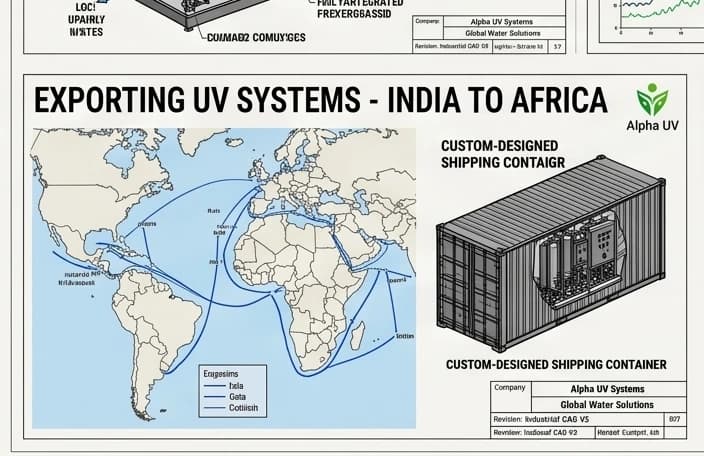
All Alpha UV System export orders ship from Jawaharlal Nehru Port Trust (JNPT), also known as Nhava Sheva, located in Navi Mumbai approximately 55 km from our Greater Noida manufacturing facility (road transport via NH-19 and NH-48, or rail freight to Nhava Sheva ICD). JNPT is India's largest container port and serves all major African liner routes.
| Destination Port | Country | Typical Transit Time (Sea Freight) | Common Routing | Liner Services (Examples) |
|---|---|---|---|---|
| Port of Mombasa | Kenya | 18–24 days | Direct East Africa service or via Colombo/Singapore transshipment | MSC, Maersk, CMA CGM |
| Apapa / Tin Can Island, Lagos | Nigeria | 28–38 days | Via Jebel Ali (UAE) transshipment to West Africa feeder | MSC, Hapag-Lloyd, PIL |
| Port of Dar es Salaam | Tanzania | 22–28 days | Direct East Africa service or via Colombo transshipment | MSC, Maersk, Evergreen |
| Porto de Luanda | Angola | 30–40 days | Via Jebel Ali or Cape Town / Durban transshipment | MSC, CMA CGM, Hapag-Lloyd |
Jebel Ali (UAE) is the primary transshipment hub for West African routing — Lagos-bound shipments from JNPT almost invariably transit Jebel Ali before connecting to West Africa feeder services operated by PIL, MSC, and CMA CGM. This adds 5–10 days to the total transit time relative to East African direct services, but represents the most reliable routing given West Africa port congestion dynamics.
Alpha UV System's export packaging standards for African sea freight shipments:
- UV chambers: Individually crated in reinforced plywood export crates with PE foam cushioning and desiccant packs. Crates are marked with standard orientation and fragile indicators.
- Lamp assemblies: Each Philips TUV or Philips UV-C lamp individually wrapped in bubble pack, packed in purpose-built lamp cartons, then secondary-packed in reinforced outer cartons. Shock-absorbing material on all six faces to prevent quartz sleeve fracture during port handling.
- Control panels: Wrapped in anti-static foam, crated with waterproof PE liner inside outer plywood case.
- Spare parts kits: Packed in separate labelled cartons included in the same shipping container as the main system.
Manufacturing lead times for standard configurations: 10–15 working days. Custom configurations (non-standard flow rates, special flange specifications, bespoke control panel programming): 20–28 working days. Urgent replacement lamp air freight (Philips TUV or Philips UV-C) is available with 48-hour dispatch to major African hubs — typically 3–5 additional days to Nairobi, Lagos, Dar es Salaam, and Luanda.
Import Documentation for African Markets
Correct import documentation is the difference between smooth customs clearance and costly delays. The following table details the documentation requirements for each of Alpha UV System's four primary African markets for UV systems export India Africa water treatment shipments.
| Document | Kenya | Nigeria | Tanzania | Angola |
|---|---|---|---|---|
| Commercial Invoice | Required (KRA) | Required (NCS) | Required (TRA) | Required (AGT) |
| Packing List | Required | Required | Required | Required |
| Bill of Lading / Airway Bill | Required | Required | Required | Required |
| Certificate of Origin | Required (COMESA preference) | Required (ECOWAS / general) | Required (EAC preference) | Required (general) |
| CE Declaration of Conformity | Recommended / MDB required | Required for MDB projects | Required for MDB projects | Required for MINEA / MDB |
| ISO 9001:2015 Certificate | Recommended | Required for government tenders | Required for MDB tenders | Required for MINEA projects |
| HS Code (UV sterilisers) | 8421.21.90 | 8421.21.90 | 8421.21.90 | 8421.21.90 |
| Pre-Shipment Inspection | Required (PVOC — KEBS) | Required (SON / NAFDAC for applicable goods) | Not mandatory (TBS COC scheme applies to some goods) | Required (CRIE — MINCOMER) |
| Portuguese translation required | No | No | No | Yes (MINEA and AGT) |
Notable Kenya-specific requirement: KEBS (Kenya Bureau of Standards) operates a Pre-Export Verification of Conformity (PVoC) scheme. Regulated products exported to Kenya — including water treatment equipment in some categories — require a PVoC inspection and Certificate of Conformity (CoC) before shipment. Alpha UV System has experience navigating the KEBS PVoC process and can coordinate with KEBS-appointed inspection agencies (Bureau Veritas, Intertek, SGS) for pre-shipment inspection in India.
HS Code 8421.21.90 covers UV water purification equipment under the Harmonised System. This code is used consistently across all four markets for tariff classification of UV disinfection systems. Import duty rates vary by country and applicable trade preference schemes — buyers should confirm current duty rates with their clearing agent at the destination port.
NGO and Development Bank Project Support
UV system NGO water project Africa procurement has distinctive requirements compared to commercial industrial procurement. NGO programme managers and MDB project implementation units (PIUs) require:
- Bill of Materials (BOM) traceability: Full component-level BOM with manufacturer names, part numbers, and country of origin for all major components — required for donor reporting and asset registers.
- Training documentation: Operation and maintenance manuals in English (and Portuguese for Angola orders), suitable for training local operators who may not have prior UV disinfection experience.
- Warranty certificates: Formal warranty documentation identifying warranty period, terms, and the escalation process for warranty claims — required for project asset registers.
- Spare parts availability certification: Written confirmation of spare parts availability and lead times, required by some donor agencies to demonstrate sustainable operation post-project-closure.
- End-of-life disposal guidance: RoHS compliance certificate and UV lamp disposal guidance — required for EU-funded and environmentally mandated donor programmes.
Alpha UV System can provide all of the above documentation as a standard export documentation package for NGO and MDB-funded projects. We have supplied this documentation package for projects funded by World Bank, AfDB, USAID implementing partners, GIZ, and bilateral donors.
Spare Parts Programme for African Operators
The single largest operational risk for UV water treatment systems in remote African locations is lamp failure without readily available replacement stock. A UV system with a failed lamp delivers zero disinfection — the flow passes through the chamber unchecked. This is not a theoretical risk: it has been documented in NGO project evaluations where UV systems were installed but lamp replacement was not planned and funded from project inception.
Alpha UV System's Africa spare parts programme addresses this directly:
- Starter spare kit with every installation: Every UV system export order includes a starter spare kit in the same shipping container — one replacement Philips TUV or Philips UV-C lamp, one replacement quartz sleeve, one O-ring set, and one UV intensity sensor (where fitted). This gives the operator immediate replacement capability from day one, without depending on international shipping for the first maintenance event.
- Annual spare parts supply agreements: For NGO projects, government water authorities, and institutional operators, Alpha UV System offers annual spare parts supply agreements: a scheduled lamp replacement set is dispatched ahead of the lamp's rated service life, ensuring planned maintenance rather than reactive breakdown response.
- 48-hour air freight dispatch: Urgent replacement lamps (Philips TUV, Philips UV-C), quartz sleeves, and control components are available for air freight dispatch within 48 hours of order confirmation. Delivery to Nairobi, Lagos, Dar es Salaam, and Luanda is typically 3–5 days from dispatch.
- Regional stocking partners: Alpha UV System is developing relationships with regional water treatment distributors in East and West Africa to hold buffer stock of high-turnover spare parts — reducing air freight dependency for routine consumables.
Philips TUV and Philips UV-C replacement lamps are also available through Philips Signify's global distribution network in many African markets, providing a secondary in-country sourcing option for operators who prefer local procurement for consumables.
Frequently Asked Questions: UV Systems Export India to Africa
Q1: Will an Indian UV system work on African power supply without a voltage converter?
Alpha UV System's Africa export-specification UV systems are fitted with universal-input electronic ballasts rated 85–265V AC, 50/60 Hz. They operate across the full voltage range of African municipal power supplies — including the low-voltage conditions (160–180V) documented during grid stress in urban networks in Lagos, Nairobi, and Luanda — without any external voltage converter. Standard domestic-market Indian UV systems use fixed 220–240V ballasts and are not suitable for African deployment without a voltage stabiliser. Always confirm the voltage specification when sourcing any Indian UV water treatment system for Africa.
Q2: What warranty is provided on UV systems exported to Africa?
Alpha UV System provides a 12-month warranty on UV chambers, control panels, and electronic components from the date of installation or 18 months from the date of shipment, whichever is earlier. Philips TUV and Philips UV-C lamps carry Philips' own warranty. Warranty claims are handled by our export team via email and WhatsApp — field diagnosis is conducted remotely with replacement components dispatched by air freight. Warranty documentation suitable for MDB project asset registers is provided with every export order.
Q3: Is CE certification sufficient for African government and MDB procurement?
CE certification is accepted as the internationally recognised conformity standard for UV water disinfection equipment by World Bank, African Development Bank, and USAID procurement frameworks, and by the government procurement agencies of Kenya, Nigeria, Tanzania, and Angola for imported equipment. Some tenders additionally require ISO 9001:2015 certification — Alpha UV System holds both. For KEBS PVoC-regulated categories in Kenya, pre-shipment inspection by a KEBS-appointed agency is required in addition to CE marking.
Q4: How quickly can replacement lamps reach a site in rural Africa?
Replacement Philips TUV and Philips UV-C lamps are available for air freight dispatch from our Greater Noida facility within 48 hours of order confirmation. Transit time to Nairobi, Lagos, Dar es Salaam, or Luanda is typically 3–5 days from dispatch date, subject to customs clearance at the destination airport. For remote sites beyond major cities, we recommend the annual spare parts supply programme — scheduled lamp sets are dispatched before the rated lamp life expires, eliminating reliance on urgent international shipping for routine maintenance.
Q5: What HS code should be used for UV system imports into Africa?
UV water disinfection systems are classified under HS code 8421.21.90 (filtering or purifying machinery and apparatus for liquids — other) across Kenya, Nigeria, Tanzania, and Angola. This code covers UV sterilisers for water treatment. Import duty rates and VAT/GST treatment vary by country and applicable regional trade preference schemes (EAC for Kenya/Tanzania, ECOWAS for Nigeria). Alpha UV System provides a pro forma invoice with the correct HS code declared, and can supply a detailed product description for customs classification purposes. Your appointed clearing agent at the destination port should confirm the applicable duty rate before shipment.
Q6: How do I verify that a UV system from India meets WHO water quality standards for Africa?
WHO Guidelines for Drinking-water Quality (4th Edition, 2017) do not specify a particular UV system brand or country of manufacture — they specify the microbiological outcome (zero detectable E. coli per 100 ml) and the UV dose required to achieve it (minimum 40 mJ/cm² for 4-log E. coli inactivation). Any UV water treatment system — from any country — that can demonstrably deliver 40 mJ/cm² at validated flow rates and UV transmittance conditions meets the WHO water quality Africa UV requirement. Alpha UV System supplies validated dose calculation documentation and test certificates with every export order, confirming 40 mJ/cm² delivery at the specified flow rate and UVT design point. Indian UV system export Africa procurement based on validated dose documentation — not on country of origin or brand name alone — is the correct approach for WHO water quality Africa UV compliance.
Conclusion: Alpha UV System's Africa Export Programme
UV systems export India Africa water treatment procurement is a well-established and growing trade flow — driven by the combination of WHO-compliant UV dose performance, CE certification accepted across MDB procurement frameworks, universal voltage operation for variable African power infrastructure, and a cost structure that is competitive relative to European UV suppliers. Indian UV disinfection equipment has delivered documented performance in Kenyan coastal utilities (Mombasa), Lagos industrial installations, Dar es Salaam municipal schemes, and Luanda infrastructure rebuild projects.
Alpha UV System exports UV water treatment systems to Kenya, Nigeria, Tanzania, Angola, and other African markets. Our Africa export programme covers:
- 85–265V, 50/60 Hz universal-voltage UV systems built for African power supply conditions
- CE marking and ISO 9001:2015 certification for MDB and government tender compliance
- KEBS PVoC, NESREA, EWURA, and MINEA documentation support
- Sea freight from JNPT to Mombasa, Lagos, Dar es Salaam, and Luanda
- Starter spare kits with every installation and 48-hour air freight dispatch for urgent replacements
- Annual spare parts supply agreements for planned maintenance programmes
- Full MDB-compliant documentation packages including BOM traceability, O&M manuals, and warranty certificates
For an Africa export quotation, technical specification, or MDB documentation package, contact our export team via WhatsApp or visit our Africa UV systems export page for detailed product listings and flow-rate-based pricing.
Recommended UV Systems
Alpha UV System products for this application — powered by genuine Philips UV-C lamps.
Commercial UV Water Purification System
500 – 5,000 LPH
HACCP-compliant UV water purification for hotels, restaurants, and offices
Residential UV Disinfection System
100 – 500 LPH
Safe drinking water for homes and villas — no chemicals, no taste change
Industrial UV Water Treatment System
5,000 – 50,000 LPH
Schedule M 2025 and HACCP compliant UV for pharma, food & beverage, and process water
Not sure which system suits your application? WhatsApp our engineers for a free recommendation →
Related solutions
See how Alpha UV System applies this to your industry or city.
Need a UV system?
Talk to our UV engineers — WhatsApp for a quote in 2 hours, or browse the full catalog on IndiaMART.