Quick Answer: UV Water Treatment in Southeast Asia
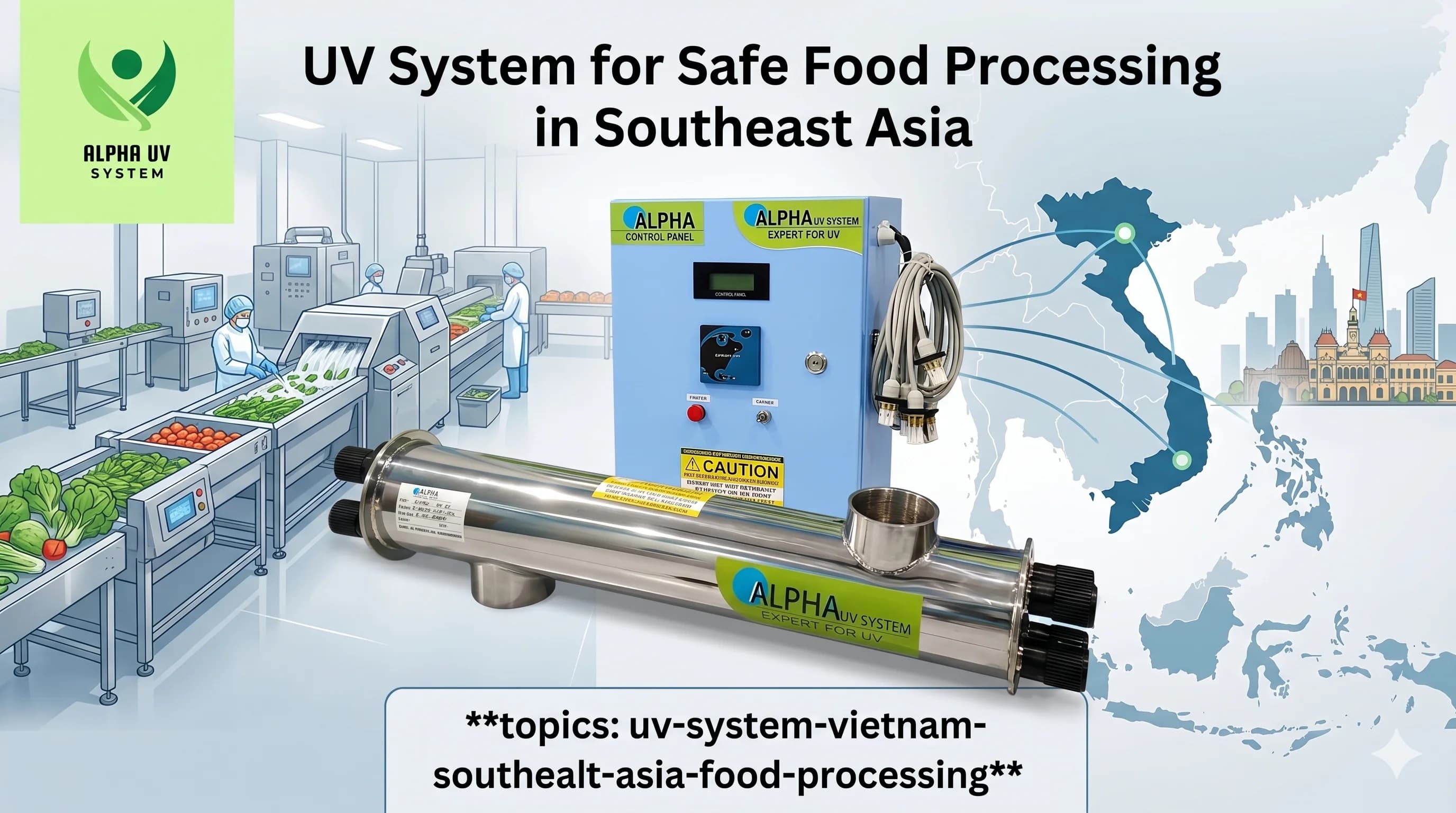
UV water treatment systems are required in Vietnam, Thailand, Malaysia, Cambodia, and Laos for three distinct compliance contexts: (1) food processing facilities exporting to the EU, USA, or Japan, where HACCP documentation of water quality is a Critical Control Point; (2) aquaculture operations disinfecting inlet seawater or freshwater before introducing shrimp post-larvae or fish fingerlings; and (3) international hotel brands requiring CE-certified UV systems as part of global engineering brand standards. Alpha UV System exports CE-certified UV water treatment systems from Greater Noida, India to all five Southeast Asian markets, with sea freight transit times of 14–28 days from JNPT to regional ports.
Southeast Asia UV Water Treatment Market — Demand Drivers
The UV water treatment system Vietnam Southeast Asia food processing market has expanded significantly since 2022, driven by three converging forces. First, EU and US regulatory scrutiny of seafood and food imports from Vietnam and Thailand tightened following several high-profile contamination alerts — forcing processors to document water treatment at every stage of production. Second, the shrimp and fish aquaculture sector across Vietnam, Thailand, and Malaysia suffered repeated losses from Vibrio, White Spot Syndrome Virus, and Enterocytozoon hepatopenaei, creating strong commercial pressure to adopt UV disinfection at the inlet water stage. Third, international hotel brands accelerating post-COVID expansion across Southeast Asia brought with them global engineering standards specifying UV water treatment at kitchen and beverage outlets.
For Indian UV system manufacturers, Southeast Asia represents the most commercially significant export market after the Middle East — offering volume demand across multiple sectors, familiarity with CE and ISO 9001 quality documentation, and competitive logistics via the JNPT-Singapore-HCMC shipping corridor. Alpha UV System has supplied UV water treatment systems across Vietnam, Thailand, Malaysia, and Cambodia in food processing, aquaculture, and hospitality applications.
Country Comparison: UV Water Treatment Applications by Market
| Country | Primary UV Application | Dominant Certification Requirement | Key Regulatory Body | Typical System Range |
|---|---|---|---|---|
| Vietnam | Seafood export processing, aquaculture inlet water | CE marking + HACCP documentation (EU import) | MOIT, VASEP, Ministry of Health | 5,000 – 2,00,000 LPH |
| Thailand | F&B export processing, shrimp aquaculture, hotels | CE + TISI + Thai FDA supplier audit | Thai FDA, TISI, Department of Fisheries | 3,000 – 1,50,000 LPH |
| Malaysia | Food manufacturing, hotel brand standards, halal processing | CE + SIRIM + JAKIM halal water documentation | SIRIM, Ministry of Health Malaysia | 2,000 – 80,000 LPH |
| Cambodia | NGO/institutional water projects, garment factory drinking water | CE + WHO water quality documentation | Ministry of Rural Development, MOH | 500 – 20,000 LPH |
| Laos | Institutional and resort applications, NGO projects | CE + WHO documentation | Ministry of Health Lao PDR | 500 – 10,000 LPH |
Vietnam: Seafood Export Compliance and UV Water Requirements
Vietnam is the world's third-largest seafood exporter, shipping over USD 9 billion of seafood annually to the EU, USA, Japan, South Korea, and China. All three of the largest export markets — the European Union, the US Food and Drug Administration, and Japan's Ministry of Agriculture, Forestry and Fisheries (MAFF) — require Vietnamese processing facilities to maintain documented HACCP systems in which water quality is a Critical Control Point.
The EU Drinking Water Directive requirement is the most stringent: water used in food processing in third countries exporting to the EU must meet EU Drinking Water Directive 98/83/EC standards. Specifically, water in contact with food products must show zero detectable E. coli and zero Enterococcus per 100 ml sample. UV water treatment achieves this standard by delivering a minimum 40 mJ/cm² UV dose — achieving greater than 4-log (99.99%) reduction of E. coli and comparable reductions of other bacterial and viral pathogens.
US FDA requirements under 21 CFR Part 123 (Seafood HACCP) require that water used in seafood processing meets Safe Drinking Water Act standards — again requiring documented treatment and zero detectable fecal coliform. Japan MAFF requires compliance with the Japan Food Sanitation Act water quality standards as a condition of import certification for seafood from Vietnam.
For Vietnamese food processors, the HACCP documentation package Alpha UV System supplies with every UV water treatment system export provides the water quality compliance evidence needed for EU, FDA, and Japanese MAFF third-party audit documentation. The package includes: UV dose calculation report (English format), Philips TUV lamp Certificate of Analysis, CE Declaration of Conformity, HACCP CCP template for water treatment, and UV intensity monitoring calibration certificate.
Ho Chi Minh City and the Mekong Delta provinces — Can Tho, Ca Mau, Bac Lieu, Soc Trang — account for the majority of Vietnam's seafood export processing volume. Hanoi-based processing facilities, though smaller in seafood volume, service the northern export corridor to China and Korea. Alpha UV System's export team can issue Ho Chi Minh City and Hanoi delivery quotations with sea freight lead times from JNPT.
Vietnam Food Processing: UV System Sizing by Processing Type
| Processing Type | Daily Processing Volume | Required UV Capacity | Typical UV Model Range | Export Compliance |
|---|---|---|---|---|
| Shrimp processing (cooked/IQF) | 5–20 tonnes/day | 10,000 – 40,000 LPH | UV-10K to UV-40K series | EU, FDA, Japan MAFF |
| Fish fillet processing | 10–50 tonnes/day | 20,000 – 80,000 LPH | UV-20K to UV-80K series | EU, FDA |
| Catfish (tra/basa) processing | 20–100 tonnes/day | 40,000 – 1,50,000 LPH | UV-40K to UV-150K series | EU, FDA |
| Ready-to-eat food processing | 2–10 tonnes/day | 5,000 – 20,000 LPH | UV-5K to UV-20K series | EU, FDA, Japan MAFF |
| Bottled water/beverage production | 50,000 – 5,00,000 bottles/day | 5,000 – 50,000 LPH | UV-5K to UV-50K series | Vietnam MOH, WHO |
Thailand: Food Processing and F&B Export Market
Thailand is ASEAN's largest food exporter — a USD 35 billion annual export sector covering canned seafood, processed chicken, frozen shrimp, packaged food, and beverages. Thai food processing UV water treatment system requirements arise from three regulatory sources: Thai FDA Good Manufacturing Practice (GMP) for food manufacturers; Thai Department of Fisheries standards for aquaculture produce; and international buyer audit requirements (BRC, IFS, SQF) that specify documented water treatment as part of food safety management system verification.
Bangkok and the Eastern Seaboard industrial zones — Chonburi, Rayong, Samut Sakhon — concentrate the majority of Thai food processing capacity. Thai food processors exporting under BRC Global Standard for Food Safety are required to document water quality at all points where water contacts food, and to demonstrate that water treatment delivers potable water quality at the point of use. UV water treatment with Philips UV-C lamp technology and UV intensity monitoring satisfies BRC Clause 4.6 water quality documentation requirements.
Thai FDA requires that imported food processing equipment from non-ASEAN countries meets recognised international standards — CE marking satisfies this requirement for UV water treatment systems. Alpha UV System's CE Declaration of Conformity and ISO 9001 certification have been accepted by Thai FDA auditors as supporting documentation for Thai food processing facilities importing our UV systems.
The Thai shrimp processing sector — Thailand is the world's largest shrimp processor — represents significant UV water treatment system demand both at the farm inlet water stage and at the processing plant stage. Samut Sakhon Province, the centre of Thailand's shrimp processing industry, has significant UV water treatment system Vietnam Southeast Asia food processing application overlap with Vietnam's shrimp sector, as both source shrimp from similar aquaculture production systems requiring inlet water UV disinfection.
Malaysia: SIRIM Certification, Halal Processing, and Hotel Brand Standards
Malaysia's UV water treatment market is structured around three distinct regulatory contexts: SIRIM (Standards Malaysia) certification for equipment sold into government or regulated procurement; halal food processing water requirements under JAKIM (Department of Islamic Development Malaysia); and international hotel brand engineering standards for properties in Kuala Lumpur, Penang, and Johor Bahru.
SIRIM certification is not universally mandatory for imported UV systems in Malaysia — CE marking is widely accepted as an equivalent international standard by Malaysian procurement agencies and private sector buyers. For government tender procurement in Malaysia, SIRIM certification or an accepted equivalent (CE + ISO 9001) is typically required. Alpha UV System's CE and ISO 9001 documentation has been accepted for Malaysian government institutional procurement in several projects.
Halal food processing in Malaysia requires that water used in production is not contaminated by sources that would compromise halal status. UV water treatment — which adds nothing to water and produces no chemical by-products — is the preferred disinfection method for halal-certified food processors, as it avoids the chlorine residual concerns that some JAKIM auditors raise for chlorination systems. Alpha UV System supplies HACCP documentation that explicitly notes the absence of chemical additives — a useful supporting document for Malaysian halal food processing certification applications.
Kuala Lumpur's concentration of international hotel brands — including properties operating under major US, European, and Asian hotel group standards — creates demand for CE-certified UV water treatment systems meeting brand-specific engineering documentation requirements. Port Klang (Kuala Lumpur's main container port) receives sea freight from JNPT in 14–18 days — the shortest transit time of any Southeast Asian port for Indian UV system exports.
Cambodia and Laos: NGO Water Projects and Institutional Applications
Cambodia and Laos represent smaller but growing UV water treatment markets, driven primarily by NGO and development sector water projects and institutional applications. Phnom Penh's expanding garment manufacturing sector — employing over 600,000 workers — has created institutional drinking water demand in factory complexes where piped water quality is unreliable. UV water treatment systems serving 500–5,000 workers at point-of-distribution are a common application in Cambodian industrial zones.
NGO water projects in Cambodia and Laos typically require WHO water quality documentation and CE certification as procurement conditions — both of which Alpha UV System standard export documentation satisfies. The Cambodia Ministry of Rural Development and the Lao Ministry of Health reference WHO Guidelines for Drinking-water Quality as the applicable standard for project water quality verification.
Sihanoukville's growing coastal resort sector creates hospitality UV demand similar to the broader Southeast Asia market. Transit time from JNPT to Sihanoukville port is 22–28 days — longer than other Southeast Asian routes — making advance planning for spare parts supply important for Cambodian project operators.
Aquaculture UV Disinfection: Technical Guide for Southeast Asia
Aquaculture inlet water UV disinfection is the fastest-growing UV water treatment application in Southeast Asia — and technically the most demanding. The challenge is treating large volumes of seawater or freshwater to eliminate pathogens before introduction to shrimp or fish culture systems, without using chemicals that harm the cultured species or create residuals incompatible with organic or export market standards.
UV disinfection is the only approved water treatment method for aquaculture inlet water in most Southeast Asian country fisheries guidelines — because it eliminates pathogens through photochemical DNA damage rather than chemical addition. A properly sized UV water treatment system Vietnam Southeast Asia food processing aquaculture installation delivers greater than 4-log (99.99%) inactivation of Vibrio species, and effective inactivation of White Spot Syndrome Virus (WSSV), Infectious Myonecrosis Virus (IMNV), and Enterocytozoon hepatopenaei (EHP) at appropriate UV doses.
Aquaculture UV Sizing: Flow Rate Calculation Method
UV system sizing for aquaculture inlet water treatment follows a straightforward formula based on pond or tank volume and daily water exchange rate:
Required UV Capacity (LPH) = Pond Volume (litres) × Daily Exchange Rate (%) ÷ Exchange Period (hours)
Worked example — 1-hectare shrimp grow-out pond, 30% daily exchange:
- Pond area: 10,000 m²
- Average water depth: 1.2 m
- Pond volume: 10,000 × 1.2 = 12,000 m³ = 1,20,00,000 litres
- Daily exchange: 30% = 36,00,000 litres/day
- Exchange period: 8 hours (tidal or pump-driven exchange window)
- Required UV flow rate: 36,00,000 ÷ 8 = 4,50,000 LPH
- With 1.25 safety factor: 5,62,500 LPH — typically served by 3 × UV-200K units in parallel
For recirculating aquaculture systems (RAS) with continuous water exchange, the UV capacity is sized to the recirculation pump flow rate rather than daily exchange volume. Alpha UV System UV systems can be configured in parallel manifold arrangements to achieve any required flow rate for large-scale aquaculture installations.
Aquaculture UV System Sizing Reference Table
| Pond/Tank Size | Culture Type | Daily Exchange Rate | Exchange Period | Required UV Capacity | Recommended Configuration |
|---|---|---|---|---|---|
| 0.5 hectare | Vannamei shrimp | 30% | 8 hours | ~2,25,000 LPH | 2 × UV-120K parallel |
| 1 hectare | Vannamei shrimp | 30% | 8 hours | ~4,50,000 LPH | 3 × UV-160K parallel |
| 2 hectare | Black tiger shrimp | 25% | 10 hours | ~6,00,000 LPH | 4 × UV-160K parallel |
| 500 m² RAS tank | Tilapia / Pangasius | 100% recirculation | Continuous | Per pump flow rate | UV sized to pump LPH |
| Hatchery, 50,000 L | Post-larvae / broodstock | 50% | 4 hours | ~6,250 LPH | 1 × UV-8K |
Aquaculture Pathogen UV Dose Requirements
| Pathogen | Species Affected | Minimum UV Dose (mJ/cm²) | Log Reduction Achieved | Notes |
|---|---|---|---|---|
| Vibrio harveyi / Vibrio parahaemolyticus | Shrimp (all species) | 30 mJ/cm² | >4-log | EMS/AHPND causative agent; UV is primary control |
| White Spot Syndrome Virus (WSSV) | Shrimp (all species) | 45 mJ/cm² | >3-log | Most economically damaging shrimp pathogen in Asia |
| Infectious Myonecrosis Virus (IMNV) | Vannamei shrimp | 40 mJ/cm² | >3-log | Prevalent in Southeast Asia vannamei culture |
| Enterocytozoon hepatopenaei (EHP) | Vannamei / monodon shrimp | 60 mJ/cm² | >2-log | Microsporidian; higher UV dose required |
| Aeromonas hydrophila | Freshwater fish (tilapia, catfish) | 25 mJ/cm² | >4-log | Common in Vietnamese pangasius (tra/basa) culture |
Alpha UV System aquaculture UV systems are designed and validated to deliver a minimum 60 mJ/cm² UV dose at rated flow rate — covering the full pathogen spectrum including EHP. All systems use Philips TUV lamps with factory-verified UV output and include UV intensity sensors for continuous dose monitoring.
International Hotel Brands in Southeast Asia: UV Water Treatment Standards
International hotel brands operating across Vietnam, Thailand, and Malaysia have standardised water treatment requirements embedded in their global engineering and food safety standards. Properties operating under major US, European, and Asian hotel group brands in Ho Chi Minh City, Bangkok, and Kuala Lumpur are required by brand engineering standards to install documented UV water treatment at kitchen potable water supply points and beverage preparation water outlets.
The documentation requirements for hotel brand UV procurement are specific: CE marking (required for EU-headquartered brands and increasingly adopted by US brands for ASEAN procurement); ISO 9001 quality management certification for the UV system manufacturer; HACCP CCP documentation for water treatment; and Philips TUV lamp Certificate of Analysis confirming UV output. Alpha UV System's standard hotel export package covers all four documentation requirements.
Hotel procurement in Southeast Asia typically routes through regional engineering procurement managers based in Singapore, Bangkok, or Kuala Lumpur — who require English-language technical documentation and the ability to obtain spare parts (replacement Philips TUV lamps and quartz sleeves) without extended lead times. Alpha UV System's air freight spare parts dispatch from Greater Noida reaches Bangkok and Kuala Lumpur in 2–4 days — supporting hotel brand standards for maintenance response times.
CE Certification and ASEAN Country Registration
CE marking is the primary international certification accepted across Southeast Asian procurement for UV water treatment systems. Its acceptance reflects the dominance of EU-based food safety standards (EU Drinking Water Directive, EU food hygiene regulations) in setting Vietnamese and Thai export compliance requirements, and the familiarity of ASEAN procurement professionals with European quality documentation.
Country-specific registration requirements vary across Southeast Asia. Vietnam's Ministry of Industry and Trade (MOIT) registration is required for certain categories of imported industrial equipment, but UV water treatment systems imported for use in food processing facilities typically qualify under food processing equipment exemptions when accompanied by CE and ISO 9001 documentation. Alpha UV System's export team can advise on current MOIT registration status for specific project types.
Thailand's TISI (Thai Industrial Standards Institute) certification is required for products on Thailand's mandatory product certification list. UV water treatment systems are not currently on the mandatory TISI list, meaning CE + ISO 9001 documentation is the applicable procurement standard for Thai food processing and aquaculture applications. Thai FDA supplier audit requirements for imported equipment are satisfied by CE Declaration of Conformity and ISO 9001 certificate.
Malaysia's SIRIM (Standards Malaysia) certification for imported equipment is required for a defined list of regulated products. UV water treatment systems fall outside SIRIM mandatory certification scope for most applications — CE marking plus ISO 9001 is the accepted standard for Malaysian private sector and institutional procurement. For Malaysian government tender procurement, SIRIM or accepted equivalent documentation (CE + ISO 9001) is the standard requirement.
Alpha UV System's certification portfolio for ASEAN export: ISO 9001:2015 (Design, Manufacture and Supply of UV Water Disinfection Systems); CE Declaration of Conformity per relevant EU Directives; RoHS compliance certificate (EU Directive 2011/65/EU); ISO 12100 machine safety conformity; and Philips TUV lamp Certificate of Analysis.
Shipping Guide: JNPT to Southeast Asian Ports
All Alpha UV System exports to Southeast Asia ship from JNPT (Jawaharlal Nehru Port Trust, Nhava Sheva, Mumbai) via the established India-Southeast Asia container shipping corridor. Transit times and typical cost ranges are as follows:
| Destination Port | City Served | Sea Freight Transit | Typical Frequency | Air Freight (spare parts) |
|---|---|---|---|---|
| Cat Lai Port / Tan Cang | Ho Chi Minh City | 18–22 days | Weekly direct / 2× transship | 2–3 days |
| Hai Phong Port | Hanoi | 20–25 days | Weekly via Singapore transship | 3–4 days |
| Laem Chabang Port | Bangkok | 20–25 days | Weekly direct / transship | 2–3 days |
| Port Klang | Kuala Lumpur | 14–18 days | Multiple weekly direct | 2–3 days |
| Sihanoukville Port | Phnom Penh | 22–28 days | Weekly via Singapore transship | 3–4 days |
Sea freight costs for UV system shipments (typically 1–3 CBM per unit, depending on system size) are competitive relative to European UV system suppliers shipping to Southeast Asia — where transit times from European ports exceed 25–35 days and freight costs are substantially higher. Air freight is used for urgent replacement Philips TUV lamps, quartz sleeves, and O-ring sets to keep installed UV systems operational.
Import Documentation for Southeast Asian Countries
| Country | Customs Agency | Required Import Documents | HS Code (UV Systems) | Duty Notes |
|---|---|---|---|---|
| Vietnam | General Department of Vietnam Customs (GDVC) | Commercial invoice, packing list, Bill of lading, COO, CE Declaration, ISO 9001 cert, HS code declaration | 8421.21 / 8421.29 | ASEAN-India FTA (AIFTA) preferential duty may apply |
| Thailand | Thai Customs Department | Commercial invoice, packing list, AWB/BL, COO, CE Declaration, ISO 9001 cert | 8421.21 / 8421.29 | ASEAN-India FTA reduces MFN duty |
| Malaysia | Royal Malaysian Customs (RMCD) | Commercial invoice, packing list, BL, COO, CE Declaration, ISO 9001 cert, SIRIM exemption letter (if required) | 8421.21 / 8421.29 | ASEAN-India FTA; Sales and Service Tax (SST) applies |
| Cambodia | General Department of Customs and Excise (GDCE) | Commercial invoice, packing list, BL/AWB, COO, CE Declaration, ISO 9001 cert | 8421.21 / 8421.29 | ASEAN-India FTA; VAT applies at customs |
| Laos | Lao Customs Department | Commercial invoice, packing list, BL/AWB, COO, CE Declaration, ISO 9001 cert | 8421.21 / 8421.29 | ASEAN-India FTA; customs valuation per WTO methodology |
Alpha UV System provides a complete export documentation package with every shipment: commercial invoice (CIF or FOB as required), packing list, Certificate of Origin (India COO for ASEAN-India FTA preferential duty), CE Declaration of Conformity, ISO 9001 certificate, and Philips TUV lamp Certificate of Analysis. Our export team coordinates with the freight forwarder to ensure GDVC, Thai Customs, RMCD, and GDCE documentation requirements are met at origin before shipment.
Technical Specifications for Tropical Climate Operation
Southeast Asian operating conditions impose specific technical requirements on UV water treatment systems that differ from temperate climate specifications. Alpha UV System UV systems for Southeast Asian export are configured with the following tropical climate specifications:
- IP65 enclosure rating — Protection against dust ingress and water jets; required for outdoor aquaculture pump house installations and food processing facility wet areas.
- Ambient temperature rating: 5°C – 50°C — Covering the full range from air-conditioned food processing facilities to open-air aquaculture pump stations in tropical climates.
- Universal voltage input: 100–240V AC, 50/60 Hz — Compatible with Vietnamese (220V/50Hz), Thai (220V/50Hz), and Malaysian (240V/50Hz) power supply standards without transformer.
- Corrosion-resistant wetted parts — 316L stainless steel UV chambers and fittings for seawater aquaculture applications; corrosion-rated Teflon seals for high-salinity environments.
- Philips TUV lamp technology — Factory-specified UV-C output maintained over 9,000-hour rated lamp life; no output degradation from tropical ambient temperature variation within rated range.
- UV intensity monitoring — Digital UV sensor output (4–20 mA) compatible with SCADA and PLC systems used in modern aquaculture and food processing facilities.
For outdoor aquaculture installations in coastal Vietnam, Thailand, and Malaysia, all control panels are specified with IP65 stainless steel enclosures and UV-resistant cable glands. Salt spray resistance is particularly important for shrimp farm installations within 500 metres of tidal water.
Frequently Asked Questions: UV Water Treatment — Vietnam and Southeast Asia
What UV dose is required for shrimp farm inlet water in Vietnam and Thailand?
The recommended minimum UV dose for shrimp aquaculture inlet water in Vietnam and Thailand is 60 mJ/cm² — sufficient to achieve greater than 4-log inactivation of Vibrio species and greater than 2-log inactivation of EHP (Enterocytozoon hepatopenaei), which is currently the most UV-resistant major pathogen in Southeast Asian shrimp culture. WSSV and IMNV are effectively inactivated at 45 mJ/cm². Alpha UV System aquaculture systems are validated at 60 mJ/cm² at rated flow rate to cover the full pathogen spectrum. Higher UV doses (up to 100 mJ/cm²) can be specified for high-biosecurity hatchery and broodstock applications.
How does UV water treatment help Vietnamese seafood exporters meet EU import requirements?
EU import requirements for seafood from Vietnam require that processing facilities maintain documented HACCP systems in which water quality is a Critical Control Point. Water in contact with food must meet EU Drinking Water Directive standards: zero detectable E. coli and zero Enterococcus per 100 ml. A UV water treatment system delivering 40 mJ/cm² achieves these microbial standards. Alpha UV System provides the full HACCP documentation package with every UV system — including UV dose calculation report, Philips TUV lamp COA, and HACCP CCP template in English format — which Vietnamese processors can submit directly to EU competent authority auditors. This documentation has been accepted by EU official control inspectors at Vietnamese seafood facilities.
Does CE certification satisfy ASEAN country procurement requirements for UV systems?
Yes, CE marking is the primary international certification accepted across Vietnam, Thailand, Malaysia, Cambodia, and Laos for UV water treatment system procurement in food processing, aquaculture, and institutional applications. CE marking satisfies: Vietnam MOIT requirements for food processing equipment imports; Thai FDA supplier audit documentation requirements; Malaysian SIRIM-equivalent documentation for private sector procurement; and Cambodia and Laos Ministry of Health documentation requirements for institutional water treatment projects. For Malaysian government tender procurement, CE plus ISO 9001 documentation is the accepted standard. Country-specific mandatory certification (TISI, SIRIM mandatory list) does not currently include UV water treatment systems in most Southeast Asian countries.
How long does shipping from India to Ho Chi Minh City and Bangkok take?
Sea freight from JNPT (Mumbai) to Ho Chi Minh City (Cat Lai / Tan Cang Port) takes 18–22 transit days. To Bangkok (Laem Chabang Port): 20–25 days. To Kuala Lumpur (Port Klang): 14–18 days — the shortest Southeast Asia route from JNPT. To Phnom Penh (via Sihanoukville Port): 22–28 days. These transit times are significantly shorter than shipping from European UV system manufacturers to Southeast Asia (typically 25–35 days from European ports), making Indian-sourced UV systems advantageous for project timelines. Air freight for urgent spare parts (Philips TUV replacement lamps, quartz sleeves) reaches Bangkok and Ho Chi Minh City in 2–3 days from Greater Noida dispatch.
How are spare parts supplied to Southeast Asian UV system operators?
Alpha UV System maintains a spare parts inventory of Philips TUV replacement lamps, quartz sleeves, and O-ring seal sets at our Greater Noida manufacturing facility. For Southeast Asian operators, spare parts are dispatched by air freight on receipt of order — reaching Bangkok, Ho Chi Minh City, Kuala Lumpur, and Phnom Penh in 2–4 days. We recommend Southeast Asian operators maintain a minimum local stock of one replacement Philips TUV lamp and one quartz sleeve per UV unit — sufficient to cover the annual maintenance lamp change and any unscheduled quartz sleeve replacement. Philips TUV lamps used in Alpha UV systems are also available from Philips Signify distributors in Thailand and Malaysia as an alternative local supply channel.
Are Alpha UV systems compatible with Southeast Asian power supply voltages?
Yes. Alpha UV System UV systems for Southeast Asian export are supplied with universal voltage input rated 100–240V AC, 50/60 Hz — compatible with Vietnam (220V/50Hz), Thailand (220V/50Hz), Malaysia (240V/50Hz), Cambodia (230V/50Hz), and Laos (230V/50Hz) power supply standards without requiring a step-down or step-up transformer. Control panels include overload protection and surge protection appropriate for the power supply quality typical of Southeast Asian industrial and agricultural installations. For aquaculture installations with generator power supply (common in coastal aquaculture operations in Vietnam and Thailand), the wide input voltage range accommodates the voltage variation typical of generator power output.
Conclusion: Southeast Asia UV Export Programme
The UV water treatment system Vietnam Southeast Asia food processing market represents one of the most technically demanding and commercially significant export segments for Indian UV system manufacturers. The combination of EU seafood export compliance pressure on Vietnamese and Thai food processors, aquaculture biosecurity requirements driving UV adoption across shrimp and fish farms, and international hotel brand standards requiring CE-certified UV documentation creates multi-sector demand that Indian CE-certified UV system manufacturers are positioned to serve competitively relative to European UV system suppliers.
Alpha UV System's Southeast Asia export programme covers all five major markets — Vietnam (Ho Chi Minh City and Hanoi), Thailand (Bangkok and Eastern Seaboard), Malaysia (Kuala Lumpur and Penang), Cambodia (Phnom Penh and Sihanoukville), and Laos — with sea freight logistics from JNPT, complete CE and HACCP documentation, and air freight spare parts support to keep installed UV systems operational.
For a project quotation covering UV water treatment system sizing, technical specifications for your application, and sea freight delivery to your Southeast Asian port, contact our export team via WhatsApp or visit our Southeast Asia export page for detailed country and application information.
Standards, authorities & further reading
External references used to inform this guide. Regulations evolve — check the latest revision on each authority's site before compliance decisions.
- Central Pollution Control Board (CPCB), Government of India
- Central Ground Water Board (CGWB)
- BIS IS 10500:2012 — Drinking Water Quality Specification
- WHO — Guidelines for Drinking-water Quality (4th ed.)
- FSSAI — Food Safety & Standards Authority of India
- NSF/ANSI 55 — Ultraviolet Microbiological Water Treatment Systems
Recommended UV Systems
Alpha UV System products for this application — powered by genuine Philips UV-C lamps.
Commercial UV Water Purification System
500 – 5,000 LPH
HACCP-compliant UV water purification for hotels, restaurants, and offices
Residential UV Disinfection System
100 – 500 LPH
Safe drinking water for homes and villas — no chemicals, no taste change
Industrial UV Water Treatment System
5,000 – 50,000 LPH
Schedule M 2025 and HACCP compliant UV for pharma, food & beverage, and process water
Not sure which system suits your application? WhatsApp our engineers for a free recommendation →
Related solutions
See how Alpha UV System applies this to your industry or city.
Need a UV system?
Talk to our UV engineers — WhatsApp for a quote in 2 hours, or browse the full catalog on IndiaMART.