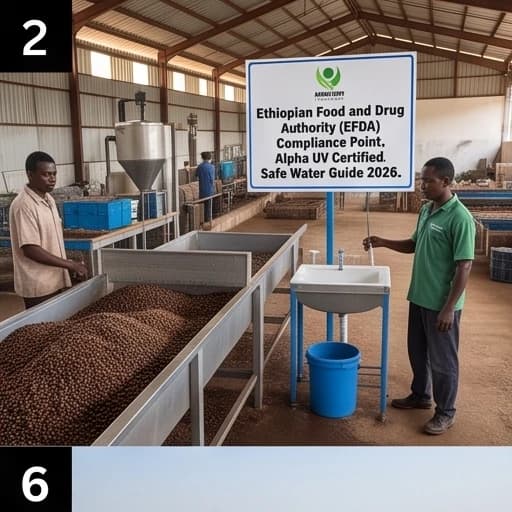
Quick Answer: UV water treatment Ethiopia coffee processing is uniquely important for the birthplace of coffee (Coffea arabica originated in Ethiopian highlands) — Ethiopia is the world's sixth-largest coffee producer (500,000+ tonnes/year) and Africa's largest; more critically, Ethiopian specialty coffee (Yirgacheffe, Sidama/Sidamo, Guji, Harrar, Limu, Bench) commands the world's highest specialty premiums, with single-origin microlot Yirgacheffe selling at USD 8–25/kg (versus USD 1.50–2.50/kg for commodity coffee). Water quality in Ethiopian washed coffee processing is a critical quality parameter — the ECX (Ethiopian Commodity Exchange) Grade 1 and Grade 2 washed coffee classification directly depends on the clean fermentation and washing water used at 100,000+ registered washing stations. Zero-chlorine is mandatory at coffee washing stations — chlorine at 0.1–0.5 mg/L inhibits Saccharomyces and Lactobacillus fermentation (altering mucilage removal kinetics and flavour precursor development), and creates chloroanisole off-flavours in coffee beans detectable at ppb levels in finished brew (the same mechanism that causes wine cork taint at concentrations below 0.01 mg/L). UV disinfection is Ethiopia's coffee washing standard solution: no chemical, no residual, safe for fermentation microbiome. NSF/ANSI 55 Class A at 40 mJ/cm². Alpha UV ships to Addis Ababa (ADD) or directly to Hawassa (for Sidama/Yirgacheffe logistics hub) within 48–72 hours.
Ethiopia Coffee Processing — Water Sources and UV Applications
Ethiopia's washed (wet-processed) coffee is concentrated in highland zones with distinct water sources:
- Yirgacheffe (Gedeo Zone, SNNPR — world's most famous specialty coffee origin): 5,000+ small washing stations (cooperative-owned under Yirgacheffe Coffee Farmers Cooperative Union — YCFCU, 25,000+ members); river and spring water sources (Amaro highlands, Wonago river catchments); UVT 78–88% (highland spring-fed sources — excellent water clarity); pH 6.5–7.2; zero Cl imperative (Yirgacheffe's distinctive floral/bergamot character — attributable to Geisha-type heirloom varieties and terroir — is exquisitely sensitive to chlorine degradation of aromatic aldehydes and terpene precursors)
- Sidama/Sidamo (Sidama Region — largest Ethiopian coffee origin by volume): Sidama Coffee Farmers Cooperative Union (SCFCU — 50,000+ member farmers, 82 cooperative member societies); Wondo Genet hot spring zone; Rift Valley highland springs (TDS 80–200 ppm, UVT 80–88%); major washing stations produce 200,000+ bags/year for ECX Grade 1 and specialty export
- Harrar (Harari Region / Oromia East — Ethiopia's dry-process natural coffee): Harrar natural (sun-dried) coffee does not use washing/fermentation water — harvested cherries dried in sun on raised African drying beds; water demand is for worker welfare and pre-drying cherry cleaning (brief surface wash); limited UV demand compared to wet-process origins
- Kaffa / Bench-Sheko (Southwest — wild forest coffee): Kaffa biosphere reserve (UNESCO — 760,000 ha; wild Coffea arabica genetic diversity reserve); wild-harvest and garden coffee; small washing stations using Kibish and Baro river tributaries; UVT 72–82%
Coffee Washing Station UV Specifications
| Processing Stage | Water Role | UV Specification | Alpha UV System |
|---|---|---|---|
| Cherry intake washing (initial rinse of freshly delivered coffee cherries before pulping) | Removes field soil, leaves, debris; initial E. coli reduction on cherry surface; float separation of underripe cherries | Zero Cl mandatory (any Cl on cherry skin penetrates pulp during pulping and contacts mucilage fermentation zone — affects fermentation microbiome); E. coli 0 CFU/100 mL; UVT 78–88% typical highland source | AU-S 15, zero Cl, 40 mJ/cm²; highland spring or river water; compact installation at washing station water intake; solar-compatible for remote washing stations |
| Fermentation tank water (mucilage removal — 12–48 hour fermentation) | Water immersion fermentation (wet process): pulped parchment coffee submerged in concrete fermentation tanks; Saccharomyces/Lactobacillus natural fermentation removes mucilage; water changed 1–3 times during fermentation cycle | Zero Cl absolutely mandatory — even trace Cl from piped supply (0.05 mg/L) inhibits fermentation; E. coli 0 CFU/100 mL (contaminated fermentation water creates off-flavours — "potato defect" Burkholderia gladioli-related, "fermented/sour" defect from E. coli lactate pathway); UV provides clean water for fermentation tank without inhibiting fermentation microbiome | AU-S 15 or AU-M 25 (depending on fermentation tank capacity and filling rate); zero Cl, 40 mJ/cm²; critical application — UV directly impacts cup quality and ECX grade classification |
| Post-fermentation washing (final parchment rinse in washing channels) | Multi-stage washing channel (3–5 channels in series); parchment coffee floated through clean water channels to remove fermentation residue; final wash channel water quality determines parchment cleanliness | Zero Cl (final wash water residual Cl detected in green bean export lot — EU green bean import inspection); E. coli 0 CFU/100 mL; UVT 78–88% | AU-M 25, zero Cl, 40 mJ/cm²; channel water makeup supply; SCFCU / YCFCU washing station documentation |
| Dry mill process water (Addis Ababa dry mills — hulling, sorting, grading) | Worker welfare; equipment CIP wash; dust suppression (minimised); humidity control for green bean conditioning rooms (<11% moisture conditioning) | Potable standard E. coli 0 CFU/100 mL for worker welfare; dry mill does not use large water volumes in product contact | AU-S 8 for dry mill worker welfare supply; NSF/ANSI 55 Class A |
ECX and Specialty Export Compliance
- ECX (Ethiopian Commodity Exchange) grading: ECX grades washed Arabica as Grade 1 (85+ cupping score) to Grade 5 (below 80); water quality at washing station directly determines grade outcome; ECX Quality Inspection and Grading (QIG) system checks bean physical quality (colour, uniformity, defect count) and cup quality at Addis Ababa central grading lab; "fermented" or "sour" cup defects from contaminated fermentation water are Grade 4–5 disqualifying defects
- Specialty coffee direct trade (SCA — Specialty Coffee Association scoring): Direct-trade buyers (Intelligentsia Coffee, Blue Bottle Coffee, Stumptown — USA; The Barn, Five Elephant — Germany; Workshop Coffee — UK) require SCA cupping score 86+ for specialty sourcing; these buyers send QC representatives to Ethiopian washing stations — water quality documentation at washing station is part of the traceability and quality assurance programme they require
- EU food safety compliance for green coffee import: EU Regulation (EC) 852/2004 food hygiene — green coffee beans (unroasted) are a food commodity; E. coli or Salmonella detected in green bean shipment triggers EU RASFF alert; Ethiopia's coffee sector has had historical RASFF alerts for ochratoxin A (OTA — mould toxin from improper drying) but water quality improvement at washing stage also reduces mould-related mycotoxin risk
FAQ
Why is zero chlorine so important at Ethiopian coffee washing stations?
The chloroanisole mechanism in coffee is directly analogous to wine cork taint: chlorophenols (formed when chlorine reacts with phenolic compounds in coffee cherry skin, pulp, and mucilage at pH 6–7) are methylated by naturally occurring moulds (Penicillium, Aspergillus) present in coffee processing environments to form 2,4,6-trichloroanisole (TCA) and 2,6-dichloroanisole (2,6-DCA). These chloroanisoles have sensory detection thresholds in brewed coffee of 1–5 ppt (parts per trillion) — far below the concentration of their chlorophenol precursors. Even 0.05 mg/L free chlorine in washing water is sufficient to form detectable chlorophenol precursors at the 1,000–5,000 ppm phenolic concentration present in coffee cherry skin. Yirgacheffe's terroir-driven floral and citrus cup character is particularly vulnerable: chloroanisoles directly suppress the terpene and aldehyde volatiles (linalool, geraniol, bergamot-related compounds) that define Yirgacheffe's distinct sensory identity. Specialty coffee buyers conduct gas chromatography analysis of sample lots — chloroanisole detection at ppb levels is grounds for rejection of an entire 60-kg lot. UV disinfection prevents this quality catastrophe while providing biological safety.
What UV system is appropriate for a YCFCU cooperative washing station in Yirgacheffe?
A typical YCFCU (Yirgacheffe Coffee Farmers Cooperative Union) member washing station in Gedeo Zone: capacity 100–500 tonnes cherry input per harvest season (October–January); water flow 1–5 m³/hour (cherry washing intake + fermentation tank fills + channel washing); power supply: EEPCO (Ethiopian Electric Power) grid supply with frequent outages (4–8 hours/day in rural Yirgacheffe); water source: highland spring or micro-dam (UVT 78–88%, low TDS). UV specification: AU-S 15 (40W, 6 m³/hour rated, 25 mJ/cm² minimum dose at 78% UVT — operating at 5 m³/hour gives 40 mJ/cm²); zero Cl; compact wall-mount for washing station utility structure; UPS backup (12V battery + inverter, 2-hour backup) for grid outage periods. Cost profile: AU-S 15 installed USD 900–1,400 per washing station; lamp replacement USD 60–80/year; water quality test USD 50–80/year (YCFCU laboratory or Hawassa University food science lab). YCFCU provides shared technical support for member station UV maintenance — cooperative model reduces per-station maintenance cost.
Does natural (dry-process) Harrar coffee require UV water treatment?
Natural (sun-dried) Harrar coffee processing differs fundamentally from washed processing — coffee cherries are spread whole on raised African drying beds and sun-dried for 15–20 days (no water used in the primary processing stage; mucilage remains on bean through the drying process, contributing to Harrar's characteristic fruity/wine cup character). Water demand at Harrar natural processing sites is minimal: (1) Worker welfare drinking water (Ethiopia OSHA compliance — E. coli 0 CFU/100 mL; AU-S 8 compact unit); (2) Brief cherry surface rinse at intake (optional — some Harrar processors skip cherry washing entirely to preserve natural micro-organisms on cherry skin that drive the natural fermentation during drying). UV is appropriate for the cherry intake rinse where used — zero Cl to preserve natural fermentation. For Harrar dry mills (Harar Town, Dire Dawa) processing natural parchment: worker welfare UV supply only. AU-S 8 (25W, 3 m³/hour) is adequate for Harrar dry-site potable supply; contrast with Yirgacheffe wet stations that may use AU-S 15 or AU-M 25 for larger fermentation tank water volumes.
Standards, authorities & further reading
External references used to inform this guide. Regulations evolve — check the latest revision on each authority's site before compliance decisions.
Recommended UV Systems
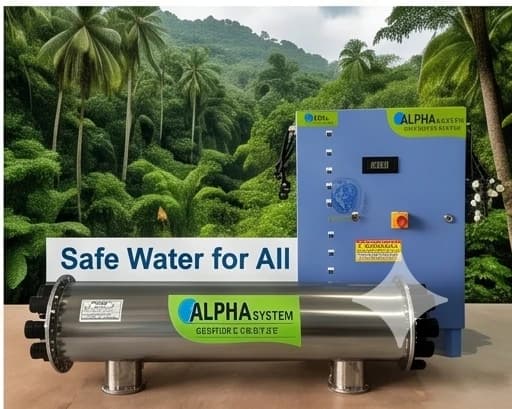
Alpha UV System products for this application — powered by genuine Philips UV-C lamps.
Commercial UV Water Purification System
500 – 5,000 LPH
HACCP-compliant UV water purification for hotels, restaurants, and offices
Industrial UV Water Treatment System
5,000 – 50,000 LPH
Schedule M 2025 and HACCP compliant UV for pharma, food & beverage, and process water
Not sure which system suits your application? WhatsApp our engineers for a free recommendation →
Related solutions
See how Alpha UV System applies this to your industry or city.
Need a UV system?
Talk to our UV engineers — WhatsApp for a quote in 2 hours, or browse the full catalog on IndiaMART.