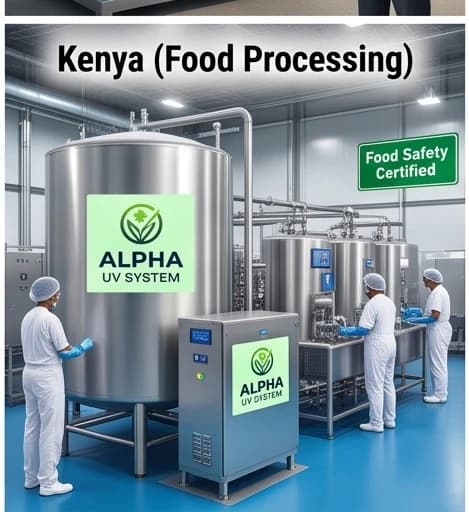
Quick Answer: Kenya's food processing sector — USD 2.5 billion/year manufacturing GDP, including East Africa's largest dairy industry (Brookside/Lactalis, New KCC, Daima/Sameer Agriculture), the world's second-largest black tea export (Kenya Tea Development Agency/KTDA — 500,000 smallholders, CTC tea factories), EABL brewery (Diageo: Tusker, Senator, Guinness Kenya), Coca-Cola Kenya bottling (NABC), horticulture export processing (French beans, avocados, passion fruit), and growing processed food FMCG (Bidco, Procter & Gamble, Unilever Kenya) — requires NSF/ANSI 55 Class A UV at 40 mJ/cm² for process water under Kenya Bureau of Standards (KEBS) KS EAS 12:2018, KS 05-11 (dairy quality), and international buyer standards (GLOBALG.A.P., BRC, SQF, FSSC 22000). KEBS Standardisation Mark (S-Mark) licensing for food manufacturers includes process water quality as an inspection criterion. Alpha UV ships to JKIA in under 48 hours from India or Mombasa Port in 18–22 days.
Kenya Food Processing Water Treatment Context
Kenya's food processing industry — concentrated in Nairobi Industrial Area, Thika Road corridor (Kiambu County), Mombasa, and tea factory clusters in Kericho/Nandi/Murang'a/Kirinyaga highlands — is East Africa's most developed food manufacturing sector, with exports reaching 40+ countries. International parent companies (Diageo/EABL, Coca-Cola, Lactalis/Brookside, Bidco/Wilmar, Procter & Gamble, Unilever) apply their global food safety frameworks — universally requiring HACCP with documented CCP for process water.
KEBS — Kenya's national standards body — licenses food manufacturers under the Standardisation Mark (S-Mark) scheme, requiring compliance with KS EAS standards. KS EAS 12:2018 (drinking water) and product-specific standards (KS 05-11 for dairy, KS 1 for tea, KS 372 for bottled water) all reference WHO microbiological parameters requiring E. coli = 0/100 mL in process water. KEBS Standards Enforcement Officers visiting food manufacturing facilities verify process water quality — NSF/ANSI 55 Class A UV documentation satisfies KEBS inspection requirements.
Export market access drives UV adoption: UK (BRCGS/BRC Global Standard for Food Safety), EU (FSSC 22000, IFS Food), and US (FDA FSMA Preventive Controls Rule, Safe Quality Food SQF) all require documented water treatment CCPs.
Dairy Sector — Brookside and Kenya Dairy Industry
Kenya's dairy sector is Africa's most productive per capita — with 4 million smallholder dairy farmers, 4 billion litres/year milk production, and a sophisticated chilled distribution network. Major processors:
| Dairy Processor | Location | Standard | Alpha UV System |
|---|---|---|---|
| Brookside Dairy (Lactalis Group — Kenya market leader) | Ruiru, Kiambu County (Nairobi peri-urban) | Lactalis global HACCP, KEBS KS 05-11, zero Cl | AU-M 30, zero residual Cl, MODBUS RS485, duty/standby |
| New Kenya Cooperative Creameries (New KCC) | Industrial Area, Nairobi; Eldoret; Mombasa | KEBS KS 05-11, ISO 22000, FSSC 22000 | AU-M 25, NSF/ANSI 55 Class A, MODBUS |
| Daima Foods (Sameer Agriculture, Kenafric) | Nairobi Industrial Area | KEBS, HACCP, zero Cl for fermented products | AU-M 25, zero residual Cl |
| Fresha (Buzeki Dairy) | Eldoret, Uasin Gishu County | KEBS KS 05-11, ISO 22000 | AU-M 25, NSF/ANSI 55 Class A |
Brookside Dairy — Kenya's largest dairy processor (handling 1.2 million litres/day at its Ruiru facility), acquired by Lactalis Group (France, the world's largest dairy company) in 2019 — applies Lactalis's global Quality, Safety, and Environment (QSE) framework. Lactalis QSE requires zero residual chlorine in all product-contact process water for yogurt, fermented dairy (Mala — Kenya's traditional fermented milk product), UHT milk, and flavoured milk. Chlorophenol off-flavour (from chlorine reacting with milk casein) is detected at <0.01 mg/L — UV disinfection is the only commercially viable zero-residual treatment. Alpha UV AU-M 30 with duty/standby configuration at Brookside Ruiru ensures production continuity during 2-hour lamp replacement windows without impacting 24-hour production schedules.
Tea Processing — KTDA Factories and Export Standards
Kenya's tea industry — the world's second-largest black tea exporter (approximately 25% of global CTC black tea exports, after India) — processes tea through 69 KTDA (Kenya Tea Development Agency) factories in highland districts (Kericho, Nandi, Kisii, Murang'a, Kirinyaga, Meru, Embu) plus 15+ private estate factories (Unilever Tea Kenya/Lipton, Williamson Tea, James Finlay/Finlays, George Williamson Kenya):
| Tea Factory Type | Location | Water Source / UVT | Standard | Alpha UV System |
|---|---|---|---|---|
| KTDA CTC factory (typical, 100+ across Kenya highlands) | Kericho, Nandi, Murang'a highlands | Highland spring/stream 82–92% | KEBS KS 1 tea, ISO 22000, HACCP, UK buyer BRC | AU-S 15, NSF/ANSI 55 Class A, MODBUS RS485 |
| Unilever Tea Kenya (Lipton, PG Tips — Kericho estate) | Kericho, Rift Valley | Highland spring 84–92% | Unilever HACCP, BRC AA, HACCP, zero Cl | AU-M 25, zero residual Cl, MODBUS TCP |
| James Finlay (Finlays) — Kericho/Nandi | Kericho, Nandi highlands | Highland spring 84–92% | Finlays HACCP, BRC, Rainforest Alliance, zero Cl | AU-M 25, zero residual Cl, MODBUS RS485 |
| Williamson Tea — Kaisugu, Ndanai estates | Kericho | Highland spring 82–90% | KEBS, BRC, HACCP, ISO 22000 | AU-S 15, NSF/ANSI 55 Class A |
Kenya's highland tea factory water sources — typically highland streams and springs fed by Mau Escarpment and Aberdare Range recharge — show excellent water quality: UVT 82–92%, turbidity <1 NTU, iron <0.05 mg/L. These high-UVT sources allow efficient UV dose delivery without pre-treatment for most tea factory applications.
Unilever Tea Kenya (Kericho estate — producing Lipton Yellow Label and PG Tips tea bags for global markets) applies Unilever's global food safety management system requiring BRC AA grade certification. BRC Global Standard for Food Safety requires HACCP plan with water CCP documented at the manufacturing and blending stage — NSF/ANSI 55 Class A UV with MODBUS logs provides the BRC-required CCP monitoring record.
Zero residual chlorine is particularly important for tea processing: chlorine at >0.01 mg/L in tea manufacturing process water reacts with catechins (tea polyphenols) to form chlorophenols and related compounds that produce off-flavour in brewed tea — detectable by Unilever's sensory QC panels at concentrations well below the regulatory limit. UV disinfection eliminates this risk completely.
Horticulture Processing — French Beans and Avocados
Kenya's horticulture export sector (French beans, avocados, passion fruit, baby corn, snow peas, herbs — USD 400 million/year to EU and UK) requires GLOBALG.A.P. certification at farm level and BRC Global Standard for Storage and Distribution at packing house/cold store level. Both require documented process water quality:
| Product / Facility | Location | Standard | Alpha UV System |
|---|---|---|---|
| French bean packing house (Kiambu, Nakuru) | Kiambu County, Central Rift | GLOBALG.A.P. FV, BRC Storage, HACCP | AU-M 25, NSF/ANSI 55 Class A, MODBUS RS485 |
| Avocado processing (Murang'a, Kiambu) | Central Kenya highlands | GLOBALG.A.P., BRC, EU Regulation EC 852/2004 | AU-M 25, NSF/ANSI 55 Class A |
| Export ready-to-eat herbs (Nairobi EPZ) | Athi River EPZ | GLOBALG.A.P., BRC AA, HACCP, E. coli = 0 / 100 mL | AU-M 25, zero residual Cl, MODBUS TCP, duty/standby |
Ready-to-eat herb processing (baby spinach, parsley, coriander, basil) — exported to UK Tesco, Sainsbury's, Waitrose, Marks & Spencer, and European retailers — is the highest-risk horticulture category for waterborne pathogen contamination. UK FSA (Food Standards Agency) and EU DG SANTE require E. coli = 0/100 mL at product contact water points, with HACCP CCP validation. NSF/ANSI 55 Class A UV at 40 mJ/cm² provides >4-log E. coli reduction — satisfying the UK FSA and EU DG SANTE requirement at the wash water treatment stage. Ready-to-eat herb packers in Athi River EPZ apply duty/standby UV configuration to ensure uninterrupted treatment during lamp replacement windows.
Frequently Asked Questions
What KEBS S-Mark licensing requirements apply to food manufacturers using UV water treatment?
KEBS Standardisation Mark (S-Mark) licensing — required for all food products sold in Kenya under Sections 9 and 10 of the Standards Act (Cap 496) — involves factory inspection by KEBS Standards Officers assessing production process quality against the applicable KS standard. For food manufacturers, process water quality is assessed under the applicable product standard: KS 05-11 (dairy products — E. coli = 0/100 mL in process water), KS 372 (bottled water — comprehensive microbiological suite), KS 1 (tea — microbiological), and KS EAS 12:2018 (general drinking water quality). KEBS inspectors accept NSF/ANSI 55 Class A UV validation reports as evidence of adequate water treatment. Additionally, KEBS compliance documentation requires: (1) UV system validation report confirming 40 mJ/cm² dose delivery; (2) recent (within 3 months) third-party microbiological test results from a KEBS-accredited laboratory; (3) maintenance records confirming lamp change at rated hours. Alpha UV provides KEBS S-Mark formatted documentation at commissioning for each installation.
How does BRC Global Standard for Food Safety apply to Kenyan tea exporters?
BRC Global Standard for Food Safety (Issue 9) — the UK's leading food safety certification standard, required by UK retailers (Tesco, Sainsbury's, Waitrose, Marks & Spencer, ASDA, Lidl UK) for all food supply chain members — applies to Kenyan tea factories and packing facilities supplying UK-labelled tea brands. BRC Issue 9 Clause 4.6.2 (Water supply) requires: process water meets WHO Drinking Water Guidelines; documented water treatment with validation records; annual risk assessment of water quality; and HACCP plan with water treatment as a CCP. BRC auditors (certification bodies: SGS, Bureau Veritas, Intertek, BRCGS-approved Kenya offices) assess the UV system validation certificate, MODBUS dose logs, and microbial test results during annual BRC audit. BRC AA grade (the highest BRC rating — required by Marks & Spencer and Waitrose for direct supply) requires continuous MODBUS logging rather than periodic grab sampling as the CCP monitoring method. Alpha UV AU-M systems with MODBUS TCP logging satisfy BRC AA monitoring requirements for Kericho tea estate packing facilities.
What is KTDA's water treatment specification for CTC tea factories?
Kenya Tea Development Agency (KTDA) — the parastatal managing 69 smallholder tea factories across Kenya highlands (processing over 400,000 tonnes of green leaf annually) — maintains a factory technical standard for process water quality referenced in KTDA's Factory Manual. KTDA specification requires: E. coli = 0/100 mL in all water used for CTC tea processing (withering, rolling, fermentation, drying) and factory cleaning (trough washing, machinery CIP); documented water treatment with validation records; and quarterly microbiological testing. KTDA factories draw water from highland springs and streams (UVT 82–92%), making them ideal for efficient UV dose delivery. Alpha UV AU-S 15 units are sized for typical KTDA factory water demand (15–30 m³/day process water). NSF/ANSI 55 Class A documentation satisfies KTDA Factory Manual requirements and simultaneously qualifies for BRC certification that KTDA factories seek for UK and EU buyer direct supply programs.
Why do Kenya tea factories specify zero-chlorine UV rather than chlorination?
Kenya's tea industry — producing CTC black tea for global export under Unilever (Lipton), Finlays (Finlays Tea), Williamson, and KTDA brand supply agreements — requires zero residual chlorine in all manufacturing process water for a scientifically compelling reason: chlorine reacts with tea catechins (the polyphenolic antioxidant compounds that define tea's flavour profile and health attributes) to form chlorophenols and AOX compounds detectable in brewed tea at concentrations as low as 10 ppb. Unilever Tea's sensory QC protocol (measuring chlorophenol off-flavour in brewed tea at its Lipton laboratories in Enfield, UK) can detect chlorophenol contamination from process water at levels well below regulatory limits — triggering batch rejection. UV disinfection eliminates the chlorophenol formation pathway completely while delivering WHO-level microbiological safety — the only treatment approach that simultaneously satisfies Unilever's zero-chlorine specification and KEBS/WHO microbiological requirements.
What is the logistics route for UV systems to Kenya tea factories in Kericho highlands?
Kericho is approximately 260 km from Nairobi via Nakuru (A104 highway — tarmac throughout, 3.5–4 hours). Air freight to JKIA Nairobi (under 48 hours from India) then road to Kericho is the standard route. Alternatively, sea freight to Mombasa Port (18–22 days from India) then road Mombasa–Kericho (560 km via Nairobi, 8 hours). KTDA factories (typically remote highland sites, 20–50 km from Kericho town) require road freight from Kericho town centre — all-weather murram access roads. Alpha UV packs AU-S 15 units at <50 kg total (reactor + controller + lamp) for easy manual handling at remote factory sites without crane access. Spare lamps by DHL Express from India via JKIA: 3–4 working days to Nairobi; same-day or next-day road courier to Kericho. For the 15 private tea estates (Finlays, Williamson, Unilever) with established Nairobi logistics networks, standard road freight from Nairobi is routine.
Logistics and Supply Chain
Alpha UV supplies Kenya food processors via air freight to JKIA (under 48 hours from India) for urgent and pharmaceutical-grade installations, or sea freight to Mombasa Port (18–22 days from India) with road freight for planned project deliveries. Nairobi Industrial Area and Ruiru: direct JKIA road delivery (30–45 minutes). Kericho highlands: 260 km road from Nairobi (3.5–4 hours). Mombasa port to Kericho: 560 km (8 hours).
Spare parts (UV lamps, quartz sleeves) dispatch from India by DHL Express — JKIA hub in 3–4 working days, then same-day/next-day courier to all major Kenya food processing hubs.
Documentation with every Kenya food processing installation: NSF/ANSI 55 Class A validation report, KS EAS 12:2018 / WHO 4th edition compliance declaration (English), KEBS S-Mark food manufacturing process water documentation, BRC Issue 9 Clause 4.6.2 water treatment evidence, GLOBALG.A.P. IFA water CCP records, Diageo GBS / Coca-Cola KORE / Lactalis HACCP formatted records (as applicable), MODBUS RS485/TCP register map, IP65 certification, and O&M manual in English and Swahili.
Alpha UV Systems — UV water treatment for Kenya food processing industry. NSF/ANSI 55 Class A | KEBS S-Mark / KS EAS 12:2018 compliant | BRC AA continuous MODBUS logging | Diageo GBS brewery zero-chlorine | Lactalis/Brookside dairy HACCP | KTDA tea factory process water | Unilever Tea zero-chlorine. Delivery via JKIA 48 hours or Mombasa Port. Contact us for Kericho tea factory or Nairobi dairy processing sizing.
Standards, authorities & further reading
External references used to inform this guide. Regulations evolve — check the latest revision on each authority's site before compliance decisions.
- Central Pollution Control Board (CPCB), Government of India
- Central Ground Water Board (CGWB)
- BIS IS 10500:2012 — Drinking Water Quality Specification
- WHO — Guidelines for Drinking-water Quality (4th ed.)
- FSSAI — Food Safety & Standards Authority of India
- NSF/ANSI 55 — Ultraviolet Microbiological Water Treatment Systems
Recommended UV Systems
Alpha UV System products for this application — powered by genuine Philips UV-C lamps.
Commercial UV Water Purification System
500 – 5,000 LPH
HACCP-compliant UV water purification for hotels, restaurants, and offices
Industrial UV Water Treatment System
5,000 – 50,000 LPH
Schedule M 2025 and HACCP compliant UV for pharma, food & beverage, and process water
Not sure which system suits your application? WhatsApp our engineers for a free recommendation →
Related solutions
See how Alpha UV System applies this to your industry or city.
Need a UV system?
Talk to our UV engineers — WhatsApp for a quote in 2 hours, or browse the full catalog on IndiaMART.