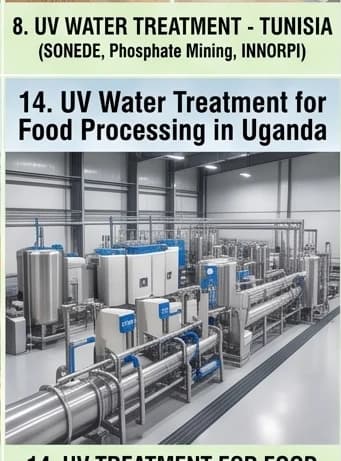
Quick Answer: UV water treatment Uganda food processing market is driven by Uganda's growing agro-processing sector — Uganda is East Africa's largest food exporter by volume (maize, beans, fish, dairy, vegetable oil) to EAC member states (Kenya, Tanzania, Rwanda, Burundi, South Sudan, DRC). UNBS (Uganda National Bureau of Standards) enforces EAS 12:2018 (East African Standard for drinking water) and product-specific food safety standards aligned to CODEX Alimentarius. Key sectors requiring UV water treatment: Lake Victoria fish processing (Nile perch — EU DG SANTE export compliance); dairy processing (UNBS EAS 38 milk standard — zero coliform in pasteurisation water); maize milling and grain processing (UNBS, export to EAC food markets); and brewery/beverage manufacturing (Uganda Breweries/Diageo, Nile Breweries/ABInBev — global quality standards). UV at 40 mJ/cm² (NSF/ANSI 55 Class A) is the standard food-grade water disinfection method. Alpha UV ships to Entebbe International Airport or via Mombasa Port within 48 hours (air) or 22–26 days (sea+road).
Uganda Food Processing Sector and Water Treatment
Uganda's food processing sector — processing approximately 15% of agricultural output (vs. 30%+ in Kenya) and targeting substantial growth under the National Development Plan III (NDP III, 2020–2025) — operates from four main processing hubs: Kampala Industrial Area (largest concentration — brewery, oils, beverages, packaged foods); Jinja Industrial Area (textile, food, steel — benefiting from Owen Falls/Nalubaale hydropower on the Nile); Lira and Gulu (northern Uganda grain and legume processing for South Sudan trade); and Masaka and Mbarara (dairy processing for southwestern Uganda milk basin).
UV water treatment Uganda food processing demand is shaped by market access requirements: EAC member states apply EAS 12:2018 (equivalent to WHO Guidelines) at food product level; EU applies EU Regulation 852/2004 for fish products exported from Uganda; global brewery standards (Diageo, ABInBev) require zero chlorine in process water. Water quality across Uganda's processing zones varies significantly — Kampala Industrial Area groundwater (iron 0.5–2 mg/L, UVT 72–82%) differs substantially from Jinja factory water (Lake Victoria source, NWSC supply, UVT 68–78%) and northern Uganda's shallow seasonal groundwater (variable coliform, UVT 60–75%).
Lake Victoria Nile Perch — EU DG SANTE Compliance
Uganda's fish processing sector is the country's highest-value agro-processing export — Nile perch (Lates niloticus) from Lake Victoria is processed at 15+ EU-approved processing facilities on the lake shores at Entebbe, Masese (Jinja), Butiaba (Hoima), and Kasese (Katunguru). EU market access for Ugandan fish is governed by EU Commission implementing regulations and monitored by EU DG SANTE:
| Processing Stage | Water Contact | EU Standard | Alpha UV Specification |
|---|---|---|---|
| Landing and initial wash | Lake water or pumped lake + borehole blend; first contact with Nile perch on landing | EU Reg 853/2004 Annex III Sect VIII: potable water for first wash of fishery products; E. coli 0/100 mL | AU-M 25/30, lake intake or borehole supply, 40 mJ/cm², NSF/ANSI 55 |
| Filleting and processing water | Direct contact with Nile perch fillet; cross-contamination between fish risk | EU 853/2004: potable water for all processing stages; HACCP CCP for water disinfection | AU-M 25/30, zero Cl, 40 mJ/cm², MODBUS logging for EU DG SANTE HACCP audit |
| Ice-making (flake ice for Nile perch chilling) | Flake ice in direct contact with fish; ice machine feed water = food contact | EU 853/2004: potable water for ice making; EU DG SANTE inspection criterion | AU-M 25 at ice maker feed, NSF/ANSI 55 Class A |
| Final rinse (pre-packing) | Last water contact before vacuum packing and freezing | HACCP CCP: critical control point for product microbiological quality | AU-M 25/30, zero Cl, validated 40 mJ/cm², full CCP documentation |
Uganda's Nile perch processing sector was subject to an EU import ban from 1997 to 2000 following EU inspection missions finding HACCP non-compliance, including inadequate water treatment. Uganda regained EU access after implementing MAAIF (Ministry of Agriculture, Animal Industry and Fisheries) Quality Assurance System for fish exports, which mandates UV or equivalent validated water treatment at all EU-approved processing facilities. MAAIF's Fish Quality Assurance inspectors verify UV system NSF certificate and operating records during quarterly facility inspections.
Dairy Processing — UNBS EAS 38 Compliance
| Dairy Processor | Location | Market | Alpha UV Specification |
|---|---|---|---|
| Pearl Dairy (Uganda's largest dairy — Lato milk brand) | Mbarara (southwestern dairy zone) | Uganda domestic + EAC export (Kenya, DRC) | AU-M 25/30, zero Cl, 40 mJ/cm², UNBS EAS 38 compliance |
| Brookside Uganda (Lactalis subsidiary) | Kampala distribution, Mukono processing | Uganda domestic; EAC regional | AU-M 25, Lactalis global HACCP standard, zero Cl |
| Farm Fresh Uganda (UHT, flavoured milk) | Jinja processing | Uganda domestic, South Sudan export | AU-M 25, UNBS EAS 38, zero Cl for UHT process water |
| Midland Dairy | Lira (northern Uganda) | Northern Uganda domestic + South Sudan | AU-S 15/AU-M 25, borehole source, 40 mJ/cm² |
UNBS EAS 38 (East African Standard for milk and milk products) requires pasteurised and UHT milk manufacturers to use water meeting EAS 12:2018 in all product-contact applications. For dairy processors in Mbarara and Jinja sourcing from municipal boreholes or NWSC supply, UV at 40 mJ/cm² post-softener is standard — zero chlorine is required because residual chlorine at >0.5 mg/L reacts with dairy proteins to form chlorinated compounds that cause off-flavours detectable in pasteurised milk.
Maize Milling and Grain Processing
Uganda is East Africa's largest maize surplus producer — exporting 600,000+ MT annually to Kenya, South Sudan, Rwanda, and Burundi. Maize milling (posho mills) and grain processing facilities in Kampala (Mukwano Group), Lira, Gulu, and Arua use water for cleaning, tempering, and conditioning grain. UNBS-certified grain processors applying KEBS (Kenya Bureau of Standards) and EAC market standards must use potable water meeting EAS 12:2018 in any food-contact application:
- Grain tempering water: Water added to dry maize before milling (to optimise moisture content for clean separation) — must be EAS 12 compliant; UV at 40 mJ/cm² at tempering water supply
- Equipment cleaning water: Roller mill and sifter cleaning — EAS 12 required; UV at cleaning water supply; AU-S 15 at cleaning station supply point
- Packaging area potable water: Worker welfare and bag-sealing area — EAS 12 at all potable outlets; AU-S 8/15 at packaging area water supply
Brewery and Beverage Sector
Uganda's brewery sector — dominated by Uganda Breweries (Diageo, capacity 3 million HL/year) and Nile Breweries (ABInBev, capacity 2 million HL/year) — applies parent company global quality standards (Diageo Global Brewing Standards, ABInBev MAMBA Quality Standard) that are significantly more stringent than UNBS domestic food safety requirements. Both standards mandate zero chlorine in brewing process water — the chlorine-to-phenol reaction produces chlorophenols (detectable at 5 ppb in beer) that cause "medicinal" off-flavours that trigger consumer complaints at global quality audit thresholds:
UV at 40 mJ/cm² post-activated carbon in Uganda Breweries and Nile Breweries is the specified biological safety barrier for chlorine-free brewing water. Alpha UV AU-M 30 in duty/standby configuration is specified for brewing volumes of 100,000+ HL/year — providing continuous operation without production interruption during lamp maintenance.
FAQ
What UNBS standard applies to water in Uganda food processing factories?
UNBS EAS 12:2018 (East African Standard for drinking water quality, aligned to WHO 4th ed.) applies to water used in food processing. Key parameters: E. coli 0 CFU/100 mL, total coliforms 0 CFU/100 mL, turbidity <4 NTU (4 NTU is EAC limit; WHO recommends <1 NTU for UV treatment effectiveness). UV at 40 mJ/cm² at point of use satisfies EAS 12 biological requirements. UNBS food safety inspectors evaluate water treatment records as part of product certification audits.
Is Uganda's Nile perch export sector at risk of EU import restrictions?
Uganda's EU-approved fish processing facilities must maintain continuous HACCP compliance including validated water treatment. EU DG SANTE has issued Uganda with compliance warnings in 2018 and 2022 regarding individual facility HACCP deficiencies (not sector-wide bans since 2000). Each facility maintains its own EU approval status — failure of water treatment CCP at any facility risks that facility's individual EU approval. UV at 40 mJ/cm² with continuous UVI monitoring and MODBUS data logging provides the documented CCP evidence that protects facility EU approval during DG SANTE inspections.
What is the difference between UV water treatment requirements for dairy vs. fish processing in Uganda?
Both require EAS 12:2018 compliant water (E. coli 0 CFU/100 mL) at food contact points. The difference is in additional requirements: dairy processing requires zero chlorine residual (chlorine affects milk flavour and protein chemistry — UNBS EAS 38 processed milk standard prohibits chlorine disinfectant residual in milk contact water); fish processing (for EU export) requires full HACCP CCP documentation with continuous monitoring evidence for EU DG SANTE inspection. The UV system specification (AU-M 25/30, 40 mJ/cm², zero Cl) is identical for both — documentation depth differs.
Can Alpha UV serve fish processing plants on the Lake Victoria shore?
Yes. Fish processing facilities at Entebbe, Masese (Jinja), Butiaba, and Kasese can receive Alpha UV systems via air freight to Entebbe (48 hours, road transport to site) or via Mombasa Port + road to Jinja (22–26 days). Lake Victoria shore facilities using lake water intake require upstream 5-micron pre-filtration before UV (lake water UVT 50–70% varies with season); borehole-supplied facilities (UVT 72–84%) install UV directly without pre-filtration in most cases.
Do maize millers in Uganda need UV water treatment?
UNBS-certified maize millers applying EAC certification for export to Kenya, Rwanda, and South Sudan must demonstrate EAS 12:2018 water quality in all food-contact water applications. Small posho mills (village-level) are not typically UNBS-certified. Large commercial maize mills (Mukwano, Afro-Kai, Premier Foods Uganda) targeting formal EAC market distribution require UV at 40 mJ/cm² as part of UNBS compliance. Uganda Export Promotions Board (UEPB) increasingly requires UNBS certification for formal agricultural commodity exports, driving UV adoption in the grain processing sector.
What UV system is appropriate for a small Uganda food processing factory?
A small Uganda food processing factory (5–20 employees, 1–5 m³/hour water demand) — typical for UNBS-certified maize miller, small dairy processor, or jam/sauce producer — requires Alpha UV AU-S 8 (1–3 m³/hour) or AU-S 15 (3–8 m³/hour). Capital cost: USD 1,800–3,500 installed. Operating cost: replacement lamp every 14–16 months at Ugandan operating hours (USD 120–180). For UNBS audit compliance, the AU-S 15 includes NSF/ANSI 55 Class A certification and lamp life alarm — satisfying UNBS documentation requirements at minimal cost.
Standards, authorities & further reading
External references used to inform this guide. Regulations evolve — check the latest revision on each authority's site before compliance decisions.
- Central Pollution Control Board (CPCB), Government of India
- Central Ground Water Board (CGWB)
- BIS IS 10500:2012 — Drinking Water Quality Specification
- WHO — Guidelines for Drinking-water Quality (4th ed.)
- FSSAI — Food Safety & Standards Authority of India
- NSF/ANSI 55 — Ultraviolet Microbiological Water Treatment Systems
Recommended UV Systems
Alpha UV System products for this application — powered by genuine Philips UV-C lamps.
Commercial UV Water Purification System
500 – 5,000 LPH
HACCP-compliant UV water purification for hotels, restaurants, and offices
Industrial UV Water Treatment System
5,000 – 50,000 LPH
Schedule M 2025 and HACCP compliant UV for pharma, food & beverage, and process water
Not sure which system suits your application? WhatsApp our engineers for a free recommendation →
Related solutions
See how Alpha UV System applies this to your industry or city.
Need a UV system?
Talk to our UV engineers — WhatsApp for a quote in 2 hours, or browse the full catalog on IndiaMART.