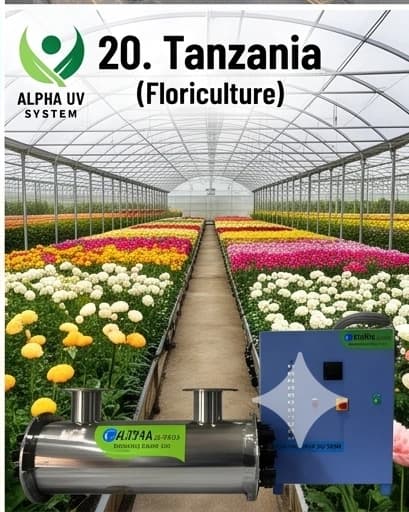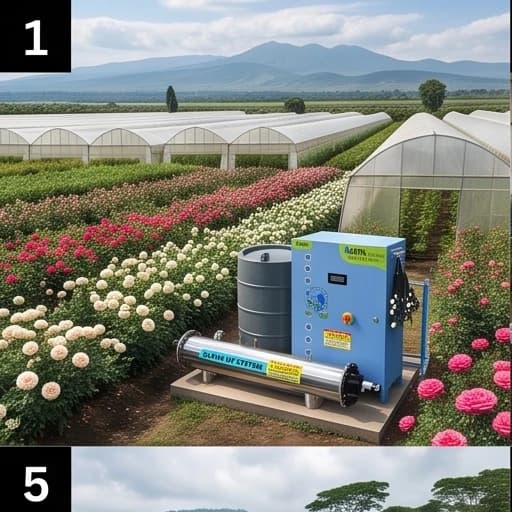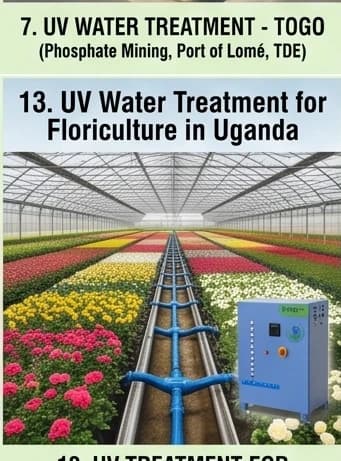
Quick Answer: UV water treatment Uganda floriculture market is driven by East Africa's second-largest cut flower export sector — Uganda exports USD 60+ million in cut flowers annually (roses, summer flowers, tropical foliage), primarily to EU auction markets (Royal FloraHolland, Aalsmeer, Naaldwijk) via Entebbe International Airport direct cargo flights. Uganda's floriculture is concentrated on the northern Lake Victoria shores (Entebbe peninsula, Wakiso District, Mukono) where lake water, borehole water, and rainwater harvesting supply farm irrigation. EU buyers and Dutch auction houses require GLOBALG.A.P. (Global Good Agricultural Practices) and MPS-A (Most Precious Sustainability — water quality module) certification for all Ugandan flower exporters. Both standards require UV treatment of irrigation water and post-harvest treatment water — eliminating pathogen and chemical residual risks that cause flower quality defects and certification audit failures. UV at 40 mJ/cm² (NSF/ANSI 55 Class A, 254 nm) is the standard specification. Alpha UV ships to Entebbe International Airport within 48 hours.
Uganda's Floriculture Sector and UV Water Treatment
Uganda's cut flower industry — pioneered in the late 1990s and growing to become Uganda's third-largest non-traditional export earner — operates primarily on the Lake Victoria basin's north shore, where the equatorial climate (1,150–1,300 m altitude, 18–24°C year-round temperature, 1,200–1,600 mm annual rainfall) produces optimal growing conditions for roses and summer flowers. The Entebbe peninsula (Wakiso District), Mukono District lakeshore, and emerging areas in Masaka are the primary growing zones.
UV water treatment Uganda floriculture demand is driven by three market access requirements: (1) GLOBALG.A.P. certification — mandatory for all farms supplying Royal FloraHolland, with water quality as a specific control point in the GLOBALG.A.P. IFA (Integrated Farm Assurance) standard version 6.0; (2) MPS-A certification — the most widely required sustainability standard by Dutch auction buyers, with water source quality and treatment as a mandatory audit criteria; (3) EU phytosanitary requirements — EU Regulation (EU) 2016/2031 on plant health requires post-harvest water used in flower conditioning to be free of plant pathogens (Botrytis, Fusarium, Pythium) — UV at 40 mJ/cm² inactivates these fungal pathogens in irrigation and post-harvest water.
Lake Victoria Water Quality for Floriculture
| Water Source | Location | UVT Range | Key Pathogen / Quality Issue | Alpha UV System |
|---|---|---|---|---|
| Lake Victoria direct intake (northern shore) | Entebbe peninsula, Mukono lakeshore farms | 50–70% (dependent on algal bloom season) | Cyanobacterial bloom (Microcystis — Mar/Apr, Aug/Sep); Botrytis spores; Phytophthora | AU-M 25/30, upstream 5-micron pre-filter, 40 mJ/cm²; bloom season dose verification required |
| Shallow lakeshore boreholes (Wakiso aquifer) | Entebbe farms, 100–300 m from lake shore | 68–80% | E. coli from lake seepage; iron 0.5–1.5 mg/L; algae from lake influence | AU-M 25, post iron-removal, 40 mJ/cm², NSF/ANSI 55 Class A |
| Deep boreholes (200–300 m, Kampala basin) | Inland Wakiso farms, Mukono upland | 75–85% | Iron/manganese; occasional E. coli; very low surface pathogen load | AU-S 15/AU-M 25, post iron-removal, 40 mJ/cm² |
| Rainwater harvesting (storage tanks, 10,000–500,000 L) | All farm zones; supplementary supply | 78–88% | Roof wash contamination (bird faeces — Campylobacter, Salmonella); tank biofilm; Legionella (warm tanks) | AU-S 15/AU-M 25 at tank outlet, 40 mJ/cm² |
Lake Victoria's water quality presents seasonal challenges for UV water treatment Uganda floriculture. The lake experiences annual cyanobacterial (blue-green algae) blooms — primarily Microcystis aeruginosa — in March/April (after long rains) and August/September (post-short rains), when lake surface UVT at Entebbe intakes drops below 55%. At UVT below 60%, UV systems must be oversized (or operated at reduced flow rates) to maintain 40 mJ/cm² dose delivery. Alpha UV's auto-de-rating feature adjusts dose delivery in real time based on UVI sensor reading — providing continuous dose assurance even through seasonal UVT variation without farm operator intervention.
GLOBALG.A.P. and MPS Water Quality Requirements
| Standard | Water Quality Requirement | Audit Mechanism | UV Compliance Evidence |
|---|---|---|---|
| GLOBALG.A.P. IFA v6.0 (FO — Flowers and Ornamentals) | AF 1.2.1: water sources must be assessed for quality risks; treatment validated if risks identified; irrigation water E. coli <200 CFU/100 mL (minor requirement) | Annual GLOBALG.A.P. approved certifier inspection (Control Union, SGS, Bureau Veritas) | UV system NSF/ANSI 55 certificate; annual microbiological water test at UV outlet (GLOBALG.A.P.-accredited lab) |
| MPS-A (Most Precious Sustainability) | Water quality module: source water quality documented; treatment method validated; pathogen control demonstrated; annual score reviewed by MPS Netherlands | Annual MPS-A audit (MPS-approved Ugandan auditor) + MPS Netherlands review | UV NSF certificate; UVI log summary (quarterly minimum); post-UV water test (annual) |
| Royal FloraHolland Quality Standards (RFHQ) | Cut flowers entering RFH auction: free from post-harvest pathogens (Botrytis, Fusarium) demonstrably controlled in conditioning water | RFH quality inspection at Aalsmeer/Naaldwijk arrival; flowers with disease rejection trigger supplier audit | UV post-harvest conditioning water treatment certificate; Botrytis-free conditioning water test |
| EU Directive 2006/42/EC / Phytosanitary | Plant health certificate (MAAIF Uganda) for exported flowers; post-harvest water free of listed plant pathogens | MAAIF phytosanitary inspection at Entebbe Airport export point | UV treatment record submitted in phytosanitary documentation (MAAIF recommends UV for post-harvest water) |
Post-Harvest Conditioning Water UV Treatment
Post-harvest water treatment is the highest-value UV application in Uganda floriculture — roses cut in the morning are placed in conditioning solution (hydration water + preservative) immediately post-harvest and must reach Aalsmeer auction within 36–48 hours via Entebbe-Amsterdam direct cargo flight. Conditioning water quality directly affects vase life: contaminated conditioning water (Botrytis, Pseudomonas, Fusarium from lake or borehole sources) colonises stem vascular tissue during the 4–8 hour Entebbe conditioning period, shortening vase life by 3–5 days and causing Dutch buyer quality complaints that result in price penalty or rejection.
UV at 40 mJ/cm² in conditioning water supply eliminates Botrytis cinerea spores (dose requirement: 30–40 mJ/cm²), Fusarium oxysporum (40 mJ/cm²), and Pseudomonas fluorescens (bacterial biofilm species in conditioning containers — inactivated at <20 mJ/cm²). Alpha UV AU-S 15 (3–8 m³/hour) is sized for conditioning water supply in Uganda's typical medium-size flower farm (3–10 ha in production, 50,000–200,000 stems per week).
Entebbe Airport Cargo Logistics and UV at Export Point
Entebbe International Airport (EBB) is Uganda's floriculture export gateway — cargo flights (Ethiopian Airlines, Kenya Airways, Turkish Cargo, DHL) carry chilled flower boxes direct to Amsterdam Schiphol (AMS), London Heathrow (LHR), and Dubai (DXB) for onward distribution. Flower conditioning facilities at Entebbe cargo terminal use city water (NWSC extension) or private boreholes for final conditioning before packing. UV water treatment Uganda floriculture at the export conditioning facility (final conditioning room adjacent to Entebbe cargo terminal cold stores) is a critical point that several Uganda flower exporters have installed in response to EU phytosanitary rejections at destination.
FAQ
Does GLOBALG.A.P. certification require UV water treatment on Uganda flower farms?
GLOBALG.A.P. IFA v6.0 requires farms to assess water quality risks and implement treatment if risks are identified. For Uganda farms using Lake Victoria water (UVT 50–70%, seasonal cyanobacterial blooms, potential E. coli) or shallow boreholes near the lake, GLOBALG.A.P. certifiers consistently flag water as a risk requiring treatment. UV at 40 mJ/cm² is accepted by all GLOBALG.A.P. approved certifiers as an appropriate treatment for Uganda floriculture water. Annual post-UV microbiological water test confirming E. coli <200 CFU/100 mL (minor control point) is required as audit evidence.
What UV dose is needed to control Botrytis in Uganda flower conditioning water?
Botrytis cinerea (grey mould — the primary post-harvest disease threat in cut roses) spores in conditioning water require UV at 30–40 mJ/cm² for >3 log inactivation. Alpha UV systems operating at 40 mJ/cm² (NSF/ANSI 55 Class A) provide adequate Botrytis control in conditioning water. More resistant fungal pathogens (Fusarium oxysporum, Phytophthora spp.) require 40 mJ/cm² — met by the same NSF Class A specification. No higher dose is needed for floriculture water UV treatment.
Can Alpha UV systems handle Lake Victoria's seasonal algal bloom turbidity?
During cyanobacterial bloom season (March/April, August/September), Lake Victoria surface water UVT at Entebbe intakes can drop to 48–55%. At UVT 55%, achieving 40 mJ/cm² requires either: (1) operating at 70% of maximum flow rate (reducing flow increases dose exposure time), or (2) pre-filtration to 5 microns before UV (pre-filtration removes suspended algae and restores UVT to 68–75%). Alpha UV's auto-de-rating continuously monitors UVI and automatically restricts flow to maintain 40 mJ/cm² — so farm operators don't need to manually adjust flow during bloom season. For farms with critical GLOBALG.A.P. audit windows during bloom season, adding 5-micron pre-filtration upstream is recommended.
How long does Alpha UV take to deliver to Entebbe for Uganda flower farms?
Air freight to Entebbe International Airport (EBB): 48 hours from India. Ground transport from Entebbe to Wakiso floriculture zone farms: 20–45 minutes (10–25 km). For small farms (AU-S 15), installation can be completed within 2–3 days of delivery by local plumber with Alpha UV installation guide. For larger farms (AU-M 25/30 with pre-filtration), local distributor support is available for installation and commissioning in the Entebbe/Wakiso area.
What is the ROI on UV water treatment for a Uganda flower farm?
For a 5-ha Uganda rose farm (100,000 stems/week export), UV treatment ROI calculation: (1) GLOBALG.A.P. certification premium — access to premium Dutch auction price tiers adds USD 0.05–0.15/stem above uncertified market price (USD 5,000–15,000/week additional revenue at full production); (2) Botrytis vase life improvement — each additional day of vase life reduces Dutch buyer price deduction by approximately 10%; (3) UV capital cost (AU-S 15 installed): USD 3,500–5,500 one-time. Payback period on GLOBALG.A.P. access premium alone: 1–4 weeks.
Do Uganda flower farms need UV for both irrigation and post-harvest water?
GLOBALG.A.P. and MPS-A assess both irrigation and post-harvest water quality — but the risk profile and economic impact differ. Irrigation water pathogen contamination affects plant health during growing (slower, manageable); post-harvest conditioning water contamination affects vase life directly (immediate economic impact at auction). Most Uganda flower farms prioritise post-harvest UV (AU-S 15 at conditioning room water supply) as the first installation, followed by irrigation UV (AU-M 25 at pump outlet) for GLOBALG.A.P. full compliance. Alpha UV can supply both in a single shipment with phased installation.
Standards, authorities & further reading
External references used to inform this guide. Regulations evolve — check the latest revision on each authority's site before compliance decisions.
Recommended UV Systems
Alpha UV System products for this application — powered by genuine Philips UV-C lamps.
Commercial UV Water Purification System
500 – 5,000 LPH
HACCP-compliant UV water purification for hotels, restaurants, and offices
Industrial UV Water Treatment System
5,000 – 50,000 LPH
Schedule M 2025 and HACCP compliant UV for pharma, food & beverage, and process water
Not sure which system suits your application? WhatsApp our engineers for a free recommendation →
Related solutions
See how Alpha UV System applies this to your industry or city.
Need a UV system?
Talk to our UV engineers — WhatsApp for a quote in 2 hours, or browse the full catalog on IndiaMART.