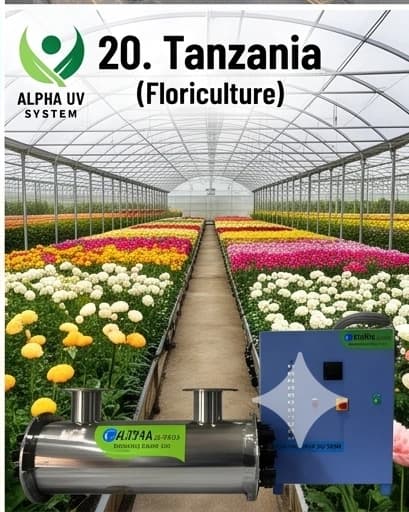
Quick Answer: UV water treatment Tanzania floriculture supports East Africa's second-most-important cut flower export sector (behind Kenya) — Tanzania exports 15,000–20,000 tonnes of cut flowers annually, primarily roses, alstroemeria, hypericum, and summer flowers, to the Netherlands Dutch flower auction (Royal FloraHolland Aalsmeer, 80% of exports) and UK/Germany direct buyers. Tanzania's floriculture cluster is concentrated in Arusha and Kilimanjaro Regions: Arusha District (16 large flower farms, 12,000+ hectares combined, on the slopes of Mount Meru); Kilimanjaro Region (Hai and Moshi Districts — Rose Bud, Hortanzia/Beco, Tanzania Flowers Ltd); Lake Manyara (Monduli/Arusha — medium-scale emerging cluster). Water source for Arusha floriculture: Arusha groundwater (Mount Meru volcanic aquifer, TDS 80–150 ppm, UVT 82–90% — one of East Africa's cleanest natural water sources) and Lake Duluti/Arusha stream flow. MPS (Milieu Programma Sierteelt — Dutch sustainable floriculture certification) requires zero-pesticide and responsible water management; GlobalG.A.P. Integrated Farm Assurance Standard (IFA v6.0) requires water source risk assessment and documented treatment. EU plant health Regulation 2016/2031 requires phytosanitary compliance for cut flower export. NSF/ANSI 55 Class A at 40 mJ/cm². Alpha UV ships to Kilimanjaro International Airport (JRO) within 48–72 hours.
Tanzania Floriculture Sector — Water Treatment Context
Tanzania's flower farms cluster around Arusha because of unique water advantages:
- Mount Meru volcanic aquifer: Arusha's floriculture zone draws from Mount Meru volcanic aquifer (clean, low-TDS groundwater at 80–150 ppm — naturally low mineral content avoids salt stress in rose petals); UVT 82–90% (high transmittance, low organic carbon); iron 0.05–0.15 mg/L (minimal — below the 0.3 mg/L threshold that fouls UV quartz sleeves)
- Zero-chlorine imperative: Roses and cut flowers are exquisitely sensitive to chlorine — free chlorine at 0.05–0.1 mg/L causes: petal edge browning (chlorine oxidises anthocyanin pigments in red and pink roses); stomata damage on leaves; reduced vase life by 2–3 days; MPS water quality protocol prohibits chlorine in irrigation water for MPS-certified farms; GlobalG.A.P. IFA v6.0 requires documented chemical-free irrigation for gap certification
- Irrigation water and post-harvest water: Two distinct water streams — (1) Drip irrigation water (ground-level application to rose stems in growing tunnels — must be Pythium-free, Fusarium-free, chlorine-free); (2) Post-harvest water (hydration buckets and cold room water changes — must be E. coli-free and chlorine-free to prevent stem-end contamination affecting vase life)
Arusha and Kilimanjaro Flower Farm UV Specifications
| Application | Water Source | UVT | Pathogen Target | Alpha UV System |
|---|---|---|---|---|
| Drip irrigation water (rose growing tunnels — Arusha Meru-slope farms) | Mount Meru volcanic borehole, TDS 80–150 ppm | 82–90% | Pythium spp. (root rot — major rose crop loss pathogen in drip irrigation systems); Fusarium oxysporum (stem rot); Phytophthora (crown rot) | AU-M 25, zero Cl, 40 mJ/cm²; Pythium inactivation requires 30+ mJ/cm² (40 mJ/cm² provides 10 mJ/cm² margin); 316L SS; MPS/GlobalG.A.P. water treatment documentation |
| Post-harvest hydration water (cold room conditioning buckets, Arusha packing houses) | Borehole + UV treated (same system as irrigation) | 82–88% | E. coli; Botrytis cinerea (grey mould — post-harvest pathogen in cut stems; UV reduces Botrytis spore load in post-harvest water); Pseudomonas and Erwinia (stem blockage bacteria) | AU-S 15 or AU-M 25, zero Cl, 40 mJ/cm²; compact installation in cold room ante-room; Botrytis spore inactivation at 40 mJ/cm² |
| Spray irrigation water (foliage misting for humidity control — Kilimanjaro farms) | Kilimanjaro groundwater (Mount Kilimanjaro aquifer, TDS 60–120 ppm, UVT 84–92%) | 84–92% | Phytophthora (overhead spray is primary vector for Phytophthora dispersal — UV reduces spore load in spray water); Pseudomonas syringae (bacterial speck on foliage) | AU-S 15, zero Cl, 40 mJ/cm²; low-flow for misting system (0.5–2 m³/hour); compact wall-mount for greenhouse utility room |
| Worker welfare (drinking water for 500–2,000 flower farm workers — Arusha/Kilimanjaro) | Borehole (same source as irrigation, separate post-UV distribution) | 82–90% | E. coli; E. coli O157:H7; Salmonella (farmworker gastroenteritis — Tanzania labour law OSHA welfare water requirement) | AU-S 8/15, separate potable supply branch from main UV system; NSF/ANSI 55 Class A; Tanzania OSHA workplace water documentation |
MPS and GlobalG.A.P. Certification Requirements
- MPS-ABC (Milieu Programma Sierteelt — environmental floriculture certification): MPS is the primary sustainability certification for Dutch auction market access (Royal FloraHolland MPS certificate required for auction floor eligibility); MPS Section 4 (water) requires: water source risk assessment; no chlorine-based disinfection in irrigation water (MPS protocol explicitly prohibits Cl in irrigation for MPS-ABC and MPS-SQ certified farms); annual water quality test from accredited laboratory; UV treatment accepted as documented alternative to chlorination
- GlobalG.A.P. IFA v6.0 (Integrated Farm Assurance — Flowers and Ornamentals module): Section FO AF 1.2 (water quality) — must assess risk of pathogen contamination in irrigation water source; FO AF 1.2.1 requires documented water treatment or risk management for pathogen-positive irrigation sources; UV installation documentation satisfies GlobalG.A.P. water treatment evidence requirement for GLOBALG.A.P. auditor
- Tesco, M&S, Albert Heijn buyer codes: Major European supermarket buyers of Arusha roses (Tesco UK; M&S Food; Albert Heijn Netherlands) impose supplier codes of conduct including zero-chlorine in product-contact water — directly requiring UV or equivalent chemical-free treatment at Tanzanian flower farm level
FAQ
What UV dose is needed to control Pythium in drip irrigation water at Arusha flower farms?
Pythium spp. (P. ultimum, P. aphanidermatum — primary root rot pathogens in rose drip irrigation systems) UV inactivation: Pythium zoospores (motile, flagellated — active infection stage) are highly UV-sensitive: 2-log inactivation (99%) at 10–15 mJ/cm²; 4-log inactivation (99.99%) at 25–30 mJ/cm². Alpha UV's 40 mJ/cm² standard dose provides >4-log Pythium inactivation — more than adequate for drip irrigation Pythium control. Pythium oospores (dormant resting stage — less UV-sensitive): 2-log at 30–40 mJ/cm². At 40 mJ/cm², AU-M 25 achieves both zoospore and oospore inactivation for comprehensive Pythium risk reduction. In Arusha rose farms with drip irrigation, Pythium crop losses can reach 15–25% of annual production value without irrigation water disinfection — UV payback is typically 6–12 months from avoided Pythium crop loss alone, before accounting for MPS/GlobalG.A.P. certification access value.
Does Botrytis cinerea require special UV treatment for Tanzania cut flower post-harvest water?
Botrytis cinerea (grey mould — the primary post-harvest disease of roses, causing petal spotting and petal blight during cold chain transport; significant vase life reduction) in post-harvest water: Botrytis conidia (asexual spores — primary infection unit) UV inactivation: 2-log at 8–12 mJ/cm²; 4-log at 20–25 mJ/cm². Alpha UV's 40 mJ/cm² provides >4-log Botrytis conidium inactivation — effective Botrytis control in post-harvest hydration water and cold room misting water. Key application: post-harvest conditioning water in cold rooms where roses stand in recut-stem hydration buckets (12–24 hours cold conditioning at 4–6°C before packing) — contaminated bucket water transfers Botrytis conidia to stem cuts, causing internal stem infection that manifests as petal spotting during 5–7 day Dutch auction transit. Arusha packing house specification: AU-S 15 at post-harvest water filling station (treating 1–3 m³/hour into conditioning buckets); zero Cl mandatory (chlorine causes stem-end browning at 0.2 mg/L, reducing vase life by 1–2 days).
How does Alpha UV reach Kilimanjaro flower farms?
Kilimanjaro International Airport (JRO, Arusha-Kilimanjaro highway, 50 km from Arusha city) is a major international airport serving the Arusha/Kilimanjaro flower farm cluster — direct flights from Amsterdam (KLM cargo, same aircraft that carries flowers outbound on return flight; inbound industrial cargo on outbound leg), Nairobi, Addis Ababa, and Doha. Air freight from India to JRO: via Nairobi (NBO) or Addis Ababa (ADD) connection — 48–72 hours total. Import duty: Tanzania HS 8421.21 — 25% (non-EAC preferential). For farms importing UV systems as part of horticultural investment (EPZ-equivalent horticultural investment status): Tanzania Investment Centre (TIC) registered horticulture investors receive import duty exemption for qualifying capital equipment under Tanzania Investment Act 1997 (Section 19 — capital goods import duty exemption). Most Arusha flower farms are TIC-registered as horticulture FDI investments — UV systems imported as capital equipment under TIC certificate attract 0% import duty. Local Arusha freight agent (experienced in horticulture capital goods import): handles TIC exemption documentation.
Standards, authorities & further reading
External references used to inform this guide. Regulations evolve — check the latest revision on each authority's site before compliance decisions.
Recommended UV Systems
Alpha UV System products for this application — powered by genuine Philips UV-C lamps.
Commercial UV Water Purification System
500 – 5,000 LPH
HACCP-compliant UV water purification for hotels, restaurants, and offices
Industrial UV Water Treatment System
5,000 – 50,000 LPH
Schedule M 2025 and HACCP compliant UV for pharma, food & beverage, and process water
Not sure which system suits your application? WhatsApp our engineers for a free recommendation →
Related solutions
See how Alpha UV System applies this to your industry or city.
Need a UV system?
Talk to our UV engineers — WhatsApp for a quote in 2 hours, or browse the full catalog on IndiaMART.