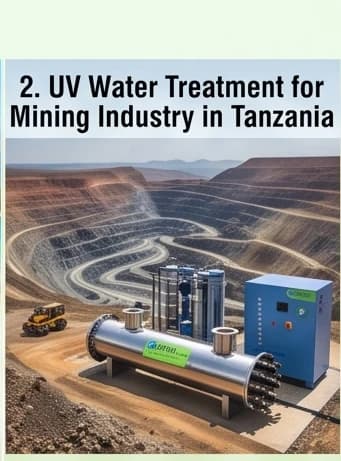
Quick Answer: UV water treatment Tanzania mining addresses water quality for one of Africa's most significant mineral economies — Tanzania is Africa's fourth-largest gold producer (50+ tonnes/year) with major deposits in the Lake Victoria Goldfields (Mwanza Region: Geita, North Mara, Bulyanhulu, Buzwagi mines). TMAA (Tanzania Minerals Audit Agency, under Ministry of Minerals) oversees mining operations alongside NEMC (National Environment Management Council) and OSHA Tanzania for environmental and occupational health compliance. Key Tanzania gold mining operations requiring potable UV treatment: Barrick Gold / Kibali consortium (North Mara mine, Mara Region — 5,000+ workforce); Geita Gold Mine / AngloGold Ashanti (Geita Region — Tanzania's largest gold mine; 8,000+ workforce); ACACIA Mining / Barrick Gold (Bulyanhulu mine, Shinyanga Region — underground mine to 2,000 m depth); Shanta Gold (New Luika mine, Songwe Region). Surface water sources in Lake Victoria zone (Mwanza, Geita, Kagera Regions): Victoria Lake water (UVT 72–82% near shore, degrading near urban discharge points), Mara River tributaries (UVT 60–74%). NSF/ANSI 55 Class A at 40 mJ/cm². Alpha UV ships via Julius Nyerere Airport (DAR) or Mwanza Airport (MWZ) within 48–72 hours.
Tanzania Mining UV Water Treatment — Mine Site Overview
| Mine / Operator | Location | Water Source | Workforce | Alpha UV System |
|---|---|---|---|---|
| Geita Gold Mine (AngloGold Ashanti — Tanzania's largest gold mine) | Geita Region, Lake Victoria shore (220 km from Mwanza) | Lake Victoria near-shore intake (UVT 74–82% at Geita); backup borehole (TDS 150–300 ppm) | 8,000+ permanent + contract workforce; large mine camp (mine town of 15,000+ residents) | AU-M 30 main camp potable supply, 40 mJ/cm²; MODBUS TCP for AngloGold HSE SCADA; NSF/ANSI 55 Class A; solar backup for remote camp sections |
| North Mara Gold Mine (Barrick Gold — Mara Region) | Tarime District, Mara Region (near Kenya border) | Mara River tributary (UVT 62–74%); mine dewatering (acidic — pH 5.5–6.2, sulfate-rich); borehole backup | 5,000+ workforce; local community water supply contribution (North Mara mine community development) | AU-M 25, 40 mJ/cm²; pre-treatment (settling + multi-media filter + iron removal for dewatering water); MODBUS for Barrick HSE; community supply documentation |
| Bulyanhulu Gold Mine (Barrick Gold / ACACIA — underground mine) | Kahama, Shinyanga Region (80 km from Lake Victoria) | Borehole (Usukuma aquifer — TDS 200–500 ppm, iron 0.3–1 mg/L); surface water from seasonal streams | 3,000+ underground and surface workforce; underground water distribution at mine levels (-1,000 to -2,000 m) | AU-M 25, 316L SS, 40 mJ/cm²; iron removal pre-treatment; compact for underground level installation; Barrick global HSE documentation |
| Tanzanite One / TanzaniteOne Mining (Merelani, Manyara Region) | Merelani Hills, Simanjiro District, Manyara | Seasonal stream (dry season borehole dependency); TDS 100–400 ppm | 2,000+ workforce (largest tanzanite mining operation globally) | AU-M 25, 40 mJ/cm², solar-compatible for remote Merelani Hills location; NSF/ANSI 55 Class A |
Tanzania Mining Regulatory Framework — Water
- TMAA (Tanzania Minerals Audit Agency) — operational oversight: TMAA audits mining company production, operational costs, and environmental compliance — water management is reviewed as part of TMAA operational audit; mine camp potable water quality is checked against WHO GDWQ
- NEMC (National Environment Management Council) EIA: All large-scale mines require EIA under Environmental Management Act (2004) — water chapter covers both potable supply and process water effluent; NEMC approves EMP (Environmental Management Plan) water management commitments; UV treatment documented as potable water management measure in EMP
- Tanzania Water Resources Act (2009): Basin Water Offices (e.g., Lake Victoria Basin Water Office, Mwanza) issue water use permits for mine site water abstraction from Lake Victoria or rivers; permit conditions may specify treatment standards for water abstracted for potable use
- OSHA Tanzania (Occupational Safety and Health Authority): Workplace potable water standard — E. coli 0 CFU/100 mL; OSHA mine inspection checks mine camp water quality; NSF/ANSI 55 Class A documentation satisfies OSHA workplace water safety evidence requirement
Lake Victoria Water Quality and UV
Lake Victoria (Africa's largest lake by area, 68,800 km²) — Geita Gold Mine and surrounding mine camp operations source water from Lake Victoria's Geita Bay:
- Lake Victoria water quality: UVT 74–82% at Geita Bay (away from urban discharge); phosphate-driven eutrophication (algal bloom risk during wet season, October–May); E. coli contamination from lakeside communities (boat traffic, fishing communities); sediment input from Mara River (north Victoria) reduces UVT to 65–72% in northern zones
- UV specification for Lake Victoria intake: Coagulation + flocculation → sedimentation → dual media pressure filtration → 25-micron cartridge → UV at 40 mJ/cm² at minimum 72% UVT (design basis); AU-M 30 provides 40 mJ/cm² at 10 m³/hour at 72% UVT inlet; solar panels integrated for power reliability (Lake Victoria zone mining camp grid supply is unreliable — 8–16 hour grid availability/day)
- Schistosomiasis risk: Lake Victoria is endemic for Schistosoma mansoni (bilharzia) — UV does not inactivate Schistosoma cercariae at 40 mJ/cm² (cercariae require 200+ mJ/cm² for complete inactivation); for potable water from Lake Victoria, UV is part of a treatment train (filtration removes cercariae prior to UV); potable water from Lake Victoria intake must include pre-filtration ≤10 µm to remove cercariae before UV stage
FAQ
What OSHA Tanzania standard applies to mine camp potable water?
OSHA Tanzania (under Ministry of Health and Social Welfare — Occupational Safety and Health Division) enforces the Occupational Health and Safety Act No. 5 of 2003 — Section 29 (provision of wholesome drinking water). Mine camp potable water standard: TZS 789 (Tanzania Standard for drinking water — aligned to WHO GDWQ 2011): E. coli 0 CFU/100 mL; total coliforms 0 CFU/100 mL; turbidity <5 NTU; pH 6.5–8.5; free chlorine (if chlorination used) 0.2–0.5 mg/L. OSHA mine inspector visits (annual inspection for large mines) check: water source documentation, treatment method, most recent water quality test results, and maintenance records for treatment equipment. Alpha UV provides NSF/ANSI 55 Class A certification documentation + water quality test protocol template (aligned to TZS 789) that satisfies OSHA mine camp inspection requirements. For underground mine levels (Bulyanhulu depth operations): OSHA requires accessible drinking water within 100 m walking distance of any underground worker — AU-S 8 compact units at underground level utility points satisfy this proximity requirement.
How does North Mara Gold Mine community water supply programme affect UV specification?
Barrick's North Mara Gold Mine Community Development Programme includes provision of potable water to surrounding Tarime District communities — fulfilling Social Development Agreement commitments under Barrick's operating licence from Ministry of Minerals. Community water supply specifications: E. coli 0 CFU/100 mL; turbidity <5 NTU; no chemical treatment residuals (communities adjacent to mine object to chlorine taste in water supplied from mine — UV provides organoleptically neutral water). AU-M 25 at community water distribution points (village kiosks) treats 3–8 m³/hour for communities of 200–500 people/kiosk. Barrick's community water supply documentation (submitted to Ministry of Minerals and TMAA as community development obligation fulfilment evidence): UV system specification sheet, NSF/ANSI 55 Class A certificate, and quarterly water quality test results (E. coli testing by Muhimbili University lab or NEMC accredited laboratory).
Standards, authorities & further reading
External references used to inform this guide. Regulations evolve — check the latest revision on each authority's site before compliance decisions.
Recommended UV Systems
Alpha UV System products for this application — powered by genuine Philips UV-C lamps.
Commercial UV Water Purification System
500 – 5,000 LPH
HACCP-compliant UV water purification for hotels, restaurants, and offices
Industrial UV Water Treatment System
5,000 – 50,000 LPH
Schedule M 2025 and HACCP compliant UV for pharma, food & beverage, and process water
Not sure which system suits your application? WhatsApp our engineers for a free recommendation →
Related solutions
See how Alpha UV System applies this to your industry or city.
Need a UV system?
Talk to our UV engineers — WhatsApp for a quote in 2 hours, or browse the full catalog on IndiaMART.