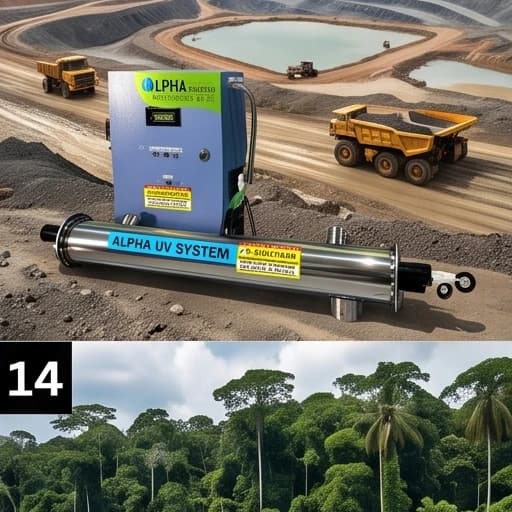
Quick Answer: UV water treatment Ghana gold mining addresses potable water quality for the world's 10th-largest gold producer (Ghana produces 130+ tonnes gold/year) — Ghana's four major gold mining companies operating large-scale mines under Environmental Protection Agency (EPA Ghana) permit: Newmont Ghana Gold (Ahafo and Akyem mines, Brong-Ahafo/Eastern Region); AngloGold Ashanti Ghana (Obuasi mine — one of Africa's deepest gold mines, 3,000+ m); Gold Fields Ghana (Tarkwa and Damang mines, Western Region); Kinross Gold (Chirano mine, Western Region). All four operate large workforce camps requiring WHO GDWQ-compliant potable water for 3,000–10,000+ workers each. EPA Ghana's Environmental Assessment Regulations LI 1652 require environmental impact assessment (EIA) water chapters covering both potable workforce water and process water management. Surface water sources at mine sites (Offin River, Ankobra River, Pra River — Western and Ashanti regions) carry turbidity from alluvial gold mining and forest catchments; borehole supplementation is common. NSF/ANSI 55 Class A at 40 mJ/cm². Alpha UV ships to Accra (ACC) within 48–72 hours; mine site delivery via Kumasi or Tarkwa road freight.
Ghana Gold Mining — UV Water Treatment Applications
| Mine / Company | Location | Water Source | UV Application | Alpha UV System |
|---|---|---|---|---|
| Newmont Ghana / Ahafo Mine (Brong-Ahafo — Ghana's largest gold mine by output) | Kenyase, Brong-Ahafo Region (280 km northwest of Accra) | Subri River / Awensu River (surface water, UVT 62–74% dry season, 50–65% wet season); emergency borehole backup | Mine workforce camp potable water (8,000+ workers + families — 15,000+ total population on concession); WHO GDWQ E. coli 0 CFU/100 mL; reagent preparation water for heap leach and carbon-in-pulp (CIP) circuit | AU-M 30, 40 mJ/cm² at 60% UVT (wet season low); MODBUS TCP for Newmont HSE water quality management; solar backup for remote camp sections; NSF/ANSI 55 Class A |
| AngloGold Ashanti / Obuasi Mine (Ashanti Region — Africa's deepest operating gold mine) | Obuasi, Ashanti Region (60 km south of Kumasi) | Oda River (UVT 58–72% — turbidity from historical artisanal mining); deep mine borehole (underground aquifer, TDS 200–500 ppm, sulfate-influenced) | Surface workers' welfare water and underground mine level potable points (water dispensers at underground level — critical where workers spend 8+ hours underground without surface supply); Obuasi town mine water supply contribution to GWCL Obuasi system | AU-M 25, 40 mJ/cm², 316L SS; underground installation (compact design, vibration-tolerant); AngloGold HSE standard documentation; Oda River low UVT — pre-treatment (settling + multi-media filtration) mandatory |
| Gold Fields Ghana / Tarkwa Mine (Western Region — Ghana's largest open-pit gold mine) | Tarkwa, Western Region (250 km west of Accra) | Bonsa River (UVT 60–74%); mine dewatering water (underground inflow — pH 5.8–6.5, iron 1–5 mg/L from sulfide oxidation) | Workforce camp potable water (6,000+ workforce); mine site surface water treatment; Gold Fields global water stewardship standard (aligned to ICMM — International Council on Mining and Metals Water Stewardship Framework) | AU-M 25, 40 mJ/cm²; iron removal pre-treatment for mine dewatering water (Fe >0.3 mg/L fouls UV quartz sleeve); MODBUS for Gold Fields global HSE SCADA |
| Kinross Gold / Chirano Mine (Western Region — mid-scale underground and open pit) | Chirano, Western Region (90 km north of Tarkwa) | Chirano Creek (Offin River tributary, UVT 62–76%) | Camp potable water (3,000+ workforce); Chirano process water (ore washing); Kinross global water management standard | AU-M 25, 40 mJ/cm², NSF/ANSI 55 Class A; Kinross HSE water quality documentation |
EPA Ghana Environmental Compliance — Water
- Environmental Assessment Regulations LI 1652 (1999) — EIA requirement: All large-scale mining operations in Ghana require Environmental Impact Assessment (EIA) approved by EPA Ghana — EIA water chapter covers: potable water source, treatment method, workforce water quality monitoring, and effluent discharge quality. UV treatment documented in EIA as potable water treatment method (replaces or supplements chlorination)
- Ghana Water Quality Guidelines for Mining (EPA Ghana, 2010): Specifies WHO GDWQ as the standard for mine workforce potable water; requires minimum annual water quality testing; specifies treatment validation documentation for mine camp potable water
- ICMM (International Council on Mining and Metals) Water Stewardship: Newmont, AngloGold, Gold Fields, and Kinross are all ICMM members — ICMM Water Stewardship Framework requires monitoring of mine site water withdrawals, treatment, and return flows; UV treatment supports reduced chemical use reporting under ICMM water stewardship metrics (zero chemical treatment = zero chemical addition to mine site water withdrawal accounting)
- Ghana Minerals Commission HSE Code: Minerals Commission Ghana (regulator for mining sector) HSE Code requires provision of potable water for all mine workers — treatment method must be validated; NSF/ANSI 55 Class A accepted as validation documentation
FAQ
What pre-treatment is needed for Ghana mining site surface water before UV?
Western and Ashanti Region surface water at gold mine sites — Offin River, Ankobra River, Bonsa River — is heavily impacted by artisanal and small-scale mining (ASM galamsey operations) and forest catchment runoff: turbidity 50–500 NTU during wet season, iron 0.5–5 mg/L (from acid mine drainage and natural geology), colour 30–100 PCU (humic acids from forest catchment). Required pre-treatment before UV: (1) Settling pond/lagoon (24–48 hour residence time) — removes heavy sediment load and coarse iron particles; (2) Multi-media pressure filtration (anthracite/sand/garnet — removes residual turbidity to <5 NTU and particles >10 µm); (3) Greensand or oxidation filter (iron removal — Fe from >0.3 mg/L to <0.05 mg/L; iron fouls UV quartz sleeve within 2–4 weeks without removal); (4) 25-micron cartridge pre-filter (final particulate polishing before UV). After this pre-treatment train: inlet UVT to UV typically 72–82% (sufficient for AU-M 25/30 at 40 mJ/cm²). UV is the final biological disinfection step — not a standalone treatment for mine site surface water.
Does galamsey (artisanal mining) contamination require special UV specifications?
Galamsey (illegal artisanal small-scale gold mining) contamination in Offin River and Pra River systems introduces elevated mercury (from amalgamation) and cyanide (from illegal cyanide leaching) in addition to turbidity. UV does not remove mercury, cyanide, or heavy metals — UV only addresses biological pathogens. For mines drawing from galamsey-contaminated surface water, pre-treatment must include activated carbon (for cyanide removal, if present at >0.1 mg/L) and RO membrane (for mercury and heavy metal removal below drinking water limits). After RO: UV at 40 mJ/cm² for biological disinfection of RO permeate. For mine camp potable water where surface water is galamsey-impacted: RO → UV is the mandatory treatment train (UV alone is insufficient). Gold Fields Tarkwa and Newmont Ahafo sites use borehole backup supply (less galamsey-contaminated than surface rivers) specifically to reduce treatment complexity for potable water systems.
How does UV compare to chlorination for mine camp potable water in Ghana?
Mine camp potable water chlorination is common in Ghana (calcium hypochlorite granules — locally available, low-cost). UV advantages over chlorination in mine camp context: (1) No chemical storage — chlorine granules require secure storage (corrosive, toxic); in remote mine camps, chemical logistics are a management burden; UV requires only electricity (solar-compatible); (2) No chlorine taste — camp workers reject chlorinated water if taste is perceptible (>0.5 mg/L Cl), leading to unsafe bottled water consumption or surface water use; UV provides organoleptically acceptable water without taste modification; (3) No by-product formation — chlorine + humic acids in high-colour forest water (Ashanti/Western Region) forms trihalomethanes (THMs) and haloacetic acids (HAAs) — carcinogenic disinfection by-products; UV forms none; (4) Continuous monitoring — UV intensity sensor with alarm provides documented treatment validation for EPA Ghana and ICMM HSE audit (chlorine tablet dosing is manual and difficult to document continuously). Chlorination may be used as post-UV residual preservation for large distribution networks (mine camp pipe network extending >1 km from central UV treatment point) — combined UV + low-dose Cl residual (0.1–0.2 mg/L) is sometimes specified for very large camp networks.
Standards, authorities & further reading
External references used to inform this guide. Regulations evolve — check the latest revision on each authority's site before compliance decisions.
Recommended UV Systems
Alpha UV System products for this application — powered by genuine Philips UV-C lamps.
Commercial UV Water Purification System
500 – 5,000 LPH
HACCP-compliant UV water purification for hotels, restaurants, and offices
Industrial UV Water Treatment System
5,000 – 50,000 LPH
Schedule M 2025 and HACCP compliant UV for pharma, food & beverage, and process water
Not sure which system suits your application? WhatsApp our engineers for a free recommendation →
Related solutions
See how Alpha UV System applies this to your industry or city.
Need a UV system?
Talk to our UV engineers — WhatsApp for a quote in 2 hours, or browse the full catalog on IndiaMART.