Quick Answer: UV water treatment in Ghana is the validated chemical-free disinfection method for Ghana Standards Authority-licensed packaged water plants, gold and bauxite mining industry process water, BRC-compliant cocoa and palm oil export processing facilities, Accra and Kumasi borehole building water systems, and international NGO WASH projects. Alpha UV's NSF/ANSI 55 Class A certified systems deliver 40–80 mJ/cm² validated dose with SS 316L chambers, shipping from Mundra or JNPT to Tema Port (Accra) in 14–18 days with GSA-format compliance documentation.
Ghana's Water Quality Context and the UV Treatment Market
Ghana is West Africa's most stable democracy and a regional economic leader, with GDP growth averaging 5–7 percent over the past decade driven by gold, cocoa, oil (Jubilee Field offshore), and an expanding services sector. Ghana's water sector is managed by the Ghana Water Company Limited (GWCL) under the Public Utilities Regulatory Commission (PURC), with the Community Water and Sanitation Agency (CWSA) serving rural areas. JMP estimates that approximately 79 percent of Ghana's urban population has access to at least basic water services — one of the higher rates in West Africa — but distribution system reliability and post-treatment quality remain challenges in Accra's Tema, Ashaiman, and Adenta districts and in secondary cities such as Tamale, Kumasi, and Takoradi.
Ghana's UV water treatment market is shaped by three intersecting forces: the growing middle class's preference for verified safe water over municipal supply, the country's significant mining sector requiring documented process water treatment, and the food and agricultural export sector's compliance requirements from European buyers for BRC and GlobalG.A.P. certified water quality management in processing facilities.
Waterborne disease remains a public health challenge in Ghana: cholera outbreaks are periodic in Accra's informal settlements (James Town, Agbogbloshie), and the Northern Region faces endemic Guinea worm disease — a parasite transmitted through contaminated water that the Ghana Health Service is working to eradicate. UV water treatment Ghana in community and institutional water systems addresses the microbial contamination that underlies Ghana's waterborne disease burden.
Water Source and Quality by Region
Accra and Greater Accra — Volta River Supply and Boreholes
Greater Accra's primary water source is the Volta River, treated at Kpong Water Treatment Works and Weija Water Treatment Works operated by GWCL. Kpong and Weija-treated water meets Ghana Standards Authority (GSA) GS 175:2009 (drinking water standard) at the treatment works, but distribution losses (estimated at 50 percent of production) and pressure intermittency create post-treatment contamination risk in the distribution network. Accra borehole water — widely used in residential estates and commercial buildings — varies in quality: East Legon, Airport Residential, and Cantonments boreholes draw from the Crystalline Basement Complex aquifer with TDS of 200–600 mg/L and generally low iron; Tema industrial zone boreholes show higher dissolved solids. UVT of Accra borehole water after 5-micron filtration: typically 82–90 percent.
Kumasi and Ashanti Region — Surface Water and Gold Mining
Kumasi draws water from the Owabi and Barekese reservoirs — Lake Bosomtwe area surface water treated by GWCL. The Ashanti Region is Ghana's gold mining heartland, with operations by Newmont (Ahafo, Akyem mines), AngloGold Ashanti (Obuasi), Gold Fields (Tarkwa, Damang), and Kinross. Mining areas around Kumasi and Obuasi have documented groundwater contamination from artisanal and small-scale mining (galamsey) operations, with mercury, arsenic, and elevated turbidity in surface water bodies near galamsey sites. Mining companies' environmental compliance programmes and community water supply systems in mining concession areas specify UV disinfection as part of water quality assurance for worker camps and community water points.
Tamale and Northern Ghana — Groundwater and Surface Water
Northern Ghana's savanna belt relies on groundwater from shallow and deep boreholes, hand-dug wells, and seasonal river abstraction. Groundwater quality in the North ranges from acceptable (granite basement aquifer in Guinea Savanna zone, TDS 150–400 mg/L) to poor (Iron-rich boreholes with Fe 2–10 mg/L in some locations). Seasonal surface water sources — used for community water supply during dry season when borehole yields drop — carry high turbidity and bacterial loads. NGO and government rural water supply schemes in Northern Ghana specify UV systems for community water kiosks, with UNICEF and USAID procurement requiring NSF/ANSI 55 Class A documentation.
Western Region — Oil Industry and Coastal Ports
Ghana's Western Region hosts Takoradi Port (the country's main commodity export port) and the offshore oil industry infrastructure for the Jubilee, TEN, and Sankofa oil fields. Tullow Oil, ENI, and GNPC operations require potable water for offshore platform crew accommodation. Takoradi city supply draws from the Daboase treatment works on the Pra River — adequate at treatment but subject to distribution deterioration as with Accra. UV water treatment Ghana at hotel, hospital, and industrial facility level in Takoradi addresses the post-treatment quality gap.
Ghana Standards Authority (GSA) and Regulatory Framework
Ghana Standards Authority (GSA) administers GS 175:2009 — Ghana's drinking water quality standard, aligned with WHO GDWQ. The Food and Drugs Authority (FDA) regulates packaged water production, food processing water quality, and pharmaceutical water systems. UV disinfection is accepted by both GSA and FDA as a valid treatment method with NSF/ANSI 55 Class A documentation as the accepted performance evidence.
| Regulatory Body | Standard | UV Requirement | Alpha UV Documentation |
|---|---|---|---|
| GSA | GS 175:2009 (Drinking Water) | UV as approved disinfection; 40 mJ/cm² for 4-log E. coli reduction | NSF/ANSI 55 Class A certificate + GSA-format technical data |
| FDA Ghana | Packaged Drinking Water Regulation | Validated UV or chemical disinfection at filling point | NSF/ANSI 55 Class A certificate for FDA licensing audit |
| FDA Ghana | GMP guidelines (pharmaceutical water) | WHO-GMP aligned; 80 mJ/cm² for PW loops | AU-H series 80 mJ/cm² validation documentation |
| EPA Ghana | Environmental Assessment and Audit (mining water) | Effluent and treated water quality per EPA permit | Dose verification at commissioning; EPA permit compliance documentation |
| GlobalG.A.P. / BRC | Food export audit standards | Documented UV disinfection for cocoa, palm oil, and fresh produce processing | NSF/ANSI 55 certificate + dose delivery records for auditor review |
Key Application Sectors
Cocoa and Agricultural Export Processing
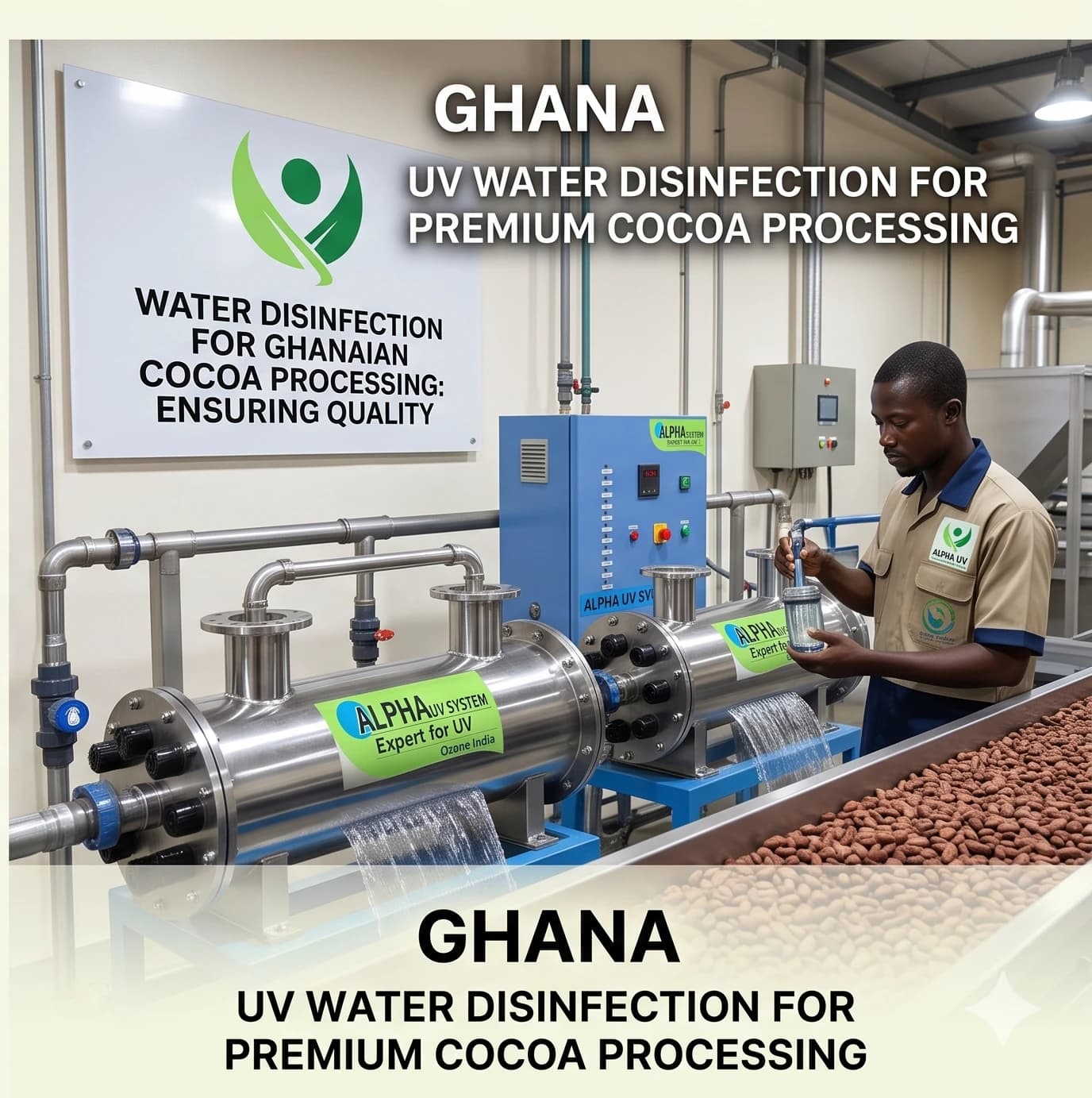
Ghana is the world's second-largest cocoa producer, exporting approximately 800,000–900,000 tonnes annually to Europe and North America. Cocoa processing — both cocoa bean cleaning/fermentation and the growing value-added processing sector (Cargill, Barry Callebaut, Olam processing in Tema) — requires process water quality documentation for BRC Global Standard for Food Safety and FSSC 22000 compliance. UV water treatment Ghana in cocoa processing plants eliminates the bacterial contamination risk in cleaning water and product-contact water that BRC and European food buyer auditors flag. Palm oil and rubber processing — additional major Ghanaian agricultural exports — have similar food safety water quality requirements for European market access.
Gold and Bauxite Mining — Worker Camp and Process Water
Ghana's gold mining sector — the second-largest gold producer in Africa — generates significant UV water treatment demand for worker camp potable water, mine laboratory water, and processing plant water. Newmont's Ahafo and Akyem mines, AngloGold Ashanti's Obuasi operation, and Gold Fields' Tarkwa complex collectively employ tens of thousands of workers requiring SANS 241 or WHO-GDWQ compliant drinking water. Mining company HSE specifications typically reference NSF/ANSI 55 Class A for UV disinfection performance in mine water supply tenders. Bauxite processing (Worsley, GACL at Awaso) also uses UV in process and potable water systems within the plant complex.
Hospitality and Real Estate
Accra's growing hospitality sector — international hotel chains (Marriott Accra, Kempinski Hotel Gold Coast City, Radisson Blu, Mövenpick) and the expanding serviced apartment and co-living market — specifies UV water treatment in building water supply as a standard feature in international-brand accommodation. The Ghana Tourism Authority's star rating criteria increasingly reference water quality management systems, aligning with international hotel brand engineering standards that require NSF/ANSI 55 UV documentation for each property's water treatment plant. Airport Residential, East Legon, and Cantonments residential estates also specify UV at building entry in premium real estate developments.
Pharmaceutical and Healthcare
Ghana's pharmaceutical sector — with manufacturers including Letap Pharmaceuticals, GIHOC Pharmaceuticals, and Ernest Chemists — and private hospital chains (37 Military Hospital, Korle Bu Teaching Hospital expansions, Ridge Hospital redevelopment) require FDA Ghana-approved water treatment systems for pharmaceutical-grade water and hospital water supply. FDA Ghana GMP inspectors require UV systems at 80 mJ/cm² for pharmaceutical Purified Water, with documentation consistent with WHO-GMP Annex 4 requirements. Alpha UV's AU-H series is specified in Accra pharmaceutical plant GMP water system designs.
System Design for Ghanaian Water Sources
| Application | Pre-Treatment | UV System | Target Dose |
|---|---|---|---|
| Accra / Tema borehole (Crystalline Basement) | 5μm cartridge filter | AU-S or AU-M series | 40 mJ/cm² |
| Volta River treated supply (building entry) | 5μm cartridge filter | AU-S series | 40 mJ/cm² |
| Northern Ghana borehole (high iron) | Iron removal filter → 5μm cartridge | AU-S or AU-M series | 40 mJ/cm² |
| Mining camp potable water | Sand filter → 5μm cartridge | AU-M series (IP65 enclosure) | 40 mJ/cm² |
| Cocoa / food processing plant | Sand filter → cartridge → UV | AU-M series | 40 mJ/cm² |
| FDA packaged water plant | RO → UV polishing | AU-M series | 40 mJ/cm² |
| Pharmaceutical PW (FDA GMP) | RO + EDI | AU-H series (sanitary) | 80 mJ/cm² |
CFD Reactor Design for Ghana's Tropical High-Temperature Conditions
Ghana's tropical climate — ambient temperatures of 25–35°C year-round, with Tema industrial zone reaching 38°C during the harmattan — affects UV system performance in two ways. First, elevated water temperature reduces UV lamp output slightly: at 35°C water temperature versus the 20°C reference temperature used in NSF/ANSI 55 biodosimetry testing, low-pressure UV lamp output decreases by approximately 5–8 percent. Alpha UV's IIT-trained engineers accounted for this temperature coefficient in the reactor's NSF validation, ensuring that dose delivery at Ghana's ambient temperatures still meets the 40 mJ/cm² threshold at full rated flow.
Second, Ghana's high ambient temperature accelerates biological fouling on quartz sleeves in UV reactors installed in outdoor or poorly ventilated locations. Biofilm formation on the outer quartz sleeve surface — from airborne biological deposition during lamp inspection — can accumulate faster in Ghana's humid tropical conditions than in temperate climates. Alpha UV's reactor design uses a sealed quartz sleeve with end-cap O-ring seals that prevent biofilm access to the outer sleeve surface, and the quartz wiper assembly option (recommended for Ghana's high-iron borehole applications) maintains inner sleeve cleanliness mechanically. ANSYS Fluent CFD modelling of Ghana's tropical-condition reactor confirmed that sleeve fouling at the thermal deposition rates expected in Ghana's high-temperature humid conditions reduces RED efficiency by less than 8 percent over a 12-month service interval — within the reactor's safety margin above the minimum dose threshold.
Logistics and Import via Tema Port
Tema Port — 25 km east of Accra — is Ghana's main international port and West Africa's most efficient container terminal, ranked consistently among the top performers on the West Africa container shipping corridor. India-Ghana shipping services connect Mundra or JNPT directly to Tema via Indian Ocean services with transshipment at Colombo or Jebel Ali. Transit time Mundra/JNPT to Tema: 14–20 days. Ghana Revenue Authority customs clearance at Tema: 3–7 working days with complete documentation. Tema to Accra city delivery: same day (25 km). Tema to Kumasi: 4–5 hours road freight.
Alpha UV prepares Ghana import documentation including: NSF/ANSI 55 certificates in GSA/FDA Ghana format, Certificate of Origin (Form A), commercial invoice with HS 8421.21 classification, packing list, and GSA-format technical data sheets. For projects financed by World Bank, AfDB (African Development Bank), or bilateral donors, Alpha UV provides procurement documentation in the format required by the specific financing institution's procurement guidelines.
Frequently Asked Questions
Does FDA Ghana accept NSF/ANSI 55 as sufficient documentation for packaged water plant licensing?
Yes. Ghana Food and Drugs Authority (FDA) inspectors accept NSF/ANSI 55 Class A performance certificates as the primary evidence that a UV disinfection system delivers the required inactivation dose for packaged drinking water production licensing. The NSF/ANSI 55 certificate documents the validated flow rate, UV dose, and test organism challenge (MS2 bacteriophage and B. subtilis spores) used in the biodosimetry validation study at an independent US EPA-approved laboratory. For FDA packaged water facility licensing inspections, Alpha UV provides the NSF/ANSI 55 certificate, a technical data sheet in English (Ghana's official language), system schematic, and installation and maintenance manual — the complete documentation set required for the FDA audit.
How should UV systems be specified in mining company water treatment tenders in Ghana?
Mining company HSE and engineering procurement teams in Ghana typically specify UV performance requirements in tender documents rather than naming specific brands, to maintain competitive bidding while ensuring technical compliance. The standard specification for UV water treatment Ghana in mining applications is: NSF/ANSI 55 Class A validated performance at the specified flow rate and minimum UVT of the site water (post pre-treatment); SS 316L reactor chamber; UV intensity sensor with continuous dose monitoring; minimum 40 mJ/cm² validated dose; automatic flow shut-off on UV lamp failure; MODBUS RTU RS485 communication for SCADA integration; IP65-rated enclosure for outdoor or dusty mine environment. Alpha UV's product range meets all these specification criteria, and Alpha UV can provide application engineering letters confirming compliance with Ghana mining company standard tender specifications.
Is there a risk of UV system theft or tampering in Ghana field installations?
UV system security — tampering, cable theft, and component removal — is a real operational risk in Ghana's peri-urban and rural installation environments. Alpha UV recommends the following security measures for Ghana field installations: (1) install the UV system inside a lockable GI or steel enclosure with padlock hasp; (2) use conduit-protected electrical wiring between the UV controller and power supply; (3) register the system with the local CWSA or GWCL district office for periodic inspection visits that deter tampering; (4) for solar-powered systems, use a tamper-evident sealed enclosure for the solar charge controller and battery bank. UV lamp theft is uncommon — the lamps have no street value — but controller and sensor theft occurs in unattended locations. Locked enclosures reduce this risk effectively at low cost.
What power conditioning is needed for Ghana's ECG/NEDCo electricity supply?
Ghana's Electricity Company of Ghana (ECG, serving southern Ghana) and Northern Electricity Distribution Company (NEDCo) supply 230 V / 50 Hz AC, with voltage fluctuations ranging from 190–250 V and frequent outages of 2–6 hours. Alpha UV's SMPS ballasts (180–265 V AC) handle this voltage range without external voltage stabilisation. For ECG supply areas with frequent deep voltage sags below 180 V (reported in some Greater Accra peri-urban zones), a voltage stabiliser (AVR) rated at 2× the UV system power draw is recommended. For sites with extended daily outages, connection to a generator backup or UPS-backed supply ensures continuous UV operation. Alpha UV's automatic restart function restores validated operation within 5 minutes of power restoration after any outage.
How long does shipping from India to Tema Port take?
Sea freight transit from Mundra or JNPT (Nhava Sheva) to Tema Port, Accra takes 14–20 days, depending on shipping service and transshipment routing. Direct services via Colombo transshipment are the fastest; services routing via Jebel Ali (UAE) or Tanger Med (Morocco) take 18–22 days. Upon vessel arrival at Tema, Ghana Revenue Authority customs clearance typically takes 3–7 working days with complete import documentation. Alpha UV recommends pre-lodging the import entry and clearing documents before vessel arrival to minimise port dwell time. Total door-to-Accra transit from Alpha UV's factory despatch: 20–28 working days. For urgent projects, Alpha UV can air freight critical UV system components via Kotoka International Airport (ACC), Accra, with arrival in 2–3 days.
Conclusion: UV Water Treatment Ghana — NSF-Certified Performance for West Africa's Most Stable Economy
Ghana's UV water treatment market reflects the country's economic maturity and its deepening integration with international trade and food safety standards. Mining companies specifying UV to WHO-GDWQ standards for worker camp potable water, cocoa processors achieving BRC Global Standard certification for European chocolate buyers, FDA-licensed packaged water plants submitting NSF/ANSI 55 documentation, and international hotel brands specifying UV by engineering standard — all converge on the same requirement: documented, validated dose delivery from certified reactors that Ghana's regulators and international auditors accept.
Alpha UV's reactors — CFD-optimised for Ghana's tropical temperatures and high-iron borehole water characteristics, with MODBUS integration for mine SCADA systems and IP65 enclosures for tropical field environments — arrive at Tema Port with GSA/FDA Ghana format documentation already prepared, ready for regulatory submission. Contact Alpha UV's Africa export team for Ghana pricing, FDA-format compliance documentation, and mining industry water system design consultation.
Standards, authorities & further reading
External references used to inform this guide. Regulations evolve — check the latest revision on each authority's site before compliance decisions.
Recommended UV Systems
Alpha UV System products for this application — powered by genuine Philips UV-C lamps.
Commercial UV Water Purification System
500 – 5,000 LPH
HACCP-compliant UV water purification for hotels, restaurants, and offices
Industrial UV Water Treatment System
5,000 – 50,000 LPH
Schedule M 2025 and HACCP compliant UV for pharma, food & beverage, and process water
Not sure which system suits your application? WhatsApp our engineers for a free recommendation →
Related solutions
See how Alpha UV System applies this to your industry or city.
Need a UV system?
Talk to our UV engineers — WhatsApp for a quote in 2 hours, or browse the full catalog on IndiaMART.