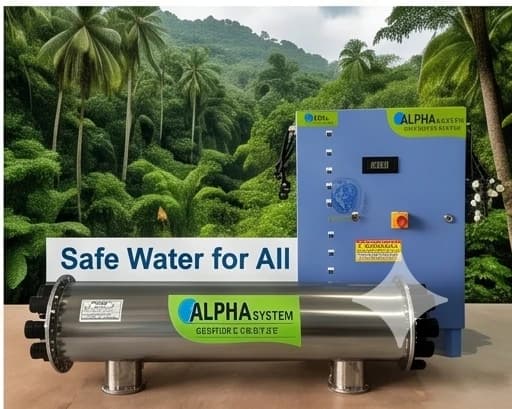
Quick Answer: UV water treatment in Ethiopia is the validated chemical-free disinfection method for EFDA-licensed packaged water plants, coffee and sesame export processing facilities requiring EU food safety water quality documentation, Addis Ababa borehole building water systems, and NGO community water projects meeting WHO-UNICEF procurement standards. Alpha UV's NSF/ANSI 55 Class A certified systems deliver 40–80 mJ/cm² validated dose with SS 316L chambers, shipping from JNPT via Djibouti Port to Addis Ababa in 18–24 days with EFDA-format compliance documentation for Ethiopian Food and Drug Authority licensing.
Ethiopia's Water Access and Quality Landscape
Ethiopia is Africa's second most populous country — 125 million people — and the continent's fastest-growing large economy, averaging 8–10 percent GDP growth over the past decade. Despite this growth trajectory, Ethiopia's water infrastructure faces profound challenges: the WHO/UNICEF Joint Monitoring Programme (JMP) estimates that only 42 percent of Ethiopia's population has access to basic drinking water services, with rural populations drawing from unprotected wells, springs, and surface water sources across the country's diverse topography.
Ethiopia's Blue Nile (Abay) river system — which originates in Lake Tana near Bahir Dar and contributes approximately 85 percent of the downstream Nile flood — provides surface water of variable quality heavily influenced by seasonal erosion and agricultural runoff. The Ethiopian rainy season (June–September) generates extreme turbidity events in highland rivers and lakes, rendering surface water sources temporarily unusable without conventional pre-treatment. UV water treatment Ethiopia is deployed as part of multi-barrier treatment systems rather than as a standalone solution for untreated surface water.
Ethiopia's growing private sector — Addis Ababa's rapidly expanding commercial real estate, the Hawassa Industrial Park (Chinese-developed garment manufacturing zone), Eastern Industrial Park, and the national coffee processing sector — creates a UV treatment demand profile increasingly aligned with international food safety and pharmaceutical standards. Ethiopian coffee (Yirgacheffe, Sidama, Harrar) commands premium prices in European and North American specialty markets; coffee washing stations and export processors are increasingly subject to GlobalG.A.P. and BRC audit requirements that include documented water quality management.
Water Source and Quality Characteristics by Region
Addis Ababa — Borehole and Reservoir Supply
Addis Ababa Water and Sewerage Authority (AAWSA) draws water from the Legedadi and Gefersa reservoirs, supplemented by extensive borehole extraction from the Akaki aquifer beneath the city. Akaki aquifer water is characterised by moderate TDS (300–800 mg/L), low turbidity (1–5 NTU under normal conditions), and variable bacterial contamination depending on proximity to informal settlement sewage infiltration zones. UVT of Addis Ababa borehole water after 5-micron cartridge filtration: typically 83–90 percent. AAWSA reservoir supply — treated conventionally — has UVT of 88–93 percent at the distribution entry point, suitable for UV polishing with cartridge pre-filtration only.
Hawassa and Rift Valley Lakes — Fluoride-Affected Groundwater
Ethiopia's Central Rift Valley — the region of Hawassa, Ziway, Langano, and Abijata lakes — has naturally high fluoride concentrations in groundwater, with recorded levels of 5–30 mg/L in rift valley wells (WHO guideline: 1.5 mg/L). The Hawassa Industrial Park, which hosts garment manufacturers (PVH Calvin Klein, H&M, Alibaba-backed factories), draws industrial water from Lake Hawassa and deep boreholes. Both sources require defluoridation pre-treatment before UV polishing for potable supply within the industrial park. Alpha UV engineers the complete treatment train — defluoridation column followed by UV reactor — for Hawassa Industrial Park potable water systems.
Jimma and Coffee-Growing Regions — Highland Stream Water
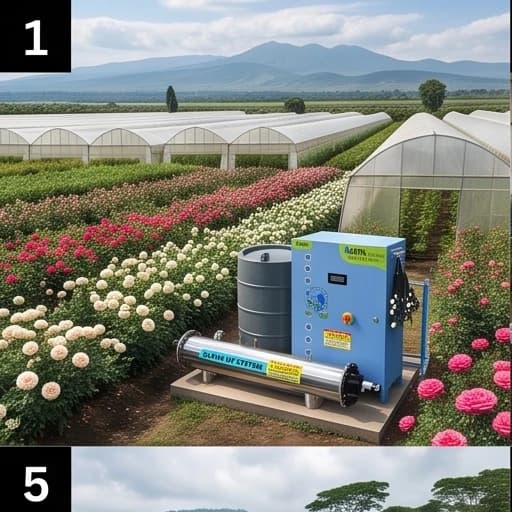
Ethiopia's coffee-growing highlands (Jimma, Kaffa, Illubabor, Sidama, Gedeo) use seasonal highland streams and springs for coffee cherry washing — the wet-processing method that produces the clean, fruity cup profile commanding premium prices in specialty coffee markets. These highland water sources are generally low TDS (50–200 mg/L) with excellent natural quality during dry season but carry elevated turbidity and bacterial loads during the rainy season (June–September). GlobalG.A.P. certification for coffee export to European retail requires documented microbial testing of washing water. UV disinfection at coffee washing stations provides the documented E. coli control that GlobalG.A.P. auditors and specialty coffee importers require.
Tigray and Afar — Arid Region Groundwater
Northern Ethiopia's Tigray region and the Afar Depression have severely water-scarce groundwater with highly variable quality — some Afar boreholes produce hot saline water from geothermal zones, while others produce acceptable quality from basaltic aquifers. NGO and UN-funded water projects in these regions (UNICEF WASH programmes, USAID, WFP) specify UV systems to WHO GDWQ standards with NSF/ANSI 55 Class A performance documentation for procurement compliance.
EFDA Regulatory Framework and International Standards
The Ethiopian Food and Drug Authority (EFDA) — previously FMHACA — regulates food and beverage production water quality, pharmaceutical water systems, and packaged drinking water under Ethiopia's Food, Medicine and Healthcare Administration and Control Proclamation. EFDA standards align with WHO international guidelines and require packaged water producers to demonstrate validated disinfection performance.
| Regulatory Body | Standard | UV Dose Requirement | Alpha UV Documentation |
|---|---|---|---|
| EFDA | Ethiopian Drinking Water Standard (ES 261:2002 / updated) | UV as approved disinfection; WHO GDWQ 40 mJ/cm² guidance adopted | NSF/ANSI 55 Class A certificate + EFDA-format technical data |
| EFDA | Food Safety standards for processing water | Microbial quality per WHO GDWQ; 0 CFU/100 mL E. coli at point of use | NSF/ANSI 55 Class A; dose delivery records for EFDA inspection |
| EFDA (pharmaceutical) | WHO-GMP aligned GMP guidelines | 80 mJ/cm² for Purified Water systems in licensed pharmaceutical plants | AU-H series 80 mJ/cm² validation report |
| GlobalG.A.P. | IFA Standard v6 (coffee and food export) | UV accepted for irrigation and process water microbial risk management | UV validation report + sensor dose delivery records |
| UNICEF / USAID | WHO GDWQ (humanitarian and development sector procurement) | 40 mJ/cm² minimum | NSF/ANSI 55 Class A; UNGM vendor registration documentation |
Key Application Sectors
Coffee Processing — Washing Stations and Export Preparation
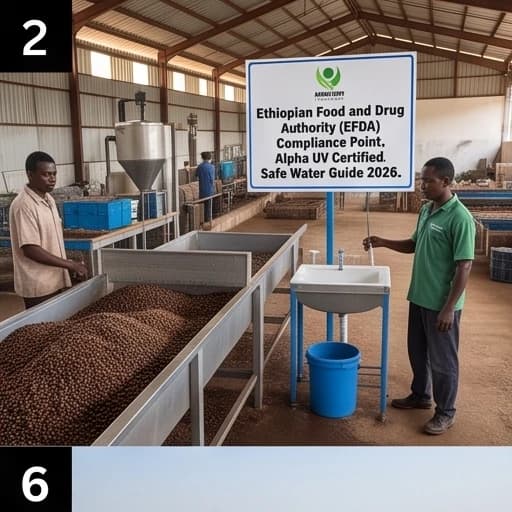
Ethiopia processes approximately 450,000 tonnes of coffee annually, of which a growing proportion (now over 40 percent) is wet-processed through washing stations. The global specialty coffee market's growing insistence on traceability and food safety documentation — led by importers such as Olam, Sucafina, and direct-trade roasters — has created demand for documented water quality management at Ethiopian washing stations. UV water treatment Ethiopia at coffee washing stations eliminates the E. coli and coliform contamination that can affect wet-processed coffee quality and triggers rejection at European importer testing. Alpha UV's AU-S series (2–5 m³/hour, compact installation, solar-compatible DC option) is specifically suited to washing stations in highland areas without grid power reliability.
Packaged Water Production
Ethiopia's bottled water market has grown rapidly alongside the Addis Ababa middle class — with brands including Ambo mineral water (state-owned), Aqua Safe, and dozens of smaller regional EFDA-licensed producers. The EFDA packaged water licensing process requires demonstrated UV or chemical disinfection at the filling point. Alpha UV's AU-M series (2–20 m³/hour) with NSF/ANSI 55 Class A certificates is the standard specification for EFDA-licensed packaged water plants across Ethiopia's major cities.
Industrial Parks — Hawassa, Bole Lemi, Eastern Industrial
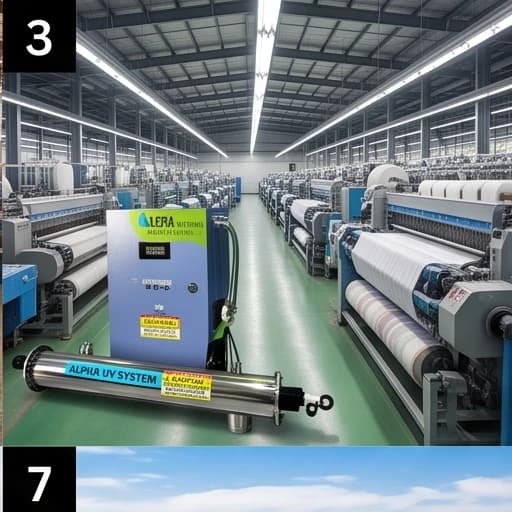
Ethiopia's government-developed industrial parks attract international garment, textile, and food processing manufacturers who operate under their home-country food safety and occupational health standards. PVH (Calvin Klein, Tommy Hilfiger), H&M, and Chinese garment manufacturers in Hawassa Industrial Park require potable water meeting WHO standards for worker consumption and garment finishing water free of microbial contamination. Alpha UV supplies UV water treatment systems to industrial park water treatment stations, sizing for the combined flow demands of multiple tenant factories within a shared water supply infrastructure.
Hospitals and Development Sector
Ethiopia's public hospital infrastructure is being upgraded with World Bank and AfDB funding — the Health Sector Transformation Plan includes hospital water and sanitation improvements. Private hospitals (Bethzatha Hospital, St. Gabriel Hospital, Black Lion Hospital affiliate projects) specify UV water treatment in hospital water supply systems. Development organisations (MSF, IRC, Oxfam) and UN agencies (UNICEF WASH, WFP) procure UV systems for refugee camp and emergency water supply in Tigray, Somali Region, and Afar, where NSF/ANSI 55 Class A certification is the standard procurement requirement.
System Design for Ethiopian Water Quality
| Application | Pre-Treatment | UV System | Target Dose |
|---|---|---|---|
| Addis Ababa borehole (Akaki aquifer) | 5μm cartridge filter | AU-S or AU-M series | 40 mJ/cm² |
| Hawassa Rift Valley (fluoride-affected) | Defluoridation → 5μm cartridge → UV | AU-S or AU-M series | 40 mJ/cm² |
| Coffee washing station (highland stream) | Sand filter → UV (dry season); Coagulation → sand filter → UV (rainy season) | AU-S series (compact / solar-compatible) | 40 mJ/cm² |
| Industrial park potable supply | Sand filter → 5μm cartridge | AU-M series | 40 mJ/cm² |
| EFDA packaged water plant | RO → UV polishing | AU-M series | 40 mJ/cm² |
| Pharmaceutical PW (EFDA-GMP) | RO + EDI | AU-H series (sanitary) | 80 mJ/cm² |
| NGO community water point | Slow sand filter → UV | AU-S series (DC power option) | 40 mJ/cm² |
CFD Optimisation for Seasonal Water Quality Variability
Ethiopia's pronounced wet and dry season cycle creates a specific reactor sizing challenge: dry season water quality (low turbidity, high UVT) and rainy season quality (elevated turbidity, reduced UVT after pre-treatment) can differ significantly at the same site. UV reactors sized purely for dry season UVT will underperform during the rainy season when pre-treatment reduces but does not eliminate turbidity effects on UVT.
Alpha UV's IIT-trained engineers addressed this seasonal variability challenge using ANSYS Fluent CFD to model reactor performance across the UVT range of 75–92 percent typical of Ethiopian water sources across seasons. The analysis resulted in automatic sensor-adjusted dose control: Alpha UV's reactors equipped with the UV-intensity feedback controller continuously adjust the system's validated operating flow rate based on real-time UVT measurement (via the built-in UV sensor), automatically reducing maximum flow to maintain the 40 mJ/cm² dose threshold when UVT drops during rainy season. An automated flow-limit alarm alerts the operator when rainy-season pre-treatment performance is insufficient to maintain dose at the full design flow rate — triggering pre-treatment maintenance before water quality is compromised at the UV stage.
Import and Logistics via Djibouti to Ethiopia
Ethiopia is landlocked, with all import cargo reaching Addis Ababa through Djibouti Port — which handles approximately 95 percent of Ethiopia's international trade — and via the Ethio-Djibouti Standard Gauge Railway (SGR) or road freight on the Djibouti-Addis Ababa corridor. This logistics route is well-established and efficient by African landlocked country standards.
Sea freight from JNPT (Nhava Sheva) or Mundra to Djibouti Port: 10–14 days. Djibouti Port customs clearance (Ethiopian Revenues and Customs Authority handles Ethiopia-bound cargo at Djibouti): 3–7 working days. SGR rail from Djibouti to Addis Ababa: 10–12 hours. Road freight alternative: 2–3 days. Door-to-Addis Ababa total transit: 18–26 working days from factory despatch. Alpha UV prepares Ethiopia import documentation including EFDA import permit application support, Certificate of Origin, commercial invoice with HS code 8421.21 classification, NSF/ANSI 55 certificates in EFDA audit format, and Amharic-language technical summaries for government inspection submissions.
Frequently Asked Questions
Can UV systems in Ethiopia operate on solar power for off-grid installations?
Yes. Alpha UV offers 24 V DC ballast options for its smaller UV systems (AU-S series, up to 3 m³/hour), directly compatible with 24 V solar-battery systems that are widely deployed in Ethiopia's rural off-grid health posts, community water points, and coffee washing stations. The DC ballast maintains stable UV lamp output across the 22–28 V range typical of 24 V battery systems under charging conditions. Larger systems (AU-M series, 5–50 m³/hour) require AC power; a 230 V AC inverter rated at 1.5× the UV system power draw provides the power supply from a solar-battery bank. Alpha UV can specify complete off-grid solar-UV system packages, sizing the solar array and battery bank for Ethiopian irradiance levels (Ethiopian Plateau: approximately 5.5–6.5 peak sun hours per day).
How does the EFDA licensing process work for packaged water plants using UV?
EFDA licensing for packaged drinking water production in Ethiopia follows a multi-step process: (1) site approval and infrastructure inspection; (2) water source quality documentation (physical, chemical, microbiological testing by EFDA-accredited laboratory); (3) treatment process review, where EFDA inspects the treatment train including UV disinfection; (4) product testing of packaged water samples. For the UV disinfection step, EFDA inspectors require documentation confirming the system delivers the minimum disinfection dose — Alpha UV's NSF/ANSI 55 Class A certificate provides this evidence in an internationally recognised format. Alpha UV also provides Amharic-language technical summaries to assist Ethiopian licensees in preparing their EFDA documentation submissions.
Does UV remove fluoride from Rift Valley borehole water in Ethiopia?
No. UV disinfection inactivates microorganisms by damaging DNA but has no effect on dissolved chemical contaminants including fluoride, arsenic, or nitrate. Rift Valley borehole water with fluoride concentrations of 5–30 mg/L requires a dedicated defluoridation system — bone char contactors (the traditional Ethiopian method documented by UNICEF), activated alumina adsorbers, or the nalgonda process using alum coagulation — before the water reaches the UV reactor. Alpha UV designs integrated treatment systems for Hawassa Industrial Park and Rift Valley applications that package the defluoridation pre-treatment with the UV reactor into a single skid-mounted system, providing a single-vendor solution for the complete treatment train.
What UNGM procurement requirements apply to UV systems for Ethiopia NGO projects?
United Nations Global Marketplace (UNGM) procurement for UV water treatment systems — used by UNICEF, WFP, UNHCR, and OCHA for Ethiopia emergency and development water projects — requires NSF/ANSI 55 Class A certification as the primary performance standard. Vendors must be UNGM-registered, and products must have independent third-party performance certification. Alpha UV maintains UNGM vendor registration and provides NSF/ANSI 55 Class A certificates, country of origin documentation, and quality management system certification (ISO 9001) required for UN procurement submissions. USAID and World Bank procurement processes for Ethiopia WASH projects similarly accept NSF/ANSI 55 Class A as the UV performance standard.
What warranty and spare parts availability does Alpha UV provide for Ethiopia installations?
Alpha UV provides an 18-month warranty on UV chamber, control electronics, and UV lamp. For Ethiopia, spare parts (UV lamps, quartz sleeves, O-rings, UV sensors) are stocked by Alpha UV's Addis Ababa authorised distributor, with replenishment from the India manufacturing plant via Djibouti as needed. Critical spare parts for planned annual maintenance (one UV lamp replacement per year is standard at 8,000 hours burn time for single-shift operation) can be pre-positioned with the distributor or shipped with the original system order as a spare parts kit. Remote diagnostics support via WhatsApp video call from Alpha UV's engineers in India provides first-line troubleshooting for Ethiopian operators.
Conclusion: UV Water Treatment Ethiopia — Validated Solutions for Africa's Fastest-Growing Economy
Ethiopia's UV water treatment opportunity is as diverse as the country itself — from specialty coffee washing stations in Yirgacheffe highland highlands seeking GlobalG.A.P. certification, to Hawassa Industrial Park garment manufacturers needing WHO-standard potable water, to UNICEF WASH projects in Tigray requiring NSF/ANSI 55-validated emergency water systems, to Addis Ababa pharmaceutical plants meeting EFDA-GMP standards. The shared requirement across all these applications is documented, internationally validated UV dose delivery that Ethiopian regulators, international food buyers, and UN procurement officers accept without question.
Alpha UV's NSF/ANSI 55 Class A certified systems — with solar-compatible DC options for off-grid coffee and NGO applications, MODBUS integration for industrial park BMS, and EFDA-format Arabic and Amharic documentation — arrive in Addis Ababa via Djibouti with the complete compliance package that eliminates Ethiopian regulatory friction. Contact Alpha UV's Africa export team for Ethiopia pricing, EFDA documentation support, and off-grid solar-UV system design consultation.
Standards, authorities & further reading
External references used to inform this guide. Regulations evolve — check the latest revision on each authority's site before compliance decisions.
Recommended UV Systems
Alpha UV System products for this application — powered by genuine Philips UV-C lamps.
Commercial UV Water Purification System
500 – 5,000 LPH
HACCP-compliant UV water purification for hotels, restaurants, and offices
Industrial UV Water Treatment System
5,000 – 50,000 LPH
Schedule M 2025 and HACCP compliant UV for pharma, food & beverage, and process water
Not sure which system suits your application? WhatsApp our engineers for a free recommendation →
Related solutions
See how Alpha UV System applies this to your industry or city.
Need a UV system?
Talk to our UV engineers — WhatsApp for a quote in 2 hours, or browse the full catalog on IndiaMART.