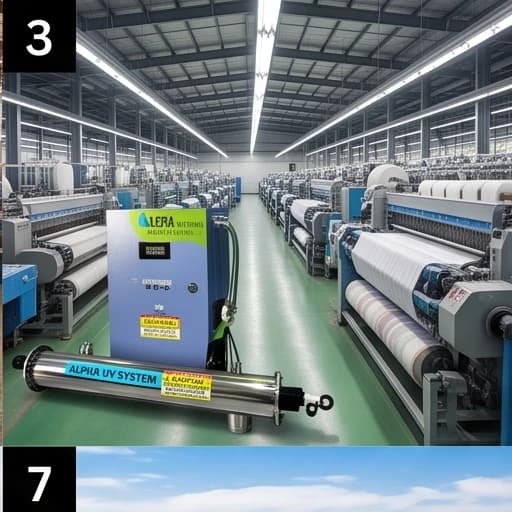
Quick Answer: UV water treatment Ethiopia textile industry is essential for the world's newest major garment manufacturing hub — Ethiopia's government-built industrial parks now house 300+ textile and garment manufacturers supplying H&M, Calvin Klein, PVH (Tommy Hilfiger), Levi's, Gap, Walmart, and Primark. The flagship Hawassa Industrial Park (HIP — Southern Nations Region, 320 km from Addis Ababa) is a 130+ company, 60,000+ worker manufacturing zone built to LEED Platinum standard — it is Africa's largest and most sustainable industrial park. GOTS v7.0 (Global Organic Textile Standard — primary certification for organic cotton fabric production at HIP) requires zero-chlorine in all process water (dyeing, finishing, washing) and validated water treatment documentation. OEKO-TEX Standard 100 and Bluesign (major synthetic fibre standards) also impose zero-Cl requirements. Key UV drivers: Hawassa Industrial Park (zero-Cl dyeing for H&M organic cotton collection; Rift Valley Lake water supply); Bole Lemi Industrial Park (BLI — Addis Ababa; same buyer standards); Adama Industrial Park (Adama, Oromia — synthetic garments); GOTS certification body (Control Union, Bureau Veritas, CERES) audit compliance; and buyer code of conduct documentation (H&M Supplier Requirements Manual, PVH Corporation Supplier Code). NSF/ANSI 55 Class A at 40 mJ/cm². Alpha UV ships to Hawassa via Addis Ababa Bole Airport (ADD) with same-day domestic courier.
Hawassa Industrial Park — Water Treatment Context
Hawassa Industrial Park (HIP) is Ethiopia's most prestigious manufacturing investment — built by China Civil Engineering Construction Corporation (CCECC), managed by IPDC (Industrial Parks Development Corporation, EIC-supervised):
- Water source — Lake Hawassa and Awash basin groundwater: HIP draws primarily from Hawassa Water Supply Project (Rift Valley Lake Hawassa — saline-influenced, TDS 200–400 ppm; UVT 68–78%); supplemented by Rift Valley highland groundwater boreholes (TDS 100–200 ppm, UVT 78–86%); alkalinity-adjusted treatment plant at HIP perimeter supplies industrial process water to factory connections
- LEED Platinum water standard: HIP's LEED Platinum certification (one of Africa's few LEED Platinum industrial facilities) requires water efficiency and treatment documentation; UV treatment contributes to LEED water quality credit and chemical-free treatment point for LEED v4 Indoor Water Quality credits
- 60,000+ worker welfare water: HIP's enormous workforce requires WHO GDWQ-compliant drinking water — potable supply from UV-treated borehole at worker canteen and dormitory complexes; OSHA Ethiopia workplace water compliance
GOTS v7.0 Water Treatment Requirements
| GOTS Requirement | Water Standard | UV Role | Alpha UV System |
|---|---|---|---|
| GOTS v7.0 Section 2.4.8 (water treatment chemicals — prohibition) | Chlorine-based disinfectants (sodium hypochlorite, calcium hypochlorite, chlorine dioxide) are prohibited in GOTS certified textile processing units for product-contact water; all water treatment must use GOTS-permitted substances | UV is explicitly GOTS-compliant as a physical (non-chemical) treatment method — UV does not introduce any chemical substance into process water; zero chemical residual; no GOTS substance restriction applies to UV | Any Alpha UV system — AU-S 8 to AU-M 30 — is inherently GOTS-compliant; NSF/ANSI 55 Class A document demonstrates validated physical treatment for GOTS certification body audit |
| GOTS v7.0 Section 3.2 (wastewater pre-treatment) | Wastewater pre-treatment from GOTS certified facilities — wastewater treatment documentation required; chemical-free input water contributes to GOTS wastewater quality targets (lower AOX — adsorbable organic halogen — in effluent when Cl not used in process water) | UV zero-Cl process water reduces AOX in textile wastewater (chlorine in dyebath reacts with textile dyes to form chlorinated organic compounds — AOX discharged in effluent); UV-treated process water lowers AOX without changing dyeing chemistry | AU-M 25 for dyeing line process water; zero Cl documentation contributes to GOTS wastewater parameter compliance at HIP ETP (Effluent Treatment Plant) |
| GOTS certification body audit (Control Union Ethiopia, Bureau Veritas) | Annual audit by GOTS-accredited certification body — checks: water treatment method and documentation; no chlorine in process water; annual water quality test | NSF/ANSI 55 Class A certificate + UV installation records submitted to GOTS certification body as water treatment evidence; certification body accepts UV documentation for GOTS process water compliance | AU-M 25, NSF/ANSI 55 Class A; documentation package includes: system specification, installation record, lamp replacement log, UVI calibration record — all required for GOTS certification body file |
Ethiopia Textile Industrial Parks UV Specifications
- Hawassa Industrial Park (HIP — 130+ companies; H&M Conscious Collection, PVH, Levi's suppliers): Rift Valley supply (UVT 68–78%); AU-M 25, zero Cl, 40 mJ/cm², GOTS documentation; 130 factories × average 1 UV system each = 130 systems; IPDC infrastructure includes centralised UV at park water supply → individual factory UV at dyeing line entry (two-stage protection)
- Bole Lemi Industrial Park (BLIP — 63+ companies; Addis Ababa): AAWSA + borehole (UVT 70–82%); H&M, Calvin Klein, Gap supply chain; AU-M 25, zero Cl, 40 mJ/cm², GOTS + OEKO-TEX documentation; BLIP factory installation density similar to HIP
- Adama Industrial Park (Adama, Oromia — synthetic fabric): Awash River (Adama/Nazret water supply, UVT 70–78%); synthetic garment manufacturers (polyester, nylon — OEKO-TEX Standard 100 and Bluesign); AU-M 25, zero Cl (OEKO-TEX prohibits Cl-based treatment for OEKO-TEX certified fabric); 40 mJ/cm²
- Dire Dawa Industrial Park (eastern Ethiopia, Djibouti corridor): Dechatu River and Dire Dawa Water Supply (UVT 70–80%); garment export via Port of Djibouti; proximity to Gulf reduces air freight costs for finished garments; same GOTS/OEKO-TEX standards as other IPDC parks
FAQ
Why does H&M's Conscious Collection require zero-chlorine water treatment at Ethiopian factories?
H&M's Conscious Collection (organic cotton and recycled material garments — H&M's sustainability product line) requires GOTS v7.0 certification from fabric to finished garment throughout the supply chain, including Ethiopian manufacturing facilities. H&M Supplier Requirements Manual (SRM) Section 5.3 (chemical management) explicitly prohibits chlorine-based disinfection in process water at GOTS-certified supplier factories — this reflects both GOTS v7.0 substance restriction and H&M's own Chemical Restriction List (H&M CRL, aligned to ZDHC MRSL). The H&M Chemical Restriction List prohibits residual chlorine (>0.1 mg/L) in any water that contacts organic cotton textile during processing — chlorine oxidises organic cotton cellulose (bleaching effect undesired for Conscious natural colours) and creates chlorinated organic by-products (AOX) in effluent (H&M's supplier Environmental Management System — EMS — includes effluent AOX compliance monitoring). UV at 40 mJ/cm² post-activated carbon is the approved chemical-free alternative in H&M SRM for Ethiopian factory water treatment at Hawassa and Bole Lemi.
What is the GOTS certification process for Ethiopian garment factories?
GOTS (Global Organic Textile Standard v7.0) certification for Ethiopian garment factories (typically final-stage manufacturers doing cut-make-trim from GOTS-certified organic cotton fabric supplied from India, Turkey, or Pakistan): (1) Factory applies to GOTS-accredited certification body (CB) operating in Ethiopia — Control Union Certifications (CU, Netherlands-based with Ethiopia representative) or Bureau Veritas (BV Ethiopia); (2) CB conducts pre-certification inspection of factory: raw material traceability, chemical management (restricted substance compliance — zero Cl), water treatment documentation, wastewater management, social criteria (Ethiopian Labour Proclamation compliance); (3) Water treatment documentation required at inspection: UV system certificate (NSF/ANSI 55 Class A), annual water quality test, UV installation record, lamp replacement log; (4) CB issues GOTS scope certificate valid 1 year (renewable annually); (5) Factory can label finished garments with GOTS logo and H&M/PVH can use GOTS claim in marketing. Annual CB re-inspection checks UV system status — lamp within service life, UVI sensor functional, water quality test current.
Standards, authorities & further reading
External references used to inform this guide. Regulations evolve — check the latest revision on each authority's site before compliance decisions.
- Central Pollution Control Board (CPCB), Government of India
- Central Ground Water Board (CGWB)
- BIS IS 10500:2012 — Drinking Water Quality Specification
- WHO — Guidelines for Drinking-water Quality (4th ed.)
- CPCB — Environment (Protection) Rules: STP Standards
- NSF/ANSI 55 — Ultraviolet Microbiological Water Treatment Systems
Recommended UV Systems
Alpha UV System products for this application — powered by genuine Philips UV-C lamps.
Commercial UV Water Purification System
500 – 5,000 LPH
HACCP-compliant UV water purification for hotels, restaurants, and offices
Industrial UV Water Treatment System
5,000 – 50,000 LPH
Schedule M 2025 and HACCP compliant UV for pharma, food & beverage, and process water
Not sure which system suits your application? WhatsApp our engineers for a free recommendation →
Related solutions
See how Alpha UV System applies this to your industry or city.
Need a UV system?
Talk to our UV engineers — WhatsApp for a quote in 2 hours, or browse the full catalog on IndiaMART.