Quick Answer: UV water treatment in Tanzania is the validated chemical-free disinfection method for TBS-licensed packaged water producers, Zanzibar resort and mainland safari lodge water systems complying with international hotel brand standards, Dar es Salaam borehole building water systems, TANESCO-powered industrial facilities, and NGO WASH projects meeting WHO-UNICEF standards. Alpha UV's NSF/ANSI 55 Class A certified systems deliver 40–80 mJ/cm² validated dose with SS 316L chambers, shipping from JNPT via Dar es Salaam Port in 14–18 days with TBS-format compliance documentation.
Tanzania's Water Quality Landscape and UV Treatment Opportunity
Tanzania is East Africa's largest country by area and among the fastest-growing economies on the continent, driven by gold mining, tourism (Serengeti, Ngorongoro, Kilimanjaro, Zanzibar), natural gas development (Rufiji basin, Lindi), and an expanding manufacturing sector in the Dar es Salaam Special Economic Zone. Tanzania's water supply is managed by the Energy and Water Utilities Regulatory Authority (EWURA) through a network of urban water authorities — the Dar es Salaam Water and Sewerage Authority (DAWASA), and 22 urban water authorities in regional capitals — and the Ministry of Water's rural water supply programme.
Despite substantial investment in urban water infrastructure, Tanzania faces persistent water quality challenges: JMP estimates that approximately 57 percent of the population has access to basic water services, with the rural majority dependent on surface water, unprotected springs, and shallow wells of variable quality. Dar es Salaam's rapidly growing population — now estimated at 7–8 million — has outpaced DAWASA's supply capacity; water scarcity and supply intermittency in peri-urban wards like Ukonga, Goba, and Bunju drive extensive borehole extraction for commercial and residential use.
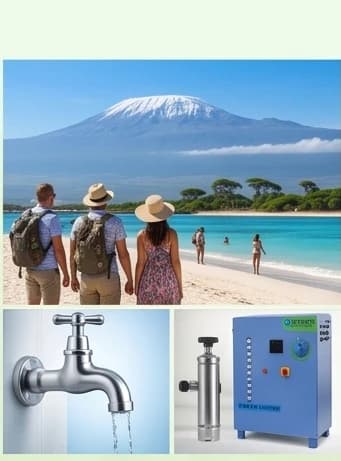
Tanzania's tourism sector — contributing approximately 17 percent of GDP in pre-pandemic years and rapidly recovering — creates a high-value UV water treatment demand for international hotel and safari lodge water systems. Operators of Serengeti and Ngorongoro lodges, Zanzibar beach resorts, and Kilimanjaro mountain lodges require international hotel brand-standard water quality (NSF/ANSI 55 documentation) in extremely remote locations that make chemical-dependent treatment impractical.
Water Source and Quality by Region
Dar es Salaam — Ruvu River and Coastal Aquifer
DAWASA draws water from the Ruvu River (both Upper Ruvu at Morogoro and Lower Ruvu at Bagamoyo) and distributes treated water to Dar es Salaam via aging transmission mains. Ruvu River water quality varies seasonally: dry season turbidity of 10–50 NTU, rainy season (March–May, November–December) turbidity of 200–2,000 NTU. After conventional treatment at Ruvu Water Treatment Works, Dar es Salaam supply UVT is typically 82–90 percent — adequate for UV polishing with 5-micron pre-filtration.
Dar es Salaam's coastal aquifer is exploited extensively by commercial buildings, hotels, and industrial facilities in Msasani Peninsula, Oysterbay, Masaki, Kariakoo, and the Dar es Salaam industrial area. Coastal borehole water quality ranges from excellent (deep boreholes in the Kijitonyama aquifer: TDS 200–400 mg/L, low iron) to brackish (shallow coastal boreholes near Coco Beach and Masaki: TDS 1,000–4,000 mg/L). RO pre-treatment is required for saline coastal boreholes before UV polishing.
Zanzibar — Coral Limestone Aquifer and Resort Desalination
Zanzibar's water supply is sourced from the coral limestone aquifer underlying the islands (Unguja and Pemba), supplemented by desalination for resort areas where coastal saltwater intrusion has rendered near-shore boreholes unusable. Zanzibar's Zana Water Corporation supplies the urban areas of Stone Town and Zanzibar City, but the rapidly developing resort corridor (North Coast, East Coast beaches from Nungwi to Jambiani) is almost entirely self-supplied through resort-level desalination and UV systems. International hotel brands operating in Zanzibar — Melia, Constance, Park Hyatt, Riu, Bracco collection properties — all specify UV in their resort water systems as part of their global engineering standards. NSF/ANSI 55 documentation is mandatory for these specifications.
Kilimanjaro Region — Mountain Spring Water
Kilimanjaro's KKKT springs (Chagga highland springs) and Moshi municipal supply draw from Mount Kilimanjaro's snow and glacier melt — one of Tanzania's highest-quality natural water sources, with TDS of 50–150 mg/L and naturally low turbidity. However, population growth in Moshi and the coffee-growing Kilimanjaro foothills has increased surface contamination risk from agricultural and settlement runoff. Kilimanjaro airport and the growing conference and lodge sector in Arusha and Moshi specify UV water treatment for premium water quality assurance in upmarket accommodation.
Lake Victoria Zone — Northwestern Tanzania
Tanzania's Lake Victoria shoreline cities (Mwanza, Musoma, Bukoba) draw from Lake Victoria — a source shared with Kenya and Uganda. Lake Victoria water is characterised by heavy algal growth (cyanobacteria blooms in inshore areas), elevated turbidity (5–50 NTU), and significant microbial contamination from lakeside settlements. Conventional treatment (coagulation, sedimentation, filtration, chlorination) is standard at Mwanza Urban Water Supply Authority's treatment works, but post-distribution quality deteriorates rapidly in the aging Mwanza distribution network. Commercial buildings and hotels in Mwanza specify UV at building entry level.
TBS Regulatory Framework and EAC Water Standards
Tanzania Bureau of Standards (TBS) administers EAS 12:2014 (East African Community Drinking Water Quality Standard) — the same EAC standard applicable in Kenya, Uganda, and Rwanda — as Tanzania's national drinking water quality standard. TBS also implements Tanzania's mandatory product certification programme for imported goods, including water treatment equipment falling under mandatory standards. UV water treatment systems require TBS Third Party Verification certification from an accredited inspection body before import.
| Regulatory Body | Standard | UV Requirement | Alpha UV Documentation |
|---|---|---|---|
| TBS | EAS 12:2014 (Drinking Water / EAC standard) | UV as approved disinfection; 40 mJ/cm² for 4-log E. coli reduction | NSF/ANSI 55 Class A certificate + TBS TPV inspection report |
| TFDA | Tanzania Food and Drugs Authority (packaged water) | Validated disinfection at filling point; TFDA licensing inspection | NSF/ANSI 55 Class A certificate in TFDA submission format |
| TFDA (pharmaceutical) | WHO-GMP aligned GMP standards | 80 mJ/cm² in pharmaceutical PW loops | AU-H series 80 mJ/cm² validation documentation |
| Tanzania Tourism Board / Hotel standards | Hotel star classification criteria (water quality) | International hotel brand engineering standards (NSF/ANSI 55) | NSF/ANSI 55 certificate for hotel brand engineering review |
| UNICEF / USAID | WHO GDWQ (NGO and development procurement) | 40 mJ/cm² minimum; NSF/ANSI 55 Class A | NSF/ANSI 55 certificate; UNGM vendor registration |
Key Application Sectors
Tourism — Safari Lodges and Zanzibar Beach Resorts
Tanzania's tourism sector hosts some of Africa's most iconic properties — Singita, &Beyond, Asilia Africa, Nomad Tanzania, Four Seasons Serengeti, and Zanzibar's luxury beach resorts. These properties operate in extremely remote locations (Serengeti, Selous, Ruaha, Mahale Mountains) where chemical resupply (chlorine tablets or cylinders) is logistically complex and potentially disruptive to the wilderness experience. UV water treatment Tanzania at safari lodge level provides chemical-free, sensor-verified disinfection from borehole or small stream sources without the chemical management infrastructure that chlorination requires.
International safari lodge operators specify UV systems to NSF/ANSI 55 standards because their guests are drawn from the same European and North American markets where NSF certification is the standard consumer protection framework. Lodge operators' liability exposure from waterborne illness among high-value guests makes validated, documented UV performance a business necessity, not merely a regulatory requirement. Alpha UV's compact AU-S series (1–5 m³/hour), solar-DC powered for off-grid lodge applications, with MODBUS telemetry for remote lodge management monitoring, is the specification solution for Tanzania's safari lodge UV market.
Packaged Drinking Water
Tanzania's packaged water market has grown rapidly, with TFDA-licensed producers in Dar es Salaam, Arusha, Moshi, and Zanzibar serving the expanding urban middle class and the tourism sector. TFDA licensing requires documented disinfection performance — NSF/ANSI 55 Class A certification accepted by TFDA inspectors as the primary performance evidence. Alpha UV's AU-M series (5–50 m³/hour) is the specification choice for Tanzania's larger packaged water production plants serving national distribution.
Manufacturing and Industrial Parks
Tanzania's Special Economic Zones — Dar es Salaam EPZ (Benjamin William Mkapa SEZ), Mtwara EPZ, and the emerging Bagamoyo Port SEZ — attract manufacturing investment in garments, agro-processing, and light manufacturing that requires documented process water quality. UV water treatment Tanzania in EPZ food processing facilities (cashew processing, horticulture packing for EU export) requires BRC or GlobalG.A.P. format documentation. Alpha UV's AU-M series provides the NSF/ANSI 55 documentation that BRC auditors accept for Tanzania EPZ food export facilities.
Healthcare and NGO
Tanzania's rural health centre and district hospital network — being upgraded under the Big Results Now (BRN) health programme and World Bank SWASH+ project — includes water supply improvement as a key component. UNICEF WASH Tanzania specifies UV in rural water point systems where the solar-powered AU-S DC variant eliminates grid power dependency. MSF, IRC, and Oxfam programmes in South Sudan border areas and refugee camps (Nyarugusu, Nduta, Mtendeli) procure UV systems through UNGM-registered vendors with NSF/ANSI 55 Class A certification as the mandatory procurement standard.
System Design for Tanzanian Water Sources
| Application | Pre-Treatment | UV System | Target Dose |
|---|---|---|---|
| Dar es Salaam deep borehole (clean) | 5μm cartridge filter | AU-S or AU-M series | 40 mJ/cm² |
| Dar es Salaam coastal borehole (saline) | RO → 5μm cartridge → UV | AU-S or AU-M series | 40 mJ/cm² |
| Zanzibar resort (desalination) | SWRO → UV polishing | AU-S series | 40 mJ/cm² |
| Safari lodge (borehole, off-grid) | Sand filter → 5μm cartridge | AU-S series (24 V DC / solar) | 40 mJ/cm² |
| Lake Victoria treated supply (building) | 5μm cartridge filter | AU-S or AU-M series | 40 mJ/cm² |
| TFDA packaged water plant | RO → UV polishing | AU-M series | 40 mJ/cm² |
| Pharmaceutical / hospital PW | RO + EDI or 0.2μm | AU-H series (sanitary) | 80 mJ/cm² |
CFD Optimisation for Off-Grid Safari Lodge Pulsed-Demand Applications
Tanzania's safari lodge UV application presents the most demanding hydraulic profile in Alpha UV's product range: remote borehole sources, solar-battery power supply, flow rates of 1–5 m³/hour serving lodge kitchens, guest room plumbing, and laundry, with highly pulsed demand patterns across the day. Lodge water consumption peaks sharply at guest wake-up time (7:00–8:30 AM, shower demand) and again during food preparation (17:00–19:00 PM), with near-zero flow during midday game drive hours.
Alpha UV's IIT-trained engineers modelled this pulsed-demand profile in ANSYS Fluent CFD — evaluating how the UV reactor's hydraulic performance at 10–120 percent of rated flow affects Reduction Equivalent Dose (RED) efficiency. The analysis confirmed that Alpha UV's AU-S geometry, with its compact cylindrical reactor and coaxial lamp-to-sleeve geometry optimised for flows in the 1–5 m³/hour range, maintains RED efficiency above 0.88 from 20–120 percent of rated flow. Below 20 percent of rated flow (during near-zero lodge demand), the system's automatic standby mode reduces lamp power to minimum while maintaining lamp warm temperature, enabling rapid dose restoration within 10 seconds of flow resumption — without the 3–5 minute warm-up delay of a cold-start UV lamp that can allow unpurified water to pass through during peak morning demand events.
Import Logistics via Dar es Salaam Port
Dar es Salaam Port is Tanzania's primary import gateway, handling approximately 95 percent of Tanzania's container trade. The Tanzania Ports Authority (TPA) has invested significantly in port modernisation, with the Tanzanian government's Big Port expansion programme adding new container berths. India-Tanzania shipping is served by multiple weekly container services.
Sea freight from JNPT (Nhava Sheva) to Dar es Salaam: 14–18 days via direct services or via Colombo transshipment. Alternative Mombasa transshipment adds 2–3 days for final delivery to Dar es Salaam by coastal feeder or road. Tanzania Revenue Authority (TRA) customs clearance at Dar es Salaam: 3–7 working days with complete documentation. Alpha UV prepares Tanzania import documentation including: TBS Third Party Verification (TPV) certificate from accredited inspection body at Indian factory, Certificate of Origin, NSF/ANSI 55 certificates in TFDA submission format, commercial invoice with HS 8421.21, and packing list. For off-grid safari lodge UV systems being air-freighted to remote airstrips (Seronera, Mwagusi, Grumeti), Alpha UV coordinates lightweight packaging and Tanzanian Aviation Authority cargo documentation.
Frequently Asked Questions
Can UV systems work in remote Serengeti lodge locations with only solar power?
Yes. Alpha UV's AU-S series is available with a 24 V DC ballast that operates directly from a 24 V solar-battery system — the standard power configuration in Serengeti, Selous, and Ruaha lodge infrastructure. The 24 V DC ballast handles the 22–28 V range typical of 24 V battery banks across the charge cycle without requiring an inverter. Power consumption of the AU-S DC system (1–5 m³/hour flow rates) is 40–120 W, requiring a modest solar array (200–400 W panels) and battery bank (100–200 Ah at 24 V) for continuous 24-hour operation. Alpha UV can specify the complete solar-UV system — panel size, battery bank, charge controller, UV reactor, and filter pre-treatment — as an integrated package for remote Tanzania lodge water systems.
What TBS documentation is required to import UV systems to Tanzania?
Tanzania Bureau of Standards (TBS) requires Third Party Verification (TPV) certification for imported goods under mandatory product standards. For UV water treatment systems, an accredited inspection body (Bureau Veritas, SGS, or Intertek) conducts pre-shipment inspection at Alpha UV's factory in Ahmedabad, verifying that the UV system conforms to the applicable standard (NSF/ANSI 55 Class A or EAC equivalent). The TPV certificate is lodged with TBS and Tanzania Revenue Authority before shipment. Without a valid TBS TPV certificate, goods may be held at Dar es Salaam Port pending destination inspection, which causes significant delays. Alpha UV manages the TBS TPV inspection scheduling as part of the standard Tanzania export process, with typical inspection completion within 3–5 working days of production readiness.
How does UV protect Zanzibar resort guests from waterborne disease risk?
Zanzibar's coral limestone aquifer water — the source for most beach resort boreholes — generally has low turbidity and low TDS, but bacterial contamination from septic tank infiltration near resort buildings and from shallow coastal wells with seawater mixing creates microbial risk. UV disinfection at 40 mJ/cm² achieves >4-log (99.99%) inactivation of E. coli, Salmonella, Vibrio cholerae (the cholera pathogen), Hepatitis A virus, and Cryptosporidium — the primary pathogens responsible for travellers' diarrhoea and serious waterborne illness in tourist populations. Chemical-free UV treatment leaves no taste or odour in Zanzibar's naturally fresh borehole water, maintaining the premium water quality experience that luxury resort guests expect. NSF/ANSI 55 certification provides the documented, auditable performance evidence that international hotel brands' engineering departments require for property water safety certification.
What is the lead time for UV system delivery to Tanzania for an urgent project?
For standard Alpha UV systems (AU-S or AU-M series from stock), factory despatch from Ahmedabad is within 5–7 working days of order confirmation and advance payment receipt. Sea freight transit to Dar es Salaam: 14–18 days. TRA customs clearance: 3–7 days. Total door delivery to Dar es Salaam: 22–30 working days from order. For urgent lodge or resort projects with tight commissioning deadlines, Alpha UV can air freight to Julius Nyerere International Airport (DAR), with factory-to-Dar transit of 3–5 days total (factory despatch 1–2 days, air transit 2–3 days, customs 1 day). Air freight cost is significantly higher than sea freight and is recommended only for genuinely critical-path project items.
Is after-sales service available for UV systems in remote Tanzania locations?
Alpha UV maintains an authorised service partner in Dar es Salaam who stocks UV lamps, quartz sleeves, O-rings, and sensor units for Alpha UV systems. For remote lodge installations in Serengeti, Selous, and Ruaha, spare parts are air-freighted to the nearest bush airstrip on Tanzania Air Services or Air Excel scheduled flights, or via lodge supply aircraft. Annual maintenance visits are coordinated through Alpha UV's Dar es Salaam service partner, with the lodge operator's maintenance team trained to perform routine lamp replacement and sleeve inspection between service visits. Remote diagnostics support from Alpha UV's engineers via WhatsApp satellite internet from the lodge resolves the majority of operational issues without requiring a technical site visit.
Conclusion: UV Water Treatment Tanzania — Validated Performance from Zanzibar to the Serengeti
Tanzania's UV water treatment market spans the full spectrum of operating conditions — from Zanzibar resort SWRO polishing where post-RO UVT exceeds 95 percent, to remote Serengeti lodge boreholes with solar-DC UV systems operating in the wilderness without grid power, to Dar es Salaam commercial borehole systems serving the growing urban middle class, to UNICEF WASH refugee camp systems requiring NSF/ANSI 55 procurement compliance. This breadth of applications demands UV technology that is genuinely versatile: solar-compatible DC options, compact safari lodge configurations, high-flow industrial park systems, and pharmaceutical-grade sanitary designs.
Alpha UV's product range — engineered by IIT-trained engineers, validated by NSF/ANSI 55 Class A biodosimetry, and CFD-optimised for pulsed safari lodge demand profiles and Tanzania's diverse water quality — delivers validated performance across this entire spectrum. From Nungwi beach resort to Ngorongoro Crater to Mwanza Lake Victoria shore — UV water treatment Tanzania from Alpha UV is the documented, certified, chemical-free disinfection solution that Tanzania's tourism, industrial, and development sectors depend on.
Contact Alpha UV's Africa export team for Tanzania pricing, TBS TPV documentation support, and off-grid safari lodge UV system design.
Standards, authorities & further reading
External references used to inform this guide. Regulations evolve — check the latest revision on each authority's site before compliance decisions.
Recommended UV Systems
Alpha UV System products for this application — powered by genuine Philips UV-C lamps.
Commercial UV Water Purification System
500 – 5,000 LPH
HACCP-compliant UV water purification for hotels, restaurants, and offices
Industrial UV Water Treatment System
5,000 – 50,000 LPH
Schedule M 2025 and HACCP compliant UV for pharma, food & beverage, and process water
Not sure which system suits your application? WhatsApp our engineers for a free recommendation →
Related solutions
See how Alpha UV System applies this to your industry or city.
Need a UV system?
Talk to our UV engineers — WhatsApp for a quote in 2 hours, or browse the full catalog on IndiaMART.