Quick Answer: UV water treatment in Uganda is the validated chemical-free disinfection method for UNBS-licensed packaged water plants, Lake Victoria treatment chain polishing in Kampala and Jinja, agro-processing export facilities meeting EU food safety water standards, hospital and pharmaceutical water systems, and NGO community water projects. Alpha UV's NSF/ANSI 55 Class A certified systems deliver 40–80 mJ/cm² validated dose with SS 316L chambers, shipping from JNPT via Mombasa Port and road freight to Kampala in 18–24 days with UNBS-format compliance documentation.
Uganda's Water Situation and UV Treatment Market Context
Uganda — the Pearl of Africa — is a landlocked East African nation of approximately 48 million people with an economy increasingly driven by oil development (Kingfisher and Tilenga fields in the Albertine Graben), coffee export, agro-processing, and a growing services sector. Uganda's water supply is managed by National Water and Sewerage Corporation (NWSC) in urban areas and the Ministry of Water and Environment (MWE) in rural areas. Lake Victoria — which Uganda shares with Kenya and Tanzania — is the primary water source for Kampala, Jinja, and the Lake Victoria basin cities.
Uganda's NWSC supply reaches approximately 77 percent of urban residents with piped water, but distribution system reliability varies significantly across Kampala's zones. Kawempe, Makindye, and Rubaga divisions experience regular supply interruptions of 12–24 hours, driving commercial buildings and institutions to supplement with borehole extraction. Ugandan groundwater quality is generally good in highland areas (Kabale, Mbale, Fort Portal) — naturally low TDS from basement aquifer sources — but near Lake Victoria's shoreline and in Kampala's densely settled areas, shallow groundwater is bacterially contaminated.
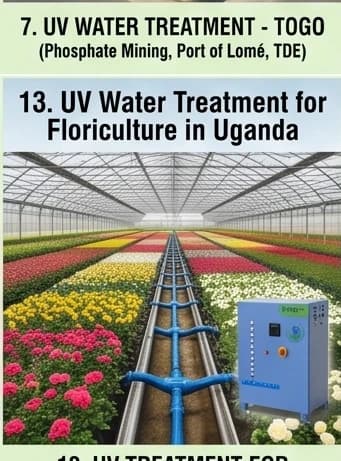
The UV water treatment Uganda market is led by institutional demand: international NGOs, UN agencies, faith-based hospital networks (Mengo Hospital, Mulago National Referral, St. Francis Hospital Nsambya), and the growing private hotel sector in Kampala and at gorilla trekking lodges in the Bwindi and Mgahinga areas near the DRC border. The agro-processing sector — Uganda coffee (Robusta and Arabica), vanilla, cocoa, sesame, and cut flowers for European markets — increasingly requires documented water quality management for GlobalG.A.P. and BRC compliance.
Water Source and Quality by Region
Kampala — Lake Victoria Supply and Borehole Extraction
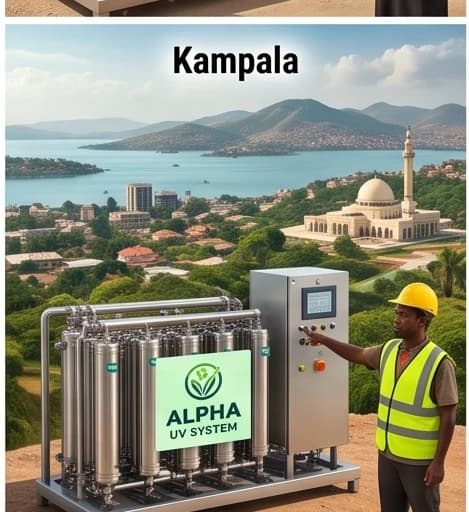
NWSC Kampala draws from Lake Victoria at Ggaba Water Works (two intake points), treating approximately 240,000 m³/day through conventional treatment (coagulation, clarification, rapid sand filtration, chlorination) before distribution. Lake Victoria water at Ggaba intake shows seasonal quality variation: dry season turbidity 5–30 NTU, algal cyanobacteria blooms during March–May rains reduce UVT to 72–80 percent at the intake. After conventional treatment, NWSC supply UVT at the building entry point is typically 84–91 percent — suitable for UV polishing with 5-micron cartridge pre-filtration.
Kampala's borehole water varies by zone: Kololo and Naguru (hillside areas) boreholes draw from crystalline basement aquifer with TDS 150–350 mg/L and good microbial quality from depth. Nakawa and Ntinda Industrial Area boreholes show elevated bacterial contamination from industrial zone sewage infiltration, with TDS 400–900 mg/L. Iron levels of 0.5–3 mg/L are common in Kampala borehole water, requiring iron removal pre-treatment before UV to prevent quartz sleeve fouling.
Jinja — Nile Source and Owen Falls
Jinja, Uganda's industrial capital on the Nile source at Lake Victoria's outlet, draws water from the Victoria Nile — among East Africa's cleanest large river water sources (TDS 70–150 mg/L, turbidity 2–10 NTU dry season). Jinja's Clive Road waterworks treats Victoria Nile water to UNBS standards. Industrial facilities in Jinja's industrial estate (Kakira Sugar, Uganda Breweries, Nile Breweries, Roofings Group) use this treated water supplemented by borehole extraction for process water. Jinja's clean source water makes it one of Uganda's most UV-friendly environments — post-conventional treatment, UVT reaches 90–95 percent, allowing direct UV installation with minimal pre-treatment.
Fort Portal, Kabale, and Western Highlands — Mountain Spring Water
Western Uganda's highland areas (Kabale, Fort Portal, Kisoro, Bundibugyo) have excellent groundwater quality — crystalline basement aquifer springs and boreholes with TDS 50–200 mg/L, naturally low turbidity, and low microbial loads from the protected forest catchments. These areas host Uganda's gorilla trekking tourism lodges (Bwindi Impenetrable Forest, Mgahinga) — expensive luxury properties that specify UV water treatment despite excellent source water as a quality assurance and guest safety measure, consistent with international safari lodge standards.
Northern Uganda — Gulu and Lira Post-Conflict Water Recovery
Northern Uganda's major cities (Gulu, Lira, Soroti) are recovering from decades of LRA conflict that left water infrastructure damaged. NWSC is extending services to northern cities under World Bank and AfDB-funded programmes. NGO WASH projects in northern Uganda — UNICEF, IRC, Oxfam, and local organizations — have deployed UV water treatment in community water kiosks, health centre water systems, and school water supply as part of the post-conflict reconstruction WASH response. NSF/ANSI 55 Class A documentation is required for NGO procurement in these programmes.
UNBS Regulatory Framework and EAC Standards
Uganda National Bureau of Standards (UNBS) administers EAS 12:2014 (East African Community Drinking Water Quality Standard) — Uganda's national drinking water standard — and operates a mandatory certification scheme for imported goods including water treatment equipment. The Uganda Registration Services Bureau (URSB) and UNBS jointly administer import standards compliance. Uganda National Drug Authority (NDA) regulates pharmaceutical water systems under WHO-GMP aligned guidelines.
| Regulatory Body | Standard | UV Requirement | Alpha UV Documentation |
|---|---|---|---|
| UNBS | EAS 12:2014 (Drinking Water / EAC standard) | UV as approved disinfection; 40 mJ/cm² for 4-log E. coli reduction | NSF/ANSI 55 Class A certificate + UNBS-format technical data |
| UNBS | Mandatory certification for imported water treatment equipment | Pre-shipment conformity assessment (PSCA) from accredited inspection body | Bureau Veritas / SGS PSCA certificate arranged by Alpha UV |
| NDA Uganda | WHO-GMP aligned pharmaceutical guidelines | 80 mJ/cm² for Purified Water in licensed pharmaceutical plants | AU-H series 80 mJ/cm² validation; WHO-GMP Annex 4 documentation |
| NEMA Uganda | National Environment Management Authority (effluent standards) | UV for effluent polishing in licensed discharge permits | Dose verification at commissioning for NEMA compliance records |
| UNICEF / WHO | WHO GDWQ (humanitarian and NGO procurement) | 40 mJ/cm² minimum; NSF/ANSI 55 Class A | NSF/ANSI 55 certificate; UNGM registration documentation |
Key Application Sectors
Packaged Water Production
Uganda's packaged water market has expanded rapidly with urbanisation and middle-class growth. UNBS-licensed packaged water brands including Cool Pure, Mountain Dew (Uganda), and dozens of regional producers serve Kampala's retail market. UNBS licensing requires documented disinfection performance at the filling point — NSF/ANSI 55 Class A certificates accepted as the standard performance evidence. Alpha UV's AU-M series (5–30 m³/hour) is specified in UNBS-licensed packaged water plants across Kampala and Jinja.
Coffee and Agro-Processing Export
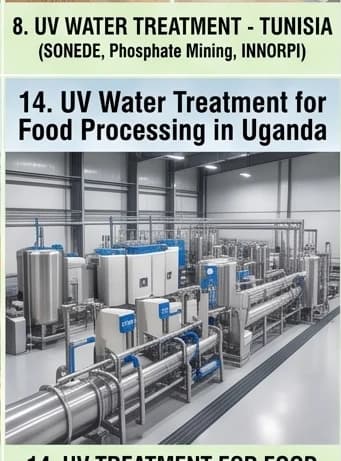
Uganda is the second-largest coffee exporter in Africa (after Ethiopia) and among the world's leading vanilla, cocoa, and sesame producers. Ugandan coffee — both Robusta (Lake Victoria basin) and Arabica (Elgon, Rwenzori highlands) — is increasingly sold to specialty roasters who require GlobalG.A.P. certification from their supply chain, including documented water quality management at wet processing stations. Vanilla and cocoa processors exporting to the EU require BRC Global Standard water quality documentation. UV water treatment Uganda at coffee washing stations, vanilla curing facilities, and cocoa fermentation centres provides the chemical-free, documented disinfection that EU food safety auditors require.
Hotels and Tourism Lodges
Kampala's international hotel sector — Serena Hotel, Sheraton Kampala, Protea Hotel by Marriott, Mestil Hotel, and the growing boutique hotel market — specifies UV water treatment as part of hotel water safety management. Gorilla trekking lodge operators in Bwindi (Sanctuary Gorilla Forest Camp, Mahogany Springs Lodge, Clouds Mountain Gorilla Lodge) and Mgahinga specify UV at lodge water supply as a standard feature consistent with international safari lodge engineering standards. NSF/ANSI 55 documentation is the standard international hotel brand requirement for UV system specification.
Healthcare and Faith-Based Hospitals
Uganda's hospital network — Mulago National Referral Hospital, Mengo Hospital, St. Francis Hospital Nsambya, Lacor Hospital (Gulu), and Uganda's growing private hospital sector — requires UV water treatment for dialysis pre-treatment, CSSD (central sterile services) water, patient ward supply, and pharmaceutical compounding water. NDA Uganda GMP auditors require 80 mJ/cm² UV in pharmaceutical Purified Water loops. World Vision, USAID HEAL Uganda, and faith-based hospital improvement programmes fund UV system installations in upcountry district hospitals.
System Design for Ugandan Water Sources
| Application | Pre-Treatment | UV System | Target Dose |
|---|---|---|---|
| Kampala borehole (iron-affected) | Iron removal → 5μm cartridge | AU-S or AU-M series | 40 mJ/cm² |
| NWSC Lake Victoria supply (building entry) | 5μm cartridge filter | AU-S series | 40 mJ/cm² |
| Jinja Victoria Nile supply (clean) | 5μm cartridge filter only | AU-S series | 40 mJ/cm² |
| Highland spring (western Uganda lodge) | 5μm cartridge filter | AU-S series (DC / solar option) | 40 mJ/cm² |
| Coffee washing station | Sand filter → UV (dry season); extended pre-treatment rainy season | AU-S series | 40 mJ/cm² |
| UNBS packaged water plant | RO → UV polishing | AU-M series | 40 mJ/cm² |
| Pharmaceutical PW (NDA-GMP) | RO + EDI | AU-H series (sanitary) | 80 mJ/cm² |
CFD Reactor Design for Lake Victoria Basin Water
Lake Victoria's unique water chemistry presents a specific UV reactor design consideration: the lake is undergoing progressive eutrophication from agricultural runoff and lakeside population growth, leading to increasing cyanobacteria (blue-green algae) concentrations in inshore abstraction zones used by NWSC Ggaba and the Jinja water works. Cyanobacteria cells — when present in treated water at post-filtration concentrations — absorb UV energy at 254 nm more strongly per unit turbidity than mineral turbidity particles, reducing UVT at a given turbidity level. Alpha UV's IIT-trained engineers modelled this cyanobacteria-turbidity UVT relationship in ANSYS Fluent CFD simulations to confirm that the reactor's dose delivery performance at the UVT range observed in Lake Victoria-derived supply (after conventional treatment and 5-micron cartridge filtration: 82–91 percent) meets the 40 mJ/cm² target across the full seasonal range.
The CFD analysis specifically addressed the minimum seasonal UVT scenario (82 percent, occurring during peak algal bloom periods in March–May) and confirmed that Alpha UV's AU-S and AU-M series maintain RED efficiency of 0.86 at 82 percent UVT at rated flow — delivering a safe margin above the 40 mJ/cm² minimum. This seasonal performance assurance means Kampala commercial building operators do not need to reduce UV system flow rate during the short rains algal bloom period — maintaining water supply continuity without compromising disinfection performance.
Logistics to Uganda via Mombasa
Uganda is landlocked, with over 85 percent of import cargo arriving via Mombasa Port in Kenya, and then transported by road (the Northern Corridor: Mombasa–Nairobi–Kampala) or Standard Gauge Railway (SGR) from Mombasa to Naivasha and then road to Kampala. The Mombasa–Kampala corridor is one of East Africa's busiest and best-managed trade routes, with competitive freight rates and reliable transit times.
Sea freight from JNPT (Nhava Sheva) to Mombasa: 10–14 days. Mombasa customs clearance (Kenya): 3–7 days. Road freight Mombara–Kampala (1,200 km via Nairobi): 3–5 days. Total factory-to-Kampala transit: 18–26 working days. Alpha UV prepares Uganda import documentation including: UNBS Pre-Shipment Conformity Assessment (PSCA) certificate, NSF/ANSI 55 Class A certificates in UNBS format, Certificate of Origin, commercial invoice (HS 8421.21), and packing list. Uganda Revenue Authority (URA) clearance in Kampala is handled by the Ugandan importer's clearing agent using documents pre-cleared at Mombasa for transit goods under the EAC Customs Union transit bond system.
Frequently Asked Questions
Does UNBS accept NSF/ANSI 55 as performance evidence for UV systems in Uganda?
Yes. UNBS evaluates UV water treatment systems against EAS 12:2014 (the EAC drinking water standard) requirements for disinfection performance. NSF/ANSI 55 Class A — validated at an independent US EPA-approved laboratory using MS2 bacteriophage and Bacillus subtilis spore challenge organisms — is accepted by UNBS as the definitive performance evidence for UV system compliance. UNBS also requires Pre-Shipment Conformity Assessment (PSCA) certification from an accredited inspection body (Bureau Veritas, SGS, or Intertek) conducted at Alpha UV's factory before shipment. Alpha UV arranges PSCA inspection as a standard part of Uganda export orders, ensuring import clearance without delays at Kampala.
How does UV handle Lake Victoria algae in Kampala building water systems?
UV disinfection inactivates cyanobacteria (blue-green algae cells) — including Microcystis, Anabaena, and Cylindrospermopsis species prevalent in Lake Victoria — by damaging their DNA at 254 nm wavelength. At 40 mJ/cm², UV achieves >4-log inactivation of cyanobacteria cells, eliminating the microbial risk they carry. However, UV does not degrade microcystin and other cyanotoxins that cyanobacteria release when their cells are lysed — a process that can actually be accelerated by UV. For Lake Victoria-derived supply with significant algal bloom events, Alpha UV recommends: (1) a 5-micron pre-filter to remove intact algal cells before UV, minimising lysis-induced toxin release; (2) activated carbon post-filtration where cyanotoxin presence is a concern in the source water. The NWSC conventional treatment (coagulation, sedimentation, filtration) upstream of the building UV system removes the majority of algal cell burden, making the building-entry UV polishing step safe for daily operation.
What is the power situation for UV systems in Kampala given load shedding?
UEDCL (Uganda Electricity Distribution Company) supply to Kampala typically delivers 10–16 hours per day of grid power, with load shedding schedules varying by zone and season. Alpha UV's SMPS ballasts (180–265 V AC) handle the voltage fluctuations typical of UEDCL supply. For commercial buildings and hospitals requiring continuous 24-hour UV operation, connection to a diesel generator (standard in Kampala commercial buildings) or a dedicated UPS provides uninterrupted power during load shedding. Alpha UV's automatic restart function restores validated UV operation within 5 minutes of power restoration. For NGO community water systems in northern Uganda where generator supply is impractical, the AU-S DC variant with solar power is specified.
Can Alpha UV systems be used for wastewater effluent polishing at Ugandan industrial plants?
Yes. UV disinfection of treated industrial and municipal wastewater effluent — to meet NEMA Uganda discharge standards before release to receiving water bodies — is a proven UV application. For Uganda's sugar mills (Kakira, Kinyara), textile plants, and agro-processing facilities discharging to Lake Victoria catchment tributaries, UV effluent polishing achieves the microbial quality required by NEMA's National Environment (Effluent Discharge) Standards. The UV dose for effluent polishing is typically 40–60 mJ/cm², with pre-treatment to reduce turbidity below 5 NTU required before UV is effective. Alpha UV can size UV systems for effluent polishing at Ugandan industrial plants based on NEMA permit requirements and measured effluent UVT values.
How is after-sales support provided for UV systems in upcountry Uganda?
Alpha UV's Kampala authorised service partner stocks UV lamps, quartz sleeves, and O-rings for Alpha UV systems and provides commissioning support, annual maintenance visits, and emergency technical support. For upcountry installations (Gulu, Mbarara, Mbale, Fort Portal), spare parts are despatched from Kampala by Uganda's reliable courier services (SafeBoda, MTN courier, Airtel courier) or via Kampala-based NGO supply chains. Remote diagnostics via WhatsApp video call and UV data logger review allows Alpha UV's India-based engineers to diagnose operational issues remotely, minimising unnecessary site visits to remote northern Uganda or western highland installations. Preventive maintenance schedules are aligned with NGO project visit calendars to ensure technical support coincides with funded site visits.
Conclusion: UV Water Treatment Uganda — Clean Water for the Pearl of Africa
Uganda's UV water treatment market reflects the country's development trajectory: a growing urban middle class demanding reliable safe water, international food buyers requiring GlobalG.A.P. water quality documentation from coffee and vanilla processors, international hotel brands specifying NSF/ANSI 55 UV for Kampala hotels and Bwindi gorilla lodges, and UN and NGO programmes deploying validated UV systems in northern Uganda's post-conflict WASH recovery. The common thread is the need for documented, NSF-certified UV dose delivery — performance that UNBS regulators, EU food safety auditors, NDA pharmaceutical inspectors, and UNICEF procurement officers all accept.
Alpha UV's UNBS PSCA-certified systems — optimised by CFD analysis for Lake Victoria's eutrophication-affected UVT range, available in solar-DC configurations for off-grid western Uganda lodges, and fully documented in UNBS and NDA Ghana-GMP format — arrive in Kampala via Mombasa with the complete compliance package ready for regulatory submission. Contact Alpha UV's Africa export team for Uganda pricing, UNBS PSCA documentation support, and system design for Lake Victoria-sourced water applications.
Standards, authorities & further reading
External references used to inform this guide. Regulations evolve — check the latest revision on each authority's site before compliance decisions.
Recommended UV Systems
Alpha UV System products for this application — powered by genuine Philips UV-C lamps.
Commercial UV Water Purification System
500 – 5,000 LPH
HACCP-compliant UV water purification for hotels, restaurants, and offices
Industrial UV Water Treatment System
5,000 – 50,000 LPH
Schedule M 2025 and HACCP compliant UV for pharma, food & beverage, and process water
Not sure which system suits your application? WhatsApp our engineers for a free recommendation →
Related solutions
See how Alpha UV System applies this to your industry or city.
Need a UV system?
Talk to our UV engineers — WhatsApp for a quote in 2 hours, or browse the full catalog on IndiaMART.