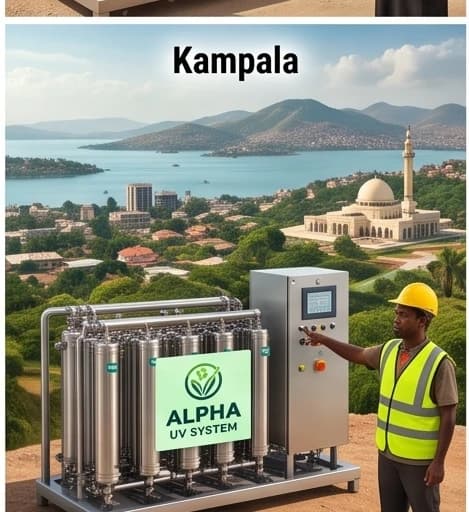
Quick Answer: UV water treatment system Kampala market is driven by Uganda's capital (3.5+ million metro population) where NWSC (National Water and Sewerage Corporation) supplies treated Lake Victoria water to approximately 35% of the city — with 65% of residents depending on boreholes, rainwater, or private water vendors. NWSC Gaba WTP (Water Treatment Plant, on Lake Victoria shore): raw water UVT 48–65% (dry season) to 38–52% (wet season due to algae and turbidity); after treatment, UVT at distribution: 70–80%. Kampala groundwater (shallow Buganda aquifer): UVT 72–84% with coliform contamination from Kampala's predominantly pit-latrine sanitation. Key UV demand drivers: international NGO and INGO facilities (WHO, UNICEF, UNHCR, Red Cross, MSF — all maintaining high-standard office and guesthouse water); UN-aligned embassy and diplomatic quarter water; Kampala industrial area food manufacturers targeting EAC (East African Community) markets; and private hospitals (International Hospital Kampala, Case Medical Centre) requiring WHO-grade water. Uganda drinking water standard (EAS 12:2018, East African Standard — WHO 4th ed. aligned) governs water quality. NSF/ANSI 55 Class A at 40 mJ/cm². Alpha UV ships to Entebbe International Airport (EBB) within 48 hours air freight.
Kampala's UV Water Treatment System Landscape
Kampala — Uganda's capital and commercial centre, built across seven hills surrounding Nakivubo Channel on the northern shore of Lake Victoria — operates water infrastructure that has chronically lagged behind the city's 4% annual population growth. NWSC's Gaba WTP (commissioned 1928, expanded multiple times, current capacity 220 MLD serving 1.5 million people) draws raw water from Lake Victoria, treating it through conventional coagulation-sedimentation-filtration-chlorination before distribution. NWSC's coverage area — primarily central Kampala, Nakasero, Kololo, Ntinda, Bugolobi — leaves Wakiso, Kira, and the rapidly growing northern and eastern peri-urban zones on private water supply.
The UV water treatment system Kampala market is shaped by three distinct segments: (1) the international community (embassies, UN agencies, INGOs, international schools) applying WHO drinking water quality standards that exceed NWSC distribution network end-point quality; (2) commercial and industrial users (food manufacturers, private hospitals, hotels) with food safety and clinical compliance requirements; (3) development projects installing decentralised water treatment in areas beyond NWSC network reach. In all three segments, UV at 40 mJ/cm² is the preferred point-of-use or point-of-process disinfection method.
NWSC Supply and Groundwater Quality
| Water Source | Coverage | UVT Range | Key Issue | Alpha UV System |
|---|---|---|---|---|
| NWSC Gaba WTP (Lake Victoria) | Central Kampala, Kololo, Nakasero, Ntinda | 70–80% (post-treatment) | Residual chlorine degrades in Kampala's heat; algal taste/odour spikes in March–April bloom season | AU-M 25, post-storage UV, 40 mJ/cm², NSF/ANSI 55 Class A |
| Kampala shallow boreholes (Buganda aquifer) | Wakiso, Kira, Makindye, Rubaga zones | 72–84% | E. coli from pit latrine contamination; iron 0.4–1.8 mg/L; fluoride in some areas | AU-S 15/AU-M 25, post iron-removal, 40 mJ/cm² |
| Private water kiosk boreholes (peri-urban) | Informal settlements (Bwaise, Kawempe, Kisenyi) | 65–78% | High coliform; variable E. coli; shared vendor storage tank re-contamination | AU-M 25 at kiosk supply, 40 mJ/cm², WHO WASH programme compatible |
| Embassy / UN compound boreholes (Nakasero hill) | Diplomatic quarter, Kololo | 74–84% | WHO diplomatic facility water standards; WHO Geneva 4th ed. required | AU-M 25, NSF/ANSI 55 Class A, MODBUS logging, WHO-compatible documentation |
| International Hospital private supply (Namuwongo) | Private hospitals, medical facilities | 70–80% | Clinical water quality: healthcare-associated infection (HAI) prevention; Legionella, Pseudomonas | AU-M 25, 40 mJ/cm², clinical-grade installation |
International NGO and Diplomatic Sector
Kampala hosts the highest concentration of international development and humanitarian organisations in East Africa — over 300 INGOs, UN agencies, bilateral donors, and diplomatic missions operate from Kampala, with a combined international staff and expatriate community exceeding 15,000 people. This community has maintained a consistent UV water treatment system Kampala market segment since the mid-2000s, driven by WHO, UN, and home-country embassy water safety standards that apply regardless of host country norms.
| Organisation Type | Facility | Water Standard Applied | Alpha UV Specification |
|---|---|---|---|
| UN agencies (UNHCR, UNICEF, UNDP, WFP, WHO Uganda) | Country offices, guesthouses, staff residences, Nakasero/Kololo | WHO Drinking Water Guidelines 4th ed.; UN Security Management System (UNSMS) water safety requirements | AU-S 15/AU-M 25, NSF/ANSI 55 Class A, 40 mJ/cm², MODBUS logging |
| MSF (Médecins Sans Frontières) | MSF field office and medical facilities, Kampala + project sites (Adjumani, Arua, Moyo) | MSF Water and Sanitation Field Manual (WASH); potable water: 0 NTU, 0 coliform, 0 E. coli at point of use | AU-S 15 portable/skid, 40 mJ/cm², field-deployable configuration |
| International School of Uganda (ISU), Lincoln Community School | School campuses, Lubowa and Kololo | WHO drinking water; parent country health authority standards; school water safety | AU-M 25, 40 mJ/cm², post-storage tank, NSF/ANSI 55 |
| US Embassy, EU Delegation, UK High Commission | Embassy compounds, Nakasero | US State Department / EU OSHA water safety for diplomatic facilities | AU-M 25, NSF/ANSI 55 Class A, full documentation for embassy HSE audit |
Kampala Industrial Area — Food and Beverage Manufacturing
Kampala's Industrial Area (located between Nalukolongo and the Kampala Entebbe Expressway) hosts Uganda's principal food and beverage manufacturing cluster. Manufacturers supply both the domestic Ugandan market and export to East African Community (EAC) member states (Kenya, Tanzania, Rwanda, Burundi, South Sudan, DRC) under the EAS 12:2018 food safety standard:
- Uganda Breweries (Diageo subsidiary — Uganda Waragi, Bell Lager, Guinness): Industrial Area, Kampala — Diageo Global Brewing Standards, zero Cl process water; AU-M 30
- Nile Breweries (ABInBev — Nile Special, Club, Castle): Kampala Industrial Area — ABInBev MAMBA Quality Standard, zero Cl; AU-M 30
- BIDCO Africa (cooking oils, margarine, soaps): Kampala, Jinja — ISO 22000, HACCP, EAS 12; AU-M 25
- SBC Uganda (Coca-Cola bottler): Kampala — Coca-Cola KORE standard, zero Cl, FSSC 22000; AU-M 30
FAQ
Is NWSC Kampala water safe without UV treatment?
NWSC water meets EAS 12:2018 at the Gaba WTP outlet. However, at point of use in Kampala buildings, distribution network age, storage tank re-contamination, and chloramine decay mean compliance cannot be assured. Studies in Kampala consistently find 15–30% of household tap samples exceed EAS 12 coliform limits. For commercial, food, pharmaceutical, and NGO applications, UV at 40 mJ/cm² at point of use is essential — not optional. NWSC itself recommends point-of-use treatment for high-risk populations and commercial food applications.
What is the delivery process for Alpha UV to Kampala?
Air freight to Entebbe International Airport (EBB): 48 hours from India. Sea freight is possible via Mombasa Port (Kenya) with road transport to Kampala (8–10 hours, 600 km): total 22–26 days. Uganda Revenue Authority import duties apply (approximately 25% CET + 18% VAT); consult a local Kampala customs agent. Alpha UV's Kampala distribution partner handles customs clearance and last-mile delivery to Kampala Industrial Area, Nakasero, Kololo, or project sites throughout Uganda.
Do UN agencies in Kampala require specific UV documentation?
UN agencies apply UNSMS (UN Security Management System) water safety requirements — water at UN compound facilities must meet WHO Guidelines for Drinking Water Quality (4th ed.) at point of consumption. UV at 40 mJ/cm² satisfies WHO requirements. UN procurement for water treatment equipment requires UNGM-registered suppliers or local partner procurement — Alpha UV's Kampala distributor is available for local-currency procurement. UN agency HSE officers typically request NSF/ANSI 55 Class A certificate and commissioning report as documentation.
Can Alpha UV systems operate on Uganda's power supply?
Uganda's UEGCL/UMEME grid operates at 240V / 50 Hz — within Alpha UV's universal ballast range (100–240V, 50/60 Hz). Power reliability in Kampala is variable — UMEME grid supply experiences 4–8 hour daily outages in many industrial and commercial areas. Alpha UV recommends UPS backup (30-minute minimum for continuous production operations) or automatic shut-off/restart configuration for facilities on intermittent UMEME supply. Generator-powered sites (common in Kampala industrial area) operate Alpha UV systems without modification at generator output voltages (typically 200–230V, 50 Hz).
What UV system is right for a peri-urban Kampala water kiosk?
Peri-urban water kiosks (Wakiso, Kira, Entebbe corridor) serving communities not reached by NWSC mains typically pump borehole water to a 1,000–5,000 litre storage tank and sell by the jerry can. Alpha UV AU-S 8 (1–3 m³/hour) or AU-S 15 (3–8 m³/hour) installed at the kiosk tank outlet provides NSF/ANSI 55 Class A disinfection for the community supply. WASH NGOs (Wateraid Uganda, World Vision, IRC) and UNICEF Uganda specify UV treatment for community water kiosks — Alpha UV is available through development sector procurement channels.
Does Kampala's brewing sector require UV water treatment?
Yes. Uganda's two major breweries (Uganda Breweries/Diageo, Nile Breweries/ABInBev) both operate under parent company global quality standards that explicitly require zero chlorine in brewing process water. NWSC distributes chlorinated water — post-NWSC activated carbon removes chlorine, but carbon filters also remove residual disinfection, creating re-contamination risk. UV at 40 mJ/cm² post-carbon (or post-RO) is specified in both Diageo and ABInBev brewing water standard operating procedures as the biological safety barrier for chlorine-free brewing water.
Standards, authorities & further reading
External references used to inform this guide. Regulations evolve — check the latest revision on each authority's site before compliance decisions.
Recommended UV Systems
Alpha UV System products for this application — powered by genuine Philips UV-C lamps.
Commercial UV Water Purification System
500 – 5,000 LPH
HACCP-compliant UV water purification for hotels, restaurants, and offices
Industrial UV Water Treatment System
5,000 – 50,000 LPH
Schedule M 2025 and HACCP compliant UV for pharma, food & beverage, and process water
Not sure which system suits your application? WhatsApp our engineers for a free recommendation →
Related solutions
See how Alpha UV System applies this to your industry or city.
Need a UV system?
Talk to our UV engineers — WhatsApp for a quote in 2 hours, or browse the full catalog on IndiaMART.