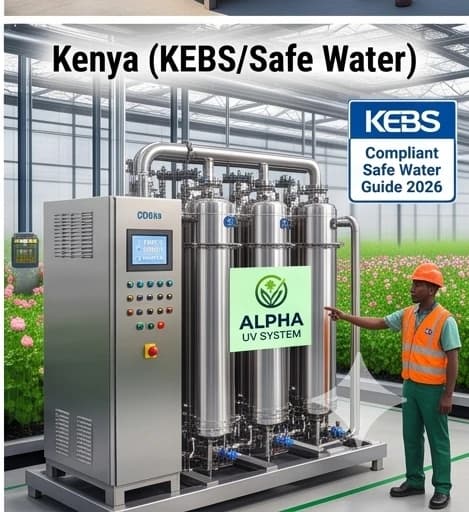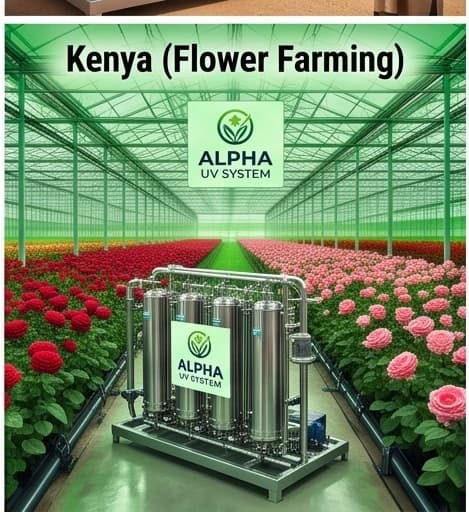
Quick Answer: Kenya's floriculture sector — the world's third-largest cut flower exporter (USD 700 million/year), supplying approximately 40% of EU-imported cut flowers through JKIA — requires NSF/ANSI 55 Class A UV at 40 mJ/cm² for post-harvest washing water under GLOBALG.A.P. IFA v5.4 (Integrated Farm Assurance) and MPS-ECAS (Milieu Programma Sierteelt — Eco-label Certification for Assured Sustainability). Farms are concentrated at Lake Naivasha (1,884m altitude, 80 km from Nairobi — 50+ farms including Oserian Development Company, Flamingo Horticulture/Finlays, Vegpro/AAA Growers) and the Athi River Export Processing Zone (EPZ, near Nairobi — post-harvest packing houses serving smallholder outgrower schemes). Lake Naivasha water UVT 76–86% (rift valley freshwater lake, excellent UV efficiency); Athi River EPZ borehole 74–84%. Dutch Flower Auction (FloraHolland/Royal FloraHolland — Aalsmeer) import compliance requires EU DWD 2020/2184-equivalent water quality for product contact. Alpha UV ships to JKIA in under 48 hours from India.
Kenya Floriculture Water Treatment Context
Kenya's flower farming industry — developed from the 1970s around Lake Naivasha's reliable water supply, equatorial high-altitude growing conditions (1,800–2,200 m), and proximity to JKIA international cargo — has grown into the world's third-largest cut flower export sector. EU supermarkets (Albert Heijn, Aldi, Lidl, Waitrose, Tesco, Carrefour) source Kenyan roses, carnations, alstroemeria, and seasonal flowers for year-round supply — the GLOBALG.A.P. certification is a mandatory pre-condition for supply to any major European retail chain.
GLOBALG.A.P. IFA v5.4 — the international farm assurance standard applied by all Kenya-to-EU flower supply chains — requires documented water quality for post-harvest operations. Water used in post-harvest rose washing, grading table rinsing, cold room humidification, and packaging line sanitisation must meet E. coli = 0/100 mL (or <1 CFU/100 mL depending on operation). The HACCP plan must document water as a CCP with validated treatment and ongoing dose monitoring records.
MPS-ECAS (Milieu Programma Sierteelt Environmental Certification for the Assured Supply Chain) — another major Dutch/EU certification applied by farms supplying FloraHolland auction — similarly requires documented water treatment with zero-chemical process water as a sustainability bonus criterion. UV water treatment UV water treatment Kenya flower farming enables EU auction premium status alongside statutory GLOBALG.A.P. compliance.
Lake Naivasha Floriculture Zone
Lake Naivasha — Kenya Rift Valley freshwater lake (altitude 1,884 m, approximately 80 km northwest of Nairobi) — hosts East Africa's most intensive cut flower farming cluster. Over 50 farms operate on the lake's shoreline, abstracting lake water for irrigation and post-harvest operations under WRMA (Water Resources Management Authority) water abstraction licences:
| Farm / Company | Water Source / UVT | Certification | Alpha UV Application |
|---|---|---|---|
| Oserian Development Company (Naivasha — Flamingo brand) | Lake Naivasha 78–86% | GLOBALG.A.P., MPS-ECAS, Fairtrade, RainForest Alliance | AU-M 25, post-harvest washing, NSF/ANSI 55 Class A |
| Flamingo Horticulture (Finlays Group, Naivasha) | Lake Naivasha 78–86% | GLOBALG.A.P., MPS-ECAS, ETI Base Code | AU-M 25, post-harvest + grading rinse, MODBUS RS485 |
| Vegpro/AAA Growers (Naivasha, also Athi River) | Lake Naivasha 78–86% / borehole 80–88% | GLOBALG.A.P., MPS-A, BRC Produce | AU-M 25, packing house HACCP CCP, auto de-rating |
| Kariki Group (Naivasha, Timau) | Borehole 80–88% | GLOBALG.A.P., MPS-ECAS | AU-M 25, NSF/ANSI 55 Class A |
| Highlands Flowers (Naivasha) | Lake Naivasha 78–86% | GLOBALG.A.P., Rainforest Alliance | AU-S 15, post-harvest washing |
Lake Naivasha water quality is exceptional by East African standards — UVT 78–86% (rift valley freshwater, low DOC, limited industrial pollution due to distance from Nairobi Industrial Area, altitude-driven clean catchment). This high UVT means UV reactor flow rates can be maximised — UV water treatment Kenya flower farming at Lake Naivasha achieves 40 mJ/cm² at higher flow rates per unit lamp power than equivalent installations at Athi River or Nairobi sites.
However, Lake Naivasha's ecology is sensitive — RAMSAR-designated wetland (1995), supporting hippo populations, endemic fish, and migratory birds. WRMA abstraction licences include effluent quality conditions preventing chemical contamination of lake return flows. UV disinfection (zero chemical residual, no chlorine or chloramine discharge) satisfies WRMA's environmental abstraction licence condition for zero-chemical effluent — a significant advantage over chlorination-based treatment which would require dechlorination before lake or wetland return.
Athi River Export Processing Zone — Packing Houses
The Athi River EPZ (Export Processing Zone) — approximately 35 km southeast of Nairobi at Athi River town — hosts post-harvest packing houses that consolidate cut flowers from smallholder outgrower farms across Kiambu, Kajiado, and Machakos counties for export through JKIA. These packing houses apply GLOBALG.A.P. Chain of Custody (CoC) certification — requiring water quality compliance along the post-harvest supply chain, not just at the farm level.
| Application | Location | Water Source / UVT | Standard | Alpha UV System |
|---|---|---|---|---|
| Cut flower packing house (EPZ consolidation) | Athi River EPZ | Borehole 74–84% | GLOBALG.A.P. CoC, MPS, BRC Produce | AU-M 25, NSF/ANSI 55 Class A, MODBUS RS485 |
| Rose grading and cold storage (EPZ) | Athi River EPZ | Borehole 74–84% | GLOBALG.A.P., EU DWD equivalent, HACCP | AU-M 25, zero residual Cl, duty/standby |
| Vegetable packing (French beans, mangetout — EPZ) | Athi River EPZ | Borehole 74–84% | GLOBALG.A.P. FV, UK Red Tractor equivalent, HACCP | AU-M 25, NSF/ANSI 55 Class A, MODBUS |
Athi River EPZ borehole water (Kapiti Plains alluvial aquifer, 40–100 m depth): UVT 74–84% — slightly lower than Lake Naivasha but well within NSF/ANSI 55 Class A UV treatment range without pre-treatment. Auto de-rating control manages seasonal UVT variation (dry season drawdown drops UVT to 74–76%; wet season percolation recovers to 82–84%).
JKIA Cold Chain — The JKIA Flower Export Hub
JKIA (Jomo Kenyatta International Airport) — Nairobi — handles approximately USD 700 million/year in horticultural exports, primarily cut flowers departing on cold chain freighters for Amsterdam Schiphol (Royal FloraHolland auction) and London Heathrow. The JKIA Kenya Flower Council (KFC) Cargo Village hosts cold chain facilities where flowers are consolidated, sorted, re-iced, and palletised for air freight departure.
KFC Cargo Village cold chain facilities require HACCP-compliant process water for ice-making (used for rose cooling during transit preparation) and equipment sanitation (conveyor cleaning, grading table washing). As a GLOBALG.A.P. Chain of Custody-certified facility, KFC Cargo Village water quality must match the GLOBALG.A.P. IFA farm-level standard. NSF/ANSI 55 Class A UV with MODBUS dose logging serves as the KFC Cargo Village water treatment CCP documentation for GLOBALG.A.P. CoC annual audit.
Frequently Asked Questions
What GLOBALG.A.P. water requirements apply to Kenyan cut flower farms?
GLOBALG.A.P. IFA v5.4 (Integrated Farm Assurance — Flowers and Ornamentals module) includes the following water quality requirements for cut flower farms: (1) AF 1.2 (Water management) — risk assessment of water sources used for post-harvest operations; (2) FO CB 7.6 (Post-harvest chemical treatments and water quality) — water used for post-harvest treatments must meet E. coli = 0/100 mL (or <100 CFU/100 mL for irrigation of intact products with documentation) — interpreted by GLOBALG.A.P. inspectors as E. coli = 0/100 mL for post-harvest rose washing water contact with cut surfaces; (3) HACCP plan documentation with water treatment as CCP; (4) corrective action records for non-compliant water results. NSF/ANSI 55 Class A UV certification (confirming >4-log E. coli reduction at rated flow and minimum UVT) with MODBUS dose logs constitutes the treatment validation and CCP monitoring evidence required by GLOBALG.A.P. inspectors. GLOBALG.A.P. accredited certifiers (Control Union, Bureau Veritas, SGS, Intertek — all present in Nairobi and Naivasha) accept Alpha UV's documentation package for annual GLOBALG.A.P. renewal audits.
What is MPS-ECAS certification and how does UV treatment support it?
MPS (Milieu Programma Sierteelt — Environmental Programme for the Ornamental Plant Sector) is a Dutch sustainability certification system for flower and plant growers, processors, and supply chain members. MPS-ECAS (Eco-label Certification for the Assured Supply Chain) is the most comprehensive MPS certification — covering environmental performance (water use, energy, chemicals, waste), social standards (ETI Base Code compliance — worker rights), and supply chain traceability. For water treatment, MPS-ECAS requires: zero-chemical process water for post-harvest operations (or documented justification for chemical use); water treatment records; and water use efficiency documentation. UV disinfection satisfies the zero-chemical requirement without any documentation of chemical types, concentrations, or disposal methods. MPS-ECAS certified farms receive access to Royal FloraHolland's MPS certification display — displayed at Amsterdam auction blocks — enabling premium pricing (typically 5–15% above non-MPS-certified comparable flowers) from socially conscious EU buyers. Dutch flower importers increasingly source exclusively from MPS-ECAS certified farms.
How does altitude (1,884m Lake Naivasha) affect UV water treatment performance?
UV disinfection performance is not affected by altitude — UV photon delivery, germicidal wavelength (254 nm), and water absorption characteristics are altitude-independent. UV dose (mJ/cm² = mW·s/cm²) depends only on lamp intensity, flow rate, and water UVT — all unaffected by ambient air pressure at 1,884 metres. This contrasts with some chemical disinfection methods where atmospheric pressure can affect dissolved gas behaviour. Practically, this means Alpha UV AU-M systems specified for Lake Naivasha farms are identical specifications to sea-level installations — no altitude correction factor is needed. The Lake Naivasha climate (equatorial, with daily temperatures 15–25°C, no frost, minimal UV lamp thermal stress) is actually optimal for standard (non-amalgam) UV lamp performance — amalgam lamps are not required at Naivasha's moderate temperatures.
What is the Royal FloraHolland (Dutch Flower Auction) water compliance requirement for Kenyan suppliers?
Royal FloraHolland (Amsterdam Aalsmeer, the world's largest flower auction — trading over EUR 5 billion/year) maintains a supplier qualification program for direct-to-auction Kenya growers. RFH quality assurance requires GLOBALG.A.P. or MPS-ECAS certification as a pre-condition for auction access. RFH additionally maintains its own sustainability criteria (Royal FloraHolland Quality Standard — RFHQS) including water quality documentation aligned with Dutch Drinking Water Decree (Drinkwaterbesluit 2011) standards for post-harvest water (equivalent to EU DWD 2020/2184: E. coli = 0/100 mL). NSF/ANSI 55 Class A UV documentation package from Alpha UV is accepted by RFH quality inspectors (visiting Naivasha farms during annual RFHQS assessment) as evidence of compliant post-harvest water treatment. Kenyan flower growers with Alpha UV installations and complete MODBUS dose log records have accessed RFH direct-to-auction status — bypassing intermediary flower exporters and capturing 10–20% higher per-stem prices at Aalsmeer.
What is the logistics route for UV systems to Lake Naivasha flower farms?
Lake Naivasha is 80 km from JKIA (approximately 1.5 hours via Naivasha Road/B3 highway). Air freight to JKIA (under 48 hours from India) with road freight to Naivasha farm is the standard route for all flower farm UV system deliveries. JKIA cargo customs clearance: 3–5 working days (KRA industrial equipment). For larger AU-M units for major farm packing houses (Oserian, Finlays/Flamingo): sea freight to Mombasa Port (18–22 days from India) then road Mombasa–Naivasha (525 km via A104/B3, 7–8 hours) is the most cost-effective route for planned installations. Spare lamps and quartz sleeves by DHL Express from India: JKIA hub 3–4 working days then same-day road delivery to Naivasha farm.
Logistics and Supply Chain
Alpha UV supplies Kenyan flower farms via air freight to JKIA (under 48 hours from India) for urgent and pharmaceutical-grade installations, or sea freight to Mombasa Port (18–22 days from India) for planned project deliveries. Lake Naivasha road delivery from JKIA: 80 km, 1.5 hours. Athi River EPZ road from JKIA: 35 km, 45 minutes. Mombasa to Naivasha: 525 km, 7–8 hours road.
Spare parts (UV lamps, quartz sleeves) dispatch from India by DHL Express — JKIA hub in 3–4 working days then same-day Naivasha delivery. Annual lamp replacement for flower farm packing house UV systems is scheduled during farm shutdown periods (typically July–August for major re-certification or maintenance). GLOBALG.A.P. audit-ready documentation is included with every Kenya floriculture installation.
Documentation with every Kenya flower farm installation: NSF/ANSI 55 Class A validation report, KS EAS 12:2018 / WHO 4th edition compliance declaration (English), GLOBALG.A.P. IFA FO water CCP documentation, MPS-ECAS zero-chemical water treatment statement, Royal FloraHolland RFHQS water quality compliance record, WRMA zero-chemical effluent compliance declaration (Lake Naivasha RAMSAR), MODBUS RS485/TCP register map, IP65 certification, and O&M manual in English.
Alpha UV Systems — UV water treatment for Kenya cut flower farming. NSF/ANSI 55 Class A | GLOBALG.A.P. IFA post-harvest water CCP | MPS-ECAS zero-chemical certification support | Royal FloraHolland RFHQS water compliance | WRMA RAMSAR Lake Naivasha zero-chemical licence | Oserian / Flamingo / Vegpro / AAA Growers specifications. Delivery via JKIA 48 hours. Contact us for Lake Naivasha packing house sizing.
Standards, authorities & further reading
External references used to inform this guide. Regulations evolve — check the latest revision on each authority's site before compliance decisions.
Recommended UV Systems
Alpha UV System products for this application — powered by genuine Philips UV-C lamps.
Commercial UV Water Purification System
500 – 5,000 LPH
HACCP-compliant UV water purification for hotels, restaurants, and offices
Industrial UV Water Treatment System
5,000 – 50,000 LPH
Schedule M 2025 and HACCP compliant UV for pharma, food & beverage, and process water
Not sure which system suits your application? WhatsApp our engineers for a free recommendation →
Related solutions
See how Alpha UV System applies this to your industry or city.
Need a UV system?
Talk to our UV engineers — WhatsApp for a quote in 2 hours, or browse the full catalog on IndiaMART.