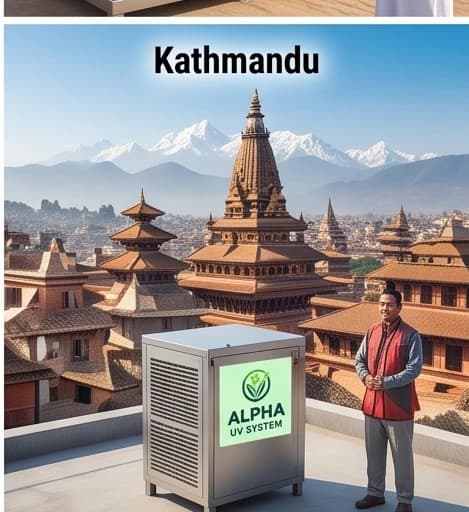
Quick Answer: UV water treatment system Kathmandu market is driven by Nepal's capital (1.5 million population, Kathmandu Valley metropolitan population 3.5 million) where KUKL (Kathmandu Upatyaka Khanepani Limited) and KVWSMB (Kathmandu Valley Water Supply Management Board) supply Bagmati River-sourced treated water with UVT 55–72% at distribution — one of South Asia's most challenging municipal water quality profiles due to heavy industrial and sewage contamination of the Bagmati River upstream of Kathmandu WTPs. Key UV demand drivers: Kathmandu's 1,200+ hotels and guesthouses serving 600,000+ international tourists annually (trekking gateway to Everest Base Camp, Annapurna Circuit, and Langtang); international NGO sector (350+ INGOs in Kathmandu including UNICEF, WHO, Save the Children with drinking water security mandates); Nepal pharmaceutical sector (120+ manufacturers regulated by DFTQC — Department of Food Technology and Quality Control — supplying domestic and regional markets); and international hotel brands (Hyatt Regency, Marriott, Radisson). Nepal Drinking Water Quality Standards (NDWQS 2006, WHO-aligned) govern water quality. NSF/ANSI 55 Class A at 40 mJ/cm². Alpha UV ships to Tribhuvan International Airport (KTM) within 48 hours air freight from India.
Kathmandu's UV Water Treatment System Landscape
Kathmandu Valley's water supply crisis is among Asia's most acute: KUKL's supply meets only 40–50% of valley demand (2024 estimate), with the balance met by private tanker trucks, dug wells, and stone spouts (traditional dhunge dharas). KUKL's Melamchi Water Supply Project — a 26.7 km tunnel from Melamchi River (clean Himalayan source) to augment Bagmati River supply — was completed in 2021 but has faced operational disruptions. KUKL supply: Bagmati River (highly contaminated — BOD 20–80 mg/L, total coliforms 10,000–100,000 CFU/100 mL at Bagmati intake), treated through conventional processes (coagulation, sedimentation, filtration, chlorination) to NDWQS 2006 compliance at WTP outlet but with UVT 55–72% at distribution — among the lowest UVT in South Asian municipal supplies.
UV water treatment system Kathmandu at 40 mJ/cm² with high-intensity lamps and CFD-validated dose maintenance at low UVT is the commercial standard for the hotel, NGO, and pharmaceutical sectors who cannot rely on KUKL distribution quality at point of use.
KUKL Supply and Water Quality by Zone
| Zone / Area | Water Source | UVT at Point of Use | Key Issue | Alpha UV System |
|---|---|---|---|---|
| Kathmandu CBD (Thamel, New Road, Durbar Square) | KUKL Bagmati-sourced supply | 55–68% | Highest contamination risk in older distribution mains; heavy tanker truck dependency in peak summer; biofilm in 10,000-litre plastic rooftop tanks common in Thamel hotel stock | AU-M 25, post-tank, 40 mJ/cm², NSF/ANSI 55 Class A; 5-micron pre-filter |
| Patan (Lalitpur) — commercial and residential | KUKL + private tanker supplement | 58–70% | Patan is secondary KUKL supply zone; tanker truck water (unregulated quality — typically 50–200 CFU total coliforms/100 mL) mixed with KUKL supply in storage tanks | AU-M 25, post-tank, 40 mJ/cm² |
| Bhaktapur — industrial and heritage tourism | KUKL rural supply; borehole supplement | 62–74% | Brick kiln industry (Bhaktapur pottery corridor) groundwater competition; borehole quality variable (iron 0.5–2 mg/L) | AU-M 25, post iron-removal filter if Fe >0.3 mg/L, NSF/ANSI 55 Class A |
| Bouddhanath / Pashupatinath zone (tourism, hotel) | KUKL + private borehole | 60–72% | High hotel and guesthouse density; international tourist expectation; KUKL supply intermittent (4–8 hours/day); storage tank re-contamination | AU-M 25 post-tank, NSF/ANSI 55 Class A, HACCP documentation for hotel licensing |
| Melamchi augmented zones (post-2021) | Melamchi River + Bagmati blend at KUKL WTP | 65–78% | Melamchi water (Himalayan river, low contamination, UVT 85–92%) blended with Bagmati; blend quality better than pure Bagmati supply but still requires point-of-use UV | AU-M 25, post-tank, 40 mJ/cm² |
NGO and International Organisation Sector
Kathmandu's international NGO community — the largest concentration in South Asia relative to city size — has established UV water treatment at office and compound drinking water supply as a standard:
| Organisation Type | Water Challenge | Alpha UV Application |
|---|---|---|
| UN agencies (UNICEF, WHO, UNFPA, WFP, UNDP — all Lalitpur/Sanepa) | UN compound drinking water; UN DSS (Department of Safety and Security) minimum water quality standards for UN premises: E. coli 0 CFU/100 mL, total coliforms 0 CFU/100 mL; reliance on Kathmandu KUKL at risk of non-compliance | AU-M 25 at compound main water supply, 40 mJ/cm², NSF/ANSI 55 Class A, documented treatment for UN DSS compliance |
| INGOs (Save the Children, Oxfam, World Vision, Care Nepal) | Office and field compound drinking water; INGO staff welfare water safety; international staff health risk management (gastroenteritis from Bagmati-contaminated water is a significant health risk for international staff without immune acclimatisation) | AU-S 15 at INGO office water supply; AU-M 25 at larger compound installations |
| Embassies (Indian, US, European embassies — Maharajgunj zone) | Embassy staff and events water quality; diplomatic compound standard equivalent to country-of-origin water quality; embassy medical officer requirement | AU-M 25 at embassy compound main supply, NSF/ANSI 55 Class A |
| International schools (Lincoln School, British School, Rato Bangala) | School drinking water for international students; WASC/CIS accreditation water quality provision; canteen HACCP | AU-M 25 or AU-S 15 depending on school size; NSF/ANSI 55 Class A; HACCP documentation for accreditation |
Hotel and Tourism Sector
| Hotel / Category | Brand Standard | Water Challenge | Alpha UV System |
|---|---|---|---|
| Hyatt Regency Kathmandu (280 rooms, Bouddhanath) | Hyatt global brand standards; HACCP; WHO-aligned Legionella management | KUKL supply; building tank system; international brand water standard significantly exceeds KUKL distribution quality | AU-M 25 kitchen post-softener; AU-M 25 MP spa; MODBUS logging for Hyatt brand audit |
| Marriott Kathmandu (Durbarmarg — opening 2025) | Marriott Global Water Quality Standard (GWQS); HACCP | New property — KUKL supply intermittent; tanker supplement management; international guest expectation | AU-M 25 kitchen; AU-M 30 cooling tower; NSF/ANSI 55 Class A |
| Radisson Blu (Lazimpat, Kathmandu) | Radisson brand standard; HACCP; SAARC-region hospitality water standards | KUKL Bagmati supply; older Lazimpat distribution; building storage tank biofilm | AU-M 25 post-tank and post-softener; MODBUS TCP logging |
| Thamel boutique hotels and guesthouses (1,000+ properties) | Nepal Tourism Board classification; varying standards; backpacker through mid-range | Heaviest reliance on KUKL + tanker supplement in Thamel; rooftop plastic tank re-contamination; international guest stomach illness risk | AU-S 8/15, compact wall-mount, simple operation for independent hotel management |
FAQ
Why is Kathmandu's KUKL water quality so poor compared to other South Asian capitals?
The Bagmati River — KUKL's primary source for Kathmandu's water supply — flows through a densely populated urban catchment before water abstraction. Upstream of KUKL's intake points, Bagmati receives: untreated or partially treated sewage from Kathmandu's 3.5 million residents (sewerage coverage 50–60%, remaining septic tank and open discharge); industrial effluent from brick kilns, dyeing units, and light industry in the Patan-Bhaktapur corridor; and agricultural runoff from urban-fringe farming. Result: Bagmati intake BOD 20–80 mg/L (WHO recommends <5 mg/L for a drinking water source), total coliforms 10,000–100,000 CFU/100 mL. KUKL's WTP (conventional treatment: coagulation-flocculation-sedimentation-filtration-chlorination) treats this to NDWQS standard at WTP outlet — but the contamination load requires high chlorine doses (leaving high chloramine residuals) and the resulting UVT at distribution is 55–72%, among South Asia's lowest. UV water treatment system Kathmandu at point of use addresses the residual contamination risk that distribution network quality cannot guarantee.
What is Nepal Drinking Water Quality Standards (NDWQS 2006) and how does UV comply?
Nepal Drinking Water Quality Standards (NDWQS 2006, published by Ministry of Drinking Water and Sanitation, aligned to WHO Guidelines for Drinking Water Quality) specifies: E. coli 0 CFU/100 mL, total coliforms 0 CFU/100 mL, turbidity <5 NTU, pH 6.5–8.5. UV at 40 mJ/cm² achieves >4 log E. coli reduction — satisfying NDWQS 2006 biological requirements. DFTQC accepts UV disinfection as a validated water treatment method for commercial food premises (bottled water, food processing) under Nepal Food Act 2023 and Food Rules. For hotel licensing under Nepal Tourism Act, DoTM (Department of Tourism) inspectors require water quality certificates showing NDWQS compliance at point of use — UV system installation records and annual water quality test certificates satisfy this requirement.
How does Alpha UV deliver to Kathmandu and what are the import considerations?
Air freight to Tribhuvan International Airport (KTM, Kathmandu): 48 hours from India. Nepal Customs: water purification equipment (HS 8421.21) — general duty rate 5% + VAT 13%. Nepal-India bilateral trade agreement (bilateral preference under SAFTA): 0% duty for Indian-origin water treatment equipment. Alpha UV equipment manufactured in India is eligible for SAFTA 0% duty. Customs clearance at KTM airport: 3–5 working days. Ground transport: within Kathmandu Valley, delivery within 2–4 hours of customs clearance. Freight companies (DHL, FedEx, and Nepal-based freight forwarders) handle customs clearance at KTM regularly.
What UV system specification is appropriate for a KUKL-supplied Thamel hotel?
A 40-room Thamel boutique hotel with 10,000-litre rooftop plastic storage tank (KUKL + tanker truck supply): post-tank UV at AU-S 15 (40 mJ/cm², up to 8 m³/hour) handles the daily water demand at full occupancy (40 rooms × 200 litres/room/day = 8 m³/day total demand, with peak draw rate well within AU-S 15 capacity at 8 m³/hour). Wall-mount installation in the rooftop tank room; 230V Nepal grid power; simple operation for hotel maintenance staff. Annual water quality test from Nepal-accredited laboratory confirms SLS/NDWQS compliance. This is the standard specification for 80% of Thamel's independent hotel and guesthouse stock.
Does the Melamchi Water Supply Project improve Kathmandu's UV treatment requirements?
Partially. Melamchi River water (from a high-altitude Himalayan catchment north of Kathmandu) has excellent raw water quality: UVT 90–96%, BOD <1 mg/L, total coliforms <10 CFU/100 mL at abstraction. When Melamchi supply operates fully (subject to tunnel maintenance and seasonal availability), KUKL blends Melamchi with Bagmati-sourced supply — improving distribution water quality (UVT 65–78% in Melamchi-augmented zones vs. 55–65% in pure Bagmati zones). However, even with Melamchi augmentation, building storage tank re-contamination (10,000–50,000 litre tanks serving Kathmandu commercial buildings) remains a significant quality risk. UV at 40 mJ/cm² post-storage tank remains the appropriate specification regardless of improved municipal supply quality — Melamchi reduces biological loading entering the tank, but biofilm in aging tanks remains a contamination risk UV addresses at point of use.
Standards, authorities & further reading
External references used to inform this guide. Regulations evolve — check the latest revision on each authority's site before compliance decisions.
Recommended UV Systems
Alpha UV System products for this application — powered by genuine Philips UV-C lamps.
Commercial UV Water Purification System
500 – 5,000 LPH
HACCP-compliant UV water purification for hotels, restaurants, and offices
Industrial UV Water Treatment System
5,000 – 50,000 LPH
Schedule M 2025 and HACCP compliant UV for pharma, food & beverage, and process water
Not sure which system suits your application? WhatsApp our engineers for a free recommendation →
Related solutions
See how Alpha UV System applies this to your industry or city.
Need a UV system?
Talk to our UV engineers — WhatsApp for a quote in 2 hours, or browse the full catalog on IndiaMART.