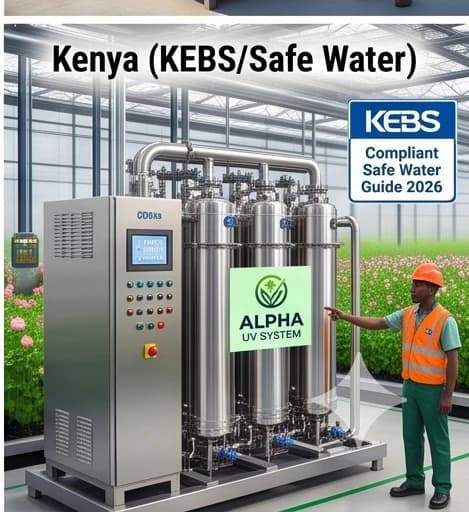
Quick Answer: UV water treatment in Kenya is the validated chemical-free disinfection method for KEBS-licensed packaged water plants, GlobalG.A.P.-certified floriculture irrigation water, Nairobi borehole building water systems, EAC-standard food processing, and rural NGO water projects. Alpha UV's NSF/ANSI 55 Class A certified systems deliver 40–80 mJ/cm² validated dose with SS 316L corrosion-resistant chambers, shipping from Mundra or JNPT to Mombasa Port in 10–14 days, with KEBS Pre-Export Verification of Conformity (PVoC) documentation support included.
Kenya's Water Quality Landscape and the UV Treatment Opportunity
Kenya is East Africa's largest economy and a regional hub for finance, logistics, and agriculture. With a population of approximately 55 million, Kenya faces significant water access and quality challenges: the Water Services Regulatory Board (WASREB) reports that urban water supply coverage reaches around 65 percent of the urban population, while rural coverage is substantially lower. Nairobi, despite being the most developed city, faces persistent distribution system leakage, pressure intermittency, and borehole dependence in peri-urban estates from Karen and Langata to Ruiru and Kiambu.
Kenya's waterborne disease burden remains significant. Typhoid, cholera, and amoebic dysentery are endemic in informal settlements and areas without reliable treated water supply. The Nairobi City Water and Sewerage Company (NCWSC) water — treated at Ngethu and Ruiru waterworks — meets KEBS standards at the treatment plant, but distribution pipe leakage (estimated at 40 percent of production) introduces post-treatment contamination. UV water treatment Kenya at point-of-entry for buildings and point-of-use for commercial and institutional facilities addresses this post-treatment contamination risk.
Kenya's floriculture sector — the world's second-largest cut flower exporter after the Netherlands — creates a specialised UV water treatment demand around Lake Naivasha and the Rift Valley. GlobalG.A.P. certification, mandatory for Kenyan flowers accessing European supermarket supply chains, requires irrigation water quality documentation including microbial testing. UV disinfection of borehole and lake water abstracted for floriculture irrigation is increasingly specified by farm operators seeking GlobalG.A.P. compliance without the chemical management complexity of chlorination that can damage sensitive flower varieties.
Water Source and Quality by Region
Nairobi — Borehole and Mixed Supply
Nairobi's commercial and residential areas draw from NCWSC supply supplemented by extensive borehole extraction. Nairobi borehole water quality varies by zone: Westlands and Upper Hill boreholes draw from shallow alluvial aquifers with TDS of 200–600 mg/L and occasional iron elevation (0.5–3 mg/L). Nairobi South (Industrial Area, South C, South B) borehole water shows higher TDS (600–1,500 mg/L) and more consistent bacterial contamination from the proximity of the Nairobi River and informal settlement runoff. UVT of Nairobi borehole water after 5-micron cartridge filtration: typically 82–90 percent, adequate for 40 mJ/cm² UV delivery without additional pre-treatment in most locations.
Lake Naivasha — Floriculture and Horticulture
Lake Naivasha in the Rift Valley is the primary water source for Kenya's flower farms (Sher Agencies, Oserian, Finlays Horticulture, and dozens of smaller growers). Lake Naivasha water quality fluctuates with lake level and season: turbidity ranges from 2–25 NTU, algae bloom events during dry season raise biological oxygen demand and reduce UVT. For floriculture irrigation UV, a sand filter pre-treatment stage is essential before UV to ensure UVT reaches 75 percent minimum (required for 40 mJ/cm² dose at rated flow). Alpha UV's AU-M series, rated for 10–200 m³/hour at 40 mJ/cm², is the standard specification for Naivasha flower farm irrigation water UV systems.
Rift Valley — High Fluoride Groundwater
Kenya's Rift Valley region has naturally occurring high fluoride in groundwater — levels of 5–150 mg/L have been documented in Nakuru, Narok, and Kajiado counties, far exceeding the WHO guideline of 1.5 mg/L. Fluoride removal requires defluoridation systems (bone char, activated alumina, or nalgonda process) that operate upstream of UV treatment. As with arsenic, UV disinfection alone does not remove fluoride. Alpha UV engineers the complete treatment train — defluoridation followed by UV polishing — for Rift Valley applications where both fluoride and microbial contamination are present.
Mombasa and Coast — Coral Aquifer and Saline Intrusion
Mombasa draws from the Mzima Springs pipeline supplemented by coral limestone aquifer boreholes. The coral aquifer produces hard water (TDS 400–900 mg/L, hardness 200–500 mg CaCO₃/L) with low turbidity and generally acceptable microbial quality from the depth of abstraction. However, coastal saltwater intrusion affects shallow boreholes on Mombasa Island and the Likoni peninsula. RO pre-treatment is required for saline boreholes before UV polishing. The Mombasa port and industrial zone (KEPZs) use UV water treatment in food processing and beverage production that requires KEBS-compliant disinfection documentation.
KEBS Regulatory Framework and EAC Standards
Kenya Bureau of Standards (KEBS) administers KS EAS 12:2018 (East African Community drinking water quality standard) and KS 459 (packaged drinking water standard). KEBS also implements the Pre-Export Verification of Conformity (PVoC) scheme for imported goods — including water treatment equipment falling under mandatory product standards. UV water treatment systems exported from India to Kenya require KEBS PVoC certification from a KEBS-accredited inspection body (Bureau Veritas, Intertek, SGS) in India before shipment.
| Regulatory Body | Standard | UV Requirement | Alpha UV Documentation |
|---|---|---|---|
| KEBS | KS EAS 12:2018 (drinking water) | UV as approved disinfection; 40 mJ/cm² recommended for 4-log reduction | NSF/ANSI 55 Class A certificate + KEBS PVoC inspection report |
| KEBS | KS 459 (packaged water) | UV or other approved disinfection at filling point | NSF/ANSI 55 Class A certificate for KEBS licensing audit |
| GlobalG.A.P. | IFA Standard v6 (irrigation water quality) | Microbial testing; UV treatment accepted as risk mitigation for E. coli | UV validation report + dose delivery records for GlobalG.A.P. audit |
| PCPB | Pest Control Products Board (floriculture inputs) | Irrigation water treatment standards for export horticulture | Chemical-free UV disinfection compliant with zero-residue export requirements |
| WHO / UNICEF | WHO GDWQ (NGO and development programmes) | 40 mJ/cm² | NSF/ANSI 55 Class A validation |
Key Application Sectors
Floriculture and Horticulture — Naivasha and Rift Valley Farms
Kenya's flower farms export approximately 130,000 tonnes of cut flowers annually, with roses, carnations, alstroemeria, and chrysanthemums from Naivasha farms commanding premium prices in European and Japanese markets. GlobalG.A.P. IFA Standard version 6, implemented by major farms from 2024, requires documented irrigation water quality management including microbial monitoring and treatment where E. coli is detected. UV water treatment Kenya at floriculture irrigation pump stations — typically 20–100 m³/hour systems at lake abstraction points — provides the chemical-free disinfection that European supermarket buyers (Marks & Spencer, Tesco, Lidl) require from GlobalG.A.P.-certified Kenyan suppliers.
The advantage of UV over chlorination for Kenyan flower farm irrigation is decisive: residual chlorine in irrigation water at concentrations above 0.5 mg/L causes petal spotting and colour fade in roses — the primary Kenyan export variety — reducing farm-gate value by 15–25 percent. UV disinfection leaves no chemical residue in irrigation water, eliminates the microbial risk that GlobalG.A.P. auditors flag, and integrates with existing irrigation system pressure without a separate chemical dosing station.
Packaged Drinking Water
Kenya's packaged water market — dominated by Dasani (Coca-Cola), Keringet (Nestlé), and hundreds of KEBS-licensed regional brands — requires UV disinfection as the final treatment step before filling. KEBS PCPB inspectors require NSF/ANSI 55 documentation at plant licensing inspection. Alpha UV's AU-M series, with stainless steel chambers and flow rates of 2–50 m³/hour, is supplied to KEBS-licensed packaged water plants across Nairobi, Mombasa, Eldoret, and Kisumu, providing the compliance documentation that KEBS auditors accept without question.
Hospitals and Healthcare — NGO and Private Sector
Kenya's healthcare water treatment market spans international NGO hospital projects (Médecins Sans Frontières, International Committee of the Red Cross field hospitals), mission hospitals (Kijabe Hospital, Tenwek Hospital), and private hospital chains (Aga Khan University Hospital Nairobi, Nairobi Hospital, MP Shah Hospital). UV water treatment Kenya in hospitals serves dialysis pre-treatment, CSSD water, patient ward supply, and kitchen/catering water. WHO GDWQ documentation and NSF/ANSI 55 Class A certification are accepted by NGO procurement departments (UNHCR, USAID, UNICEF) for UV systems in Kenya field installations.
Food and Beverage Processing
Kenya's food processing sector — including tea (Unilever Tea Kenya, James Finlay), horticulture packing (Frigoken, Homegrown), dairy (Brookside, New KCC), and beverages (East African Breweries) — uses UV water treatment in production water systems. The British Retail Consortium (BRC) Global Standard for Food Safety — required for Kenyan food exporters accessing UK and European retail — mandates documented water quality management including disinfection at the point of use. BRC auditors accept UV disinfection with NSF/ANSI 55 Class A documentation as meeting the water treatment requirement, making Alpha UV the preferred specification for Kenya's export-oriented food manufacturers.
System Design for Kenya's Water Characteristics
| Application | Pre-Treatment | UV System | Target Dose |
|---|---|---|---|
| Nairobi borehole (moderate iron) | Iron removal + 5μm cartridge | AU-S or AU-M series | 40 mJ/cm² |
| Lake Naivasha floriculture irrigation | Sand filter → 5μm cartridge → UV | AU-M series (high flow) | 40 mJ/cm² |
| Mombasa coral aquifer (hard water) | Softener or antiscalant → 5μm cartridge | AU-S or AU-M series | 40 mJ/cm² |
| Rift Valley high-fluoride borehole | Defluoridation → 5μm cartridge → UV | AU-S or AU-M series | 40 mJ/cm² |
| KEBS packaged water plant | RO → UV polishing | AU-M series | 40 mJ/cm² |
| Hospital dialysis water | RO → 0.2μm → UV | AU-H series (SS 316L) | 80 mJ/cm² |
CFD Reactor Design for Kenyan Floriculture Flow Variability
Kenya's floriculture UV applications present a specific hydraulic design challenge: flower farm irrigation pump systems draw water in pulsed demand patterns rather than steady continuous flow. Irrigation cycles activate for 20–40 minutes per zone, then pause, creating highly variable instantaneous flow rates through the UV system — ranging from zero (between irrigation cycles) to 150 percent of average design flow during peak simultaneous zone activation.
Alpha UV's IIT-trained engineers modelled this pulsed-demand hydraulic profile in ANSYS Fluent CFD to evaluate reactor RED (Reduction Equivalent Dose) efficiency across the full flow range. The analysis showed that Alpha UV's reactor geometry — with inlet flow conditioner and optimised UV lamp positioning — maintains RED efficiency above 0.85 at 30–120 percent of rated flow, with automatic lamp intensity adjustment via UV intensity sensor feedback controlling the variable-output DALI ballast. For zero-flow periods (between irrigation cycles), the system enters low-power standby mode, extending lamp life while maintaining immediate restart readiness. This pulsed-demand performance is a critical differentiator for Kenya floriculture UV systems, where reactor performance at partial flow determines whether GlobalG.A.P. microbial standards are met throughout the irrigation cycle.
Logistics and Import to Kenya
India is Kenya's second-largest source of imports after China, with well-established shipping services and a large Indian-origin business community in Nairobi and Mombasa. Alpha UV exports to Kenya via Mombasa Port — East Africa's largest port and the gateway for landlocked Uganda, Rwanda, South Sudan, and DRC.
Sea freight from Mundra or JNPT (Nhava Sheva) to Mombasa operates on Indian Ocean container services with transit times of 10–14 days. JNPT to Mombasa via Colombo: approximately 14–18 days. Mombasa Port customs clearance for goods from India: 3–7 days with complete documentation. Alpha UV prepares Kenya import documentation including: KEBS PVoC inspection (conducted at Alpha UV's factory in India before shipment), Certificate of Origin (Form A for GSP tariff benefit), standard commercial export documentation, and KEBS product technical data in the format required for PVoC inspection. Door-to-Nairobi delivery time from factory despatch: 18–24 working days total.
Frequently Asked Questions
Does KEBS require PVoC certification for UV water treatment systems imported from India?
Yes. Kenya Bureau of Standards (KEBS) requires Pre-Export Verification of Conformity (PVoC) for goods falling under mandatory product standards imported into Kenya, including water treatment equipment. For UV water treatment systems, PVoC inspection is conducted by a KEBS-accredited inspection body (Bureau Veritas, Intertek, or SGS) at Alpha UV's factory in Ahmedabad before shipment. The inspection verifies that the UV system conforms to the applicable standard (NSF/ANSI 55 Class A or equivalent KEBS standard) and that all documentation is complete. Alpha UV schedules PVoC inspection as part of the standard export process for Kenya orders, with typical inspection completion within 3–5 working days before shipment.
Is UV disinfection accepted by GlobalG.A.P. as a water treatment method for floriculture irrigation?
Yes. GlobalG.A.P. IFA Standard v6 (Integrated Farm Assurance Standard) accepts UV disinfection as a validated method for managing irrigation water microbial risk, including E. coli and Salmonella. The standard requires documented evidence that the UV system delivers the specified inactivation dose — typically 40 mJ/cm² for 4-log E. coli reduction. Alpha UV provides UV system validation reports, dose delivery records from the built-in UV intensity sensor, and NSF/ANSI 55 Class A certificates that GlobalG.A.P. certification bodies (Bureau Veritas, SGS, Kiwa) accept in Kenya farm audits. For farms requiring irrigation water testing as part of their GlobalG.A.P. plan, Alpha UV can recommend KEBS-accredited laboratories in Nairobi for quarterly microbial testing documentation.
How does high seasonal turbidity in Lake Naivasha affect UV performance?
Lake Naivasha turbidity increases significantly during the short rains (October–December) and long rains (March–May), with algal bloom events further reducing UV transmittance. During high-turbidity events (turbidity above 5 NTU at the UV inlet), the UV reactor's automatic intensity sensor detects reduced dose delivery and triggers an alarm. Pre-treatment — a pressure sand filter followed by a 5-micron cartridge filter — must be sized to handle peak seasonal turbidity and reduce it to below 1 NTU at the UV inlet. Alpha UV engineers specify pre-treatment filter capacity based on seasonal turbidity data provided by the farm, not average values, ensuring continuous dose delivery year-round. A turbidity monitor at the UV inlet provides real-time automated bypass of the irrigation system when pre-treatment underperforms during extreme weather events.
What power supply options are available for UV systems in off-grid Kenyan farms?
Many Kenyan flower farms and rural water projects operate on generator power or hybrid solar-generator systems. Alpha UV's SMPS ballasts (180–265 V AC) handle generator voltage variation reliably. For purely off-grid solar-battery systems, Alpha UV offers 24 V DC ballast variants for smaller systems (up to 5 m³/hour), powered directly from a 24 V battery bank with solar charging. For large-flow systems (10–100 m³/hour) requiring AC power, an inverter-based supply from the solar-battery bank is appropriate, with Alpha UV's wide-input ballast handling the modified sine-wave output from standard inverters. Alpha UV can size the solar-UV system power requirement and recommend inverter and battery specifications for off-grid Kenyan farm installations.
How long does customs clearance take at Mombasa Port?
Mombasa Port clearance times for goods from India average 3–7 working days with complete documentation and pre-lodgement of import entries via Kenya Revenue Authority's iCMS (Integrated Customs Management System). Goods on the KEBS PVoC scheme with valid PVoC certificates clear faster than non-PVoC goods, which are subject to destination inspection and potential holds. Alpha UV recommends engaging a Mombasa-based customs clearing agent experienced with water treatment equipment imports and ensuring that the KEBS PVoC certificate is transmitted electronically to KRA iCMS before vessel arrival. Door delivery to Nairobi from Mombasa clearance adds 1–2 days for trucking via the Standard Gauge Railway (SGR) or road.
Conclusion: UV Water Treatment Kenya — From Nairobi Boreholes to Naivasha Flower Farms
Kenya's UV water treatment market is uniquely shaped by the intersection of rapid urbanisation, export-driven agriculture, and international food safety standards that require documented water quality assurance. Whether it is a GlobalG.A.P.-audited Naivasha flower farm needing chemical-free irrigation water disinfection, a KEBS-licensed Nairobi packaged water plant requiring NSF-validated UV documentation, or an Aga Khan Hospital specifying 80 mJ/cm² for dialysis pre-treatment — UV water treatment Kenya from Alpha UV delivers the validated, certified performance that global buyers and Kenyan regulators require.
Alpha UV's CFD-optimised reactors, sized for Kenya's varied water quality from Mombasa coral aquifer to Rift Valley fluoride-affected groundwater to Lake Naivasha surface water, arrive at Mombasa with KEBS PVoC certificates already in hand — eliminating the import delay and certification uncertainty that less prepared suppliers create. Contact Alpha UV's Africa export team for Kenya-specific pricing, KEBS PVoC documentation support, and floriculture system design consultation.
Recommended UV Systems
Alpha UV System products for this application — powered by genuine Philips UV-C lamps.
Commercial UV Water Purification System
500 – 5,000 LPH
HACCP-compliant UV water purification for hotels, restaurants, and offices
Industrial UV Water Treatment System
5,000 – 50,000 LPH
Schedule M 2025 and HACCP compliant UV for pharma, food & beverage, and process water
Not sure which system suits your application? WhatsApp our engineers for a free recommendation →
Related solutions
See how Alpha UV System applies this to your industry or city.
Need a UV system?
Talk to our UV engineers — WhatsApp for a quote in 2 hours, or browse the full catalog on IndiaMART.