Quick Answer: UV water treatment in Algeria is the validated chemical-free disinfection method for IANOR-compliant packaged water plants, Sonatrach oil and gas process water and worker camp supply, Mediterranean coastal desalination polishing, Algiers and Oran commercial building borehole systems, and pharmaceutical water meeting LNCPP-GMP standards. Alpha UV's NSF/ANSI 55 Class A certified systems deliver 40–80 mJ/cm² validated dose with SS 316L chambers, shipping from Mundra or JNPT to Algiers (Bejaia) or Oran Port in 14–20 days with IANOR-format French-language technical documentation.
Algeria's Water Context and the UV Treatment Market
Algeria is Africa's largest country by area and North Africa's second-largest economy, driven by hydrocarbon exports (Sonatrach is Africa's largest oil and gas company) and a growing non-oil private sector. Algeria's water situation is defined by stark geographic contrasts: the Mediterranean coast, Tell Atlas mountains, and northern plains receive adequate rainfall, while 85 percent of the country's territory — the Saharan interior — is hyper-arid, depending entirely on deep fossil groundwater from the Albien and Continental Intercalaire aquifers (the world's largest known fossil aquifer system, estimated at 60,000 km³).
Algeria's water infrastructure has been subject to major investment since 2000, with the government's USD 15 billion water sector investment programme (2005–2009 and subsequent plans) constructing dams, desalination plants, and inter-basin transfer infrastructure. Algeria now operates the largest seawater desalination capacity in Africa — with SWRO plants at Hamma (Algiers), Cap Djinet, Beni Saf, Magtaa (Oran), Skikda, and others providing approximately 3.5 million m³/day of treated water. Post-SWRO UV polishing is standard in Algeria's desalination programme.
Algeria's state-sector orientation — Sonatrach, Sonelgaz (electricity), APC (Algerian Port Corporation), and state construction enterprises dominate the economy — means UV water treatment procurement is often government or state enterprise-led, through formal tender processes requiring technical submissions in French and conforming to Algerian public procurement regulations (code des marchés publics).
Water Source and Quality by Region
Algiers and Tell Coast — Desalination and Bejaia Aquifer
Algiers draws water from the Keddara and Taksebt reservoirs supplemented significantly by the Hamma desalination plant (200,000 m³/day) on the Bay of Algiers. Hamma SWRO permeate has UVT above 96 percent and TDS below 200 mg/L — ideal for UV polishing with minimal pre-treatment. Bejaia's coastal aquifer — the Soummam valley aquifer — provides groundwater to the Bejaia Port industrial zone (Cevital agri-industrial complex, SNVI automotive) with TDS of 400–900 mg/L and generally acceptable microbial quality from the deep aquifer depth.
Oran and Western Algeria — Magtaa Desalination
Oran — Algeria's second city and western port — relies on the Magtaa desalination plant (500,000 m³/day, one of the world's largest SWRO plants) plus the Gargar and Sidi Abed reservoirs for municipal supply. Magtaa SWRO permeate UV polishing is installed downstream of the RO trains before distribution. The Oran industrial zone (ENIEM, Renault plant in Oued Tlélat, pharmaceutical manufacturers) uses municipal supply supplemented by borehole water from the Mascara and Sig plains aquifer — TDS 400–1,200 mg/L, generally suitable for UV after 5-micron filtration.
Hassi Messaoud and Saharan Gas Fields — Fossil Groundwater
Algeria's oil and gas producing regions — Hassi Messaoud (oil), Hassi R'Mel (gas), In Amenas, and In Salah — draw potable water from the Continental Intercalaire fossil aquifer at depths of 1,500–2,500 m. Continental Intercalaire water is naturally warm (45–65°C at the wellhead — artesian thermal water), highly mineralised (TDS 1,500–5,000 mg/L), and naturally low in bacteria from the deep aquifer environment. After degassing, cooling, and desalination where TDS is excessive, the water is suitable for UV polishing for worker camp potable supply at Sonatrach and partner company (BP, Total, ENI) field facilities. Alpha UV's high-temperature-rated quartz sleeve system handles the thermal water applications where pre-treated water temperature remains above 40°C.
Constantine and Eastern Algeria — Oued El Aneb and Beni Haroun Dams
Constantine draws from the Beni Haroun dam — Algeria's largest dam by capacity — which supplies the eastern Constantine province (Mila, Jijel, Skikda) via a major inter-basin transfer scheme. Beni Haroun dam water requires conventional treatment before distribution. Constantine's industrial zone (pharmaceutical companies, food processing, textiles) specifies UV in process water systems aligned with LNCPP (Laboratoire National de Contrôle des Produits Pharmaceutiques) pharmaceutical standards.
IANOR Regulatory Framework and Algerian Standards
L'Institut Algérien de Normalisation (IANOR) administers NA (Norme Algérienne) standards for drinking water quality. Algerian standard NA 6007 (drinking water quality) aligns with WHO GDWQ. Pharmaceutical water is regulated by LNCPP under GMP guidelines aligned with EU GMP. Algeria's public procurement of UV systems follows the code des marchés publics (government procurement regulations), requiring Arabic and French technical documentation.
| Regulatory Body | Standard | UV Requirement | Alpha UV Documentation |
|---|---|---|---|
| IANOR / Ministry of Resources Hydrauliques | NA 6007 (Drinking Water Quality) | UV as approved disinfection method; 40 mJ/cm² for WHO GDWQ compliance | NSF/ANSI 55 Class A + CE mark; French-language technical data |
| LNCPP | Pharmaceutical GMP (EU GMP aligned) | 80 mJ/cm² in Purified Water loops for licensed pharmaceutical plants | AU-H series 80 mJ/cm² validation; EU GMP Annex 1 documentation |
| Sonatrach HSE | Sonatrach internal HSE standards (international oil company standards) | NSF/ANSI 55 or equivalent for camp potable water; WHO GDWQ 40 mJ/cm² | NSF/ANSI 55 Class A; API and ISO compliance documentation as required |
| ONAB / Food Authority | Algerian food safety regulations | Approved disinfection for packaged water and food processing | NSF/ANSI 55 Class A certificate for ONAB facility inspection |
| Code des marchés publics | Public procurement regulations | CE mark, ISO 9001, technical file in French for tender submissions | CE mark, ISO 9001 certificate, French-language technical dossier |
Key Application Sectors
Sonatrach — Oil and Gas Worker Camps and Process Water
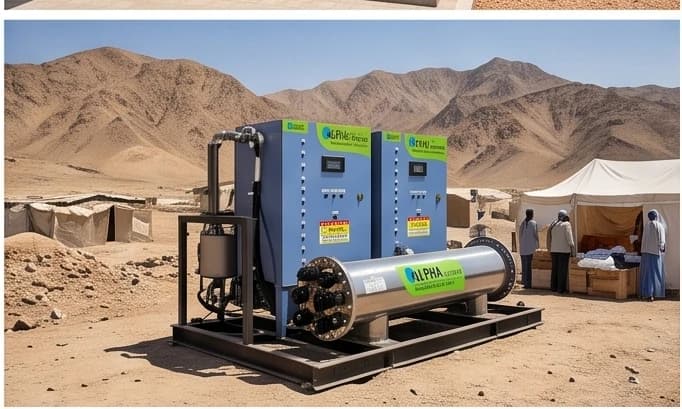
Sonatrach operates some of the world's most remote oil and gas producing infrastructure — wellhead clusters, gathering stations, and gas processing plants (GPF) at Hassi Messaoud, In Amenas, In Salah, and Illizi — where worker camps housing 500–5,000 personnel require potable water meeting WHO and Sonatrach HSE standards. UV water treatment Algeria in Sonatrach and partner company (BP Algeria, Total Energies Algeria, ENI) worker camps provides documented chemical-free disinfection of fossil aquifer water (after desalination where required) with the sensor-verified performance documentation that Sonatrach HSE departments and international operator audit teams require. Alpha UV's desert-environment specification for Algerian oil and gas applications includes IP65 enclosures for dusty desert environments, high-temperature-rated O-rings and gaskets for thermal aquifer water (post-cooling to below 40°C), and MODBUS integration for camp utility SCADA systems.
Algerian Desalination Network — Post-SWRO UV Polishing
Algeria's national SWRO desalination programme — operated by ADE (Algérienne des Eaux) and managed by Sonatrach's water subsidiary — includes UV polishing systems at Hamma (Algiers), Magtaa (Oran), Cap Djinet, and other plants as the final disinfection step before distribution. Post-SWRO water with UVT above 96 percent requires minimal lamp power for dose delivery, making UV the most energy-efficient disinfection option at this treatment stage. Alpha UV's multi-lamp reactor arrays for Algeria's high-capacity desalination plants (flow rates of 500–5,000 m³/hour per treatment line) are sized using ANSYS Fluent CFD validation to confirm dose uniformity across the full pipeline diameter at these very high flow rates.
Pharmaceutical Manufacturing
Algeria's pharmaceutical sector — one of North Africa's largest, with manufacturers including Saidal (state pharmaceutical company), Biopharm, LPA, and growing generics producers — is regulated by LNCPP under GMP standards requiring Purified Water loops with UV disinfection at 80 mJ/cm². Algeria's pharmaceutical import substitution policy (limiting finished drug imports to promote domestic manufacturing) has accelerated investment in LNCPP-compliant manufacturing facilities in Algiers, Constantine, and Oran. Alpha UV's AU-H series (electropolished SS 316L, DIN 11851 or tri-clamp sanitary connections, 80 mJ/cm² validated) is specified in Saidal and Biopharm facility GMP water system upgrade projects.
Agri-Food Processing — Cevital and Export Sector
Algeria's agri-food processing sector — led by Cevital (the largest private company in Algeria, with sugar refining, edible oil, and beverages operations at Bejaia), NCA Rouiba (juices), and dozens of smaller food producers — uses UV water treatment for process water in bottling and filling lines. EU food safety requirements for Algeria's growing food export sector (olive oil to France, dates to the Gulf) require BRC-format water quality documentation. Alpha UV's AU-M series with NSF/ANSI 55 Class A certification provides the BRC-acceptable performance evidence for Algerian food export processors.
System Design for Algerian Water Conditions
| Application | Pre-Treatment | UV System | Target Dose |
|---|---|---|---|
| Hamma / Magtaa SWRO post-treatment | 5μm polishing filter (post-RO) | AU-M series (multi-lamp, high-flow) | 40 mJ/cm² |
| Algiers / Oran borehole (moderate TDS) | 5μm cartridge filter | AU-S or AU-M series | 40 mJ/cm² |
| Saharan fossil aquifer (high TDS, warm) | Cooling → RO → 5μm cartridge → UV | AU-M series (high-temp O-rings) | 40 mJ/cm² |
| Sonatrach camp potable water | Sand filter → 5μm cartridge | AU-M series (IP65, MODBUS SCADA) | 40 mJ/cm² |
| Pharmaceutical PW (LNCPP-GMP) | RO + EDI | AU-H series (sanitary, EU GMP) | 80 mJ/cm² |
| Agri-food processing (Cevital, NCA Rouiba) | Sand filter → 5μm cartridge | AU-M series | 40 mJ/cm² |
CFD Validation for Algeria's High-Temperature Fossil Aquifer Applications
Algeria's Continental Intercalaire artesian aquifer water — emerging at 45–65°C and requiring cooling before use — presents a UV reactor operating environment substantially hotter than the 20°C reference temperature used in NSF/ANSI 55 biodosimetry validation studies. Two performance considerations apply at elevated water temperature: (1) UV lamp output changes with temperature — low-pressure mercury lamps reach optimal output at approximately 40°C amalgam temperature (the lamp's internal amalgam reservoir), and water temperatures above 40°C reduce lamp output; (2) O-ring and gasket materials rated for standard water temperatures (EPDM, rated to 80°C) must be specified for the post-cooling water temperature envelope encountered in Sonatrach field applications.
Alpha UV's IIT-trained engineers modelled the thermal performance of the UV reactor in ANSYS Fluent CFD, accounting for the temperature gradient from the lamp's thermal environment to the reactor wall. The analysis confirmed that at water temperatures of 30–45°C (post-cooling from artesian temperature), Alpha UV's amalgam lamp technology (which maintains near-constant UV output from 20–65°C water temperature, unlike standard low-pressure lamps that are sensitive to water temperature) delivers validated dose within 3 percent of room-temperature performance. Alpha UV specifies amalgam lamp technology as standard for Sonatrach and Continental Intercalaire applications in Algeria, eliminating the dose variability that would arise from using standard mercury lamps in this thermally challenging environment.
Import and Logistics to Algeria
Algeria imports through Algiers (Alger) Port (the capital's main terminal), Bejaia Port (northeast, serving eastern Algeria and Cevital industrial zone), and Oran Port (western Algeria). India-Algeria shipping operates via Mediterranean shipping lanes with transshipment typically at Jebel Ali (UAE) or Valencia (Spain). Sea freight from JNPT (Nhava Sheva) to Algiers/Bejaia: 14–20 days via Jebel Ali; 16–22 days via Valencia or Tanger Med. Algeria Customs (Douane Algérienne) clearance: 5–10 working days (Algerian customs is known for thorough inspection; complete documentation and pre-lodgement of import declarations via the SIGAD electronic customs system reduces delays).
Alpha UV prepares Algeria import documentation in Arabic and French (both required for Algerian customs and tender submissions): IANOR-format French-language technical data sheets, NSF/ANSI 55 Class A certificates, CE Declaration of Conformity (standard for EU-style markets), commercial invoice with HS 8421.21, Certificate of Origin (Form A for GSP tariff benefit), packing list, and Attestation de Conformité (conformity declaration) in the format required by Algerian customs for regulated goods. For Sonatrach procurement, Alpha UV provides tender technical submissions in the Direction Centrale Approvisionnement et Marchés (DCAM) format.
Frequently Asked Questions
What language do Algeria's UV system tender documents require?
Algerian public procurement regulations (code des marchés publics) require tender submissions in Arabic as the official language of Algeria. However, technical documents (data sheets, test certificates, manuals) are commonly accepted in French given Algeria's colonial heritage and the dominance of French in technical and commercial contexts. Sonatrach's DCAM and ADE procurement departments typically accept technical submissions in French, with Arabic-language cover documents and compliance declarations. Alpha UV provides comprehensive French-language technical packages — data sheets, NSF/ANSI 55 certificates with French summaries, system schematics, and installation manuals — as standard for Algerian export orders, with Arabic translation available upon request for public tender submissions.
How are UV systems powered in Sonatrach's remote Saharan installations?
Sonatrach's oil and gas field installations operate on self-generated power from gas turbine or diesel generators connected to the field's distribution grid. Power supply to UV systems in Sonatrach camps is typically 230 V or 400 V AC from the camp's generator distribution panel. Alpha UV's SMPS ballasts (180–265 V AC, 50/60 Hz) handle the voltage and frequency variations typical of generator power without external conditioning equipment. For installations where generator power quality is poor (high harmonic content from variable-speed drives), Alpha UV recommends a small UPS or line filter upstream of the UV controller. UV systems are typically connected to the camp's continuous power bus (not the load-shedding bus), ensuring uninterrupted UV operation is maintained as a camp safety-critical system.
How does UV handle the elevated temperature of Continental Intercalaire aquifer water?
Continental Intercalaire artesian water at 45–65°C is cooled before treatment — typically to below 40°C via heat exchangers — before entering the UV reactor. Alpha UV's systems for Algerian Saharan applications use amalgam lamp technology (rather than standard low-pressure mercury lamps) because amalgam lamps maintain near-constant UV output from 20°C to 60°C water temperature, while standard lamps drop output significantly above 30°C. O-rings, gaskets, and seals in the UV reactor chamber are specified in EPDM or silicone grade rated to 80°C minimum for Saharan applications. The quartz sleeve is rated to 150°C — well above any operating temperature encountered. Alpha UV confirms operating temperature specifications at the order stage for all Algerian oil and gas field applications.
Is Alpha UV registered as a Sonatrach-approved vendor?
Sonatrach operates a vendor qualification system (Direction Centrale Approvisionnement et Marchés — DCAM) that pre-qualifies suppliers for specific product categories. Alpha UV can be registered as a Sonatrach-qualified vendor for water treatment equipment under DCAM product category codes for UV disinfection systems. The pre-qualification process requires submission of: company registration documents, ISO 9001 quality management certificate, product technical documentation including NSF/ANSI 55 Class A certificates, evidence of similar oil and gas industry supply references, and financial information. Alpha UV's export team assists Algerian agents and distributors in preparing Sonatrach vendor registration submissions. Contact Alpha UV's MENA export team to initiate the Sonatrach vendor registration process.
What are the import duty rates for UV water treatment systems in Algeria?
Algeria applies customs duties on imported goods under the Common External Tariff schedule, with rates varying by product category and origin. Water treatment equipment under HS 8421.21 is subject to customs duty (typically 5–15 percent, confirm current rate with an Algerian customs broker), TVA (Value Added Tax at 19 percent), and potentially other charges (CAD inspection tax, domiciliation bank charges). Goods from countries with preferential trade agreements with Algeria — including the EU (Association Agreement) and Arab countries (Arab Free Trade Area) — may qualify for reduced duty rates. India does not have a free trade agreement with Algeria, so standard MFN (Most Favoured Nation) tariff rates apply to Indian-origin UV systems. Alpha UV includes HS code classification and country-of-origin documentation that accurately supports the correct tariff classification to avoid customs disputes.
Conclusion: UV Water Treatment Algeria — Validated Solutions for Africa's Largest Country
Algeria's UV water treatment market is shaped by the country's hydrocarbon wealth and the global operating standards of its oil and gas sector, the Mediterranean desalination ambition of its national water programme, and the EU-oriented food and pharmaceutical manufacturing sectors that drive European compliance standards into Algerian production facilities. From Sonatrach Saharan field camps to Hamma desalination post-treatment to Saidal pharmaceutical PW loops to Cevital Bejaia food processing — the common requirement is NSF/ANSI 55 Class A validated, CE-marked UV performance with French-language technical documentation that Algerian tender processes, LNCPP GMP auditors, and Sonatrach DCAM procurement teams accept.
Alpha UV's amalgam lamp technology for Continental Intercalaire high-temperature applications, IP65 desert-environment enclosures for Hassi Messaoud field installations, MODBUS SCADA integration for Sonatrach camp utilities, and multi-lamp CFD-validated arrays for Algeria's large-scale desalination plants — with a complete French/Arabic documentation package — deliver what Algeria's demanding UV water treatment market requires. Contact Alpha UV's MENA and Africa export team for Algeria pricing, Sonatrach DCAM vendor registration support, and field application design consultation.
Standards, authorities & further reading
External references used to inform this guide. Regulations evolve — check the latest revision on each authority's site before compliance decisions.
Recommended UV Systems
Alpha UV System products for this application — powered by genuine Philips UV-C lamps.
Commercial UV Water Purification System
500 – 5,000 LPH
HACCP-compliant UV water purification for hotels, restaurants, and offices
Industrial UV Water Treatment System
5,000 – 50,000 LPH
Schedule M 2025 and HACCP compliant UV for pharma, food & beverage, and process water
Not sure which system suits your application? WhatsApp our engineers for a free recommendation →
Related solutions
See how Alpha UV System applies this to your industry or city.
Need a UV system?
Talk to our UV engineers — WhatsApp for a quote in 2 hours, or browse the full catalog on IndiaMART.