Quick Answer
How long do UV bulbs last in water systems? Genuine Philips UV-C lamps used in water disinfection systems are rated for 9,000 operating hours at 80% UV-C output. At 9,000 hours, the lamp has degraded to the point where the delivered UV dose at rated flow rate approaches the minimum safe threshold — this defines end-of-useful-life for water disinfection, not outright failure. In continuous use (24 hours per day), 9,000 hours equals approximately 12.3 months — replace annually. At 8–12 hours per day, UV lamp lifespan in a water purifier stretches to 2–3 years. Generic or Chinese OEM UV-C lamps are typically rated at 4,000–5,000 hours — roughly half the Philips UV-C lamp life — and real-world performance is often shorter still.
Why UV Lamps Are Not Like Ordinary Light Bulbs
The single most dangerous misconception about UV water disinfection is this: people assume a UV lamp works like a household light bulb — either it is on and working, or it has burned out and they can see the problem. This is wrong, and the error can result in drinking water that passes through your UV system without being adequately disinfected.
Understanding how long UV bulbs last in water systems requires understanding how UV-C lamps fail — not suddenly, but gradually and invisibly.
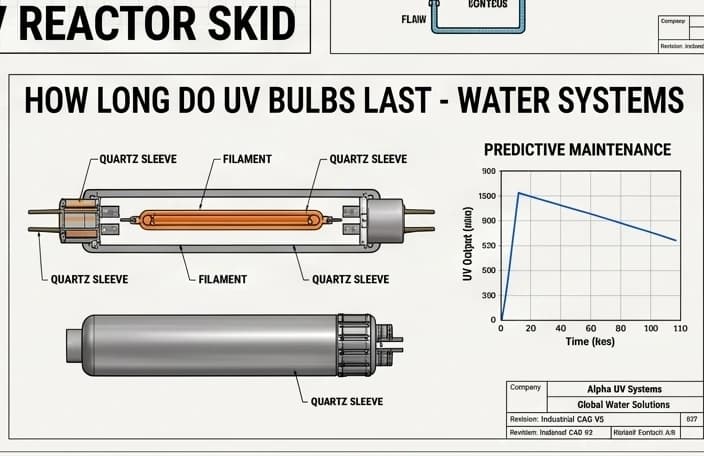
A standard light bulb produces visible light by heating a filament until it glows. Failure is mechanical — the filament breaks and the bulb goes dark. A UV-C low-pressure mercury vapour lamp produces germicidal radiation at 254 nm by exciting mercury atoms inside a sealed glass envelope. The visible pale blue-white glow you see is a byproduct, not the active output. The germicidal UV-C radiation at 254 nm is invisible.
As the lamp ages, several processes degrade UV-C output while the visible glow continues:
- Electrode sputtering: The tungsten electrodes erode with each ignition cycle and deposit tungsten on the lamp wall, gradually darkening the glass at the lamp ends
- Mercury redistribution: Mercury atoms redistribute unevenly inside the envelope, lowering the vapour pressure at the arc zone and reducing UV-C yield
- Glass solarisation: The quartz or special UV-transmitting glass envelope slowly darkens due to UV exposure, absorbing more of the UV-C before it exits the lamp
- Phosphor fatigue (in coated lamps): Does not apply to standard UV-C water disinfection lamps, but relevant for some fluorescent-type UV units
The result: a lamp approaching or beyond its rated Philips UV-C lamp life hours will still illuminate visibly, will still feel warm, and will show no outward signs of failure — yet its UV-C output may have dropped below the 40 mJ/cm² minimum dose required for reliable pathogen inactivation. Your water treatment system will appear to be running normally while providing inadequate protection.
This is why scheduled replacement based on operating hours — not appearance — is the correct maintenance approach for any UV water system lamp life programme.
UV-C Lamp Output Degradation Over Rated Life
The table below shows how UV lamp lifespan in a water purifier translates to declining germicidal effectiveness. Values are representative of Philips TUV low-pressure UV-C lamps; actual figures vary by wattage and system design.
| Operating Hours | % UV-C Output (of new lamp) | Dose at Rated Flow (mJ/cm²) | Disinfection Status | Visual Appearance | Action Required |
|---|---|---|---|---|---|
| 0 h (new lamp) | 100% | 55–60 mJ/cm² | Excellent — large safety margin | Bright blue-white glow | None |
| 1,500 h | 97–98% | 53–58 mJ/cm² | Excellent | Normal — no visible change | None |
| 3,000 h | 93–95% | 51–56 mJ/cm² | Good — adequate safety margin | Normal — no visible change | None |
| 5,000 h | 88–90% | 48–52 mJ/cm² | Acceptable — margin narrowing | Slight darkening at lamp ends | Note hours; plan replacement |
| 7,000 h | 84–86% | 45–49 mJ/cm² | Marginal — limited safety margin | Visible darkening at electrodes | Order replacement lamp now |
| 9,000 h (rated life) | 80% | 40–44 mJ/cm² | End of rated life — replace immediately | Still glowing — looks operational | Replace lamp immediately |
| 9,000+ h | Below 80% | Below 40 mJ/cm² | Inadequate — disinfection compromised | Still glowing — no visible failure | Do not use — replace urgently |
The critical observation: from 5,000 hours onward, how long UV bulbs last in water systems becomes a genuine safety question, not just a maintenance question. A well-designed UV system from a reputable manufacturer will include a safety factor in its sizing — delivering 55–60 mJ/cm² with a new lamp so that adequate dose is maintained through the full 9,000-hour UV lamp replacement schedule. Systems designed with no safety margin may fall below 40 mJ/cm² before reaching the rated hours.
How Long UV Lamps Last by Usage Pattern
UV water system lamp life is measured in operating hours, not calendar time. How long do UV bulbs last in water systems in your specific installation depends entirely on how many hours per day the system runs. The table below translates Philips UV-C lamp life hours into real-world replacement schedules for different applications.
| Hours/Day Operating | Annual Operating Hours | Years to 9,000 h | UV Bulb Replacement Schedule | Typical Application |
|---|---|---|---|---|
| 24 h/day (continuous) | 8,760 h/year | ~1.0 year | Annual replacement | Industrial plants, municipal booster, hospital water systems |
| 16 h/day | 5,840 h/year | ~1.5 years | Every 18 months | Commercial kitchens, food processing, schools |
| 12 h/day | 4,380 h/year | ~2.1 years | Every 2 years | Apartments, mid-size offices, restaurants |
| 10 h/day | 3,650 h/year | ~2.5 years | Every 2–2.5 years | Residential bungalows, small offices |
| 8 h/day | 2,920 h/year | ~3.1 years | Every 3 years | Residential with daytime-only use |
| 4 h/day | 1,460 h/year | ~6.2 years | Every 5–6 years (calendar limit: 5 years) | Seasonal/part-time use — farmhouses, guest houses |
Important note on the 4 h/day row: Even though 9,000 hours at 4 hours/day calculates to over 6 years, the recommended maximum service interval is 5 years regardless of hours. Lamp materials, seals, and ballast components age over calendar time even when the lamp is not operating. A 6-year-old lamp approaching 9,000 hours has experienced significant material ageing. The correct UV bulb replacement schedule for very low-use applications is therefore 5 years maximum, not the calculated 6+ years.
Philips UV-C vs Generic and Chinese OEM Lamps: An Honest Comparison
When evaluating how often to replace a UV lamp, the brand of lamp matters significantly. The 9,000-hour UV lamp lifespan water purifier figure applies to genuine Philips TUV series lamps manufactured to pharmaceutical-grade quality standards. Generic and Chinese OEM UV-C lamps carry very different performance profiles.
| Parameter | Philips TUV (Genuine) | Generic / Chinese OEM | Implication |
|---|---|---|---|
| Rated lamp life | 9,000 hours at 80% output | 4,000–5,000 hours (claimed) | Philips lasts 1.8–2.25× longer per lamp |
| Certificate of Analysis (COA) | Yes — batch-traceable, third-party verified UV-C output | Rarely available; claimed output unverified | Philips output figures are reliable; generic figures are nominal |
| CE Mark / certifications | CE marked, RoHS compliant, traceable manufacturing | CE marking varies; often self-declared | Philips certification is third-party audited |
| Manufacturing origin | Netherlands (Eindhoven) / Germany — check packaging | China — various OEM factories | Genuine Philips packaging states "Made in Netherlands" or "Made in Germany" |
| Real-world lamp life | Consistently 9,000 h with well-designed systems | Often 3,000–4,500 h in practice | Generic lamps may need replacement 2–3× more often |
| UV output accuracy | Measured output within ±5% of rated value | Measured output often 15–30% below claimed value | Generic lamp dose delivery uncertain; systems may under-disinfect from day one |
| Cost per lamp (India) | Higher upfront cost | Lower upfront cost | See total cost row below |
| Total cost over 5 years | 1–2 replacements; lower total spend | 3–5 replacements + uncertain safety | Philips UV-C lamp is typically lower total cost over 5 years despite higher per-lamp price |
A note on grey-market Philips lamps: the Indian market has counterfeit and grey-market Philips UV-C lamps that are either relabelled Chinese OEM products or genuine Philips lamps of unknown age and storage history. Always purchase replacement lamps from the original UV system manufacturer, an authorised Philips Signify distributor, or a trusted industrial lighting supplier. When buying, verify that the packaging states the manufacturing country and includes a batch code traceable to the Philips COA.
How to Track When Your UV Lamp Needs Replacing
Knowing how long UV bulbs last in water systems in theory is not enough — you need a method to track elapsed operating hours in your specific installation. There are four practical approaches, each suited to different system types.
Lamp-Hours Counter
The most reliable method for any system that runs continuously or on a predictable schedule. An electronic hours counter in the control panel accumulates operating hours from the moment of lamp installation. At 9,000 hours, a visual alarm (often a red LED or flashing indicator) triggers a replacement reminder. Reset the counter after installing the new lamp. This is the standard monitoring method on Alpha UV System commercial and industrial units.
UV Intensity Monitor with Alarm
A UV intensity sensor mounted in the reactor chamber measures actual UV-C irradiance in mW/cm² at the sensor position in real time. The controller compares this reading to a configured minimum threshold and triggers an alarm when output drops below the safe level — regardless of whether hours have been tracked. This method is superior to an hours counter alone because it also detects quartz sleeve fouling (mineral scale reducing UV transmission) and genuine lamp underperformance. Industrial and pharmaceutical-grade UV systems include UV intensity monitors as standard.
Calendar-Based Replacement
For residential systems without electronic monitoring, calendar-based replacement is the simplest reliable method. Establish a fixed annual replacement date — April or May is a good choice for India, completing the how often replace UV lamp cycle just before the monsoon season (June–September) when waterborne disease risk from contaminated groundwater is highest. Label the UV unit with a sticker showing the lamp installation date and the next due date.
Lamp Monitoring Methods Comparison
| Method | How It Works | Accuracy | Best For | System Types That Include It |
|---|---|---|---|---|
| Lamp-hours counter | Electronic counter accumulates operating hours; alarms at 9,000 h | High — tracks actual run time | Commercial, industrial, continuously-running systems | Alpha UV System commercial range; most quality branded systems |
| UV intensity monitor | UV-C sensor in reactor measures real-time mW/cm²; alarms below threshold | Highest — detects lamp degradation AND sleeve fouling | Industrial, pharmaceutical, food processing — any critical application | Alpha UV System industrial range; high-specification commercial systems |
| Calendar-based replacement | Fixed annual (or biennial) replacement date regardless of hours | Conservative — may replace slightly early, but never late | Residential, low-budget commercial, systems without electronic controls | All systems — can be applied to any installation |
| Manual hours log | User records switch-on/off times in a logbook; calculates cumulative hours | Moderate — depends on consistent logging | Small commercial systems with intermittent use and no electronics | Any system — user-maintained |
Signs Your UV Lamp May Need Early Replacement
Even before the UV bulb replacement schedule date arrives, certain signs indicate that a lamp may be underperforming and should be replaced ahead of its rated Philips UV-C lamp life hours.
- UV intensity monitor alarm or low reading: If your system has a UV intensity monitor and it reads more than 15–20% below the normal new-lamp level, the lamp output has degraded faster than expected. Do not wait for the hours counter — replace the lamp
- Visible darkening at lamp ends: Dark bands or rings at the electrode ends of the lamp envelope are a sign of electrode sputtering. Some end darkening after 5,000–7,000 hours is normal; heavy darkening at 3,000 hours or earlier suggests a lamp quality issue or abnormal operating conditions
- Discolouration of the lamp envelope: A pink, grey, or brown tint to the lamp body (not just the end caps) indicates mercury redistribution. Replace the lamp
- Lamp fails to strike (ignite): A lamp that does not ignite on power-up has failed outright. This is uncommon for quality lamps within rated life but common for low-quality lamps. Replace immediately
- Intermittent operation: A lamp that flickers, extinguishes and re-ignites, or takes more than 2 minutes to reach stable output is approaching end of electrode life
- Visible water discolouration or odour post-UV: Not directly a lamp sign, but if water quality changes coincide with the UV system's lamp reaching significant hours, investigate lamp condition first
Factors That Shorten UV Lamp Life
Understanding how long UV bulbs last in water systems also means understanding the factors that can cut that life short of the rated 9,000 hours. Several of these are particularly relevant to Indian operating conditions.
| Factor | Effect on Lamp Life | Indian Context | Mitigation |
|---|---|---|---|
| Frequent on/off cycling | Each ignition cycle stresses the electrodes; frequent cycling can reduce lamp life by 20–40% versus continuous operation | Demand-triggered systems that switch on with each tap opening are common in residential installations | Keep UV system on continuously for the hours the building is occupied; do not wire to flow sensor for residential use |
| High ambient temperature (poor ventilation) | UV-C lamps have an optimal wall temperature of 40°C for peak 254 nm output. Temperatures above 50°C shift mercury vapour pressure and reduce UV-C yield | Utility rooms and pump houses in North India reach 45–55°C in summer (May–June). This affects UV water system lamp life during peak summer months | Ensure adequate ventilation in the UV system installation space; avoid direct sunlight on the UV unit; install in shaded, ventilated pump room |
| Overvoltage / voltage spikes | Sustained voltage above rated input (typically 220–240V) increases arc temperature, accelerating electrode degradation and reducing Philips UV-C lamp life hours | Voltage fluctuation is common across India, particularly in Tier-2/3 towns and rural areas with weak grid infrastructure | Install a voltage stabiliser upstream of the UV system; specify a UV unit with built-in overvoltage protection |
| Incorrect or aging ballast | The electronic ballast controls current to the lamp. A failing or mismatched ballast can overdrive the lamp, causing early electrode failure | Ballast quality varies widely in locally-assembled UV systems; counterfeit electronic components are a known issue | Use the ballast specified by the UV system manufacturer; replace the ballast at the manufacturer's recommended interval |
| Cold start in very low ambient temperatures | In temperatures below 10°C, mercury condensation inside the lamp reduces UV-C output on cold start and increases thermal stress at ignition | Relevant in North India hill stations and in cold-water-fed installations (borewell water at 10–14°C in winter) | Allow 60–90 second warm-up period after cold start before routing water through the system; this is particularly relevant where water flows through the reactor immediately on power-up |
| Quartz sleeve fouling (indirect effect) | Mineral scale on the quartz sleeve does not shorten lamp life itself, but reduces UV-C transmission — causing the UV intensity monitor to read low and prompting premature lamp replacement when the lamp is actually functional | Hard water (TDS 500–1,200 ppm) is common across Delhi NCR, Rajasthan, Gujarat, and parts of Maharashtra — accelerating quartz sleeve scaling | Clean the quartz sleeve with mild acid solution (citric acid) every 6–12 months; replace the sleeve if scratched or permanently etched |
Step-by-Step UV Lamp Replacement Guide
Replacing a UV lamp is a straightforward 15-minute task for residential and small commercial systems. The procedure below covers the standard lamp-in-sleeve configuration used in most horizontal-mount and vertical-mount UV water purifiers. Always refer to your specific system's manual for model-specific steps.
- Switch off power to the UV system at the isolator or circuit breaker. Do not simply switch off at the unit's own power switch — isolate at the breaker to prevent accidental re-energisation
- Close the isolation valves on the inlet and outlet of the UV reactor to prevent water flow during the procedure
- Allow the lamp to cool for 10–15 minutes. UV-C lamps operate at surface temperatures of 60–80°C. Handling a hot lamp risks burns and thermal shock to the quartz sleeve
- Drain the reactor chamber by opening the drain plug or purge valve if fitted. Place a bucket or absorbent mat below the unit
- Remove the lamp end cap or connector. Most systems use a bayonet or push-pull connector. Disconnect the power lead from the lamp cap
- Remove the quartz sleeve (if the design places the lamp inside a sleeve). Unscrew the sleeve retaining nut at the end cap end. Slide the sleeve out carefully — it is fragile borosilicate glass
- Inspect the quartz sleeve for scale, scratches, or cracks. A scaled sleeve should be cleaned before reuse; a cracked sleeve must be replaced. A scratched sleeve reduces UV transmission and should be replaced
- Slide out the old UV lamp. Handle with a clean cloth or the gloves provided — finger oils on the lamp envelope can cause hot spots during operation. Place the old lamp in the original packaging for disposal
- Clean the quartz sleeve with a citric acid solution (10% by weight in warm water) if scaled. Soak for 20–30 minutes, rinse thoroughly with clean water, dry
- Insert the new Philips UV-C lamp into the clean quartz sleeve. Handle by the end caps only. Ensure the lamp is fully seated
- Reassemble in reverse order: reinsert the sleeve, hand-tighten the retaining nut (do not over-tighten — the nut seals against an O-ring), reconnect the power lead to the lamp cap
- Open the inlet valve slowly to fill the reactor. Check for leaks at the sleeve retaining nut and end cap O-ring. Once confirmed leak-free, open the outlet valve, restore power, and confirm the lamp illuminates. Reset the hours counter if fitted. Record the installation date on the lamp label affixed to the unit
Safety note: Never look directly at an operating UV-C lamp without appropriate UV-blocking safety glasses. Direct exposure to UV-C radiation causes photokeratitis (arc eye) and skin burns. The lamp must be inside the sealed reactor and the reactor closed before powering on.
UV Lamp Disposal in India: Mercury Content and E-Waste Rules
UV-C low-pressure mercury vapour lamps contain 3–15 mg of mercury sealed inside the glass envelope — a small quantity, but one that must be managed responsibly. Under India's E-Waste (Management) Rules 2022, UV lamps are classified as Hazardous Waste (Schedule II) and must not be disposed of in municipal solid waste streams.
Correct disposal procedure:
- Do not break the lamp — keep it intact. Breakage releases mercury vapour
- Wrap the intact lamp in the original manufacturer's packaging or three layers of newspaper
- Seal in a plastic bag labelled "Fluorescent/UV Lamp — Mercury Content — Hazardous Waste"
- Drop off at a CPCB-registered e-waste collection centre. Most major Indian cities have authorised collection points; the CPCB website maintains a state-wise directory of registered e-waste recyclers
- Many UV system manufacturers and authorised service networks offer lamp take-back at the point of replacement — ask at the time of service
If a UV lamp breaks: Evacuate the immediate area. Ventilate for at least 15 minutes before re-entering. Do not use a vacuum cleaner — this disperses mercury vapour. Collect glass fragments with damp paper towels, wearing gloves. Place all material in a sealed plastic bag and dispose as hazardous waste. The mercury content in a single low-pressure UV lamp is low enough that a single breakage in a ventilated space presents minimal long-term health risk, but the correct procedure should be followed.
Where to Buy Genuine Philips UV-C Replacement Lamps in India
The quality of the replacement lamp directly determines how long UV bulbs last in water systems after replacement. Buying an authentic lamp is as important as replacing on schedule.
Reliable sources for genuine Philips UV-C replacement lamps in India:
- Original UV system manufacturer: The most reliable source. Alpha UV System supplies genuine Philips UV-C replacement lamps for all UV systems we manufacture and for compatible third-party systems, with 24–48 hour supply across Delhi NCR and delivery within India. This ensures the correct wattage and lamp type for your specific reactor
- Authorised Philips Signify distributors: Philips Signify maintains a distributor network in major Indian cities. Authorised distributors can provide batch COA documentation on request
- Established industrial lighting suppliers: Industrial electrical suppliers in major cities typically stock Philips TUV lamps for UV applications. Verify COA and check for "Made in Netherlands" or "Made in Germany" on the packaging
Sources to avoid for UV replacement lamps:
- General online marketplaces (Amazon, Flipkart) where lamp authenticity cannot be guaranteed and counterfeit or grey-market inventory is common
- Local electrical shops without UV lamp specialisation — UV-C lamps are often confused with standard fluorescent tubes or blacklight lamps by non-specialist retailers
- Unusually low-priced "Philips" lamps — genuine Philips TUV lamps have a known minimum price; significantly below-market pricing indicates counterfeit or grey-market product
UV Lamp Replacement Cost Guide India 2026
UV lamp replacement cost in India varies by lamp wattage, system size, and whether you choose a genuine Philips UV-C lamp or a generic OEM lamp. The table below provides 2026 cost guidance for the most common UV water system configurations.
| Lamp Type | Wattage | Typical UV System Size | Philips Lamp Cost (₹) | Generic OEM Cost (₹) | Alpha UV System Supply Price | Why Philips Costs More But Is Cheaper Long-Term |
|---|---|---|---|---|---|---|
| Residential compact | 6–8 W | Under-sink / point-of-use (500–1,000 LPH) | ₹2,200–3,000 | ₹600–1,000 | Contact for current price | Philips: 1 replacement per 3 years at 8 h/day. Generic: 2–3 replacements over same period. Effective cost advantage to Philips after second replacement cycle |
| Residential standard | 11–16 W | Whole-house / apartment (2,000–5,000 LPH) | ₹3,000–4,500 | ₹900–1,500 | Contact for current price | Same replacement frequency advantage; additionally, generic lamp's uncertain UV output may under-disinfect from installation — a safety cost not captured in price |
| Commercial | 25–40 W | Restaurant / school / clinic (10,000–50,000 LPH) | ₹5,000–8,500 | ₹1,500–3,000 | Contact for current price | Commercial systems often run 16–24 h/day; Philips 9,000 h life vs generic 4,000 h means Philips replaces annually vs generic every 5–6 months. Labour cost of additional replacements further favours Philips |
| Industrial standard | 55–75 W | Industrial process / apartment block (100,000+ LPH) | ₹9,000–15,000 | ₹3,000–5,000 | Contact for current price | Multi-lamp industrial systems amplify the replacement frequency difference. A 4-lamp system with generic lamps may require 8–12 replacements over 3 years vs 3–4 with Philips. Shutdown and labour costs for each replacement are significant at industrial scale |
| Industrial high-output | 150–200 W | Large industrial / municipal booster | ₹18,000–30,000 | Limited genuine alternatives | Contact for current price | At this wattage, generic alternatives with verified performance and COA documentation are largely unavailable in the Indian market. Philips UV-C is effectively the only verifiable option |
UV lamp replacement cost in India should always be evaluated over a 3–5 year horizon, not per-lamp. The UV lamp replacement cost India calculation that counts only the purchase price of the lamp misses replacement frequency, labour cost per replacement, and — most importantly — the cost of inadequate water disinfection from an underperforming generic lamp.
Frequently Asked Questions
Can I use a UV lamp past its rated 9,000 hours?
No — using a UV lamp beyond its rated 9,000 hours is not recommended for any potable water disinfection application. At 9,000 hours, a Philips UV-C lamp has degraded to 80% of initial UV-C output, delivering the minimum acceptable dose at rated flow. Beyond 9,000 hours, output continues to fall below 80% and the delivered dose drops below 40 mJ/cm² — the minimum for reliable inactivation of bacteria, viruses, and protozoa including Cryptosporidium. The lamp will still illuminate visibly and the system will appear operational. There is no warning sign visible to the user that disinfection has become inadequate. This is precisely why the UV bulb replacement schedule must be followed by hours or calendar, not by whether the lamp appears to be working.
Do UV lamps need to warm up before water is safe to drink?
Philips UV-C low-pressure lamps reach 90% of rated UV-C output within 30–60 seconds of switch-on. For practical purposes, 60 seconds is an adequate warm-up time. Most residential UV systems are designed to be left on continuously rather than switched on and off with each demand — the low wattage (6–16W) makes continuous operation economical, and continuous operation avoids the on/off cycling that shortens UV lamp lifespan in water purifiers. If your system switches on with flow, ensure that a flow-break or delay relay provides at least 30 seconds of lamp warm-up before water passes through the reactor at rated flow rate.
Where to buy genuine Philips UV-C replacement lamps in India?
The most reliable source is the original UV system manufacturer. Alpha UV System supplies genuine Philips UV-C replacement lamps for all our systems and for compatible third-party units — confirm your system model and lamp wattage via WhatsApp and we confirm the correct lamp within 24–48 hours. Authorised Philips Signify distributors in major cities are the other verified channel. Avoid online marketplaces for UV-C replacement lamps — counterfeit and grey-market inventory is common, and there is no way to verify UV-C output or lamp life at purchase. A lamp that costs 60% less but delivers 50% of the rated hours costs more per operating hour and may under-disinfect your water.
How much does UV lamp replacement cost in India?
Genuine Philips UV-C replacement lamp costs in India in 2026 range from approximately ₹2,200–3,000 for residential 6–8W lamps up to ₹18,000–30,000 for large industrial lamps. The most common residential replacement (11–16W) falls in the ₹3,000–4,500 range for a genuine Philips lamp. UV lamp replacement cost India estimates should include the lamp plus a quartz sleeve inspection — if the sleeve is heavily scaled or scratched, sleeve replacement (typically ₹800–2,500 depending on size) adds to the service cost. Labour for a competent DIY replacement is zero; professional service typically costs ₹500–1,500 for a site visit in addition to parts.
How do I know if my UV lamp is approaching end of life?
The most reliable indicator is the lamp-hours counter on your system's control panel — when it approaches 9,000 hours (or the hours counter alarm activates), schedule replacement. If your system has a UV intensity monitor, a reading that has declined more than 15% from the initial new-lamp reading indicates either lamp degradation or quartz sleeve fouling — clean the sleeve first and re-read. Visual signs that appear on the lamp itself include darkening at the electrode ends (normal after 5,000+ hours, but heavy darkening at 3,000 hours indicates a problem) and any discolouration of the lamp body. If your system has none of these monitoring features, follow a calendar-based UV lamp replacement schedule: every 12 months for systems operating more than 16 hours/day, every 2 years for 10–12 hours/day, and every 3 years for 8 hours/day use. When in doubt, replace — a new Philips UV-C lamp costs far less than a waterborne illness.
Does a UV lamp burn out suddenly or gradually?
Gradually — this is the defining characteristic of UV-C lamp degradation and the reason why scheduled replacement by hours or calendar is essential. A UV lamp does not go dark suddenly at the end of its rated life. It continues to produce visible blue-white illumination while its 254 nm UV-C output declines steadily over thousands of hours. By the time a lamp reaches 9,000 hours, it has lost 20% of its initial UV-C output — enough to reduce the germicidal dose below the safe threshold — yet it looks completely normal. Outright lamp failure (lamp fails to ignite entirely) does occur occasionally, typically due to electrode failure after very heavy cycling, but this is unusual for quality lamps within rated hours. The far more common and more dangerous scenario is gradual degradation — a lamp that looks fine but is no longer adequately disinfecting. This is why the answer to "how long do UV bulbs last in water systems" is always measured in hours, never in visual appearance.
Need a genuine Philips UV-C replacement lamp for your system? WhatsApp us with your system model and wattage — we confirm the correct lamp and arrange supply within 24–48 hours across Delhi NCR and pan-India.
Standards, authorities & further reading
External references used to inform this guide. Regulations evolve — check the latest revision on each authority's site before compliance decisions.
Recommended UV Systems
Alpha UV System products for this application — powered by genuine Philips UV-C lamps.
Commercial UV Water Purification System
500 – 5,000 LPH
HACCP-compliant UV water purification for hotels, restaurants, and offices
Industrial UV Water Treatment System
5,000 – 50,000 LPH
Schedule M 2025 and HACCP compliant UV for pharma, food & beverage, and process water
Not sure which system suits your application? WhatsApp our engineers for a free recommendation →
Related solutions
See how Alpha UV System applies this to your industry or city.
Need a UV system?
Talk to our UV engineers — WhatsApp for a quote in 2 hours, or browse the full catalog on IndiaMART.