Quick Answer
Only UV-C (200–280 nm) effectively disinfects water. UV-C at 254 nm is absorbed directly by pathogen DNA, disrupting replication and causing cell death. UV-A (315–400 nm) and UV-B (280–315 nm) lack sufficient energy to damage pathogen DNA at practical doses. All UV water purifiers and treatment systems use UV-C lamps at 254 nm — never UV-A or UV-B.
Understanding the difference UV-A UV-B UV-C water disinfection applications is fundamental to evaluating any UV treatment system. Not all ultraviolet light is equal — wavelength determines everything about whether a UV system can kill pathogens or merely emit light that does nothing to your water. This guide covers the complete science, from the UV spectrum to lamp types to pathogen kill data at 254 nm.
The UV Spectrum: A, B, and C
Ultraviolet radiation occupies the band between visible light (400 nm) and X-rays (10 nm). Within this range, international convention divides UV into three sub-bands — each with distinct physical properties, biological effects, and relevance to water treatment.
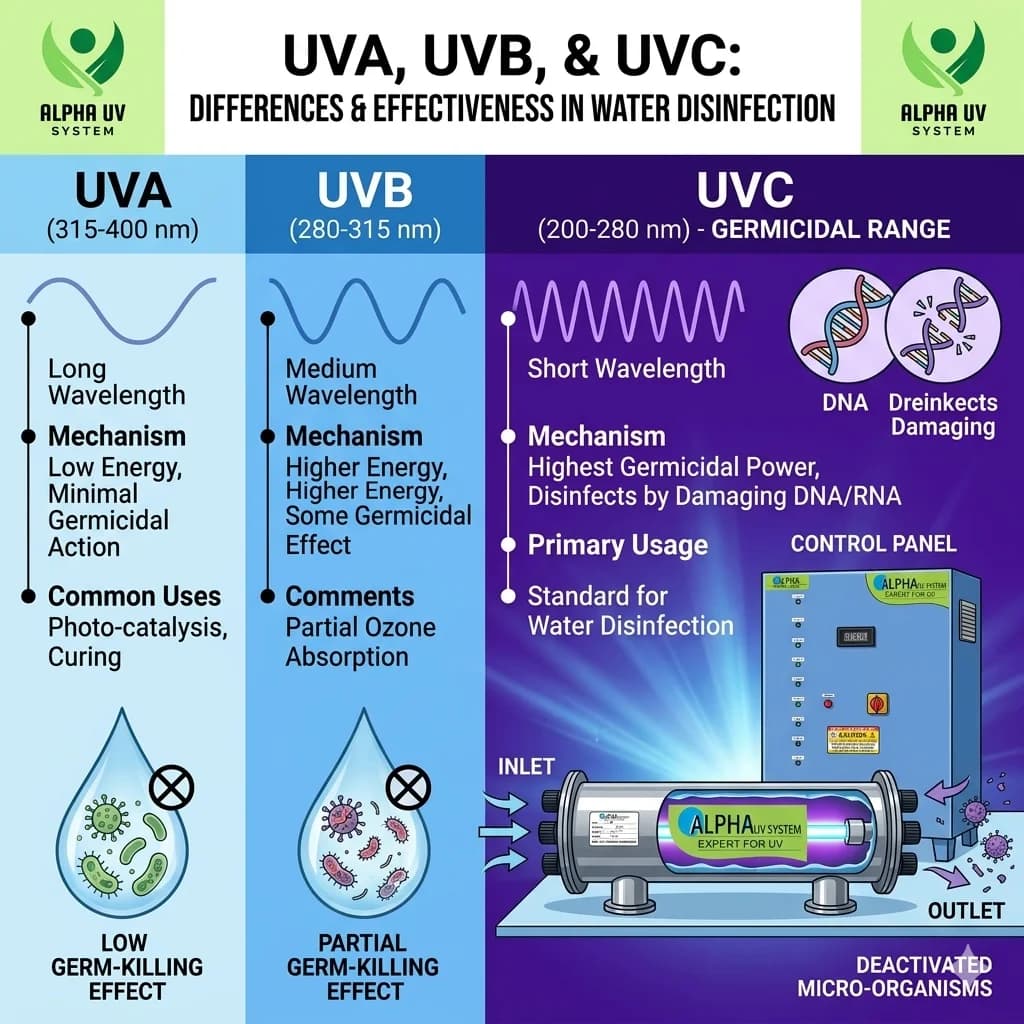
- UV-A (315–400 nm): Long-wave UV. Reaches Earth's surface; approximately 95% of the UV in sunlight is UV-A. Responsible for skin tanning and photoageing. Low photon energy.
- UV-B (280–315 nm): Medium-wave UV. Partially blocked by the ozone layer. Causes sunburn and stimulates vitamin D synthesis in skin. Moderate photon energy. Some germicidal effect at extreme doses.
- UV-C (200–280 nm): Short-wave UV. Completely absorbed by Earth's atmosphere — zero UV-C from the sun reaches ground level. Highest photon energy in the UV spectrum. This is the germicidal UV band used for water, air, and surface disinfection.
Germicidal UV is specifically defined as the 200–280 nm UV-C range. Within that range, effectiveness peaks at 254 nm — the wavelength at which the DNA nucleobases of pathogens absorb UV radiation most strongly. Understanding this difference UV-A UV-B UV-C water disinfection relevance is the starting point for every UV system specification.
| Property | UV-A (315–400 nm) | UV-B (280–315 nm) | UV-C (200–280 nm) |
|---|---|---|---|
| Reaches Earth's surface? | Yes — ~95% of UV in sunlight | Partially | No — 100% absorbed by atmosphere |
| Energy per photon | Lowest | Medium | Highest |
| DNA absorption | Very poor | Moderate | Peak at 254 nm |
| Germicidal effectiveness | Negligible | Very limited | High — up to 4-log kill at 40 mJ/cm² |
| Used in UV water treatment? | No | No | Yes — 254 nm low-pressure lamps |
Why UV-C Works on Pathogens and UV-A/B Do Not
The key to the difference UV-A UV-B UV-C water disinfection effectiveness lies in photobiology — specifically, how efficiently each UV band transfers energy to pathogen DNA. Bacteria, viruses, and protozoa are inactivated when UV radiation causes sufficient damage to their nucleic acids to prevent replication. Without replication, pathogens die and cannot cause infection.
DNA absorption spectrum: The nucleobases that form DNA — adenine, thymine, guanine, cytosine — absorb UV radiation most strongly between 260–265 nm. UV-C at 254 nm sits directly at this absorption peak. When UV-C photons strike a pathogen, they are absorbed by the DNA at maximum efficiency, causing thymine dimers — crosslinks between adjacent thymine bases that prevent the DNA strand from being read or copied. The pathogen cannot replicate and is effectively inactivated.
Why UV-A fails: At 365 nm, UV-A photon energy is too low to be meaningfully absorbed by DNA nucleobases. UV-A interacts primarily with cell surface chromophores and pigments rather than reaching the DNA. The germicidal effect is negligible — even at doses orders of magnitude higher than standard UV-C treatment doses, UV-A alone cannot achieve the 4-log pathogen kill required for safe drinking water.
Why UV-B is insufficient: UV-B has some germicidal effect because it is closer in wavelength to the DNA absorption peak. However, its absorption by DNA is only about 30% of UV-C's, meaning 10–20 times more UV-B energy is required to achieve the same log reduction. At those doses, UV-B delivery in a practical water treatment reactor becomes technically and economically unworkable. No commercial UV water disinfection system uses UV-B as its primary wavelength.
| UV Type | Wavelength | DNA Absorption Relative to UV-C | Dose for 4-log E. coli Kill | Practical for Water Treatment? |
|---|---|---|---|---|
| UV-A | 365 nm | ~1% of UV-C | Above 10,000 mJ/cm² | No |
| UV-B | 300 nm | ~30% of UV-C | ~400 mJ/cm² | No — too high dose required |
| UV-C | 254 nm | 100% (reference) | ~40 mJ/cm² | Yes — standard treatment dose |
What Lamp Type Is Used in UV Water Treatment Systems
Since the difference UV-A UV-B UV-C water disinfection performance is so stark, every legitimate UV water treatment system — from residential under-sink units to industrial flow-through reactors — uses UV-C lamps specifically. The lamp technology determines the wavelength, output, and operational life of the system.
Low-pressure mercury lamp (standard): The dominant technology in UV water treatment globally. These lamps emit approximately 95% of their UV output at exactly 253.7 nm — rounded to 254 nm in industry documentation. The Philips TUV lamp (Philips UV-C lamp) is the most widely validated low-pressure germicidal lamp in the world, with a rated lamp life of 9,000 hours and consistent UV-C output throughout its service life. Alpha UV systems use the Philips TUV lamp as standard.
Medium-pressure mercury lamp: Emits a broad polychromatic UV-C spectrum (200–300 nm) rather than a single-line output. Used in large municipal water treatment plants and for chloramine destruction in swimming pools. Higher electrical power (100 W–1,000 W per lamp) but lower UV-C conversion efficiency than low-pressure lamps.
UV-C LEDs: An emerging technology emitting at 265–280 nm. Advantages include compact size, mercury-free construction, and instant on/off operation. As of 2026, UV-C LEDs still deliver lower UV-C output per watt than mercury vapour lamps for high-dose applications, making them more suitable for point-of-use prototypes than high-flow commercial systems.
UV-A lamps (blacklight/BLB): These emit at 365–400 nm and produce zero UV-C output. They appear purple or violet due to their visible light emission. UV-A lamps are used in insect traps, curing applications, and forensic inspection — never in water disinfection. A violet-glowing lamp sold as a "UV purifier" that does not specify UV-C at 253.7–254 nm is not a germicidal water treatment device.
| Lamp Type | Primary Wavelength | UV-C Output | Lamp Life | Water Treatment Use |
|---|---|---|---|---|
| Low-pressure mercury (Philips TUV) | 254 nm | 95% at 254 nm | 9,000 hours | Residential, commercial, industrial |
| Medium-pressure mercury | 200–300 nm (broad) | 10–15% in UV-C range | 4,000–8,000 hours | Large municipal systems |
| UV-C LED (270 nm) | 265–280 nm | Variable | 10,000+ hours | Emerging; prototypes |
| UV-A lamp (BL/BLB) | 365–400 nm | Zero UV-C | 10,000 hours | Not for water disinfection |
Why Sunlight Does Not Disinfect Water Effectively
A common misconception about the difference UV-A UV-B UV-C water disinfection performance is that sunlight — which contains UV — should disinfect water. This reasoning fails because of atmospheric filtration: the ozone layer and atmospheric oxygen absorb 100% of UV-C before it reaches Earth's surface.
Sunlight reaching ground level contains approximately 95% UV-A and about 5% UV-B (wavelengths above 290 nm only — shorter UV-B is also filtered). It contains effectively zero UV-C. Since UV-A and UV-B at solar intensities cannot achieve meaningful pathogen kill at practical doses, sunlight is not a reliable water disinfection method.
SODIS (Solar Disinfection) is a field technique used in resource-limited settings: clear water in a 1-litre PET bottle is placed in direct sunlight for 6–48 hours. Any disinfection effect comes from the combined action of UV-A and solar heat — not UV-C. SODIS is unreliable in cloudy conditions, contaminated water (turbidity blocks UV penetration), cold climates, and volumes above 2 litres. It is a last-resort field measure, not a validated water treatment technology.
A UV water purifier using a Philips UV-C lamp at 254 nm delivers a controlled, validated UV-C dose of 40 mJ/cm² in a certified reactor chamber — achieving 4-log (99.99%) bacterial kill in milliseconds. This is not comparable to diffuse, variable, UV-C-free sunlight exposure over many hours.
The 254 nm Sweet Spot
The dominance of low-pressure mercury lamps in UV water treatment is not accidental. The coincidence between the physical emission of mercury vapour and the biological absorption peak of pathogen DNA makes 254 nm the most efficient germicidal wavelength available from a lamp technology that has been manufactured reliably for decades.
The exact primary emission line of a low-pressure mercury vapour lamp is 253.7 nm — universally rounded to 254 nm in water treatment specifications. DNA nucleobases absorb UV most strongly at 260–265 nm, and the absorption curve is broad enough that 254 nm achieves near-maximum energy transfer to DNA. This is why low-pressure UV-C lamps — and specifically the Philips TUV lamp used in Alpha UV systems — achieve industry-standard pathogen kill at doses as low as 40 mJ/cm².
The table below shows 254 nm UV-C performance against the pathogens most relevant to Indian drinking water safety:
| Pathogen | Log Reduction at 40 mJ/cm² | % Inactivated | Comment |
|---|---|---|---|
| E. coli | 4-log | 99.99% | WHO reference pathogen |
| Salmonella typhi | 4-log | 99.99% | Typhoid causative agent |
| Vibrio cholerae | 4-log | 99.99% | Cholera — endemic in India |
| Cryptosporidium parvum | 3-log | 99.9% | Completely chlorine-resistant |
| Giardia lamblia | 3-log | 99.9% | Chlorine-resistant |
| Rotavirus | 3-log | 99.9% | Most common child diarrhoea agent in India |
| Hepatitis A virus | 3-log | 99.9% | Common waterborne hepatitis |
UV-A in Water Treatment: Advanced Oxidation Context
While UV-A has no role in standard water disinfection, it does appear in one advanced water treatment application: Advanced Oxidation Processes (AOP). In AOP systems, UV-A or broad-spectrum UV is combined with an oxidant — typically hydrogen peroxide (H₂O₂) or ozone — to generate hydroxyl radicals (·OH). These hydroxyl radicals are extremely reactive and can oxidise pharmaceutical residues, pesticides, endocrine-disrupting compounds, and other trace organic contaminants that conventional treatment cannot remove.
This is fundamentally different from disinfection. AOP destroys chemical contaminants through oxidation; UV-C disinfection inactivates biological pathogens through DNA damage. The two processes address different problems, use different wavelengths, and are not interchangeable.
For Indian homes, restaurants, factories, and commercial buildings — the relevant technology for waterborne disease prevention is UV-C at 254 nm for pathogen inactivation. AOP is a specialist industrial water treatment process for facilities with pharmaceutical or agrochemical contamination in source water. Understanding this distinction is central to the difference UV-A UV-B UV-C water disinfection selection for any real application.
How to Tell If a UV System Is Using UV-C
Given that the difference UV-A UV-B UV-C water disinfection effectiveness is absolute — UV-C works, UV-A and UV-B do not — it is important to verify that any UV purifier or treatment system actually uses UV-C. Here is how to assess this:
Lamp envelope appearance: A genuine UV-C germicidal lamp has a transparent quartz glass envelope — it looks like clear glass. Quartz transmits UV-C wavelengths. Standard borosilicate glass absorbs UV-C and cannot be used for germicidal lamps. If the lamp has a blue or violet-tinted glass envelope, it is a UV-A blacklight lamp, not a UV-C germicidal lamp.
Lamp specification: The lamp datasheet or product label should state 253.7 nm, 254 nm, or "germicidal UV-C." A lamp spec that only states "UV lamp" or lists a wattage without a wavelength should be questioned. The Philips TUV lamp used in Alpha UV systems states UV-C output at 253.7 nm explicitly.
Visible glow colour: UV-C radiation itself is invisible to the human eye. Low-pressure mercury lamps produce a faint violet/blue glow during operation — this is from visible mercury emission lines (primarily 405 nm and 436 nm), not from UV-C. The UV-C component of the output is doing the work invisibly. A lamp that glows bright violet or purple with tinted glass is almost certainly a UV-A lamp.
System documentation: Any certified UV water treatment system will provide a UV dose validation report specifying the UV-C dose delivered (in mJ/cm²) at rated flow. If a system cannot provide this, it has not been validated for water disinfection regardless of what wavelength its lamp emits.
Alpha UV systems are supplied with Philips UV-C lamps (Philips TUV series) with confirmed UV-C output at 254 nm, and all systems are sized to deliver a minimum of 40 mJ/cm² at rated flow rate.
UV Safety: UV-C and UV-B Are Not the Same Risk
UV-B from sunlight causes sunburn through prolonged skin exposure — most people have experienced this. UV-C is a different matter entirely. Because UV-C does not reach Earth's surface naturally, human skin and eyes have no evolutionary adaptation to it. Direct UV-C exposure causes injury far more rapidly than UV-B sunburn:
- Eyes: Photokeratitis (corneal flash burn) — intense pain, tearing, and temporary vision impairment — can result from seconds of direct UV-C eye exposure without protection.
- Skin: UV-C erythema (UV burn) develops more rapidly than UV-B sunburn at equivalent intensities.
UV water treatment systems are sealed stainless steel chamber designs precisely to prevent any UV-C from exiting during operation. The lamp is enclosed inside a quartz sleeve within the steel flow chamber — no UV-C reaches the outside of the unit. The water flows around the lamp inside the chamber and exits the outlet having received the full UV-C dose. Water exiting a UV treatment system carries zero UV radiation.
The only UV-C exposure risk in a UV water treatment system occurs during lamp replacement. The safety rule is simple: always switch off power and disconnect the unit before opening the lamp access cap. Never operate a bare UV-C lamp outside a shielded chamber without appropriate UV-protective eyewear and skin coverage. For Alpha UV systems, lamp replacement takes approximately five minutes following the power-off procedure, and lamp replacement intervals are every 9,000 hours (approximately 12 months of continuous operation with a Philips UV-C lamp).
UV-treated water is completely safe. The UV-C is fully absorbed inside the treatment chamber by the water and the pathogens in it. There is no residual UV-C in the treated water.
Frequently Asked Questions
Does sunlight disinfect water if I leave it in the sun?
Not reliably. Sunlight reaching Earth's surface contains only UV-A and longer-wavelength UV-B — no UV-C, which is the germicidal component. The SODIS method (leaving clear water bottles in direct sunlight for 6+ hours) achieves limited disinfection through the combined action of UV-A and solar heat, but it is unreliable in cloudy conditions, ineffective in turbid water, and does not meet drinking water safety standards. The difference UV-A UV-B UV-C water disinfection effectiveness is the reason UV water purifiers use controlled UV-C at 254 nm rather than relying on solar exposure.
Are UV-A purifiers safe for drinking water?
A device that uses only UV-A light is not a water disinfection system. UV-A cannot inactivate waterborne pathogens at practical doses. If a "UV purifier" does not specify UV-C (200–280 nm) or 254 nm output, it should not be relied upon for drinking water safety. Always verify that a UV water treatment system specifies UV-C output and a validated UV dose (minimum 40 mJ/cm² for drinking water).
What does "germicidal UV" mean?
Germicidal UV refers specifically to UV-C radiation in the 200–280 nm range — the wavelengths that damage pathogen DNA and RNA sufficiently to prevent replication. The term is synonymous with UV-C in water treatment contexts. "Germicidal UV lamp," "UV-C lamp," and "bactericidal UV lamp" all refer to lamps emitting in this wavelength band. UV-A and UV-B are not described as germicidal in the water treatment sense because they cannot achieve practical pathogen kill at normal operating doses.
Why do some UV lamps glow purple/violet — is that UV-C?
No. The purple or violet glow visible from a UV lamp is caused by visible-range emission lines from mercury vapour (primarily at 405 nm and 436 nm), not by UV-C radiation. UV-C at 254 nm is completely invisible to the human eye. A lamp can emit significant UV-C while appearing to glow only faintly. Conversely, a bright violet-glowing lamp with a tinted glass envelope may emit primarily UV-A and no UV-C at all. Lamp colour is not a reliable indicator of UV-C output — always check the wavelength specification on the lamp datasheet.
Can I use a UV-A blacklight for water disinfection?
No. UV-A blacklights (BL or BLB lamps) emit at 365–400 nm and produce zero UV-C output. They are used for fluorescence inspection, insect attraction, and curing UV-reactive adhesives. Placing a blacklight near or in water will not disinfect it. The difference UV-A UV-B UV-C water disinfection effectiveness is absolute at practical doses: UV-A blacklights are completely ineffective for pathogen inactivation in water treatment.
Is UV-C in water treatment systems safe for humans?
Yes — when the system is operating normally. UV water treatment systems are sealed chambers: all UV-C is contained inside the stainless steel flow chamber during operation. The treated water exiting the system carries no UV radiation. The only precaution required is during lamp replacement — always power off the unit before opening the lamp access cap to avoid any UV-C eye or skin exposure. UV-treated water is safe to drink immediately after treatment; UV-C leaves no residual, no taste, and no chemical by-products in the water.
For questions about UV-C water disinfection systems for your home, restaurant, factory, or commercial building — including system sizing, Philips UV-C lamp specifications, and flow rate requirements — our team responds within 24–48 hours.
Recommended UV Systems
Alpha UV System products for this application — powered by genuine Philips UV-C lamps.
Commercial UV Water Purification System
500 – 5,000 LPH
HACCP-compliant UV water purification for hotels, restaurants, and offices
Industrial UV Water Treatment System
5,000 – 50,000 LPH
Schedule M 2025 and HACCP compliant UV for pharma, food & beverage, and process water
Not sure which system suits your application? WhatsApp our engineers for a free recommendation →
Related solutions
See how Alpha UV System applies this to your industry or city.
Need a UV system?
Talk to our UV engineers — WhatsApp for a quote in 2 hours, or browse the full catalog on IndiaMART.