Quick Answer
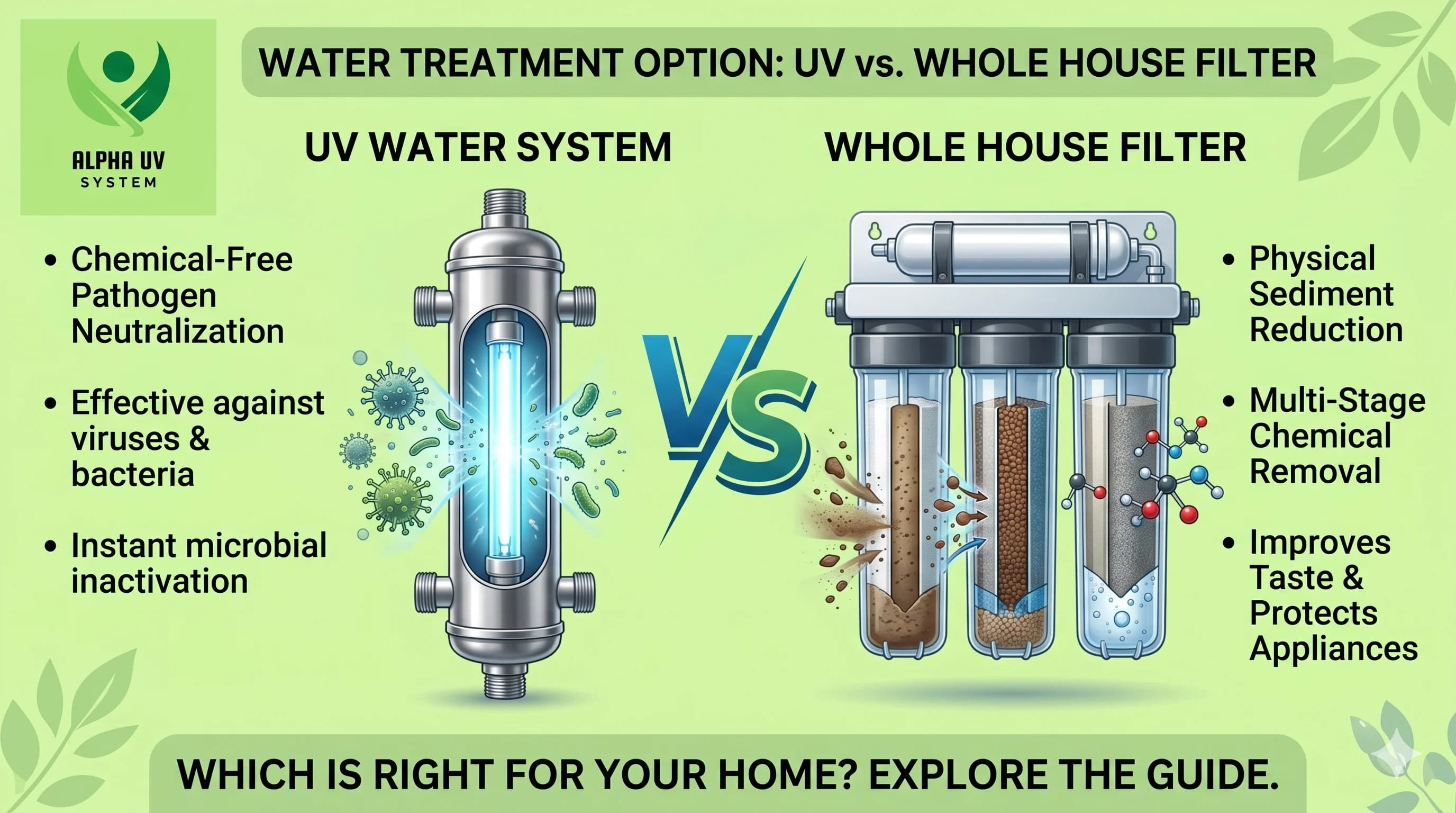
UV water systems kill bacteria, viruses, and protozoa but do not remove dissolved chemicals, heavy metals, or sediment. Whole house filters remove physical and chemical contaminants but do not kill pathogens. Most Indian homes need both: a pre-filter to remove turbidity, then UV for biological safety. Understanding the UV water system vs whole house filter difference is essential before spending a rupee on water treatment.
What a UV Water System Does
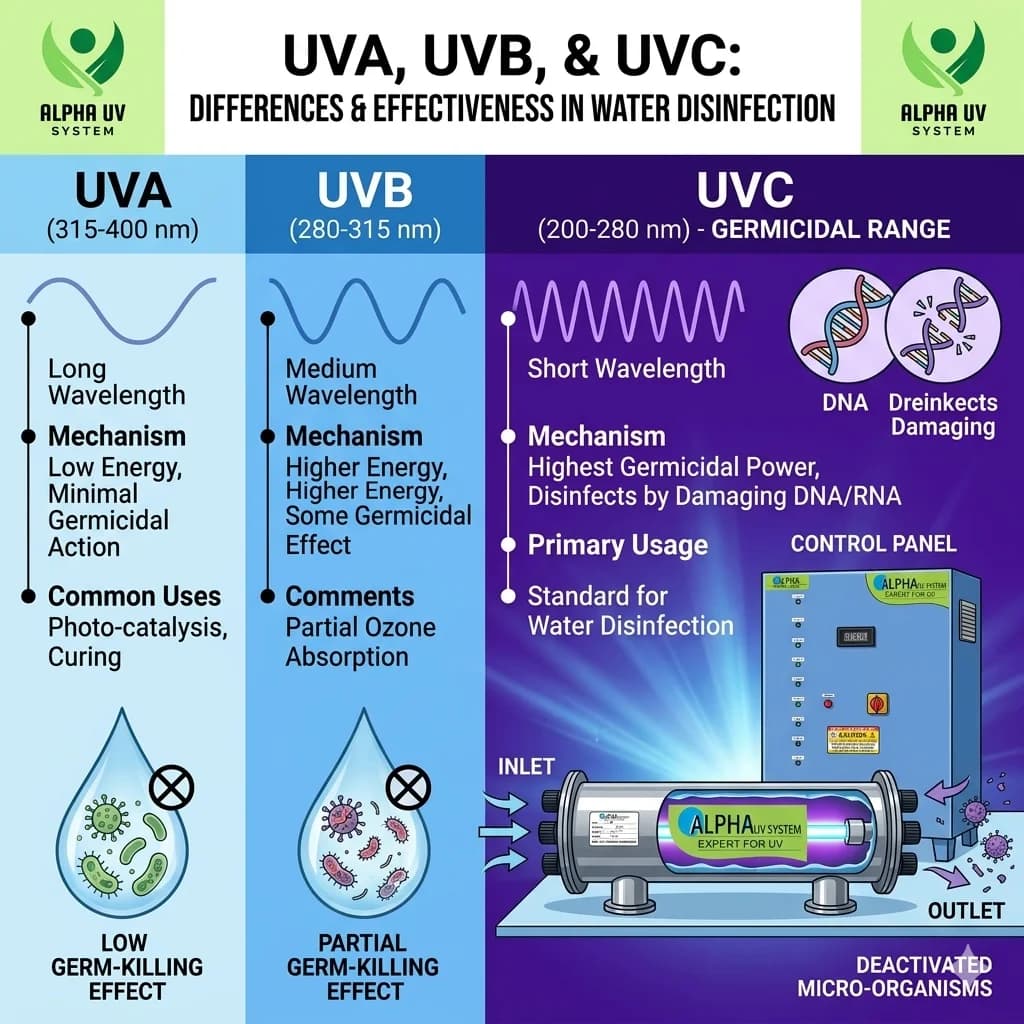
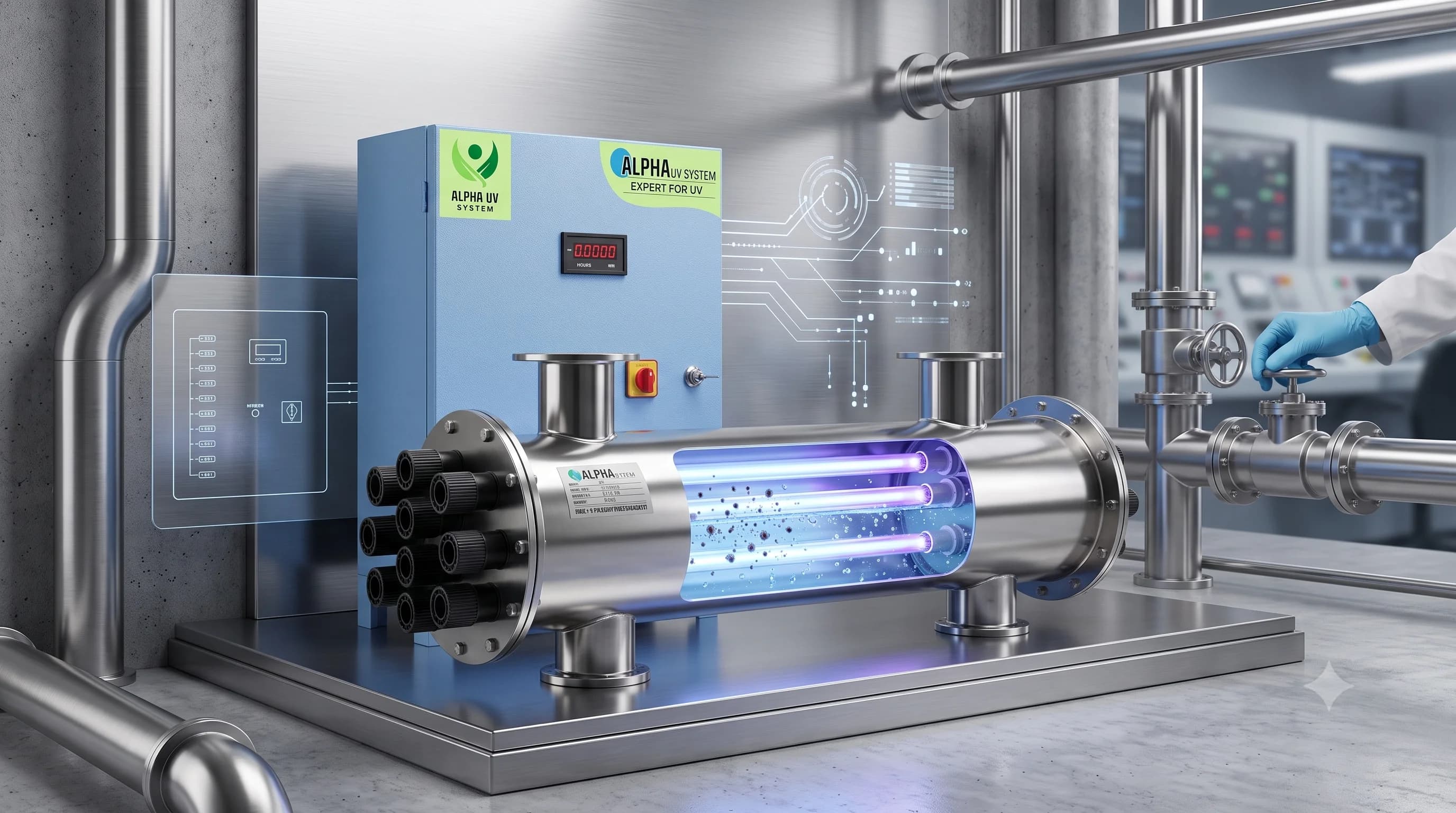
A UV water system passes water through a stainless steel chamber containing a Philips UV-C lamp. The lamp emits light at 254 nm — the precise wavelength at which DNA and RNA absorb UV energy most efficiently. When this energy penetrates a microorganism's cell wall, it causes irreversible damage to the pathogen's nucleic acids, preventing it from replicating or causing infection. The pathogen is not "killed" in the chemical sense; it is rendered biologically inert.
This process happens in seconds, adds nothing to the water — no chlorine, no residue, no change in taste or odour — and leaves no disinfection byproducts. It is the core reason industrial plants, pharmaceutical facilities, and municipal bodies choose UV over chemical alternatives. For home use, the same principle applies: clean, taste-neutral, biologically safe water without any chemical addition.
Pathogens a UV Water System Inactivates
The UV water system vs whole house filter difference is most stark when you examine what UV specifically targets. A UV system running at 40 mJ/cm² achieves the following inactivation levels:
| Pathogen | Category | Log Reduction | UV Dose Required | Status at 40 mJ/cm² |
|---|---|---|---|---|
| E. coli | Bacteria | 4-log (99.99%) | 6 mJ/cm² | Inactivated |
| Salmonella typhi | Bacteria | 4-log (99.99%) | 8 mJ/cm² | Inactivated |
| Vibrio cholerae | Bacteria | 4-log (99.99%) | 5 mJ/cm² | Inactivated |
| Rotavirus | Virus | 4-log (99.99%) | 18 mJ/cm² | Inactivated |
| Hepatitis A virus | Virus | 4-log (99.99%) | 21 mJ/cm² | Inactivated |
| Giardia lamblia | Protozoa | 3-log (99.9%) | 10 mJ/cm² | Inactivated |
| Cryptosporidium parvum | Protozoa | 3-log (99.9%) | 10 mJ/cm² | Inactivated |
Chlorine — the most common alternative disinfectant — achieves high inactivation of bacteria and viruses but is largely ineffective against Cryptosporidium even at high doses. UV is the only household-scale technology that reliably handles all three categories of waterborne pathogens.
What a UV System Does NOT Remove
This is the other half of the UV water system vs whole house filter difference, and it is equally important. UV-C light is pure disinfection — it has zero effect on any dissolved or suspended non-biological material. After passing through a UV chamber, the water will be biologically safe but will be identical in every other chemical and physical property:
- Sediment, sand, silt, rust particles: unchanged
- Total Dissolved Solids (TDS): unchanged
- Heavy metals (arsenic, lead, iron, manganese): unchanged
- Fluoride: unchanged
- Pesticides and herbicides: unchanged
- Hardness (calcium, magnesium): unchanged
- Chlorine taste and odour: unchanged
- Nitrates and nitrites: unchanged
- Industrial VOCs: unchanged
If your water contains any of these contaminants, UV alone is an incomplete solution. You need filtration in addition to — not instead of — a UV system.
What a Whole House Filter Does
The term "whole house filter" describes any filtration system installed at the point of entry to a building, treating water before it reaches any tap or appliance. Unlike UV, which is a single-technology device, a whole house filter is often a category covering five distinct filter technologies, each with a different removal mechanism and a different target contaminant list.
| Filter Type | What It Removes | What It Does NOT Remove | Maintenance Interval |
|---|---|---|---|
| Sediment filter (5–50 micron) | Sand, silt, rust, suspended solids, large particulates | Dissolved chemicals, pathogens, TDS, heavy metals | Cartridge every 3–6 months depending on turbidity |
| Activated carbon filter | Chlorine, chloramines, THMs, VOCs, taste, odour | Pathogens (bacteria can regrow on media), heavy metals, TDS, hardness | Cartridge every 3–6 months; backwash media annually |
| Water softener (ion exchange) | Calcium, magnesium (hardness); some iron removal | Pathogens, TDS, heavy metals, chlorine, pesticides | Resin regeneration with salt every 1–4 weeks |
| RO membrane system | TDS, heavy metals (arsenic, lead, fluoride), nitrates, most dissolved solids | Does not sterilise — pathogens may pass through degraded membranes; does not reliably remove VOCs | Membrane every 2–3 years; pre-filters every 6 months |
| KDF filter (copper-zinc) | Iron, manganese, hydrogen sulphide, chlorine, some heavy metals | Pathogens, TDS, fluoride, nitrates, pesticides | Media backwash every 1–2 weeks; replacement every 3–5 years |
The single most important point about whole house filters and the UV water system vs whole house filter difference: no filtration technology reliably inactivates all three categories of waterborne pathogens. Sediment and carbon filters do not kill pathogens — they may remove some by physical straining, but bacteria smaller than the filter's micron rating pass through freely. Carbon filters are, in fact, an excellent growth substrate for bacteria if the cartridge is not replaced on schedule. An ageing carbon filter in a warm, humid Indian utility area can be a microbial risk in itself.
Head-to-Head Comparison: UV System vs Whole House Filters
This table captures the full UV water system vs whole house filter difference across every performance dimension that matters for Indian households:
| Feature | UV System | Sediment Filter | Activated Carbon | RO System |
|---|---|---|---|---|
| Kills bacteria | Yes — 99.99% | No | No — can promote growth | Partial (size exclusion only) |
| Kills viruses | Yes — 99.99% | No | No | No |
| Removes sediment / turbidity | No | Yes — primary function | Limited | Yes |
| Removes heavy metals | No | No | No | Yes |
| Reduces TDS | No | No | No | Yes — 90–99% rejection |
| Removes chlorine / taste | No | No | Yes — primary function | Yes |
| Removes pesticides / VOCs | No | No | Yes — most VOCs | Partial |
| Removes hardness | No | No | No | Yes |
| Adds chemicals to water | None | None | None | None |
| Annual maintenance cost (INR) | ₹1,200–3,000 (lamp only) | ₹500–1,500 (cartridges) | ₹800–2,000 (cartridges) | ₹2,500–6,000 (membrane + filters) |
| Power consumption | 8–75W (runs only when water flows in most models) | None | None | 25–100W (pump motor) |
| Per-litre treatment cost | ₹0.03–0.10 | ₹0.01–0.05 | ₹0.02–0.07 | ₹0.15–0.40 (includes water wastage) |
Why Pre-Filtration Before UV Is Critical
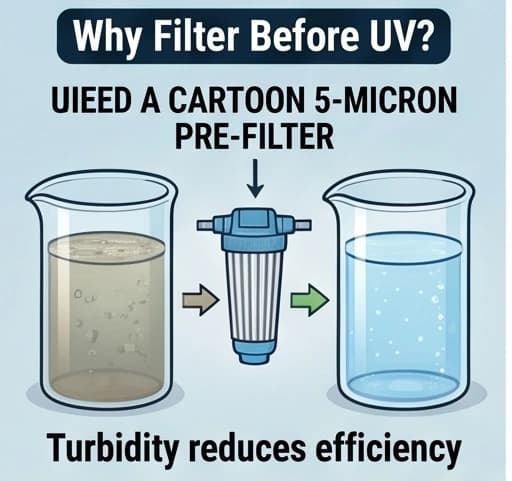
The single most important practical implication of the UV water system vs whole house filter difference is this: UV systems require pre-filtration to function correctly. UV-C light is electromagnetic radiation — it travels in straight lines and is absorbed and scattered by particles in the water. When water has high turbidity, suspended solids act as physical shields around pathogens. A bacterium hiding in the shadow of a particle of iron oxide or clay is never exposed to UV-C and passes through the chamber alive.
This is not a theoretical concern. The World Health Organisation's UV disinfection guidelines specify that water must have turbidity below 1 NTU before entering a UV chamber for reliable 4-log pathogen inactivation. Most Indian borewell water ranges from 5–50 NTU without pre-treatment. Most municipal supply water ranges from 2–10 NTU even after treatment plant processing, and quality degrades further in ageing distribution networks and storage tanks.
There is a second mechanical reason why pre-filtration matters specifically for UV systems. Iron deposits from water with high dissolved iron concentration coat the quartz sleeve surrounding the UV lamp. The quartz sleeve's job is to transmit UV-C light into the water while preventing the lamp from being cooled by the water. When iron stains this sleeve, UV transmittance drops — sometimes by 40–60% — without any visible lamp failure or alarm. The Philips UV-C lamp inside may be perfectly functional while the fouled sleeve renders the system ineffective.
The minimum pre-treatment requirement before any UV system:
- 5-micron sediment filter: Mandatory minimum. Removes particulates that shield pathogens and silt that fouls the quartz sleeve.
- Iron removal filter (if iron > 0.3 mg/L): Iron deposits foul the quartz sleeve within weeks in high-iron borewell water.
- Carbon filter (if chlorine taste is a concern): Also extends UV transmittance by removing colour-causing compounds that absorb UV-C.
Recommended pre-treatment combinations by source water quality:
- Low-turbidity municipal water: 5-micron sediment filter + UV
- Municipal water with chlorine odour: 5-micron sediment + activated carbon + UV
- Borewell water with iron: Iron removal filter + 5-micron sediment + UV
- High-TDS borewell water: Sediment + RO membrane + UV (post-RO stage)
- Highly turbid surface/well water: Coagulation/settling + dual-media filter + 5-micron cartridge + UV
Recommended Combinations by Indian Water Source
India's water quality problems are highly regional. The correct understanding of the UV water system vs whole house filter difference must be applied to your specific source water, not to a generic scenario. The following table represents the most common scenarios encountered across Indian states:
| Water Source / Region | Primary Problem | Secondary Problem | Recommended Setup |
|---|---|---|---|
| Delhi / NCR municipal supply | Residual chlorine, THMs | Bacterial re-contamination in storage tanks | 5-micron sediment + Activated carbon + UV |
| UP / Bihar borewell | High dissolved iron (1–10 mg/L) | High bacterial load, no chlorination | Iron removal filter + 5-micron sediment + UV |
| Rajasthan well water | High fluoride (1.5–6 mg/L) + very high TDS | Bacterial contamination | Sediment + RO membrane + UV (post-RO) |
| Chennai municipal supply | Elevated TDS (400–900 mg/L) | Bacterial risk during monsoon supply interruptions | Sediment + RO membrane + UV (post-RO) |
| Northeast / hill areas | Humic acid (natural organic matter), high colour | High turbidity + bacteria from surface water | Coagulation + dual-media filter + 5-micron cartridge + UV |
| Industrial area (any state) | Heavy metals, industrial effluent contamination | High TDS + bacterial load | Sediment + activated carbon + RO + UV (post-RO) |
In every scenario above, UV is the final stage — the biological safety barrier after physical and chemical contaminants have been addressed. No filter alone achieves what this combination delivers.
Which Should You Buy First?
Budget constraints are real. Not every household can install a complete multi-stage system in one purchase. If you must prioritise one treatment technology, the correct answer depends entirely on your primary water quality risk — which requires a water test, not a guess.
| Water Test Result | Primary Risk | Recommended First Purchase | Add Next |
|---|---|---|---|
| E. coli detected, turbidity < 5 NTU | Biological | 5-micron sediment + UV immediately | Carbon filter for taste |
| TDS > 500 ppm or heavy metals confirmed | Chemical / dissolved solids | RO system first | UV as post-RO stage — critical |
| Turbidity > 5 NTU, sediment visible | Physical / suspended solids | Sediment pre-filter first | UV immediately after — pathogen risk is high in turbid water |
| Iron > 0.3 mg/L, staining present | Iron fouling + biological | Iron removal filter first | Sediment + UV — iron water from borewells carries high bacterial load |
| Chlorine taste only, TDS normal, no E. coli | Aesthetic / chemical taste | Activated carbon filter | UV — carbon does not kill pathogens; add UV to protect against bacterial regrowth on carbon media |
| All parameters borderline, no specific test | Unknown | Get a water test first (NABL lab, ₹500–2,000) | Then choose based on results |
The general principle: microbiological risk is an immediate health threat. Chemical and physical contamination issues (unless severe) are more chronic. When in doubt about biological safety, UV with a 5-micron pre-filter is the highest-impact first purchase for Indian households drawing water from tanks, borewells, or ageing municipal networks.
Cost Comparison: India 2026
The total cost of ownership over 10 years tells a more accurate story than the purchase price alone. The UV water system vs whole house filter difference in cost is less about the initial system price and more about annual maintenance discipline.
| System | Purchase Price (INR) | Annual Maintenance (INR) | 10-Year Total Cost (INR) |
|---|---|---|---|
| UV system (Alpha UV System) | ₹8,000–45,000 | ₹1,200–3,000 (Philips UV-C lamp annual replacement) | ₹20,000–75,000 |
| Sediment pre-filter | ₹800–2,500 | ₹500–1,500 (cartridge replacements) | ₹6,000–23,000 |
| Activated carbon filter | ₹1,500–4,000 | ₹800–2,000 (cartridge every 3–6 months) | ₹9,500–24,000 |
| RO system | ₹8,000–25,000 | ₹2,500–6,000 (membrane + pre-filters) | ₹33,000–85,000 |
| UV + Sediment filter (recommended minimum) | ₹9,000–48,000 | ₹1,700–4,500 | ₹26,000–98,000 |
At the residential level, a UV system with a Philips UV-C lamp replaced once annually is among the most cost-effective whole-home disinfection solutions available. The per-litre treatment cost is typically ₹0.03–0.10, which compares favourably with bottled water at ₹15–25 per litre and even with RO systems when water wastage (typically 3:1 reject ratio) is factored into the per-litre cost.
Frequently Asked Questions
Can a UV water system replace a whole house filter?
No. A UV water system cannot replace a whole house filter because the two technologies solve fundamentally different problems. UV-C light inactivates pathogens — bacteria, viruses, and protozoa — but has zero effect on sediment, dissolved chemicals, heavy metals, TDS, chlorine, pesticides, or hardness. If your water contains any of these non-biological contaminants, a UV system alone will produce biologically safe water that still has chemical or physical quality problems. The UV water system vs whole house filter difference is not about which is better — it is about which problem each solves. For complete water safety, you need both technologies working in sequence.
Does a whole house filter make UV unnecessary?
No. A whole house filter — whether sediment, carbon, or even an RO membrane — does not reliably inactivate all waterborne pathogens. Sediment and carbon filters do not kill bacteria or viruses at all. Carbon media can support bacterial growth if not replaced regularly. RO membranes remove most bacteria by size exclusion but are not sterilising barriers — pathogens can pass through degraded membranes and at low concentrations. For biological safety, UV is a separate and non-negotiable requirement. This is precisely why the UV water system vs whole house filter difference matters: filtration alone cannot ensure microbiological safety.
Which is better for borewell water — UV or a whole house filter?
Borewell water in India typically presents two simultaneous problems: high biological load (no chlorination, direct aquifer contact) and physical or chemical contamination (iron, hardness, TDS, turbidity). Neither UV alone nor a filter alone is adequate for borewell water. The correct approach is a combination: an iron removal filter and 5-micron sediment filter to address physical contamination and protect the UV system's quartz sleeve, followed by a UV system with a Philips UV-C lamp to inactivate bacteria and viruses. For borewells with TDS above 500 ppm, add RO before the UV stage. The exact sequence must match your borewell's water test results.
Can I use a UV water system without a pre-filter?
You can install a UV system without a pre-filter, but it will not provide reliable disinfection in most Indian water conditions. The WHO guideline requires water turbidity below 1 NTU before UV treatment for consistent pathogen inactivation. Most Indian borewell and municipal water exceeds this threshold without pre-treatment. Beyond the disinfection concern, operating a UV system without a sediment pre-filter accelerates fouling of the quartz sleeve — particularly in water with iron or high suspended solids — which reduces UV transmittance and can cause the system to appear functional while delivering inadequate UV doses. A 5-micron sediment filter before UV is the minimum responsible installation.
Does UV remove hardness or TDS?
No. UV-C light has no effect on dissolved minerals, ions, or salts. Water hardness (caused by dissolved calcium and magnesium) and TDS (total dissolved solids — the sum of all dissolved minerals) are chemical properties of water that are completely unaffected by UV treatment. If your water has a TDS above 500 ppm, tastes salty, leaves scale on appliances, or if a water test confirms elevated hardness or specific dissolved contaminants, you need a filtration technology — an RO system for TDS reduction or a water softener for hardness — in addition to UV. UV addresses only the biological dimension of water safety.
What is the best combination for a 4-person Indian household?
For a typical 4-person Indian household with a daily water consumption of 200–400 litres, the most appropriate system depends on your water source and test results. For municipal supply, the most cost-effective and sufficient combination is: 5-micron sediment filter + activated carbon filter + UV system rated at 500–1,000 LPH with a Philips UV-C lamp. Total system cost: approximately ₹12,000–25,000 installed, with annual maintenance around ₹2,500–5,500. For borewell water with iron, replace the carbon filter with an iron removal stage. For high-TDS borewell water, add an RO system between the sediment filter and the UV stage. Have your water tested first — a NABL-accredited lab panel costs ₹500–2,000 and eliminates guesswork entirely.
Not sure which combination is right for your water?
Share your water test report or describe your water source — our team will recommend the correct UV system and pre-filter configuration for your home within 24–48 hours.
WhatsApp Us for a Free RecommendationStandards, authorities & further reading
External references used to inform this guide. Regulations evolve — check the latest revision on each authority's site before compliance decisions.
Recommended UV Systems
Alpha UV System products for this application — powered by genuine Philips UV-C lamps.
Commercial UV Water Purification System
500 – 5,000 LPH
HACCP-compliant UV water purification for hotels, restaurants, and offices
Industrial UV Water Treatment System
5,000 – 50,000 LPH
Schedule M 2025 and HACCP compliant UV for pharma, food & beverage, and process water
Not sure which system suits your application? WhatsApp our engineers for a free recommendation →
Need a UV system?
Talk to our UV engineers — WhatsApp for a quote in 2 hours, or browse the full catalog on IndiaMART.