Quick Answer
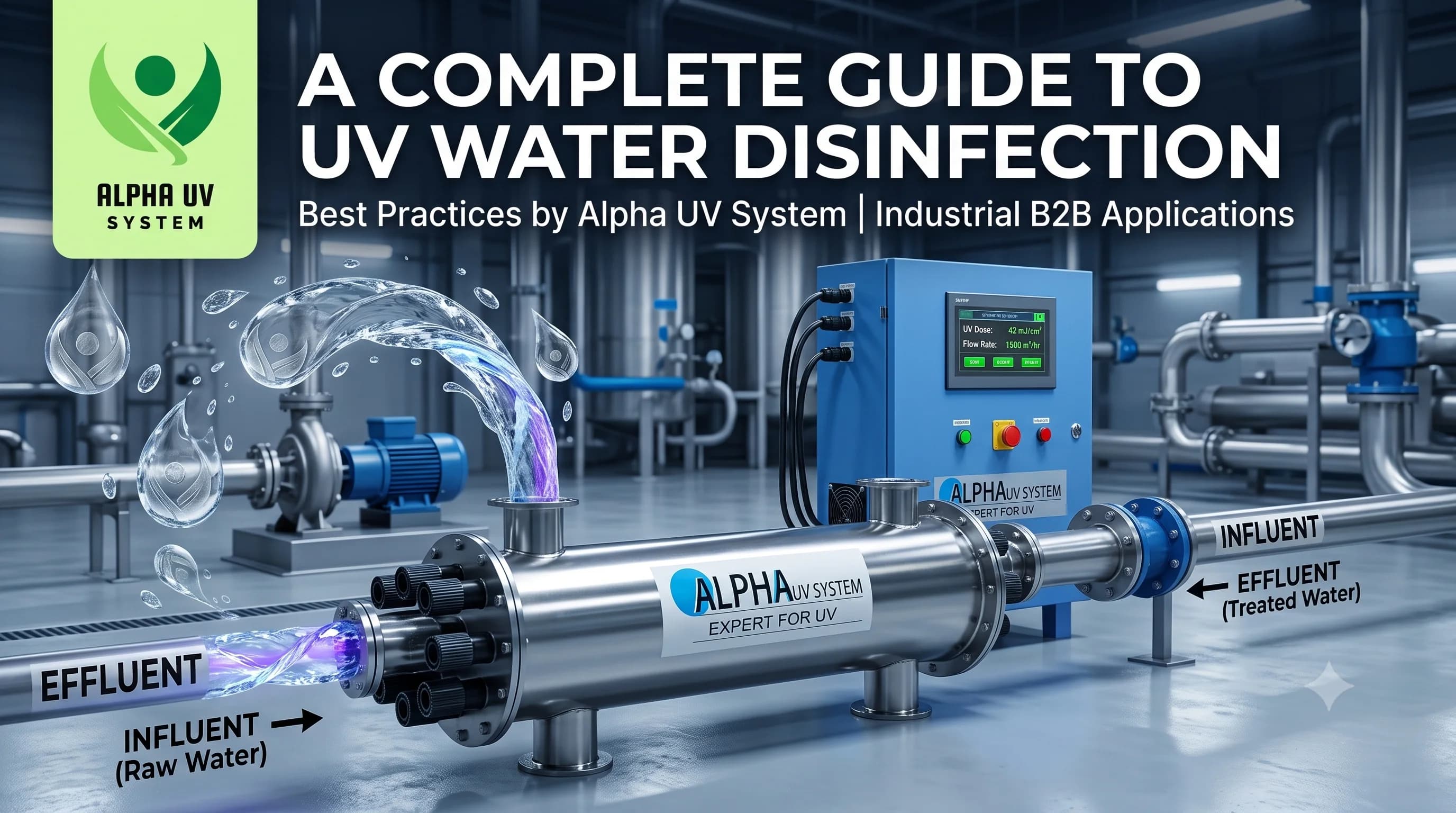
Water sterilization in commercial and industrial practice refers to UV disinfection — reduction of bacteria, viruses, and protozoa to levels that pose no risk to human health or process integrity, typically ≥4-log (99.99%) inactivation. True sterilization in the scientific sense — elimination of every viable microorganism including bacterial spores — requires autoclave conditions (121°C, 15 psi steam, 15–20 minutes) that are not practical for continuous water treatment at the volumes used in food processing, pharmaceutical manufacturing, or municipal water supply. UV water sterilization systems achieve what regulators and industry require: consistent, documented, 4-log pathogen inactivation at a UV dose of 40–100 mJ/cm², without chemicals, without taste or odour impact, and with continuous monitoring output for regulatory compliance. The term "water sterilizer" is widely used in India for UV disinfection equipment in aquaculture, pharmaceutical, and food processing applications, and is understood by FSSAI, CPCB, and NABH auditors as referring to UV disinfection systems. Systems range from ₹18,000 for a 100 LPH point-of-use unit to ₹35,00,000 for a 5,00,000 LPH municipal installation.
Water Sterilization vs Water Disinfection — The Distinction That Matters
The difference between sterilization and disinfection matters because it sets the right performance expectation for UV water treatment systems. Understanding where UV sits on this spectrum prevents both over-specification (paying for performance UV cannot deliver) and under-specification (treating UV as if it were merely a filter).
| Process | What it achieves | Technology | Practical for water treatment? |
|---|---|---|---|
| Sterilization (true) | Elimination of all viable microorganisms including spores | Autoclave (121°C, 15 psi steam), dry heat (160–180°C), gamma irradiation | No — only for small volumes, instruments, and pharmaceutical product lots |
| Disinfection (UV) | ≥4-log (99.99%) reduction of pathogens — bacteria, viruses, protozoa | UV at 40–100 mJ/cm² | Yes — continuous, for any flow rate |
| Disinfection (chlorine) | ≥4-log bacterial and viral reduction; ineffective against Cryptosporidium | Sodium hypochlorite, chlorine gas | Yes — but produces carcinogenic byproducts |
| Pasteurisation | Reduction of vegetative pathogens — not spores | Heat (72°C for 15 seconds in HTST; 63°C for 30 minutes in LTLT) | For liquid food products — not general water treatment |
In Indian commercial and regulatory contexts, "water sterilizer" is accepted as synonymous with UV disinfection equipment that meets BIS IS 10500, FSSAI Schedule IV, or equivalent microbiological performance standards. When a FSSAI auditor, a CPCB inspector, or a NABH assessor reviews a water sterilizer installation, they are assessing whether the UV system delivers a validated dose that achieves the required log reduction — not whether it meets the scientific definition of sterilization.
How UV Water Sterilization Systems Work
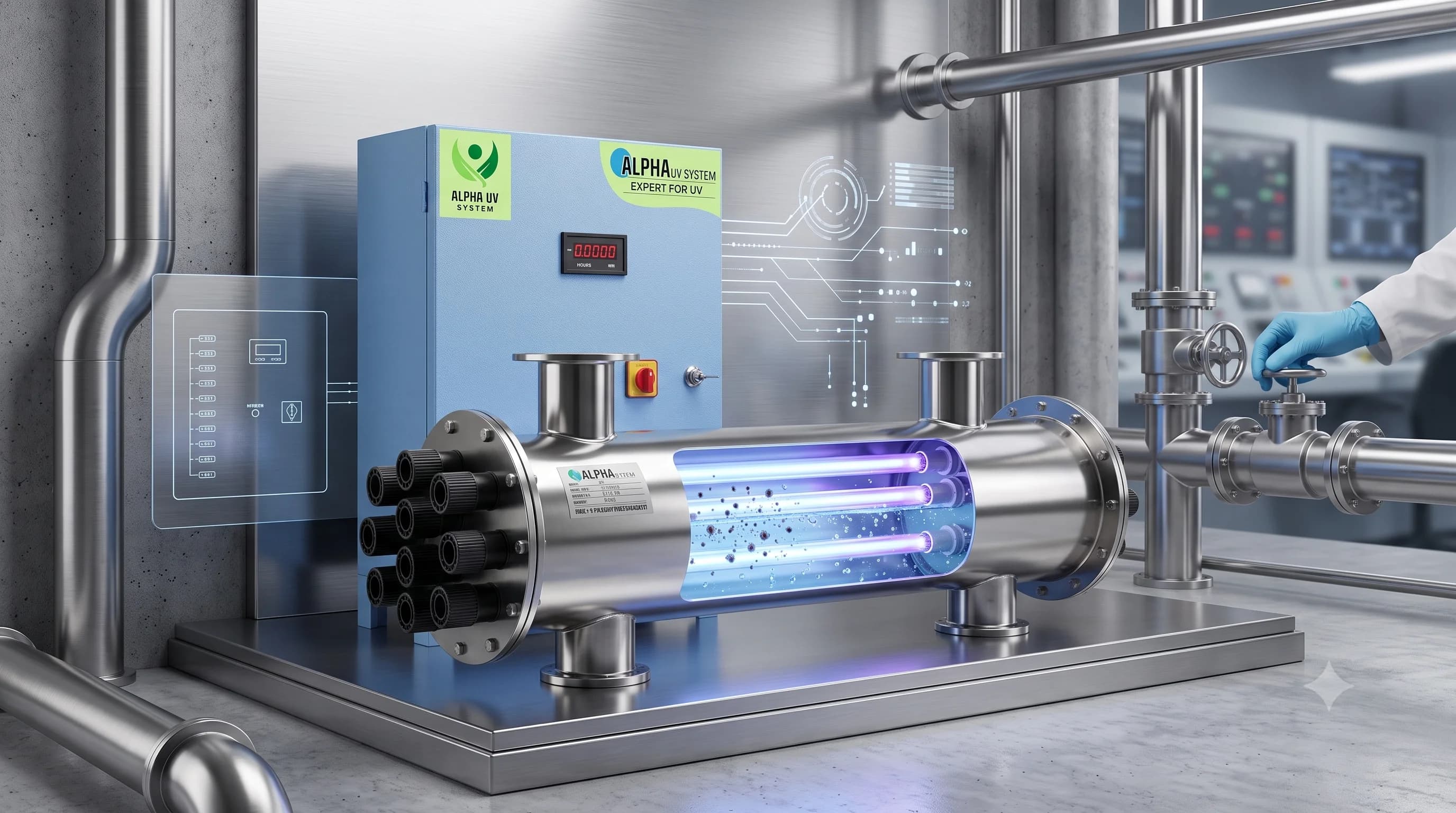
UV water sterilization at the 254 nm germicidal wavelength works by a mechanism that is fundamentally different from chemical disinfection or heat treatment. UV photons at this wavelength are absorbed by the thymine and cytosine bases in DNA and RNA, causing adjacent pyrimidine bases to form covalent bonds — thymine dimers — that prevent the cell's replication machinery from reading the genetic code. A cell with thymine dimer damage cannot divide and is biologically non-viable, regardless of whether it remains physically intact and detectable by culture or PCR methods.
Three parameters govern UV water sterilization performance:
- UV dose (mJ/cm²): The product of UV intensity and exposure time. This is the primary design parameter — set to deliver the log reduction required for the application and target organism.
- UV transmittance (UVT): The fraction of UV light at 254 nm that passes through 1 cm of the water to be treated. Higher UVT = more UV reaches pathogens = greater dose delivery efficiency for a given lamp power.
- Flow rate: Higher flow rate = shorter residence time = lower dose for the same reactor volume and lamp power. UV systems must be designed and validated at peak flow rate, not average flow.
Water Sterilization System Applications in India
Pharmaceutical — Purified Water and WFI
Pharmaceutical manufacturing under Schedule M (Good Manufacturing Practice, India) and the Indian Pharmacopoeia requires purified water with total viable count (TVC) below 100 CFU/ml, and Water for Injection (WFI) with TVC below 10 CFU/100 ml. UV water sterilization systems at 40–100 mJ/cm² are the standard technology for maintaining TVC within GMP limits throughout the purified water distribution loop. Two UV reactors are the standard pharmaceutical configuration: one after the RO/EDI system (as the primary disinfection point) and one on the distribution loop return before re-entry to the storage tank (to prevent loop biofilm regrowth). The continuous UV intensity log serves as the primary TVC control record between periodic microbiological sampling events. See our dedicated guide on UV water treatment for pharmaceutical WFI in India.
Aquaculture and Fish Farming
UV water sterilizers in aquaculture applications handle a challenge that chemical disinfection cannot: the water being treated contains the very organisms (shrimp, fish, eggs, larvae) that would be harmed by chlorine or ozone at disinfection concentrations. UV at 30–100 mJ/cm² inactivates Vibrio species, Aeromonas hydrophila, white spot syndrome virus (WSSV), and infectious salmon anaemia virus without affecting the aquatic organisms or water chemistry. UV water sterilization in Indian aquaculture is standard practice in shrimp farms in Andhra Pradesh and Tamil Nadu, fish hatcheries in Odisha, and ornamental fish breeding in Maharashtra and Karnataka. See our guide on UV water treatment for aquaculture in India.
Food and Beverage Processing
FSSAI requires all water in contact with food or food-contact surfaces to meet BIS IS 10500 microbiological standards at the point of food contact. UV water sterilization systems — positioned after activated carbon filtration and 5-micron polishing — are the FSSAI-accepted method for continuously verifiable process water disinfection. The UV intensity sensor's continuous output constitutes the CCP monitoring record for FSSAI HACCP compliance, replacing manual residual chlorine test logs. Applications: dairy processing (Listeria target — 12 mJ/cm² for 4-log), brewery process water (Saccharomyces wild strain control), bottled water plants (zero coliform at fill point), soft drink manufacturing, packaged food operations.
Hospital and Healthcare
NABH facility management standards (FMS) require hospitals to implement Water Safety Plans covering Legionella pneumophila control — the causative organism of Legionnaires' disease, which is acquired via inhalation of contaminated aerosols from showers, taps, and cooling towers. UV water sterilization at 40–100 mJ/cm² installed at building entry and as point-of-use units in ICU, operation theatre, and immunocompromised patient wards delivers the documented Legionella inactivation (UV dose requirement: 12–22 mJ/cm² for 4-log) that NABH Water Safety Plans require. See our guide on UV water treatment for hospitals in India.
Municipal and Institutional Water Treatment
Municipal water sterilization systems — multi-lamp low-pressure or medium-pressure UV reactors handling 50,000–5,00,000 LPH — are used for primary disinfection of filtered drinking water in Indian cities and towns. CPHEEO guidelines accept UV as the primary disinfection technology when followed by a low chlorine residual (0.2 mg/L) for distribution system protection. Jal Jeevan Mission (JJM) rural piped water schemes increasingly specify UV water sterilizers as the terminal treatment step for small piped water supply systems serving villages of 500–5,000 people, where continuous chlorination management is difficult to sustain but UV requires only annual lamp replacement.
UV Water Sterilization System Sizing for India
| Application | Flow rate | UV dose | System type | Price range (INR) |
|---|---|---|---|---|
| Point-of-use — clinic, lab, small office | 100–500 LPH | 40 mJ/cm² | Single 25W LP lamp, SS316L | ₹18,000–35,000 |
| Restaurant / mid-size institution | 500–2,000 LPH | 40 mJ/cm² | Single 55W LP lamp, SS316L | ₹35,000–75,000 |
| Hotel / hospital entry | 2,000–10,000 LPH | 40–60 mJ/cm² | Single 75–150W LP lamp, sensor + alarm | ₹75,000–2,00,000 |
| Food processing plant | 5,000–30,000 LPH | 40 mJ/cm² | Twin LP lamp, bypass, SCADA output | ₹1,50,000–5,00,000 |
| Pharmaceutical purified water | 500–10,000 LPH | 40–100 mJ/cm² | Single LP, loop return second reactor | ₹1,00,000–4,00,000 |
| Aquaculture hatchery | 10,000–1,00,000 LPH | 30–100 mJ/cm² | Multi-lamp array, pre-filter mandatory | ₹3,00,000–15,00,000 |
| Housing society STP | 10,000–1,00,000 LPH | 40–80 mJ/cm² | Multi-lamp LP or MP | ₹2,50,000–10,00,000 |
| Municipal WTP | 50,000–5,00,000 LPH | 40 mJ/cm² | MP lamp bank or LP channel array | ₹8,00,000–35,00,000 |
What UV Water Sterilization Cannot Do
Understanding the limits of UV water sterilization prevents misapplication and system over-reliance:
- No residual protection: UV leaves no disinfection residual. Water that sits in a storage tank or travels through distribution pipework after the UV reactor can be recontaminated. UV must be positioned immediately before the point of use, or a low-level residual disinfectant must be maintained downstream.
- No chemical removal: UV inactivates microorganisms but does not remove dissolved chemicals — nitrates, heavy metals, pesticides, hardness, iron. Pre-filtration removes particles; RO or ion exchange is needed for dissolved contaminants.
- Not effective in turbid water: Turbidity above 1 NTU shields pathogens from UV dose. UV must follow filtration, not precede it.
- No true spore inactivation: Bacterial spores (Bacillus, Clostridium) require significantly higher UV doses (80–200 mJ/cm²) for comparable reduction to vegetative cells. For applications where spore control is critical (pharmaceutical sterilization-in-place, for example), autoclave or other methods are required.
UV Water Sterilization Systems from Alpha UV System
Alpha UV System manufactures UV water sterilization systems for pharmaceutical, aquaculture, food processing, hospital, and municipal applications across India. All systems use Philips UV-C lamps, SS316L reactor chambers with EN 10204 3.1 material certificates, and calibrated UV intensity sensors with alarm relay and IP65 control panels. SCADA integration via Modbus RTU/TCP and 4–20 mA outputs is standard on systems above 500 LPH.
IIT-trained engineers provide site assessment, UVT measurement, system sizing, and commissioning with regulatory compliance documentation for Schedule M, FSSAI, CPCB, and NABH audits. MSME Udyam registered manufacturer, Greater Noida. 24–48 hour NCR response, nationwide project support.
Contact us for UV water sterilizer system specifications and pricing: WhatsApp +91 93183 05878 or call +91 95995 00580.
Related guides: UV water sterilizer systems — industrial guide | Water disinfection methods compared | UV disinfection systems — complete buyer's guide | How to calculate UV dosage
Recommended UV Systems
Alpha UV System products for this application — powered by genuine Philips UV-C lamps.
Commercial UV Water Purification System
500 – 5,000 LPH
HACCP-compliant UV water purification for hotels, restaurants, and offices
Industrial UV Water Treatment System
5,000 – 50,000 LPH
Schedule M 2025 and HACCP compliant UV for pharma, food & beverage, and process water
Not sure which system suits your application? WhatsApp our engineers for a free recommendation →
Related solutions
See how Alpha UV System applies this to your industry or city.
Need a UV system?
Talk to our UV engineers — WhatsApp for a quote in 2 hours, or browse the full catalog on IndiaMART.