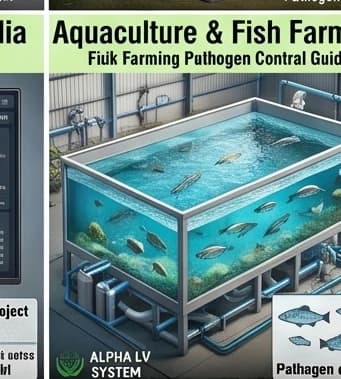
UV disinfection at 254 nm is the safest and most effective method for controlling fish pathogens in aquaculture water. Unlike chlorine, ozone, or antibiotics, UV does not harm fish, shrimp, or zooplankton, does not kill beneficial nitrifying bacteria in biofilters, and leaves no chemical residual in the water. A UV dose of 40–80 mJ/cm² eliminates Aeromonas, Vibrio, Pseudomonas, and most common fish viruses in hatchery and RAS (Recirculating Aquaculture System) water. UV is applied on the make-up water line and, in RAS, on the recirculated water after mechanical and biofilter treatment.
India is the second-largest aquaculture producer in the world, with an annual fish and shrimp production exceeding 8 million tonnes. Andhra Pradesh, West Bengal, Tamil Nadu, Odisha, Kerala, and Gujarat account for the majority of production across freshwater fish culture (catla, rohu, mrigal), shrimp farming (Litopenaeus vannamei, P. monodon), and increasingly, Recirculating Aquaculture Systems (RAS) for high-value species like salmon trout, barramundi, and ornamental fish.
Disease outbreaks driven by waterborne pathogens are the single largest cause of production loss in Indian aquaculture — costing the industry an estimated ₹15,000–25,000 crore annually in mortality, stunted growth, and antibiotic treatment costs. UV water disinfection addresses the root cause of waterborne disease spread: pathogen-laden water entering ponds, tanks, and recirculating systems. This guide covers the science and practice of UV disinfection in Indian aquaculture from hatchery through grow-out.
Fish Pathogens and UV Inactivation
Aquaculture water carries a range of bacterial, viral, parasitic, and fungal pathogens. UV disinfection at 254 nm is highly effective against bacterial and viral pathogens — less so against parasitic cysts and fungal spores, which require higher doses or complementary treatment. The key pathogens in Indian aquaculture and their UV dose requirements:
| Pathogen | Disease Caused | Affected Species | UV Dose (4-log) |
|---|---|---|---|
| Aeromonas hydrophila | Bacterial haemorrhagic septicaemia, ulcers | Catla, rohu, carp, tilapia | ~6 mJ/cm² |
| Vibrio harveyi / V. anguillarum | Vibriosis (luminescent bacteriosis in shrimp) | L. vannamei, P. monodon | ~6–10 mJ/cm² |
| Pseudomonas fluorescens | Fin rot, bacterial gill disease | Most freshwater species | ~10–15 mJ/cm² |
| Flavobacterium columnare | Columnaris disease (saddleback) | Catfish, carp, tilapia | ~15–25 mJ/cm² |
| White spot syndrome virus (WSSV) | White spot disease (most economically devastating shrimp disease) | All penaeid shrimp | ~40–60 mJ/cm² |
| Infectious hypodermal and haematopoietic necrosis virus (IHHNV) | Runt deformity syndrome in shrimp | L. vannamei | ~30–50 mJ/cm² |
| Ichthyophthirius multifiliis (Ich) | White spot disease (freshwater fish) | Carp, ornamental fish | Theronts (free-swimming stage): ~40 mJ/cm²; cysts are resistant |
For shrimp hatchery applications where WSSV and IHHNV are the primary concerns, a UV dose of 60–80 mJ/cm² is the standard specification. For freshwater fish hatchery make-up water where bacterial pathogens are the main risk, 40 mJ/cm² is generally adequate. For RAS recirculated water, the UV dose is typically set at 40 mJ/cm² for bacteria and 80 mJ/cm² for facilities where viral disease is a documented historical problem.
Why UV Is Safe for Fish, Shrimp, and Biofilters
A common misconception among aquaculture operators who encounter UV for the first time is that UV radiation must be harmful to fish or shrimp if it kills bacteria. This is incorrect — and understanding why is important for proper system design.
UV disinfection occurs inside a sealed reactor. The UV lamp is enclosed in a quartz sleeve, inside a stainless steel or PVC chamber. Water flows through the reactor, receives its UV dose in milliseconds, and exits the reactor back into the aquaculture system. Fish, shrimp, eggs, and larvae never enter the UV reactor — they remain in the tanks and ponds. Only the make-up water and (in RAS) recirculated water passes through the UV unit.
Furthermore, UV radiation at 254 nm does not produce any chemical residual. The water chemistry after UV treatment is identical to before treatment — no chlorine, no ozone, no pH shift, no dissolved oxygen reduction. Fish entering a tank supplied with UV-treated water are not exposed to any UV radiation and are not affected in any way by the treatment the make-up water received.
UV also does not kill the nitrifying bacteria (Nitrosomonas, Nitrospira) that are essential in biofilter media for converting toxic ammonia to nitrite and then to nitrate in RAS systems. The biofilter is a separate component from the UV reactor; water flows through biofilter media (where bacteria are attached to surfaces, not free-floating), then through the UV reactor (where any planktonic bacteria including pathogens released from the biofilter are inactivated). The nitrifying bacteria in the biofilter are never exposed to UV radiation.
UV Application Points in Aquaculture Systems
Make-Up Water Disinfection
Every aquaculture facility — whether earthen pond, concrete tank, or RAS — adds fresh water to compensate for evaporation, seepage, and water changes. This make-up water is a primary entry point for waterborne pathogens. A UV system on the make-up water line (sized to the maximum make-up flow rate) ensures that no pathogens enter the facility through this route.
For a shrimp hatchery drawing from a borehole, the make-up water UV system requires UV dose to match the worst-case UVT of the borehole water. Groundwater typically has UVT of 80–95% at 254 nm — high, which makes UV very efficient. Turbid surface water (river, canal) has UVT of 40–70% and requires pre-filtration before UV to raise UVT and reduce the lamp count needed.
RAS (Recirculating Aquaculture System) UV Integration
In a RAS, 90–99% of the water is recirculated — only 1–10% is replaced with fresh make-up water per day. The recirculated water passes through a treatment train between uses:
Fish tank outlet → Drum filter (mechanical solids removal) → Biofilter (ammonia/nitrite conversion) → CO₂ degassing → UV disinfection (254 nm) → Oxygenation (if needed) → Fish tank inlet
The UV reactor is positioned after the biofilter because: (a) the biofilter removes fine particles (TSS) that would reduce UVT and waste UV output; (b) pathogens that colonise the biofilter media are shed into the water as it passes through, and the UV reactor immediately downstream inactivates them before they re-enter the fish tank.
UV dose in a RAS is typically set at 40–80 mJ/cm², applied to 100% of the recirculated flow at each pass. Since water recirculates through the UV reactor multiple times per day (a typical RAS circulates its full volume 5–20 times per day), the cumulative UV exposure each pathogen receives is very high — providing a high safety margin even at lower single-pass doses.
Hatchery Broodstock and Larval Water Treatment
Hatchery water — used for broodstock conditioning, egg incubation, and larval rearing — carries the highest pathogen risk in any aquaculture operation. Introduction of a pathogen at the hatchery stage destroys the entire production cycle. UV disinfection in hatcheries is applied at every water input point:
Seawater intake (marine hatcheries): Seawater is pre-filtered through multimedia filters (sand, gravel) to remove suspended solids, then UV-treated at 60–80 mJ/cm² before entering hatchery tanks. Seawater UVT is typically 85–95% in clear offshore water, lower in inshore water with turbidity.
Maturation and spawning tank water: Water for broodstock shrimp conditioned for spawning is UV-treated at 80 mJ/cm² — higher dose to ensure WSSV and IHHNV are eliminated from the water that broodstock are bathed in.
Egg incubation water: UV-treated at 80 mJ/cm² — nauplii (newly hatched larvae) are too small to be harmed by pathogens in the incubation water, and any pathogen load dramatically increases larval mortality.
UV System Sizing for Aquaculture Applications
| Application | Flow Rate | Water Source | Typical UVT | UV Dose Target | Philips Lamp Specification |
|---|---|---|---|---|---|
| Shrimp hatchery make-up water | 1–10 m³/h | Seawater / filtered borehole | 85–95% | 80 mJ/cm² | 2 × Philips TUV 36W |
| Freshwater fish hatchery make-up | 2–15 m³/h | Borehole / filtered river | 80–92% | 40 mJ/cm² | 1–2 × Philips TUV 55W |
| RAS recirculation (small, 50–200 m³ system) | 10–50 m³/h | Recirculated fish tank water | 75–88% | 40 mJ/cm² | 2–4 × Philips TUV 55W or 95W |
| RAS recirculation (large, 200–1,000 m³) | 50–200 m³/h | Recirculated fish tank water | 75–88% | 40 mJ/cm² | Multiple parallel reactors |
| Ornamental fish breeding unit | 0.2–2 m³/h | Dechlorinated municipal / borehole | 88–95% | 40 mJ/cm² | 1 × Philips TUV 16W or 25W |
| Pond freshwater intake | 5–50 m³/h | Canal / river (pre-filtered) | 65–80% | 40–80 mJ/cm² | 2–6 × Philips TUV 95W |
Pre-Treatment Before UV in Aquaculture
UV disinfection performance in aquaculture water is determined by UVT — and aquaculture water is rarely as clear as pharmaceutical or municipal water. The main pre-treatment steps required before UV in aquaculture applications:
| Water Source | Typical Problem | Pre-Treatment Required | UVT After Pre-Treatment |
|---|---|---|---|
| Seawater (offshore/clear) | Algae, plankton | Drum filter (100 µm) + cartridge filter (20 µm) | 88–95% |
| Seawater (inshore/turbid) | TSS, algae, sediment | Settling → sand filter → cartridge filter | 80–90% |
| Borehole / groundwater | Iron, manganese, hardness | Aeration → sand filter → iron removal filter | 85–95% (after iron removal) |
| River / canal water | High TSS, organics, colour | Coagulation/flocculation → settling → sand filter → cartridge filter | 70–85% |
| RAS recirculated water | Fine particles, TAN, bacteria from biofilter | Drum filter (40–80 µm) → biofilter | 75–88% |
UV Disinfection and Antibiotic Use Reduction in Indian Aquaculture
The Indian aquaculture sector — particularly shrimp farming in Andhra Pradesh, Tamil Nadu, and Gujarat — has faced export rejections and regulatory scrutiny due to antibiotic residues in shrimp destined for European, US, and Japanese markets. Tetracyclines, chloramphenicol, and fluoroquinolones detected in Indian shrimp exports are largely driven by the practice of using antibiotics to control bacterial disease outbreaks that UV disinfection could prevent.
The MPEDA (Marine Products Export Development Authority) and CIBA (Central Institute of Brackishwater Aquaculture) both recommend UV disinfection as a disease prevention measure in aquaculture as part of the national strategy to reduce antibiotic use and improve export compliance. For export-oriented shrimp farms seeking to supply EU, US, or Japanese buyers who impose zero-tolerance antibiotic limits, UV water treatment is not optional — it is a prerequisite for obtaining the microbiological control that makes antibiotic use unnecessary for routine bacterial disease prevention.
Can UV disinfection prevent white spot syndrome virus (WSSV) in shrimp?
Yes, UV disinfection at 60–80 mJ/cm² applied to all make-up water (seawater intake) prevents WSSV from entering the farm through the water supply. WSSV is present in coastal seawater in endemic areas, and water-borne transmission through the intake is the primary route of entry into shrimp ponds and hatcheries. UV at the intake is the critical control point. However, UV does not protect against WSSV transmission through infected broodstock, carrier birds, contaminated equipment, or infected wild crustaceans entering open ponds. A complete biosecurity programme — UV water treatment + SPF (specific pathogen free) broodstock + pond netting + equipment sanitation — is required for effective WSSV prevention.
Will UV kill the bacteria in my biofilter?
No. UV reactors in a RAS treat only the water flowing through the reactor — not the biofilter media itself. Nitrifying bacteria (Nitrosomonas and Nitrospira) in a biofilter are attached to media surfaces and are not in the flowing water stream that passes through the UV reactor. The UV reactor is installed downstream of the biofilter, inactivating planktonic bacteria (including pathogens) that were shed by the biofilter into the water. The attached biofilm on the biofilter media is not affected. This is why UV position in the RAS treatment train — always after the biofilter, never before it — is critical.
What UV dose is needed for shrimp hatchery water?
Shrimp hatchery water requires a UV dose of 80 mJ/cm² at the measured UVT of the pre-treated intake water. This dose achieves >4-log (99.99%) reduction of Vibrio (the primary bacterial pathogen in marine hatcheries) and 2–3-log reduction of WSSV and IHHNV in the free water phase. The 80 mJ/cm² dose is typically delivered at a flow rate of 2–8 m³/h using 2–4 Philips UV-C lamps in a single multi-lamp reactor or series configuration. Alpha UV System provides UVT-corrected sizing for each hatchery application — the lamp count and reactor size are confirmed from a measured UVT sample of the actual pre-treated intake water.
Is UV practical for large-scale pond culture (10+ hectare farms)?
For large earthen pond culture systems with high water exchange rates (5–20% of pond volume per day), UV disinfection of the full intake volume is practical and cost-effective when the pump flow rate is manageable (typically 10–100 m³/h per pond cluster). For very large farms with multiple intake points at high flow rates, UV on the main intake header plus pre-filtration is the preferred approach — treating 100% of incoming water at the point of entry rather than treating individual pond inlets. Alpha UV System has supplied UV systems for shrimp farms in Andhra Pradesh with intake flows of 50–200 m³/h across multiple pump stations.
What UV dose is required for shrimp hatchery seawater intake?
Shrimp hatchery seawater requires a minimum UV dose of 80 mJ/cm² measured at the actual UVT of the pre-treated intake water. This dose achieves greater than 4-log (99.99%) reduction of Vibrio harveyi and V. parahaemolyticus (the dominant bacterial pathogens in marine hatcheries) and 2–3-log reduction of WSSV and IHHNV in the free water phase. The 80 mJ/cm² dose must be validated at measured UVT — seawater UVT varies seasonally from 55% to 85% depending on turbidity and organic load. Alpha UV System sizes all hatchery UV systems from a measured UVT sample of the actual pre-treated intake water, not catalogue UVT assumptions.
Can UV disinfection prevent WSSV (white spot syndrome virus) in shrimp ponds?
Yes — UV disinfection at 60–80 mJ/cm² applied to all make-up seawater at the intake prevents WSSV from entering through the water supply. WSSV is present in coastal seawater in endemic zones and water-borne transmission through the intake is the primary route of farm entry. UV at the intake is the critical biosecurity control point. However, UV does not protect against WSSV transmission via infected broodstock, carrier birds, contaminated equipment, or infected wild crustaceans entering open ponds. A complete biosecurity programme — UV water treatment plus SPF broodstock plus pond netting plus equipment sanitation — is required for effective WSSV prevention.
Will UV treatment kill the nitrifying bacteria in my RAS biofilter?
No. UV reactors treat only water flowing through the reactor — not the biofilter media itself. Nitrifying bacteria (Nitrosomonas and Nitrospira) in a biofilter are attached to media surfaces and are not in the flowing water stream that passes through the UV reactor. The UV reactor in a RAS system is installed downstream of the biofilter, inactivating planktonic pathogens shed into the water column. The attached biofilm on biofilter media is not affected. UV reactor placement — always after the biofilter, never before it — is critical for RAS system design.
Does MPEDA or CIBA recommend UV disinfection for Indian aquaculture farms?
Yes. Both MPEDA (Marine Products Export Development Authority) and CIBA (Central Institute of Brackishwater Aquaculture) recommend UV disinfection as a disease prevention measure as part of India's national strategy to reduce aquaculture antibiotic use and improve export compliance. For export-oriented shrimp farms supplying EU, US, or Japanese buyers — who impose zero-tolerance antibiotic residue limits — UV water treatment at the seawater intake is a practical prerequisite for achieving the microbial control that makes routine antibiotic use unnecessary.
Alpha UV System supplies UV disinfection systems for shrimp hatcheries, fish RAS, freshwater fish farms, and ornamental fish breeding units across India. We provide free UV dose calculation based on your water source UVT and pathogen control targets. Philips UV-C lamps with full COA documentation as standard.
WhatsApp Us for Aquaculture UV System SizingStandards, authorities & further reading
External references used to inform this guide. Regulations evolve — check the latest revision on each authority's site before compliance decisions.
Recommended UV Systems
Alpha UV System products for this application — powered by genuine Philips UV-C lamps.
Commercial UV Water Purification System
500 – 5,000 LPH
HACCP-compliant UV water purification for hotels, restaurants, and offices
Industrial UV Water Treatment System
5,000 – 50,000 LPH
Schedule M 2025 and HACCP compliant UV for pharma, food & beverage, and process water
Not sure which system suits your application? WhatsApp our engineers for a free recommendation →
Related solutions
See how Alpha UV System applies this to your industry or city.
Need a UV system?
Talk to our UV engineers — WhatsApp for a quote in 2 hours, or browse the full catalog on IndiaMART.