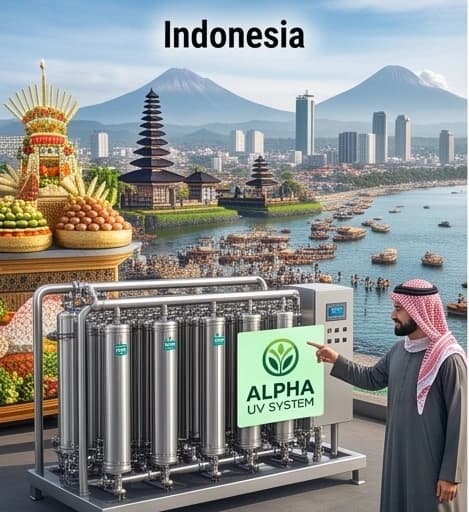
Quick Answer: UV water treatment Indonesia aquaculture is critical for Southeast Asia's 3rd largest shrimp producer — Indonesia exports USD 1.8+ billion in shrimp annually (2023), primarily Vannamei (Litopenaeus vannamei) from South Sulawesi (Pinrang, Barru, Maros), East Java (Situbondo, Banyuwangi), West Java (Indramayu, Subang), and Lampung (South Sumatra). WSSV (White Spot Syndrome Virus), EHP (Enterocytozoon hepatopenaei), IHHNV (Infectious Hypodermal and Haematopoietic Necrosis Virus), and Vibrio spp. (V. parahaemolyticus AHPND strain) destroy billions of dollars of Indonesian shrimp crops annually. KKP (Kementerian Kelautan dan Perikanan — Ministry of Marine Affairs and Fisheries) Regulation No. 75/2016 (Shrimp Aquaculture Technical Guidelines) and BPOM food safety regulations require biosecure intensive pond operations with intake water treatment. UV at 40 mJ/cm² NSF/ANSI 55 Class A is the specified biological treatment for hatchery intake water and super-intensive pond systems. EU DG SANTE requires E. coli 0 CFU/100 mL at processing — driving water treatment upstream at farm and hatchery level. Alpha UV ships to Makassar Sultan Hasanuddin Airport (UPG, South Sulawesi) or Surabaya Juanda Airport (SUB) within 48–72 hours.
Indonesia's Aquaculture Sector — Water Treatment Context
Indonesia's shrimp aquaculture geography is concentrated in four production regions:
- South Sulawesi (Pinrang, Barru, Bone districts): Indonesia's largest Vannamei production zone — 50,000+ ha shrimp ponds in coastal Sulawesi; intensive and super-intensive production systems; Bugis fishing and aquaculture community; seawater intake from Makassar Strait (UVT 72–84% in open sea, lower near coastal discharge points)
- East Java (Situbondo, Banyuwangi, Pasuruan): Second largest Vannamei zone — coastal ponds along the Java Sea; integrated with seafood processing cluster (PT Bumi Menara Internusa, PT Centralpertiwi Bahari — Indonesia's largest shrimp processors)
- West Java (Indramayu, Karawang, Subang): Proximity to Jakarta export logistics; older ponds transitioning from Black Tiger (Penaeus monodon) to Vannamei; coastal Java Sea intake (UVT 65–76%, lower than Sulawesi due to Java Sea coastal pollution)
- Lampung, Sumatra (PT Dipasena/CP Prima — largest Indonesian shrimp farm, 20,000 ha): CP Prima (Charoen Pokphand Indonesia subsidiary) operates one of the world's largest integrated shrimp farming complexes; semi-intensive to intensive management; Lampung Bay seawater (UVT 72–82%)
UV Water Treatment Applications in Indonesian Shrimp Aquaculture
| Application | Water Source | Pathogen | UV Dose | Alpha UV System |
|---|---|---|---|---|
| Shrimp hatchery intake (South Sulawesi — Makassar corridor) | Makassar Strait seawater, UVT 72–84% (brackish at hatchery location: 25–32 ppt salinity) | WSSV; IHHNV; Vibrio spp. AHPND; marine bacteria | 40 mJ/cm² NSF/ANSI 55 Class A for Vibrio and WSSV reduction; 316L SS mandatory for seawater exposure | AU-M 25, 316L SS seawater-compatible, 40 mJ/cm²; settling tank + 25-micron pre-filter for coastal turbidity |
| Super-intensive Vannamei pond intake (lined ponds, 200+ PLm² stocking density) | Canal or river seawater diversion, UVT 65–76% in Java Sea coastal zones; 72–84% Sulawesi | WSSV; EHP microsporidian spores; Vibrio AHPND; EMS | 40 mJ/cm² at pond intake via reservoir; crucial for EHP spore control at high stocking density | AU-M 25/30, 316L SS, pre-filter mandatory, 40 mJ/cm², solar or grid power |
| Shrimp seed (nauplii and zoea stage) rearing water | Filtered seawater for larval rearing tanks; UVT 80–90% (pre-filtered) | Vibrio harveyi (luminescent bacteria — "firework disease" in larvae); WSSV nauplii | 40 mJ/cm²; UV critical for luminescent Vibrio control in larval stages where antibiotic use is restricted (EU/USA market access compliance) | AU-S 8/15, compact for small-volume hatchery flow; 316L SS, 40 mJ/cm² |
| Processing plant water (integrated producer-processor — CP Prima, Bumi Menara) | PDAM or borehole; UVT 65–76% | Vibrio cholerae; V. parahaemolyticus; E. coli; total coliforms (EU DG SANTE criterion) | 40 mJ/cm² at processing plant potable water supply (EU DG SANTE E. coli 0 CFU/100 mL mandatory) | AU-M 25/30, freshwater-compatible, NSF/ANSI 55 Class A, EU DG SANTE HACCP documentation |
Export Market Compliance and Water Treatment
| Export Market | Indonesian Shrimp Requirement | Water Treatment Link | Alpha UV System |
|---|---|---|---|
| Japan (largest Indonesian shrimp market, USD 700+ million/year) | MHLW import notification; Salmonella absent in 25g; Vibrio parahaemolyticus <100 MPN/g; veterinary drug residue compliance | Zero Cl in processing water (Japan sashimi-grade); UV at 40 mJ/cm² for processing plant water disinfection; intake water UV at hatchery for Vibrio biosecurity | AU-M 25, zero Cl, NSF/ANSI 55 Class A, MHLW-compatible documentation |
| USA (FDA import — Indonesia has active import alerts for some shrimp violations) | FDA 21 CFR 123 HACCP; SIMP traceability; FDA FishList monitoring; Salmonella and sulphite compliance | Water as FDA 21 CFR 123 HACCP SSOP (Sanitation Standard Operating Procedure) — potable water treatment documented; FDA allows UV as primary disinfection with NSF/ANSI 55 Class A documentation | AU-M 25/30, NSF/ANSI 55 Class A, FDA HACCP SSOP documentation package |
| EU (Regulation (EC) 853/2004 — Indonesia EU-listed establishments) | EU DG SANTE establishment listing; potable water (EU Directive 98/83/EC: E. coli 0 CFU/100 mL) for all product contact; HACCP prerequisite programme for water | Hatchery and farm intake water UV reduces WSSV and Vibrio — indirectly supporting EU microbiological compliance at processing; direct compliance: processing plant UV at 40 mJ/cm² for EU-grade potable process water | AU-M 25/30, NSF/ANSI 55 Class A, EU DG SANTE HACCP PRP documentation |
FAQ
What is KKP Regulation No. 75/2016 and how does it affect UV use at Indonesian shrimp farms?
KKP (Ministry of Marine Affairs and Fisheries) Regulation No. 75/2016 (Petunjuk Teknis Budidaya Udang — Shrimp Aquaculture Technical Guidelines) sets biosecurity requirements for intensively operated shrimp ponds in Indonesia. Key water treatment provisions: intake water must be treated for pathogen removal before entering ponds; hatchery water must meet biosecure standards; WSSV-positive water must not be introduced to clean ponds. KKP does not specify a technology mandate but accepts UV disinfection at certified doses as the primary intake water treatment method. KKP extension officers (LPPMHP — Fish Health Surveillance Posts) inspect intensive shrimp farms and hatcheries, checking water treatment records. UV system installation documentation and quarterly water quality test results (E. coli, Vibrio plate count) constitute the KKP-acceptable water treatment verification evidence.
Why does Java Sea coastal water have lower UVT than Sulawesi Strait water?
The Java Sea (shallow epicontinental sea between Java and Kalimantan, average depth 46 m) receives significant land-based runoff from Java's dense coastal population (140 million people) and industrial zones — river discharge from Ciliwung, Brantas, and Bengawan Solo rivers carries dissolved organic matter, agricultural runoff, and industrial effluents. Result: Java Sea coastal UVT 62–76% (lower, with more dissolved colour and turbidity from terrestrial input). Makassar Strait (deeper, oceanic water body between Sulawesi and Kalimantan, average depth 1,000+ m) receives less terrestrial input: UVT 78–88% at Sulawesi coastal intake points — better UV operating conditions for South Sulawesi shrimp hatcheries. This explains why Sulawesi shrimp hatcheries can operate UV systems at closer to rated flow capacity than West Java coastal operations, which require more aggressive pre-treatment to bring UVT to 72%+ before UV.
Does CP Prima (Charoen Pokphand Indonesia) use UV water treatment at its Lampung operations?
PT Centralpertiwi Bahari / CP Prima (Indonesia's largest integrated shrimp company — 20,000 ha in Lampung and South Sulawesi, subsidiary of Thailand's CP Foods/Charoen Pokphand) applies CP Foods' global aquaculture quality standards, including CP Foods' Shrimp Biosecurity Protocol. CP's biosecurity standard requires: intake water chlorination-then-dechlorination (backup pathogen control using chlorine + sodium thiosulphate) OR UV treatment at certified dose as the primary intake water disinfection method. For super-intensive ponds at CP Prima Lampung (target 30–50 tonnes/ha/cycle Vannamei production), UV is specified at hatchery intake and at intensive pond water management points. Alpha UV systems are used at CP Prima's integrated operations where zero-chemical intake water treatment aligns with the company's export market (Japan, EU) requirements for drug residue-free shrimp.
What is the UV water treatment specification for a South Sulawesi shrimp hatchery?
A medium-scale South Sulawesi shrimp hatchery (2 million nauplii/day capacity, Pinrang district) with marine water intake from Makassar Strait (25–32 ppt salinity, UVT 78–84% after 25-micron pre-filtration): larval rearing water flow rate 2–5 m³/hour; broodstock tank supply 1–2 m³/hour; total hatchery UV capacity: AU-M 25 at 25 m³/hour rated (derated to 4–6 m³/hour operating flow at 40 mJ/cm² dose — flow rate limited to ensure full dose at hatchery intake UVT). Seawater compatibility: AU-M 25 in 316L stainless steel (not 304 SS — chloride corrosion from seawater will compromise 304 SS housing within 6–12 months in continuous seawater contact). 316L SS housing resists chloride corrosion at 25–32 ppt salinity for the system's rated lifespan (10+ years with standard maintenance).
How does Alpha UV reach remote shrimp farming locations in South Sulawesi?
Air freight to Makassar Sultan Hasanuddin Airport (UPG): 48 hours from India via Singapore or Jakarta hub. Road transport from Makassar to Pinrang (Sulawesi's largest shrimp farming district): 3.5 hours. To Barru: 2.5 hours. To Maros: 1 hour. Indonesia Customs at UPG: AIFTA 0% duty for Indian-origin equipment, VAT 11%, local Makassar customs broker handles PT import documentation. Lamp replacement supply: Alpha UV replacement lamps available from Makassar-based distribution partner or shipped from Jakarta within 3–5 days. 12,000-hour lamp life at 18 hours/day hatchery operation = 22+ months between lamp changes — comparable to annual maintenance schedules at South Sulawesi hatcheries that bring technical support from Makassar annually.
Standards, authorities & further reading
External references used to inform this guide. Regulations evolve — check the latest revision on each authority's site before compliance decisions.
Recommended UV Systems
Alpha UV System products for this application — powered by genuine Philips UV-C lamps.
Commercial UV Water Purification System
500 – 5,000 LPH
HACCP-compliant UV water purification for hotels, restaurants, and offices
Industrial UV Water Treatment System
5,000 – 50,000 LPH
Schedule M 2025 and HACCP compliant UV for pharma, food & beverage, and process water
Not sure which system suits your application? WhatsApp our engineers for a free recommendation →
Related solutions
See how Alpha UV System applies this to your industry or city.
Need a UV system?
Talk to our UV engineers — WhatsApp for a quote in 2 hours, or browse the full catalog on IndiaMART.