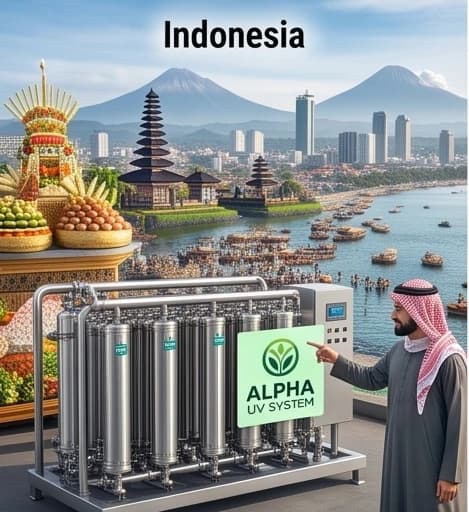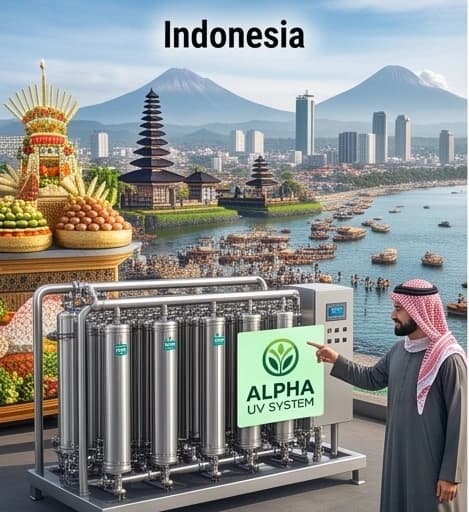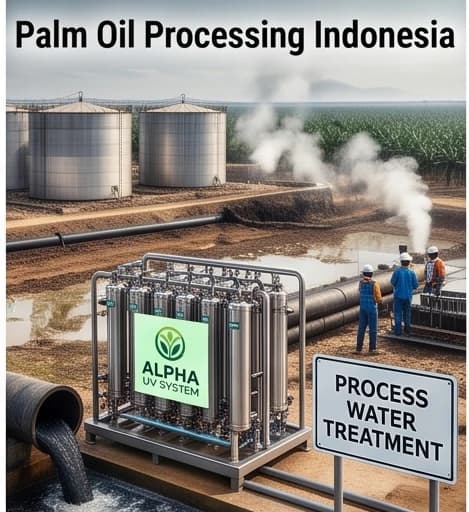
Quick Answer: UV water treatment Indonesia palm oil sector addresses water quality for one of the world's largest agribusiness operations — Indonesia produces 45+ million tonnes of crude palm oil (CPO) annually (55% of global palm oil production, 2023), primarily from Sumatra and Kalimantan plantations. Key UV water treatment applications in Indonesia's palm oil sector: (1) Worker camp and estate residential potable water — 1,000–5,000 workers per large estate, remote from municipal supply, relying on river, borehole, or rainwater; WHO GDWQ camp water standard required by RSPO (Roundtable on Sustainable Palm Oil) Principle 4 (Environmental Responsibility) and ISCC (International Sustainability & Carbon Certification); (2) Palm oil refinery process water — refined, bleached, deodorised (RBD) palm oil production requires potable water for boiler feed and steam processing; BPOM food safety compliance for food-grade palm oil; (3) Kernel processing and fractionation water quality. RSPO certification (covering 20%+ of global palm oil) requires plantation operations to provide documented potable water to estate workers — UV at 40 mJ/cm² NSF/ANSI 55 Class A is the accepted remote estate worker water treatment method. Alpha UV ships to major Kalimantan airports (Palangkaraya BPN, Balikpapan BPN, Pontianak PNK) and Sumatra airports (Pekanbaru PKU, Medan KNO) within 48–72 hours via Jakarta or Singapore hub.
Indonesia Palm Oil Sector — Water Treatment Context
Indonesia's palm oil estates (kelapa sawit) are among the world's largest agribusiness operations — major corporate groups include Wilmar International, Sinar Mas Agro Resources and Technology (SMART/Golden Agri), Musim Mas Group, Asian Agri, Salim Group (IndoAgri), and KLK (Kuala Lumpur Kepong). These multinationals operate estates of 50,000–200,000 hectares in Riau (Sumatra), Central and East Kalimantan, West Kalimantan, and North Sumatra.
Worker communities on large palm oil estates present the primary UV water treatment demand: estates with 2,000–5,000 workers have estate-owned housing compounds, schools, and medical clinics — all requiring potable water supply. RSPO Principle 4 requires: documented potable water access for all estate workers; water quality meeting WHO GDWQ or national Indonesian standards (Permenkes 492/2010 — drinking water quality); water treatment records available for RSPO auditor inspection.
Remote estate locations — often 50–200 km from nearest PDAM supply — rely on: (1) Rivers (Siak River in Riau, Kapuas River in West Kalimantan, Mahakam River in East Kalimantan — high turbidity, BOD 20–60 mg/L); (2) Boreholes (UVT 78–90% in Borneo peat soils, but with iron 0.5–3 mg/L and colour from peat humic acids); (3) Rainwater harvesting (UVT 90–98% but requires tank treatment for biological safety).
Palm Oil Estate Water Quality by Location
| Province / Region | Water Source | UVT | Key Issue | Alpha UV System |
|---|---|---|---|---|
| Riau Province, Sumatra (Wilmar, SMART estates — largest palm oil region) | Siak River or borehole; UVT 65–78% river, 72–88% borehole | 65–88% | High iron in Riau borehole (1–3 mg/L); peat humic acid colour (high TOC, darker water); worker camp E. coli from poor sanitation; RSPO audit requirement | AU-S 15, post iron-removal + 5-micron pre-filter, 40 mJ/cm², generator/solar-compatible, RSPO documentation |
| West Kalimantan (KLK, Musim Mas — Pontianak corridor) | Kapuas River abstraction; UVT 60–72% (seasonal — 52–60% during high water season) | 60–72% | Kapuas River high turbidity in wet season (November–April); peat swamp water quality; remote estate 100+ km from Pontianak | AU-S 15 / AU-M 25 with settling pre-treatment + pre-filter; generator power; RSPO compliance documentation |
| Central Kalimantan (Asian Agri — Palangkaraya corridor) | River and borehole; UVT 68–82% | 68–82% | Post-peat forest conversion — groundwater quality variable; E. coli risk from estate sanitation infrastructure | AU-S 15, compact, solar+generator compatible, 40 mJ/cm² |
| North Sumatra (PT Perkebunan Nusantara — PTPN government estates) | PDAM Medan augmented supply OR estate river; UVT 68–80% | 68–80% | PTPN (government estate) worker welfare requirements; Ministry of Manpower compliance for worker housing; RSPO legacy plantation certification | AU-M 25, NSF/ANSI 55 Class A, RSPO audit documentation, Ministry of Manpower worker welfare compliance |
Palm Oil Refinery Process Water
| Application | Water Quality Requirement | UV Role | Alpha UV System |
|---|---|---|---|
| Boiler feed water (CPO mill and refinery steam generation) | RO-treated for boiler scale prevention; biological contamination control in RO permeate storage | UV post-RO at 40 mJ/cm² prevents Pseudomonas colonisation of RO permeate storage and distribution piping before boiler; biological fouling reduces boiler efficiency and increases maintenance cost | AU-M 25, post-RO, 40 mJ/cm², stainless construction |
| Food-grade RBD palm olein refinery (BPOM food safety compliance) | Potable water for food-contact cleaning and steaming operations; BPOM Regulation 31/2018 HACCP PRP | UV at 40 mJ/cm² for food-contact water in BPOM HACCP prerequisite programme; E. coli 0 CFU/100 mL | AU-M 25, NSF/ANSI 55 Class A, BPOM HACCP documentation |
| Palm kernel oil (PKO) processing (kernel crushing, kernel oil extraction) | Potable water for kernel washing and separation; food-grade process water | UV biological safety for food-contact wash water; BPOM food safety compliance | AU-M 25, 40 mJ/cm², NSF/ANSI 55 Class A |
FAQ
What is RSPO Principle 4 and how does it require UV water treatment on palm oil estates?
RSPO (Roundtable on Sustainable Palm Oil) Principle 4 (Environmental Responsibility and Conservation of Natural Resources and Biodiversity) includes P4.7: "An occupational health and safety plan is documented, effectively communicated and implemented." This principle, combined with P6 (Responsible Consideration of Employees), requires RSPO-certified palm oil producers to provide documented potable water access conforming to national standards (Indonesia Permenkes 492/2010: E. coli 0 MPN/100 mL) or WHO GDWQ for all estate worker housing. RSPO auditors (accredited third-party — Bureau Veritas, SGS, TUV Rheinland) verify water treatment documentation during RSPO certification audits. UV at 40 mJ/cm² with NSF/ANSI 55 Class A certification and annual water quality test results constitutes acceptable RSPO water treatment documentation — confirming potable water provision for estate workers as required by RSPO Principle 4/6.
How does peat humic acid affect UV performance in Kalimantan estate boreholes?
Kalimantan and Riau Sumatra boreholes in peat-dominated areas extract water with high dissolved humic and fulvic acid content — natural organic matter from peat soil decomposition. This creates: high colour (10–80 HU, causing "brown water" appearance); high TOC (5–30 mg/L dissolved organic carbon); and reduced UVT (typically 65–78% for peat borehole water, compared to 85–95% for mineral rock borehole water). Humic acids absorb UV at 254 nm, competing with the target pathogen DNA for UV photons and reducing effective UV dose delivery. Pre-treatment for peat borehole water before UV: (1) Iron removal (aeration + greensand filter for iron >0.3 mg/L); (2) Coagulation-flocculation (removes humic acid colour and TOC — jar test required to determine coagulant dose); (3) 5-micron pre-filter; (4) UV at 40 mJ/cm². Alternatively, activated carbon (GAC) absorbs humic acids and improves UVT to 82–90% before UV — simpler for small estate water systems without coagulation infrastructure.
Can solar power adequately power UV systems at remote Kalimantan palm oil estates?
Yes. Remote Kalimantan palm oil estates typically have diesel generator power (10–100 kVA generator for estate infrastructure) and increasingly hybrid solar-diesel systems under Wilmar and SMART sustainability commitments. Alpha UV AU-S 15 (55W, 220V) can operate on any estate generator or solar hybrid inverter system. For very small remote installations (exploration camps, smallholder outgrower support programmes), AU-S 8 (25W) can operate from a 100–150Ah battery bank with 100W+ solar panel — typical small solar home system specifications found even in remote Kalimantan village locations. Generator output compatibility (100–240V, 50/60 Hz, variable output from diesel generator): AU-S 15 universal-input ballast handles diesel generator voltage variation (190–240V at rated load) without voltage regulator requirement.
Does Wilmar International or SMART Group specify Alpha UV for estate worker water treatment?
Major palm oil groups (Wilmar, SMART/Golden Agri, Musim Mas, Asian Agri) specify potable water treatment equipment through their central procurement programmes — typically requiring equipment meeting WHO GDWQ biological standards and documented with third-party certification. UV water treatment Indonesia palm oil estate specifications at Wilmar and SMART properties are based on RSPO Principle 4/6 and the groups' own sustainability frameworks (Wilmar's NDPE — No Deforestation, No Peat, No Exploitation — policy includes worker welfare water provisions). Alpha UV systems are specified by regional WASH (Water, Sanitation and Hygiene) consultants working with these groups — Alpha UV's NSF/ANSI 55 Class A certification and compact estate-compatible design (AU-S 15) make it the practical choice for remote estate water treatment installations across both Sumatra and Kalimantan.
How does ISCC certification relate to UV water treatment at Indonesian palm oil facilities?
ISCC (International Sustainability and Carbon Certification) — required for palm oil exported as sustainable feedstock to EU under RED II (Renewable Energy Directive II) for biofuel applications — includes social requirements similar to RSPO: worker welfare and access to potable water at certified production sites. ISCC System Document ISCC 202 (Social Requirements) requires producers to ensure workers have access to safe drinking water. UV water treatment at ISCC-certified palm oil estates with documentation (NSF/ANSI 55 Class A certification, annual water quality test) constitutes the evidence of "access to safe drinking water" required for ISCC audit compliance. The Indonesian government's ISPO (Indonesia Sustainable Palm Oil) certification also includes worker welfare requirements for potable water access, creating a domestic regulatory parallel to RSPO/ISCC international standards.
Standards, authorities & further reading
External references used to inform this guide. Regulations evolve — check the latest revision on each authority's site before compliance decisions.
Recommended UV Systems
Alpha UV System products for this application — powered by genuine Philips UV-C lamps.
Commercial UV Water Purification System
500 – 5,000 LPH
HACCP-compliant UV water purification for hotels, restaurants, and offices
Industrial UV Water Treatment System
5,000 – 50,000 LPH
Schedule M 2025 and HACCP compliant UV for pharma, food & beverage, and process water
Not sure which system suits your application? WhatsApp our engineers for a free recommendation →
Related solutions
See how Alpha UV System applies this to your industry or city.
Need a UV system?
Talk to our UV engineers — WhatsApp for a quote in 2 hours, or browse the full catalog on IndiaMART.