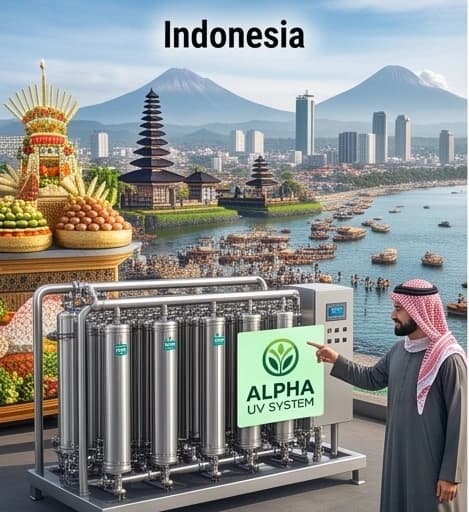
Quick Answer: Indonesia's UV water treatment system requirements range from 40 mJ/cm² NSF/ANSI 55 Class A reactors for Jakarta food processing parks, Bali resort hotels, and Sulawesi aquaculture to 80 mJ/cm² AU-H pharmaceutical-grade systems for the Bekasi–Cikarang API manufacturing corridor (BPOM GMP). Ciliwung River Jakarta supply post-treatment UVT is typically 74–82%; Bali volcanic spring supply 84–90%. The Ministry of Health standard Permenkes No. 492/MENKES/PER/IV/2010 governs drinking water. Alpha UV ships to Indonesia via Tanjung Priok (Jakarta) or Tanjung Perak (Surabaya).
Indonesia's UV Water Treatment System Landscape
Indonesia — Southeast Asia's largest economy (USD 1.47 trillion GDP, 2025) and the world's fourth most populous nation — presents one of Asia's most geographically complex UV water treatment system markets. Spanning 17,000 islands across six time zones, water quality varies from highly treated Jakarta municipal supply to remote Kalimantan peat-bog water (UVT <40%, requiring extensive pre-treatment) and pristine Bali volcanic springs (UVT 88–94%).
Three sectors drive the UV water treatment system Indonesia market: food and beverage manufacturing (the largest domestic consumption market in ASEAN), tourism and hospitality (Bali, Lombok, Komodo), and a rapidly growing pharmaceutical sector regulated by BPOM (Badan Pengawas Obat dan Makanan). Agricultural processing — palm oil (Indonesia is the world's largest producer, 45 million tonnes/year), rubber, cocoa, and coffee — and aquaculture (shrimp, tilapia, pangasius for export) complete the demand picture.
Permenkes No. 492/MENKES/PER/IV/2010 sets microbiological standards for drinking water (E. coli = 0/100 mL). The Ministry of Marine Affairs and Fisheries (KKP) regulates aquaculture water quality; BPOM (equivalent to FDA) enforces GMP for pharmaceutical manufacturing. For export markets, HACCP (Codex Alimentarius), EU DG SANTE, and US FDA standards apply to food and seafood processors.
Jakarta and Greater Jabodetabek — Urban Industrial Water
Greater Jakarta (Jabodetabek: Jakarta, Bogor, Depok, Tangerang, Bekasi) is home to Indonesia's densest concentration of food processing, pharmaceutical, consumer goods, and electronics manufacturing. PAM Jaya (DKI Jakarta water utility) draws from the Ciliwung and Cisadane rivers — both heavily impacted by upstream domestic and agricultural discharge — achieving post-treatment UVT of 72–80%. In Bekasi and Cikarang (eastern Jabodetabek), industrial estates draw from the Bekasi and Citarum rivers (post-treatment UVT 70–78%) or from private groundwater wells (UVT 78–86% from deeper alluvial aquifers).
| Industrial Estate / Zone | Location | Key Industries | Water Source / UVT | Alpha UV System |
|---|---|---|---|---|
| MM2100 Industrial Town | Bekasi, West Java | Food, pharma, FMCG, auto | Bekasi river / borewell 74–82% | AU-M 30 per estate WTP, MODBUS TCP |
| EJIP (East Jakarta IZ) | Bekasi | Electronics, food processing | Municipal blend 72–78% | AU-M 25 duty/standby |
| Cikarang Baru IZ | Cikarang, Bekasi | Pharma, chemicals, food | Borewell 78–84% | AU-M 30 + AU-H for pharma units |
| Delta Silicon IZ (Lippo) | Cikarang | Electronics, consumer goods | Municipal 72–78% | AU-M 25, MODBUS RS485 |
| Tangerang food cluster | Tangerang, Banten | Indomie, dairy, snack food | Cisadane treated 74–82% | AU-M 50 duty/standby |
Bali and Tourism Hospitality — Volcanic Spring UV Polishing
Bali's tourism industry (6.3 million international arrivals in 2024, targeting 10 million by 2027) drives a significant UV water treatment system Indonesia segment: resort hotels, villa complexes, and spa facilities along the Seminyak–Kuta–Ubud–Nusa Dua corridor require NSF/ANSI 55 Class A-validated potable water for guest rooms, restaurants, pools, and spa treatments.
Bali draws water from volcanic spring networks — Penet, Ayung, Pakerisan — with UVT 84–92% under normal conditions. However, wet season (November–March) turbidity spikes and post-eruption (Gunung Agung activity) can drop UVT to 72–78% transiently. Auto de-rating control protects guest water safety through these events without operator intervention.
Key hotel groups specifying UV on Bali: Four Seasons Jimbaran Bay and Sayan, COMO Shambhala Estate Ubud, Alila Villas Uluwatu, Bulgari Resort Bali, Banyan Tree Ungasan — all operate HACCP-certified F&B operations requiring zero E. coli at kitchen water outlets. GIBTM (Green Hotel certification, Indonesia's PROPER scheme) and Green Globe specifications for eco-resorts on Nusa Penida and Gili Islands require chemical-free water treatment where possible — UV with no residual chemical satisfies this requirement.
Sulawesi and Kalimantan — Aquaculture and Mining
Indonesia's Sulawesi province (Makassar, Kendari, Manado) is the primary hub for shrimp and seaweed aquaculture, with Sulawesi shrimp certified under ASC and BAP for export to Japan, the EU, and the US. Processing plants in Makassar's Parangloe and Kodingareng EPZ require NSF/ANSI 55 Class A process water at washing, grading, and freezing stages.
| Application | Location | Water Challenge | Certification Need | Alpha UV System |
|---|---|---|---|---|
| Shrimp processing (export) | Makassar, South Sulawesi | Brackish groundwater, Fe 0.4–1.0 mg/L | EU DG SANTE, ASC, BAP | AU-M 25, auto-wiper, NSF/ANSI 55 |
| Seaweed processing | Jeneponto, South Sulawesi | Coastal well, UVT 76–84% | BPOM food safety | AU-S 15, MODBUS logging |
| Nickel mine camp (Harita) | North Maluku / Morowali | Groundwater, seasonal turbidity | NSF/ANSI 55 Class A potable | AU-M 25, IP65, duty/standby |
| Palm oil refinery (Wilmar) | Kalimantan Timur | Peat bog water UVT 40–60% | RSPO, ISPO, process water | GAC+sand pre-filter + AU-M 30 |
| Coal mining camp (Adaro) | South Kalimantan | River water, suspended coal fines | Potable camp supply | Multi-media filter + AU-M 25, IP65 |
Kalimantan peat bog water (UVT typically 35–55%) is the most UV-challenging source in the Indonesia portfolio: dissolved humic acids absorb UV-C heavily, requiring mandatory GAC pre-treatment to raise UVT above 70% before the UV reactor can operate effectively at 40 mJ/cm² dose. Palm oil processors on RSPO (Roundtable on Sustainable Palm Oil) and ISPO (Indonesian Sustainable Palm Oil) certification need clean process water for mill operations — the GAC + UV combination is specified in mill water management plans submitted to RSPO auditors.
BPOM Pharmaceutical Compliance — Cikarang and Bekasi Corridor
Indonesia's pharmaceutical manufacturing sector is dominated by domestic producers (Kalbe Farma, Kimia Farma, Dexa Medica, Sanbe Farma, Pyridam Pharma) and multinational subsidiaries (Pfizer Indonesia, Abbott, Bayer Indonesia) clustered in the Bekasi–Cikarang industrial corridor. BPOM (Badan Pengawas Obat dan Makanan) enforces CPOB (Cara Pembuatan Obat yang Baik) — Indonesia's GMP standard aligned with ASEAN GMP and WHO GMP TRS 1044.
CPOB requires Purified Water (Aqua Purificata) and Water for Injection (Aqua pro Injectione) loops to meet pharmacopoeial specifications (Indonesian Pharmacopoeia / IP monograph, USP <1231>). The validated UV dose standard for pharmaceutical PW is 80 mJ/cm² — supplied by Alpha UV's AU-H series (316L SS, Tri-Clamp, electropolished interior, CIP-compatible). IIT-trained engineers provide CFD validation documentation (ANSYS Fluent simulation of dose delivery) for inclusion in the BPOM product registration dossier and site master file.
Surabaya and East Java — Food and Port Industry
Surabaya (Indonesia's second city, 3.3 million population) and the broader East Java industrial zone (Sidoarjo, Gresik, Mojokerto) host a dense food processing cluster — sugar refining (PT Rajawali Nusantara), dairy (Ultrajaya Milk, Greenfields), and seafood processing for the Tanjung Perak export corridor.
PDAM Surya Sembada (Surabaya water utility) draws from the Brantas and Porong rivers (post-treatment UVT 74–82%). During East Java's wet season (November–April), Brantas turbidity peaks sharply following volcanic ash deposits from Gunung Semeru and Gunung Bromo — UVT can drop to 66–72% during these events. Auto de-rating control is standard for all Surabaya industrial UV installations.
Frequently Asked Questions
What is Indonesia's drinking water standard and how does UV disinfection satisfy it?
Permenkes No. 492/MENKES/PER/IV/2010 (Ministry of Health Regulation on Drinking Water Quality Requirements) specifies total coliform = 0/100 mL and E. coli = 0/100 mL for tap drinking water. NSF/ANSI 55 Class A UV at 40 mJ/cm² delivers >4-log (99.99%) reduction in E. coli and total coliform, as well as Cryptosporidium (UV-resistant to chlorine) — exceeding Permenkes requirements. Alpha UV provides a QCVN-aligned compliance declaration with each unit. For Bali resort hotels subject to PROPER (Indonesia's environmental compliance rating), UV-based treatment contributes to chemical reduction scores under the Green Hotel assessment.
Does BPOM pharmaceutical GMP require 40 mJ/cm² or 80 mJ/cm² UV for Purified Water?
BPOM CPOB (aligned with WHO GMP TRS 1044 Annex 3 and USP <1231>) requires Purified Water to be maintained free from microbial contamination; the USP Alert Limit is 100 CFU/mL for PW. The pharmaceutical industry standard for UV in PW loops is 80 mJ/cm² (Alpha UV AU-H), providing a validated 4–5 log reduction margin with headroom for UVT fluctuation. 40 mJ/cm² (NSF/ANSI 55 Class A) applies to potable water and food-grade process water on manufacturing campuses — not to pharmacopoeial PW loops. Alpha UV supplies separate BPOM-ready validation dossiers for AU-H units: CFD dose report, NSF/ANSI 55 Class A certificate, 316L SS material cert (EN 10204 3.1), Ra surface roughness data.
Why does Kalimantan peat bog water require pre-treatment before UV?
Peat bog water (typical of Central and South Kalimantan plantation areas) contains dissolved humic and fulvic acids (DOC 15–40 mg/L) which strongly absorb UV-C radiation at 254 nm — the same wavelength used for disinfection. Raw peat water UVT of 35–55% means the UV reactor would need to operate at less than 30% of its rated flow to achieve 40 mJ/cm² dose, making direct UV application impractical. A GAC (granular activated carbon) pre-filter, preceded by a multimedia sand filter for suspended solids removal, raises UVT to 72–80% — within the Alpha UV reactor's design range. For palm oil mill process water, this pre-treatment sequence is included in the RSPO/ISPO water management plan as part of the mill's environmental compliance documentation.
What UV system is recommended for a Bali beachfront resort with volcanic spring supply?
For a beachfront resort on Bali (50–200 room property) drawing from a volcanic spring borewell (UVT 86–92% normal, 72–78% wet season dip), the AU-M 25 (25 m³/h, NSF/ANSI 55 Class A, 40 mJ/cm²) with auto de-rating controller covers potable supply, kitchen, spa, and pool make-up. MODBUS RS485 integration allows the resort BMS (Building Management System) to monitor UV dose, lamp intensity, and UVT on a dashboard — satisfying HACCP F&B audit requirements and Green Globe sustainability certification (chemical reduction score). For resorts with on-site bottled water plants or purified water dispensing, an AU-H 10 at 80 mJ/cm² is specified for that sub-loop.
What is the shipping timeline for UV systems from India to Indonesia?
Alpha UV systems ship from the Indian manufacturing facility. Sea freight to Tanjung Priok (Jakarta): 14–18 days from Nhava Sheva (Mumbai), 16–20 days from Chennai. Sea freight to Tanjung Perak (Surabaya): 16–20 days from Nhava Sheva. Both ports offer direct services without transshipment. Customs clearance in Indonesia typically takes 3–5 working days with complete documentation (commercial invoice, packing list, COO, NSF/ANSI 55 Class A certificate). Inland delivery to Cikarang or Bekasi from Tanjung Priok: 2–3 hours. For urgent pharmaceutical project deliveries, air freight via Soekarno-Hatta International Airport (Cengkareng) is available — under 48 hours from India dispatch. All documentation supplied in English and Bahasa Indonesia.
Logistics and Supply Chain
Alpha UV systems reach Indonesia via Tanjung Priok Container Port (Jakarta) for Java and Kalimantan destinations, and Tanjung Perak (Surabaya) for East Java, Sulawesi, and eastern Indonesia. Sea freight from India averages 14–20 days depending on origin port. For Bali resort and hospitality deliveries, goods transit through Benoa Port (Bali) or road from Surabaya (10–12 hours). For Sulawesi (Makassar, Manado, Kendari), domestic feeder vessels from Tanjung Priok add 2–4 days.
Spare consumables — UV lamps, quartz sleeves, O-ring kits — are held at a Jakarta warehouse partner for 48-hour dispatch to any Indonesian destination by JNE/JNT express freight. Pharmaceutical AU-H spare lamp and quartz sleeve sets ship with the initial installation package.
All documentation supplied with each Indonesia UV water treatment system: NSF/ANSI 55 Class A validation report, Permenkes 492 compliance declaration, CFD dose simulation (IIT-trained engineers, ANSYS Fluent), MODBUS register map, HACCP UV process summary sheet (English + Bahasa Indonesia), and BPOM CPOB validation dossier for pharmaceutical installations.
Alpha UV Systems — UV water treatment system Indonesia specialists. NSF/ANSI 55 Class A | Permenkes 492 compliant | BPOM CPOB pharmaceutical dossier | DG SANTE & FDA HACCP documentation. Delivery via Tanjung Priok or Tanjung Perak. Contact us for Jabodetabek industrial estate or Bali resort sizing.
Standards, authorities & further reading
External references used to inform this guide. Regulations evolve — check the latest revision on each authority's site before compliance decisions.
Recommended UV Systems
Alpha UV System products for this application — powered by genuine Philips UV-C lamps.
Commercial UV Water Purification System
500 – 5,000 LPH
HACCP-compliant UV water purification for hotels, restaurants, and offices
Industrial UV Water Treatment System
5,000 – 50,000 LPH
Schedule M 2025 and HACCP compliant UV for pharma, food & beverage, and process water
Not sure which system suits your application? WhatsApp our engineers for a free recommendation →
Related solutions
See how Alpha UV System applies this to your industry or city.
Need a UV system?
Talk to our UV engineers — WhatsApp for a quote in 2 hours, or browse the full catalog on IndiaMART.