Quick Answer
UV disinfection systems deliver ≥4-log (99.99%) inactivation of bacteria, viruses, and protozoa — including Cryptosporidium and Giardia that chlorine cannot reliably kill — at UV doses of 10–400 mJ/cm², depending on the target organism and application. The core components are a UV lamp (low-pressure or medium-pressure), a quartz sleeve protecting the lamp from water contact, a SS316L reactor chamber sized to the flow rate, and a UV intensity monitor with an alarm relay. No chemicals are added, no disinfection byproducts are formed, and no taste or odour is imparted to the water. In India, UV disinfection systems must meet BIS IS 10500 potable water standards (zero E. coli per 100 ml) for drinking water applications, CPCB General Discharge Standards (≤1,000 MPN fecal coliforms/100 ml) for STP effluent discharge, and FSSAI Schedule IV GMP water quality standards for food and beverage process water. System capacity in India ranges from 100 LPH for point-of-use hospital taps to 5,00,000 LPH for municipal STP disinfection channels, with prices from ₹18,000 for small commercial units to ₹35 lakh for large multi-lamp municipal installations.
How UV Disinfection Systems Work
UV disinfection systems work by exposing water to ultraviolet light at 254 nm wavelength — the germicidal peak at which UV-C radiation is absorbed by the DNA and RNA of microorganisms. This absorption causes pyrimidine dimer formation, cross-linking the DNA strands in a way that prevents the cell from replicating. A microorganism that cannot replicate cannot cause infection, regardless of whether it remains physically present in the water. This is the critical distinction between UV disinfection and chemical disinfection: UV does not kill cells in the conventional sense — it sterilises them by eliminating their ability to reproduce.
The UV dose delivered to each microorganism is the product of UV intensity (mW/cm²) and exposure time (seconds), expressed in mJ/cm² (equivalent to mW·s/cm²). A standard UV disinfection system for drinking water is validated to deliver a minimum of 40 mJ/cm² at the end of lamp life (when UV output has degraded to approximately 70% of initial output) and at the highest expected UV transmittance (UVT) of the source water. At 40 mJ/cm², UV achieves ≥4-log reduction of E. coli, Salmonella, Listeria, Campylobacter, Hepatitis A virus, and Adenovirus. At 10 mJ/cm², Cryptosporidium parvum — completely resistant to chlorine at practical concentrations — achieves 3-log inactivation.
UV Lamp Types: Low-Pressure vs Medium-Pressure
UV disinfection systems in India use two lamp technologies, each suited to different scale and water quality conditions:
Low-pressure UV lamps emit monochromatic light at 254 nm — the peak germicidal wavelength. They operate at 40–80 W electrical input, produce output power of 25–50 W UV at 254 nm, and have lamp lives of 9,000–12,000 hours. Low-pressure lamps are 95% efficient at the germicidal wavelength and are the standard choice for flow rates up to 50,000 LPH. Philips UV-C low-pressure lamps are the benchmark for quality in this category — used by Alpha UV System across all standard industrial and commercial installations.
Medium-pressure UV lamps emit broadband UV across 200–400 nm, with much higher electrical input (1–30 kW per lamp) and correspondingly higher UV output. They achieve equivalent doses at higher flow rates with fewer lamps, making them the choice for municipal-scale installations (50,000 LPH and above) and applications requiring photolysis of chemical compounds (chloramine destruction in swimming pools, TOC reduction in pharmaceutical water, ozone destruction). Medium-pressure systems have lamp lives of 4,000–5,000 hours but can be retrofitted quickly. Philips UV-C high-output medium-pressure lamps are specified for Alpha UV System's large-capacity installations.
UV Disinfection System Components
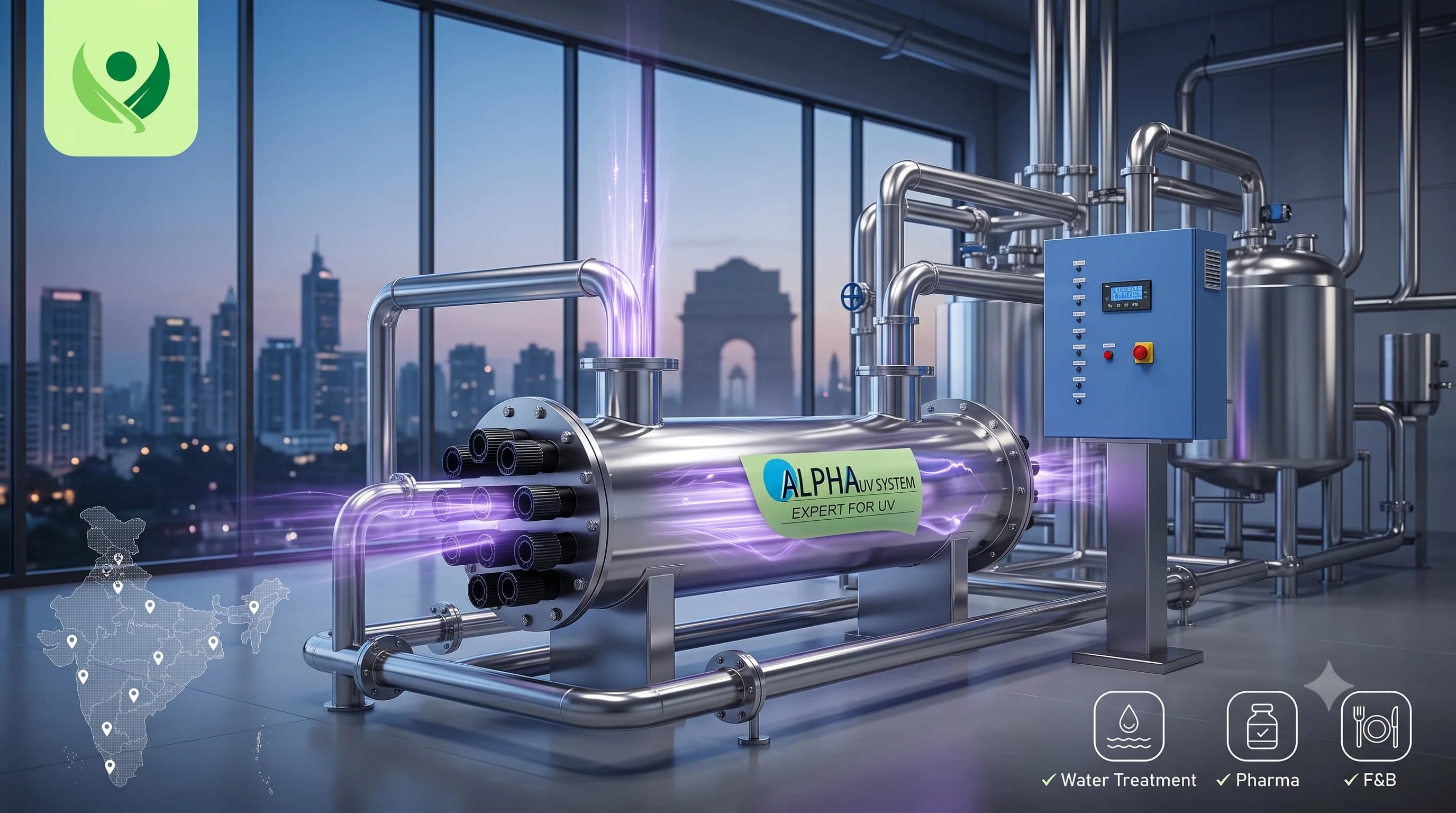
A complete UV disinfection system for industrial or municipal water treatment in India comprises:
- UV reactor chamber: SS316L (Grade 316 stainless steel) for all potable water and food contact applications. The chamber dimensions determine the hydraulic residence time and therefore the UV dose at a given flow rate. SS316L is specified over SS304 for resistance to chloride pitting in Indian ground and surface waters that often have elevated chloride content.
- UV lamp and quartz sleeve assembly: The lamp is housed inside a quartz sleeve that protects it from direct water contact and thermal shock. Quartz transmits ≥90% of UV at 254 nm — borosilicate glass transmits only 50–60% and is not suitable for UV disinfection reactors. The lamp-sleeve assembly is accessible from outside the reactor for replacement without system draining.
- UV intensity sensor: A calibrated photodetector measures real-time UV intensity inside the reactor chamber. The sensor output is displayed on the control panel and triggers an alarm if intensity falls below the setpoint (typically 70% of initial intensity, indicating lamp replacement is needed).
- Electronic control unit: Provides lamp ignition, power regulation (for lamp warm-up), UV intensity display, hour meter (lamp life tracking), and alarm relay outputs (for SCADA integration or local panel indication). IP65 rated for industrial environments.
- Inlet/outlet connections: Flanged (PN10 or PN16) for industrial systems, threaded (BSP or NPT) for smaller commercial units. Isolation valves and a bypass line are recommended for maintenance continuity.
Sizing UV Disinfection Systems for Indian Applications
Correct sizing of UV disinfection systems requires three inputs: flow rate, UV transmittance (UVT) of the source water, and the target UV dose for the pathogen or application.
Flow Rate Sizing
UV systems must be sized at the maximum design flow rate — the peak instantaneous flow, not the average. For industrial applications, peak flow occurs during CIP (clean-in-place) cycles, filling operations, or shift-change surges. For municipal applications, peak flow is typically 2–3× the average daily flow. Undersizing the UV system at average flow results in inadequate dose delivery during peak periods.
UV Transmittance (UVT) and Its Impact
UVT measures what fraction of UV light at 254 nm passes through 1 cm of the water sample. High UVT (95–98%) means the water is clear and UV penetrates efficiently — typical of treated groundwater or RO permeate. Low UVT (70–85%) means dissolved organic compounds or turbidity are absorbing UV — typical of surface water, secondary-treated STP effluent, or high-iron borewell water. A UV system sized for 95% UVT will be significantly under-dosed if the actual water has 75% UVT. All UV systems specified by Alpha UV System are sized at the minimum expected UVT for the specific source water, validated by on-site UVT measurement.
UV Dose Requirements by Application
| Application | Target organism | Required UV dose | Indian standard |
|---|---|---|---|
| Drinking water | E. coli, Salmonella, viruses | 40 mJ/cm² | BIS IS 10500 |
| STP effluent — surface discharge | Fecal coliforms | 40–80 mJ/cm² | CPCB General Standards |
| STP effluent — irrigation reuse | E. coli, helminths | 80 mJ/cm² | CPCB/WHO reuse guidelines |
| Food and beverage process water | Listeria, Salmonella, wild yeast | 40–80 mJ/cm² | FSSAI Schedule IV |
| Pharmaceutical — purified water | Total viable count <100 CFU/ml | 40–100 mJ/cm² | Schedule M / USP |
| Swimming pool — Cryptosporidium | Cryptosporidium parvum | 40 mJ/cm² | WHO/PWTAG |
| Hospital — Legionella control | Legionella pneumophila | 40 mJ/cm² | NABH / WHO GDWQ |
| Aquaculture — pathogen control | Vibrio, Aeromonas | 30–100 mJ/cm² | Application-specific |
UV Disinfection System Capacity Guide for India
| Application type | Typical flow range | Lamp configuration | Approx. system price (INR) |
|---|---|---|---|
| Small commercial (café, clinic, lab) | 100–500 LPH | Single 25W LP lamp | ₹18,000–35,000 |
| Hotel / hospital point-of-use | 500–2,000 LPH | Single 55W LP lamp | ₹35,000–75,000 |
| Food / beverage process water | 2,000–10,000 LPH | Single or twin LP lamp | ₹75,000–2,00,000 |
| Industrial process water | 10,000–50,000 LPH | Multi-lamp LP array | ₹2,00,000–8,00,000 |
| Housing society STP | 10,000–50,000 LPH | Multi-lamp LP array | ₹2,50,000–10,00,000 |
| Municipal STP / WTP | 50,000–5,00,000 LPH | MP lamp or LP bank | ₹8,00,000–35,00,000 |
Indian Regulatory Standards for UV Disinfection Systems
BIS IS 10500 — Drinking Water
BIS IS 10500:2012 sets the microbiological requirements for potable water in India: zero E. coli per 100 ml, zero total coliforms per 100 ml (desirable limit). UV disinfection at 40 mJ/cm² reliably meets this standard for water with UVT above 75%. Source water turbidity must be below 1 NTU before the UV reactor — pre-filtration is required if turbidity exceeds this level, as suspended particles shield pathogens from UV exposure.
CPCB Discharge Standards — STP/ETP
CPCB General Standards for effluent discharge to inland surface water specify fecal coliform ≤1,000 MPN/100 ml. For reuse on land or in agriculture, the standard tightens to ≤200 MPN/100 ml E. coli (WHO class A irrigation reuse). UV disinfection systems sized at 40–80 mJ/cm² for secondary-treated STP effluent consistently achieve ≤100 MPN/100 ml — well within CPCB limits — without the trihalomethane formation, residual chlorine, and dechlorination cost associated with chlorine disinfection.
FSSAI Standards — Food and Beverage
FSSAI Schedule IV (GMP for Food Business Operators) requires process water to meet BIS IS 10500 microbiological standards at every point of food contact. For HACCP compliance, the water treatment CCP must have continuous monitoring and automatic alarm capability — requirements that UV intensity monitoring in UV disinfection systems fulfil as standard. FSSAI auditors accept UV intensity logs as CCP monitoring records.
NABH Standards — Hospitals
NABH Facilities Management and Safety (FMS) standards require hospitals to implement a Water Safety Plan (WSP) with documented control measures for Legionella and other waterborne pathogens. UV disinfection systems at 40–100 mJ/cm² at building entry points and at point-of-use in ICU, operation theatre, and immunocompromised patient wards are the accepted technical control measure for Legionella under NABH.
What UV Disinfection Systems Do Not Remove
UV disinfection systems are pathogen control systems, not water purification systems in the broad sense. Understanding what UV does not do is as important as understanding what it does, for correct system specification:
- UV does not remove dissolved chemicals: Heavy metals (lead, arsenic, fluoride), nitrates, pesticides, and pharmaceutical residues pass through UV unaffected. A UV system following RO (reverse osmosis) is the correct approach where chemical removal is also required.
- UV does not remove turbidity or colour: Suspended solids, iron, manganese, and colour must be reduced by pre-filtration before the UV reactor. Turbidity above 1 NTU significantly reduces UV dose delivery.
- UV does not provide residual protection: Unlike chlorine, UV does not maintain disinfection protection in the distribution pipe after the reactor. In long distribution systems, a low-level chlorine residual (0.2 mg/L) is maintained alongside UV for distribution protection, while UV provides the primary disinfection barrier.
- UV does not remove TDS: Total dissolved solids are unaffected by UV treatment.
For detailed guidance on what UV removes and what it does not, see our guide on what UV water disinfection does not remove.
UV Disinfection Systems vs Chlorine: Indian Industrial Context
| Factor | UV Disinfection System | Chlorine (NaOCl dosing) |
|---|---|---|
| Cryptosporidium / Giardia | ✅ 3-log at 10 mJ/cm² | ❌ Resistant at practical doses |
| E. coli 4-log inactivation | ✅ 40 mJ/cm² | ✅ 0.5 mg/L × 30 min CT |
| Disinfection byproducts | None | THMs, HAAs — CPCB regulated |
| Taste and odour | None | Detectable above 0.2 mg/L |
| Chemical storage hazard | None | NaOCl secondary containment required |
| Regulatory discharge risk | None — no residual | Residual chlorine toxic to aquatic life |
| Maintenance | Lamp change every 9,000–12,000 hr | Chemical replenishment, dosing pump maintenance |
| Operating cost (per 1,000 L) | ₹0.20–0.80 (electricity only) | ₹1.50–4.00 (chemical + equipment) |
How to Select a UV Disinfection System in India
When evaluating UV disinfection systems from Indian manufacturers, request the following documentation before purchase:
- UV dose validation report: Confirms the system delivers the rated UV dose (e.g., 40 mJ/cm²) at the rated flow rate and minimum UVT. Third-party validation (DVGW, NSF, or equivalent) is the gold standard; in-house test reports should include lamp intensity measurement methodology.
- Material certificate for SS316L wetted parts: EN 10204 3.1 or equivalent. Confirms the reactor chamber, lamp holder, and fittings are genuinely SS316L, not SS304 misrepresented.
- UV lamp make and model: Philips UV-C lamps are the benchmark — they have published output-versus-time degradation curves, enabling accurate end-of-life dose calculation. Lamps without published degradation curves cannot be reliably specified for dose-critical applications.
- Control panel IP rating and alarm relay specification: IP65 minimum for industrial environments; alarm relay output for integration with building management or SCADA systems.
- After-sales support and lamp availability: UV lamp replacement every 9,000–12,000 hours is a maintenance certainty. Confirm spare lamp availability, lead time, and local service support before purchase.
UV Disinfection Systems from Alpha UV System
Alpha UV System designs and manufactures UV disinfection systems for industrial, commercial, and municipal water treatment applications across India and in export markets. Our engineering team — IIT-trained, with hands-on experience in UV reactor hydraulics, dose validation, and Indian regulatory compliance — provides flow rate and UVT analysis, system selection, and commissioning support for every installation.
All Alpha UV System UV disinfection systems use Philips UV-C lamps, SS316L reactor chambers with EN 10204 3.1 material certificates, IP65 control panels with UV intensity alarm relay, and complete installation, operation and maintenance documentation. MSME Udyam registered, manufacturing from Greater Noida with 24–48 hour response for NCR installations and nationwide project support.
To discuss your UV disinfection system requirement — flow rate, water quality, regulatory compliance, and budget — contact us on WhatsApp +91 93183 05878 or call +91 95995 00580.
Related guides: How to calculate UV dosage | UV vs chlorine for drinking water | UV disinfection for STP plants in India | UV system cost and pricing India 2026
Recommended UV Systems
Alpha UV System products for this application — powered by genuine Philips UV-C lamps.
Commercial UV Water Purification System
500 – 5,000 LPH
HACCP-compliant UV water purification for hotels, restaurants, and offices
Industrial UV Water Treatment System
5,000 – 50,000 LPH
Schedule M 2025 and HACCP compliant UV for pharma, food & beverage, and process water
Not sure which system suits your application? WhatsApp our engineers for a free recommendation →
Related solutions
See how Alpha UV System applies this to your industry or city.
Need a UV system?
Talk to our UV engineers — WhatsApp for a quote in 2 hours, or browse the full catalog on IndiaMART.