Quick Answer
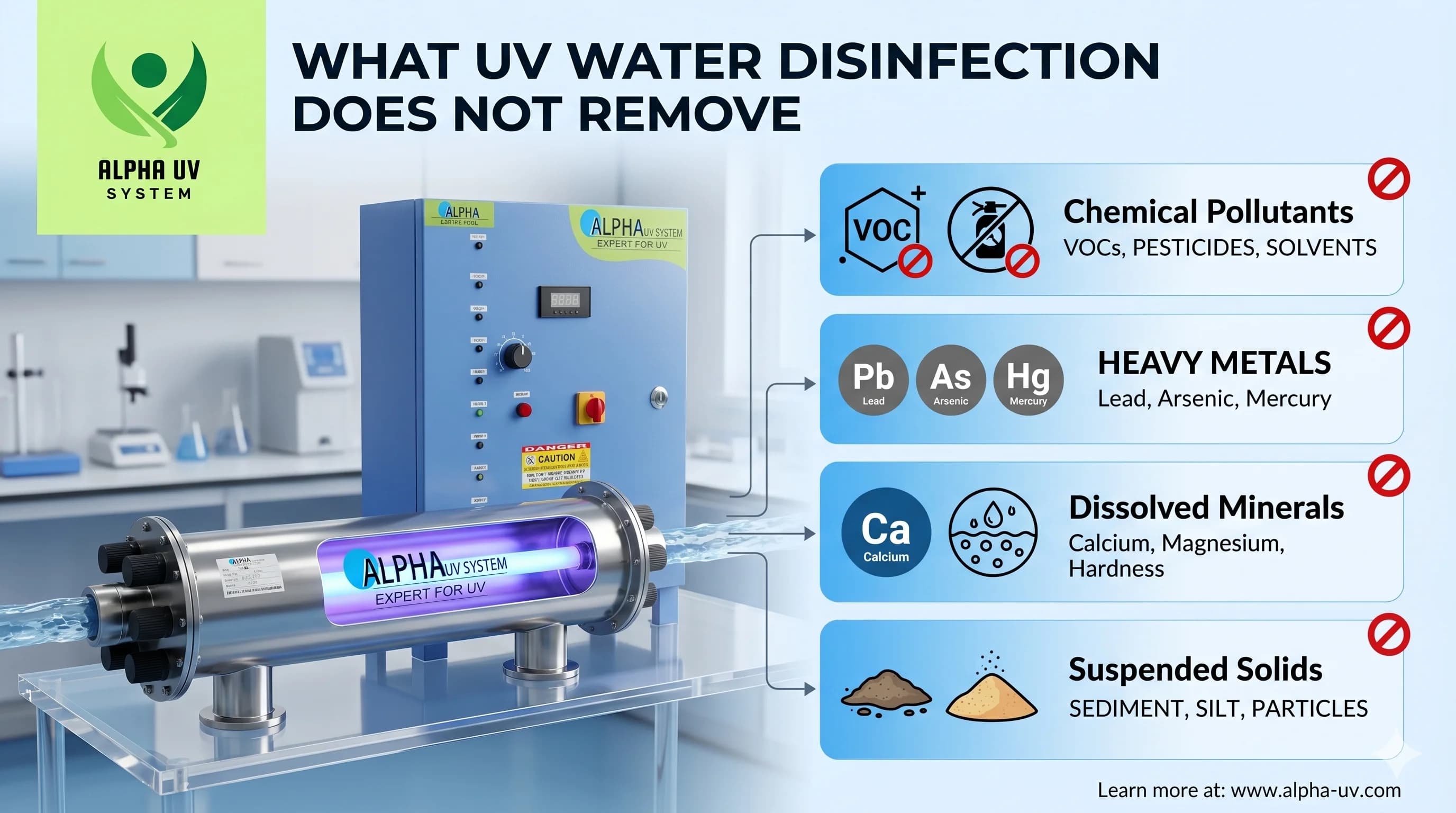
UV water disinfection does not remove any dissolved chemical, ion, metal, mineral, gas, or physical particle from water. It inactivates microorganisms — bacteria, viruses, and protozoa — by damaging their DNA with UV-C light. Arsenic, fluoride, nitrates, TDS, hardness, pesticides, pharmaceutical residues, microplastics, and dissolved gases such as hydrogen sulphide all pass through a UV reactor completely unchanged. If your water quality concern is chemical rather than microbiological, UV alone is the wrong primary technology.
What Is UV Water Disinfection?
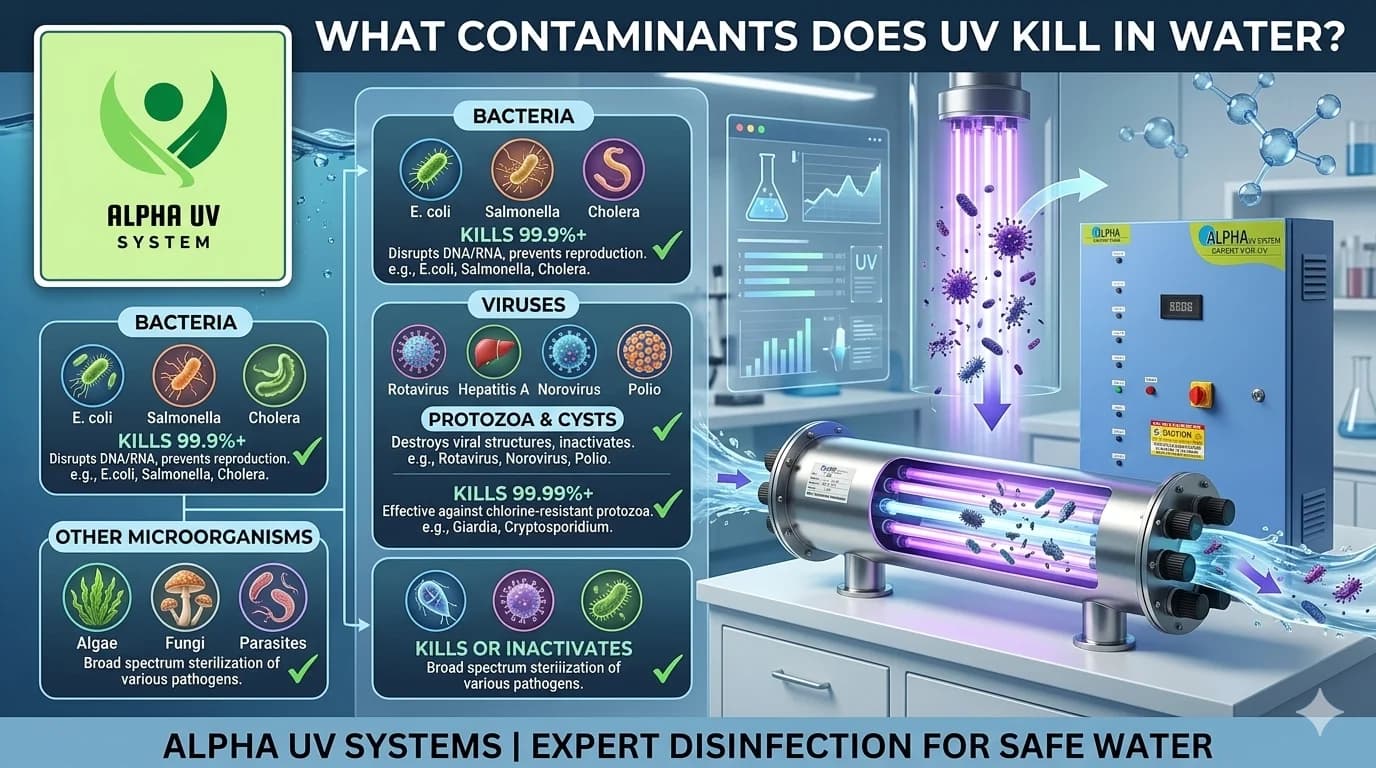
UV water disinfection is a physical treatment process in which water flows past a Philips UV-C lamp — typically emitting at 254 nm — housed inside a stainless-steel reactor chamber. The UV-C energy penetrates microbial cells and disrupts their DNA or RNA, rendering them unable to reproduce. At a validated dose of 40 mJ/cm², this process achieves more than 4-log (99.99%) inactivation of E. coli, 3-log (99.9%) inactivation of most viruses, and over 3-log inactivation of Cryptosporidium and Giardia — pathogens that are notoriously resistant to chlorine.
What UV does not do is equally important: it does not alter the chemical composition of water in any way. UV-C photons at germicidal doses carry enough energy to break microbial DNA bonds but nowhere near enough to break the ionic bonds that hold dissolved minerals, metals, and chemical contaminants in solution. This is the central limitation that every water treatment decision must account for, and it is the question — what does UV water disinfection not remove — that this article answers in full.
What UV Does NOT Remove — The Complete Picture
Dissolved Inorganic Chemicals and Ions
Dissolved inorganic contaminants are the most critical UV water purifier limitations in the Indian context. These are ions in true solution — they carry no biological activity, so UV-C has no mechanism to act on them. The following contaminants are found at unsafe concentrations across specific Indian geographies and require dedicated chemical or membrane treatment:
- Arsenic (As) — A Group 1 carcinogen. Groundwater arsenic above the BIS limit of 0.01 mg/L affects millions of people in West Bengal (particularly Murshidabad, Malda, North and South 24 Parganas), Bihar (Bhojpur, Buxar, Patna, Vaishali), and parts of eastern Uttar Pradesh. UV has zero effect on dissolved arsenic. Correct technology: coagulation-flocculation with ferric salts, iron-based adsorbents, activated alumina, or RO.
- Fluoride (F⁻) — Safe up to 1.0 mg/L (BIS). Concentrations of 3–20 mg/L cause dental and skeletal fluorosis. Rajasthan (Barmer, Jaisalmer, Nagaur), Gujarat (Mehsana, Patan, Gandhinagar), and Andhra Pradesh (Nalgonda, Prakasam) have endemic fluoride problems. UV cannot remove fluoride. Correct technology: activated alumina filters, defluoridation cartridges, or RO.
- Nitrates (NO₃⁻) — The WHO limit is 50 mg/L; BIS limit is 45 mg/L. Nitrate above these levels causes methaemoglobinaemia (blue baby syndrome) in infants. Agricultural borewells across Punjab (Ludhiana, Bathinda), Haryana (Hisar, Fatehabad, Karnal), and Rajasthan have chronic nitrate elevation from synthetic fertiliser leaching. UV has no effect on dissolved nitrates. Correct technology: RO (85–95% removal) or biological denitrification at large-scale plants.
- Nitrites (NO₂⁻) — Same category as nitrates; UV is ineffective.
- Lead (Pb) — Leaches from old lead solder joints and lead-lined pipes in heritage buildings in Delhi, Kolkata, and Mumbai. UV cannot remove dissolved lead ions. Correct technology: RO or KDF redox media.
- Mercury (Hg) — Present near chlor-alkali and paint manufacturing corridors. Requires RO or activated carbon.
- Chromium VI (Cr⁶⁺) — Hexavalent chromium is carcinogenic and found in groundwater near tanneries (Kanpur, Unnao) and electroplating clusters. UV has no effect. Correct technology: ion exchange or RO.
- Cadmium (Cd) — Near battery and pigment manufacturing. UV cannot remove cadmium. Requires RO.
- Total Dissolved Solids (TDS) — TDS is the sum of all dissolved mineral ions in water. Only RO membranes can reduce TDS — typically 90–96% rejection. UV has zero effect on TDS. This is one of the most misunderstood UV system limitations in India, where consumers sometimes believe that UV "purifies" water completely.
- Hardness (Ca²⁺, Mg²⁺) — Hard water above 300 mg/L CaCO₃ is common across Rajasthan, Gujarat, Haryana, and the Deccan Plateau. UV does not demineralise water. Correct technology: ion-exchange water softener or RO.
- Iron (dissolved Fe²⁺) — Dissolved ferrous iron in groundwater is widespread in Kerala (Palakkad, Thrissur), Assam, Chhattisgarh, and parts of Jharkhand. It stains laundry and gives water a metallic taste. UV cannot remove dissolved iron. Correct technology: aeration followed by iron removal filtration (greensand or birm media).
- Manganese (Mn) — Often co-occurs with iron. Causes black staining and neurological effects at high levels. Requires greensand filtration or oxidation followed by filtration. UV is ineffective.
- Sulfate (SO₄²⁻) — High sulfate causes laxative effects. Common in Rajasthan and coastal Andhra Pradesh. Requires RO.
- Chloride / Salinity — Coastal and brackish water in Tamil Nadu, Gujarat coast, Lakshadweep, and Kerala backwater areas have elevated chloride. UV cannot desalinate or demineralise water. Requires RO or electrodialysis.
Organic Chemical Contaminants
Organic chemicals represent a second major category of UV disinfection chemical removal gaps. India's growing agricultural chemical use, pharmaceutical manufacturing density, and industrial activity make these increasingly relevant in drinking water sources:
- Pesticides and herbicides (chlorpyrifos, endosulfan, atrazine, lindane, malathion) — Detected in groundwater across Punjab, Haryana, Maharashtra, and Andhra Pradesh. UV-C at germicidal doses does not degrade organochlorine or organophosphate pesticides. Correct technology: granular activated carbon (GAC) filtration or RO.
- Pharmaceutical residues (antibiotics, hormones, NSAIDs, antiparasitic drugs) — India's pharmaceutical manufacturing clusters around Hyderabad, Ahmedabad, Pune, and Baddi discharge API residues into waterbodies. UV cannot metabolise or chemically degrade dissolved pharmaceutical compounds at standard disinfection doses. Correct technology: activated carbon or advanced oxidation (UV/H₂O₂ at much higher doses — a different process category).
- Industrial solvents and VOCs (benzene, toluene, xylene, trichloroethylene) — Present near industrial estates in Delhi NCR, Pune-Nashik corridor, and Surat. UV disinfection does not volatilise or break down these compounds. Correct technology: activated carbon adsorption or air stripping.
- Polycyclic aromatic hydrocarbons (PAHs) — From coal tar, diesel, and combustion residues. Activated carbon required.
- Trihalomethanes (THMs) — Formed when chlorine in municipal water reacts with natural organic matter. Once formed, THMs pass unchanged through a UV reactor. Correct technology: activated carbon. Note: UV does not generate THMs, but it also cannot remove those already present.
- Haloacetic acids (HAAs) — Another chlorination disinfection by-product. Requires activated carbon.
- Cyanotoxins (microcystin-LR, anatoxin-a) — Released by cyanobacteria (blue-green algae) in eutrophied surface water reservoirs. UV at germicidal doses inactivates algal cells but does not destroy dissolved cyanotoxins already released into the water. Requires activated carbon or advanced oxidation.
- Endocrine-disrupting compounds (EDCs) — Bisphenol A, phthalates, nonylphenols. Requires activated carbon or RO membrane treatment.
Physical Contaminants
- Sediment and turbidity — UV cannot filter particles. More critically, turbidity above 1 NTU significantly reduces UV transmittance — suspended particles shield microorganisms from UV-C exposure and compromise disinfection efficacy. Sediment pre-filtration is not optional; it is a prerequisite for effective UV disinfection.
- Colour — Dissolved colour from humic and fulvic acids (common in surface-influenced water) absorbs UV-C radiation, dramatically reducing dose delivery. Requires coagulation, flocculation, and carbon filtration upstream of UV.
- Asbestos fibres — Present in water supplied through old asbestos-cement pipes. Requires membrane filtration (ultrafiltration or nanofiltration). UV is ineffective.
- Microplastics — UV-C at germicidal doses has no meaningful effect on plastic polymer particles in the 1–5,000 micron range. This is one of the clearest UV water treatment limitations for modern water quality. Correct technology: ultrafiltration (0.01–0.1 micron membrane). Standard 5-micron sediment filters remove larger microplastic fragments but not micro- and nano-scale particles.
Dissolved Gases
- Hydrogen sulphide (H₂S) — The rotten-egg sulphur smell in borewell water. UV-C can inactivate sulphate-reducing bacteria that produce H₂S, but it cannot remove the dissolved H₂S gas already present. Requires aeration before other treatment.
- Carbon dioxide (CO₂) — Passes through UV treatment unchanged. Aeration or degassing required if removal is needed.
- Free chlorine — At standard germicidal UV doses (40 mJ/cm²), free chlorine is not significantly photolysed. Removing residual chlorine taste requires activated carbon. Note: at very high UV doses used in advanced oxidation (500+ mJ/cm²), UV can decompose chlorine — but this is a different, energy-intensive process.
- Radon — A radioactive dissolved gas found in granite-bearing aquifers in parts of Rajasthan and Kerala. Requires aeration or activated carbon treatment. UV is ineffective.
Data Table 1: UV Limitations — What Is NOT Removed
| Contaminant | UV Effect | Correct Technology | Indian States / Sources Affected |
|---|---|---|---|
| Arsenic (As) | None | Ferric coagulation, activated alumina, RO | West Bengal, Bihar, eastern UP (groundwater) |
| Fluoride (F⁻) | None | Activated alumina, defluoridation cartridge, RO | Rajasthan, Gujarat, Andhra Pradesh (groundwater) |
| Nitrates (NO₃⁻) | None | RO (85–95% removal), biological denitrification | Punjab, Haryana, Rajasthan (agricultural borewells) |
| Lead (Pb) | None | RO, KDF media | Delhi, Kolkata, Mumbai (old plumbing) |
| Chromium VI (Cr⁶⁺) | None | Ion exchange, RO | Kanpur, Unnao (tannery clusters), electroplating zones |
| Cadmium (Cd) | None | RO | Battery / pigment manufacturing corridors |
| TDS (total dissolved solids) | None | RO (90–96% rejection) | All high-TDS areas: Rajasthan, Gujarat, coastal zones |
| Hardness (Ca²⁺, Mg²⁺) | None | Ion-exchange softener, RO | Rajasthan, Gujarat, Haryana, Deccan Plateau |
| Iron (dissolved Fe²⁺) | None | Aeration + iron removal filter | Kerala, Assam, Chhattisgarh, Jharkhand (groundwater) |
| Manganese (Mn) | None | Greensand filter, oxidation + filtration | Co-occurs with iron across central and eastern India |
| Sulfate (SO₄²⁻) | None | RO | Rajasthan, coastal Andhra Pradesh |
| Chloride / Salinity | None | RO, electrodialysis | Coastal Tamil Nadu, Gujarat coast, Kerala backwaters |
| Pesticides / herbicides | None at germicidal dose | GAC filtration, RO | Punjab, Haryana, Maharashtra, Andhra Pradesh (agri runoff) |
| Pharmaceutical residues | None at germicidal dose | Activated carbon, advanced oxidation | Hyderabad, Ahmedabad, Pune, Baddi pharma clusters |
| THMs (trihalomethanes) | None (pre-formed) | Activated carbon | Municipal water using chlorination — all major cities |
| Microplastics | None | Ultrafiltration (0.01–0.1 micron) | All urban and peri-urban supplies |
| Hydrogen sulphide (H₂S) | None (gas phase) | Aeration | Deep borewells across peninsular India |
| Radon | None | Aeration, activated carbon | Granite aquifers: Rajasthan, Kerala |
What UV DOES Remove Well
To be clear about the technology's genuine strengths: UV disinfection is highly effective, dose-efficient, and chemical-free for pathogen control. A properly sized Philips TUV UV reactor delivering 40 mJ/cm² achieves greater than 4-log (99.99%) inactivation of bacteria including E. coli, Salmonella typhi, Vibrio cholerae, and Shigella; 3–4 log inactivation of enteric viruses including Hepatitis A, Rotavirus, and Norovirus; and over 3-log inactivation of chlorine-resistant protozoan cysts including Cryptosporidium parvum and Giardia lamblia. UV outperforms chlorine for protozoa, adds no chemical residuals, and generates no disinfection by-products. For microbiological safety, UV is one of the best available technologies. The problem arises only when UV is used as a standalone solution for water sources whose primary quality concern is chemical — and this is exactly the UV vs RO comparison that Indian consumers need to understand clearly before purchasing.
Data Table 2: UV Efficacy vs Common Indian Water Pathogens
| Pathogen Type | UV Dose (mJ/cm²) | Log Reduction | Comment |
|---|---|---|---|
| E. coli (bacteria) | 6.6 | 4-log (99.99%) | Highly UV-sensitive; standard municipal indicator organism |
| Salmonella typhi (typhoid) | 10–15 | 4-log | Inactivated at low doses; UV highly effective |
| Vibrio cholerae (cholera) | 3–6 | 4-log | Very UV-sensitive; important in flood-affected areas |
| Rotavirus / Norovirus | 40 | 3–4 log | Requires higher dose than bacteria; BIS-10500 design point |
| Hepatitis A virus | 40 | 3-log | Clinically relevant in India; UV effective at 40 mJ/cm² |
| Cryptosporidium parvum | 10–12 | 3-log | Chlorine-resistant; UV is the preferred technology |
| Giardia lamblia | 10 | 3-log | Common in surface-water-influenced supplies across India |
How UV Fits in Multi-Barrier Treatment
The concept of multi-barrier treatment — endorsed by WHO, BIS, and the Central Public Health and Environmental Engineering Organisation (CPHEEO) — positions UV as the final disinfection barrier in a treatment train, not the only treatment. Understanding where UV belongs in the sequence is as important as understanding what does UV water disinfection not remove. UV always goes last: it disinfects water that has already been freed of turbidity, colour, iron, and other UV-absorbing or UV-shielding substances by upstream treatment. Placing UV before filtration means that particles and colour will absorb UV-C energy that should be reaching microorganisms, and disinfection will be incomplete regardless of lamp power.
Data Table 3: Treatment Combinations for Indian Water Sources
| Water Source | Primary Concern | Treatment Train | UV Role |
|---|---|---|---|
| Clear municipal piped water | Residual microbial risk, THMs | Carbon filter → UV | Final disinfection barrier |
| Municipal water with turbidity | Sediment, microbial | Sediment filter → carbon filter → UV | Final disinfection after pre-filtration |
| North Indian borewell (iron) | Iron, manganese, bacteria | Aeration → iron removal filter → sediment filter → UV | Final microbiological safety step |
| Fluoride-affected borewell (Rajasthan/Gujarat) | Fluoride, TDS, bacteria | Sediment → RO → UV | Post-RO disinfection to handle any permeate contamination |
| Arsenic-affected borewell (West Bengal/Bihar) | Arsenic, bacteria | Coagulation/adsorbent → sediment → UV | Final microbiological safety; arsenic handled upstream |
| Agricultural borewell (Punjab/Haryana) | Nitrates, pesticides, bacteria | Sediment → RO → UV | Post-RO disinfection; chemical removal by RO |
| Sulphur-smell deep borewell | H₂S gas, bacteria | Aeration → sediment filter → UV | Inactivates sulphate-reducing bacteria after gas removal |
| Industrial area supply | Heavy metals, VOCs, bacteria | Sediment → RO → activated carbon → UV | Final pathogen safety after chemical treatment |
Water Quality Testing — How to Know What Your Water Contains
The only reliable way to design the correct treatment system for any location is to test the water first. Generic product selection based on geography alone is insufficient because contamination profiles vary even within the same district. NABL-accredited laboratories offer water testing panels that cover the parameters most relevant to your source type. Basic microbiological panels (total coliform, E. coli, turbidity) start at approximately ₹500. Comprehensive chemical panels covering TDS, hardness, iron, manganese, fluoride, nitrate, arsenic, lead, and pesticide residues range from ₹1,500 to ₹2,000. For industrial or high-risk locations, extended panels including heavy metals, VOCs, and pharmaceutical residues cost ₹3,000–₹6,000. State water quality testing laboratories operated by public health engineering departments are often available at subsidised or no cost for domestic drinking water testing, particularly in fluoride- and arsenic-endemic districts.
Data Table 4: Water Testing Checklist by Region in India
| Region | Primary Source | Test Parameters | Typical Issues Found |
|---|---|---|---|
| West Bengal (Murshidabad, Malda, 24 Parganas) | Shallow tube well | Arsenic, iron, manganese, coliform, TDS | Arsenic 0.05–0.5 mg/L, high iron, bacteria |
| Bihar (Bhojpur, Buxar, Patna) | Shallow groundwater | Arsenic, iron, nitrate, coliform | Arsenic + iron co-contamination; seasonal bacteria |
| Rajasthan (Barmer, Nagaur, Jaisalmer) | Deep borewell | Fluoride, TDS, hardness, nitrate, coliform | Fluoride 3–12 mg/L, TDS 1,000–4,000 mg/L |
| Punjab / Haryana (Ludhiana, Hisar, Bathinda) | Agricultural borewell | Nitrate, pesticides, TDS, hardness, coliform | Nitrate 80–300 mg/L, pesticide residues |
| Delhi NCR | Municipal + piped Yamuna / groundwater | THMs, coliform, lead, TDS, turbidity | THMs from chlorination, lead from old plumbing |
| Kerala (Palakkad, Thrissur, Wayanad) | Dug well / borewell | Iron, manganese, coliform, pH, turbidity | High iron 2–8 mg/L, bacteria in dug wells |
| Gujarat (Mehsana, Patan, Saurashtra coast) | Borewell | Fluoride, TDS, chloride, hardness, coliform | Fluoride + high TDS + salinity (coastal) |
| Industrial corridors (Kanpur, Vapi, Tarapur) | Groundwater / piped | Chromium VI, lead, cadmium, VOCs, coliform | Heavy metal contamination from effluent discharge |
UV + RO: When to Use Both Together
The UV vs RO comparison India consumers most often encounter is framed as an either/or choice, but for many Indian water sources — particularly high-TDS borewells, fluoride zones, arsenic belts, and agricultural areas with chemical contamination — the correct answer is both technologies in sequence. RO membranes (reverse osmosis) achieve 90–96% TDS reduction, 95–99% fluoride rejection, 85–95% nitrate rejection, 95–99% arsenic rejection, and good removal of pesticides and heavy metals. However, RO membranes do not provide a sterility guarantee: the permeate side can be contaminated if there is a membrane integrity breach, a fitting leak, or post-RO biofilm growth in the storage tank. UV positioned after the RO membrane — and critically, after the pressurised storage tank before the final tap — eliminates this post-RO microbiological risk without adding any chemicals. The combination of RO for chemical reduction and UV for final disinfection is the treatment train recommended by the Alpha UV System engineering team for water sources where chemical contamination coexists with microbiological risk.
Data Table 5: UV vs RO — What Each Removes
| Contaminant Category | UV Removes? | RO Removes? | Comment |
|---|---|---|---|
| Bacteria (E. coli, typhoid) | Yes — 4-log+ inactivation | Partial — membrane rejection, not inactivation | UV is preferred for final microbiological barrier |
| Viruses (Hepatitis A, Rota) | Yes — 3–4 log at 40 mJ/cm² | Partial — NF membranes better than standard RO | UV more reliable for viral inactivation |
| Cryptosporidium / Giardia | Yes — 3-log at 10–12 mJ/cm² | Yes — physical rejection by RO membrane | Both effective; UV advantageous as it leaves no residual |
| TDS / dissolved minerals | No | Yes — 90–96% rejection | Only RO lowers TDS |
| Arsenic | No | Yes — 95–99% rejection | UV has no effect; RO is the membrane solution |
| Fluoride | No | Yes — 95–97% rejection | RO required in fluoride-endemic areas |
| Nitrates | No | Yes — 85–95% rejection | RO essential for Punjab/Haryana agricultural borewells |
| Lead / heavy metals | No | Yes — 95–99% rejection | RO required for metal-contaminated supplies |
| Pesticides / herbicides | No at germicidal dose | Yes — good rejection of most organics | Activated carbon post-RO adds additional safety |
| Microplastics | No | Yes — RO membrane rejects all particles | UF also effective; RO removes with TDS simultaneously |
| Hardness (Ca²⁺, Mg²⁺) | No | Yes — ions rejected by RO membrane | RO effectively softens water as a secondary benefit |
| Chlorine / THMs | No at standard dose | Partial — THMs partially rejected | Activated carbon most effective for chlorine / THM removal |
Common Mistakes When Relying on UV Alone
Understanding what does UV water disinfection not remove is important in theory, but recognising these mistakes in real Indian water treatment scenarios is what prevents health risks:
- Installing UV on a fluoride borewell in Rajasthan or Gujarat without RO: Families in Barmer, Nagaur, and Mehsana districts have borewell water with fluoride at 5–12 mg/L. Installing a UV purifier kills bacteria but delivers every milligram of fluoride directly to the glass. Dental fluorosis in children and skeletal fluorosis in adults develop over years. UV alone is completely inadequate here.
- Using UV as the sole treatment on arsenic-contaminated tube well water in West Bengal or Bihar: UV provides microbiological safety but allows arsenic concentrations of 0.05–0.5 mg/L to reach the consumer unchanged. Long-term arsenic exposure causes skin lesions, neuropathy, and multiple organ cancers. This is the most dangerous misapplication of UV in India's contaminated groundwater belt.
- Relying on UV for post-monsoon borewell water without a sediment pre-filter: Monsoon infiltration increases turbidity, introducing clay particles, iron colloids, and organic matter that absorb UV-C energy. Without a sediment pre-filter, UV dose delivery can drop below the 40 mJ/cm² threshold even with a functioning lamp, resulting in under-disinfected water that tests positive for coliform despite the UV system being switched on.
- Assuming UV removes the sulphur smell from deep borewells: H₂S is a dissolved gas with no biological component that UV can target. The UV system inactivates the sulphate-reducing bacteria that produced the H₂S, but the gas remains dissolved and reaches the consumer. Aeration must precede UV in any H₂S borewell treatment setup.
- Believing that UV "purifies" high-TDS water in agricultural areas of Punjab or Haryana: TDS of 1,000–2,500 mg/L from borewell water in Hisar, Fatehabad, or Bathinda is a chemical problem. UV delivers pathogen-safe water at 2,000 mg/L TDS — it does not reduce conductivity, hardness, nitrates, or salinity by even 1 mg/L. Long-term consumption of high-TDS water carries kidney and cardiovascular implications that UV cannot address.
- Installing UV without testing for pharmaceutical or pesticide contamination in peri-urban areas: Cities like Hyderabad, Pune, and Ludhiana have peri-urban groundwater affected by pharmaceutical API discharge and agricultural chemical runoff respectively. A UV system provides no protection against these contaminants. Activated carbon or RO must be incorporated into the treatment design before UV is placed as the final step.
Frequently Asked Questions
Does UV remove arsenic?
No. UV water disinfection does not remove arsenic in any form. Arsenic exists as dissolved arsenite (As³⁺) and arsenate (As⁵⁺) ions in groundwater — UV-C photons at germicidal wavelengths carry insufficient energy to alter the ionic state of dissolved arsenic. The water flowing through a UV reactor exits with the same arsenic concentration it entered with. Arsenic is a particular concern in West Bengal (Murshidabad, Malda, North and South 24 Parganas), Bihar (Bhojpur, Buxar, Patna, Vaishali), and pockets of eastern Uttar Pradesh, where groundwater arsenic regularly exceeds the BIS limit of 0.01 mg/L. For arsenic removal, the appropriate technologies are coagulation-flocculation with ferric chloride or alum followed by filtration, iron-based adsorbent media (such as GFH — granular ferric hydroxide), activated alumina, or RO membranes achieving 95–99% arsenic rejection. UV should be used as a final disinfection step after arsenic removal, not as a substitute for it.
Does UV remove fluoride?
No. Fluoride ions (F⁻) are among the simplest dissolved ions in water — a single-atom anion with no biological structure that UV can target. UV-C radiation does not affect dissolved fluoride concentration at any germicidal dose. Fluoride contamination above the BIS limit of 1.0 mg/L is endemic in Rajasthan (Barmer, Jaisalmer, Nagaur, Churu), Gujarat (Mehsana, Patan, Sabarkantha), Andhra Pradesh (Nalgonda, Prakasam, Guntur), and Telangana. Concentrations of 3–20 mg/L cause dental fluorosis in children and crippling skeletal fluorosis in adults. The proven technologies for fluoride removal are activated alumina (60–90% removal), Nalgonda technique (coagulation with alum — widely used at village level in AP/Telangana), defluoridation cartridges, and RO membranes (95–97% fluoride rejection). Any household or community in a fluoride-endemic area that installs a UV system without RO or activated alumina is drinking fluoride-contaminated water that is merely bacteria-free.
Does UV remove nitrates?
No. Nitrate (NO₃⁻) is a dissolved ionic compound. UV-C at 254 nm does not photolyse or alter nitrate ions at standard disinfection doses. Nitrate above 45 mg/L (BIS) causes methaemoglobinaemia — a condition where haemoglobin is converted to methaemoglobin and cannot carry oxygen — which is fatal in infants under six months (blue baby syndrome). Agricultural borewells across Punjab (Ludhiana, Bathinda, Moga), Haryana (Hisar, Fatehabad, Karnal), and parts of Rajasthan routinely show nitrate concentrations of 80–400 mg/L from decades of synthetic nitrogenous fertiliser use. UV addresses the microbiological aspect of borewell water in these areas but does nothing about nitrates. The correct technology for nitrate removal is RO, which achieves 85–95% rejection. For large-scale community water treatment, biological denitrification or ion exchange is used. Any household UV system in a high-nitrate borewell area must be combined with RO for safe drinking water.
Does UV remove TDS?
No. TDS — total dissolved solids — is the aggregate measure of all dissolved mineral ions, salts, metals, and other inorganic compounds in water, expressed in mg/L. UV-C photons have no ability to remove, precipitate, or alter the ionic concentration of water. A UV system does not change the TDS reading by a single mg/L. TDS above 500 mg/L (BIS acceptable limit) or 1,000 mg/L (BIS permissible limit) affects taste, can contribute to kidney stone formation with long-term consumption, and may indicate the presence of specific ions (fluoride, nitrate, chloride, sulfate) that are harmful at elevated concentrations. High-TDS water is common across Rajasthan, Gujarat, coastal areas, and agricultural zones with heavy irrigation. Only reverse osmosis — which forces water through a semi-permeable membrane under pressure — achieves the 90–96% TDS reduction needed to bring high-TDS borewell water within safe drinking limits. This is the clearest and most important UV water treatment limitation for Indian consumers to understand: UV is not a TDS-reducing technology.
Does UV remove microplastics?
No. Microplastics are physical particles of plastic polymer — polyethylene, polypropylene, PET, polystyrene — ranging from 1 micron to 5 millimetres in size. UV-C radiation at germicidal doses (40–100 mJ/cm²) cannot degrade or alter plastic polymer chains. The microplastic particles enter the UV reactor and exit it unchanged. Microplastics have been detected in municipal piped water in Delhi, Mumbai, Chennai, and Bangalore, as well as in packaged water. The appropriate technology for microplastic removal is ultrafiltration (UF membrane, 0.01–0.1 micron pore size), which physically rejects particles above its pore rating. Standard 5-micron sediment pre-filters used ahead of UV systems remove larger microplastic fragments (5+ microns) but do not address the smaller micro- and nano-scale particles now being detected in source water. RO membranes also reject all microplastics as a physical rejection mechanism. If microplastic removal is a priority, incorporate UF or RO — UV alone provides no benefit for this contaminant.
My water smells of sulphur — will UV fix this?
No, and understanding why is important for correct borewell treatment design. The rotten-egg sulphur smell in deep borewell water is caused by dissolved hydrogen sulphide (H₂S) — a gas produced by sulphate-reducing bacteria (SRB) metabolising sulphate minerals in the anaerobic aquifer environment. A UV system will inactivate the sulphate-reducing bacteria present in the water as it flows through the reactor — so UV does address part of the problem. However, the H₂S gas that the bacteria have already produced and dissolved into the groundwater remains dissolved and exits the UV reactor unchanged. The sulphur smell will persist. The correct treatment sequence for sulphur-smell borewell water is: aeration first (cascade aerator or spray nozzle, 10–15 minutes contact with air strips dissolved H₂S from the water) → sediment filtration (to capture iron and manganese oxidised during aeration) → UV disinfection (final microbiological safety step against SRB and other pathogens). Skipping aeration and installing only UV results in odourless water immediately after the reactor but persistent H₂S in the storage tank. This is one of the most commonly misunderstood UV system limitations India borewell users encounter.
Not sure whether UV alone is sufficient for your water quality, or whether you need RO, iron removal, defluoridation, or aeration upstream? WhatsApp the Alpha UV System engineering team with your water test report or location details — we will specify the complete treatment train you actually need, not just a UV system.
Standards, authorities & further reading
External references used to inform this guide. Regulations evolve — check the latest revision on each authority's site before compliance decisions.
Recommended UV Systems
Alpha UV System products for this application — powered by genuine Philips UV-C lamps.
UV System for Drinking Water
100 – 50,000 LPH
Chemical-free UV drinking water disinfection — from homes to municipalities
Residential UV Disinfection System
100 – 500 LPH
Safe drinking water for homes and villas — no chemicals, no taste change
Not sure which system suits your application? WhatsApp our engineers for a free recommendation →
Related solutions
See how Alpha UV System applies this to your industry or city.
Need a UV system?
Talk to our UV engineers — WhatsApp for a quote in 2 hours, or browse the full catalog on IndiaMART.