Quick Answer
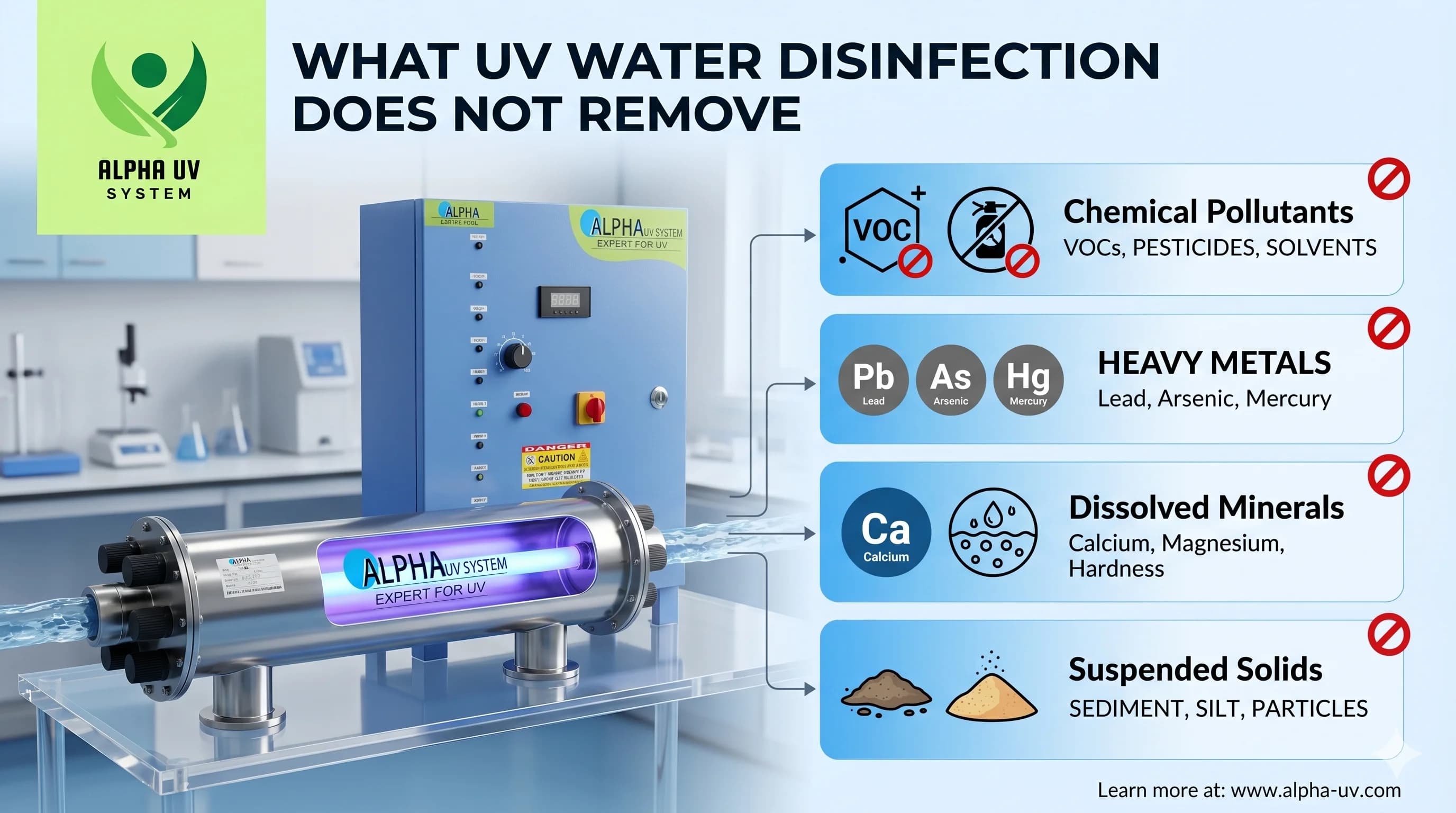
No — UV water systems do not remove chemicals from water. UV disinfection is biological treatment only: it inactivates bacteria, viruses, and protozoa by damaging their DNA with UV-C light at 254 nm. It has no effect whatsoever on dissolved inorganic chemicals (arsenic, fluoride, nitrates, lead), organic chemicals (pesticides, pharmaceuticals), TDS, hardness, sediment, or dissolved gases. If your water has a chemical contamination problem, you need filtration, reverse osmosis, activated carbon, or ion exchange — combined with UV for complete protection.
UV Is Biological Treatment Only — Not a Chemical Filter
The question of whether do UV water systems remove chemicals from water is one of the most important questions Indian households can ask before investing in a water purifier. The answer is unambiguous: they do not. Understanding exactly why requires a brief look at how UV disinfection actually works.
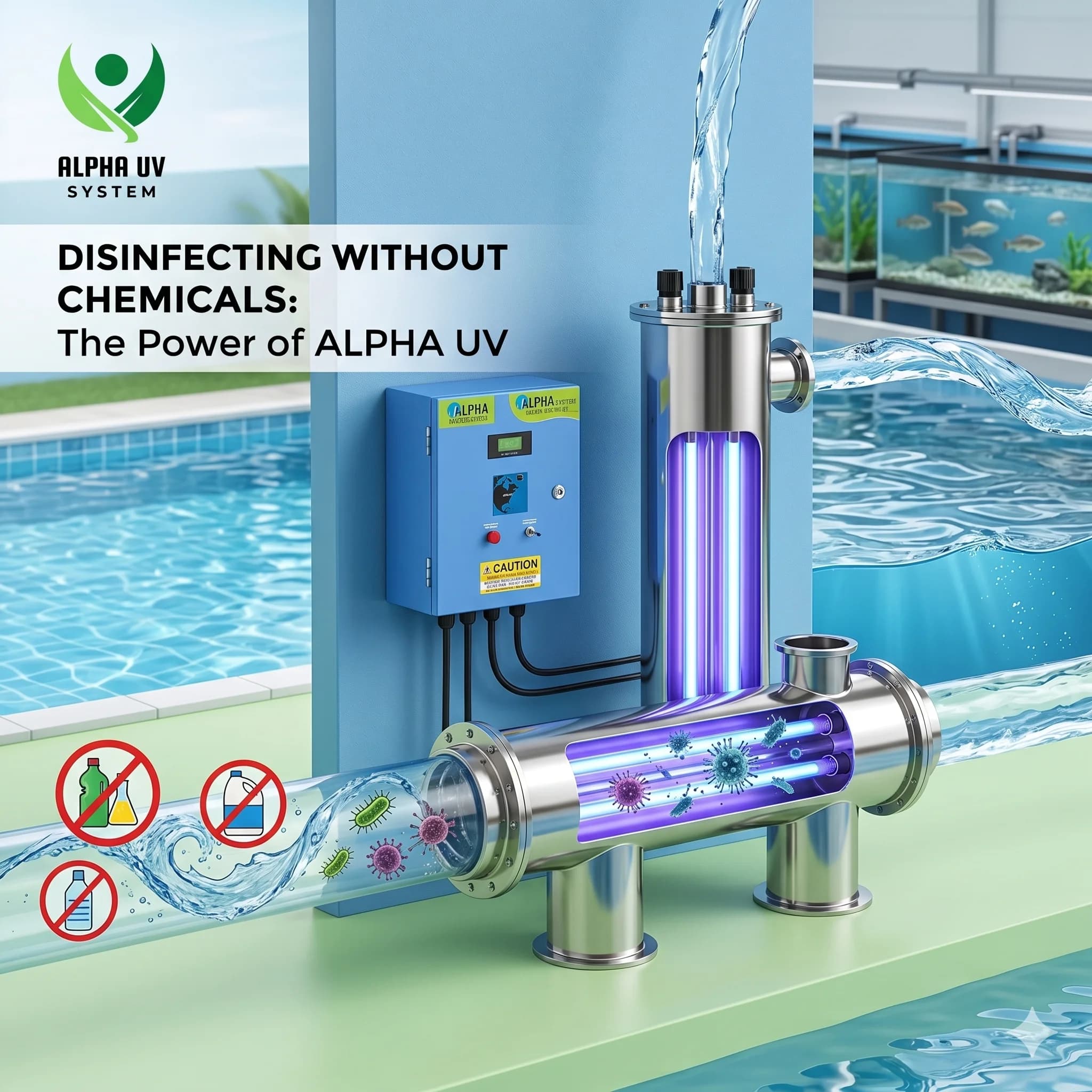
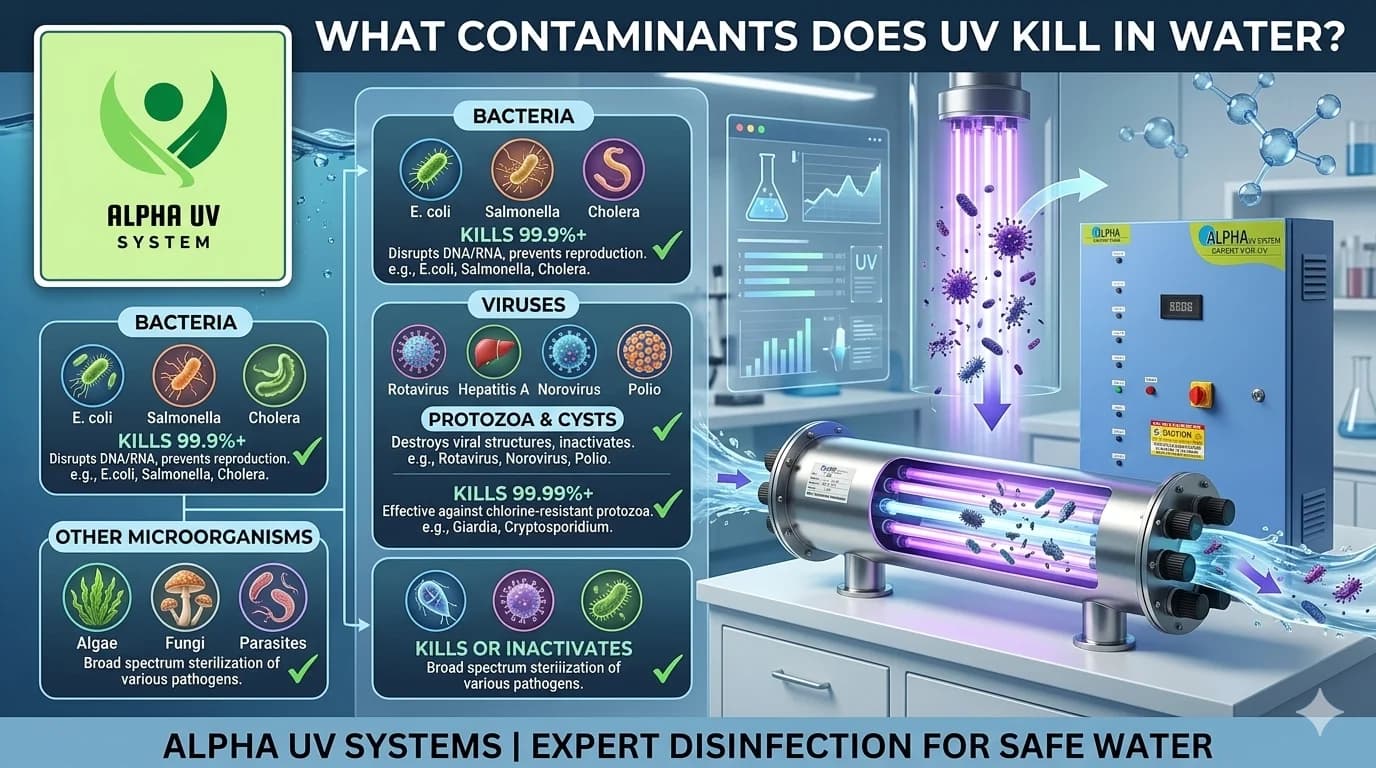
A UV water purifier passes water through a stainless steel chamber containing a Philips UV-C lamp emitting light at 254 nm — the wavelength at which DNA and RNA absorb UV energy most efficiently. When a pathogen (bacterium, virus, or protozoan cyst) passes through this chamber, the UV-C photons are absorbed by the organism's nucleic acids, breaking apart the thymine dimers that make up its genetic code. The organism can no longer replicate and is rendered harmless. This process is entirely photochemical, acting only on biological molecules.
Dissolved chemicals — arsenic ions, fluoride ions, nitrate molecules, pesticide residues, pharmaceutical compounds, hardness minerals — do not have nucleic acids. They are not living organisms. UV-C light at germicidal doses passes through them without reaction. The water coming out of a UV chamber has exactly the same chemical composition as the water going in. The only thing that has changed is the microbiological safety of that water.
This is not a design flaw. Do UV water systems remove chemicals from water? No — and they are not designed to. UV is optimised for one specific, critical job: pathogen inactivation. For chemical contaminants, separate and appropriate treatment technologies are required. The correct approach for most Indian water sources is a treatment train that combines multiple technologies, with UV as the final biological barrier before consumption.
Complete List: What UV Does NOT Remove from Water
When homeowners ask what UV cannot remove from water, the list covers virtually every non-biological contaminant category. This is a UV water treatment limitation related to chemicals that every buyer must understand before selecting a purification system.
Dissolved Inorganic Chemicals
Dissolved inorganic chemicals represent some of the most serious health threats in Indian groundwater. UV disinfection arsenic fluoride removal is simply not possible — these are ionic species dissolved in water at the molecular level, completely unaffected by UV-C photons at germicidal doses. Arsenic contamination is documented in parts of West Bengal, Bihar, Jharkhand, and eastern Uttar Pradesh, where groundwater drawn from alluvial aquifers can contain arsenic levels 10–50 times the BIS IS 10500 limit of 0.01 mg/L. Fluoride exceeding the 1.5 mg/L BIS limit is endemic across Rajasthan, Gujarat, Andhra Pradesh, and Telangana. Nitrates from agricultural inputs plague borewell water in Punjab, Haryana, and Madhya Pradesh. None of these are addressed by UV water purifier chemical removal — because UV has no chemical removal capability at all.
Organic Chemical Contaminants
Pesticides, herbicides, and pharmaceutical residues are a growing concern in Indian water sources, particularly near agricultural zones in Punjab and Haryana (endosulfan, chlorpyrifos, atrazine) and near industrial corridors in Kanpur, Vapi, and Pune (solvents, dyes, industrial chemicals). Trihalomethanes (THMs) form in chlorinated municipal water as disinfection byproducts. Volatile organic compounds (VOCs) enter groundwater from fuel spills and industrial leakage. UV at standard germicidal doses does not degrade any of these compounds. UV vs RO chemical removal is a fair comparison for organic chemicals — RO removes many organics by size exclusion, while UV removes none.
Physical Contaminants
Sediment, turbidity, suspended particulates, and microplastics are physical contaminants that UV cannot remove. In fact, sediment and turbidity actively interfere with UV disinfection by shielding microorganisms from UV exposure — this is why a sediment pre-filter is always required before a UV unit. Colour from iron, manganese, or tannins passes through UV unchanged.
Dissolved Gases
Hydrogen sulphide (H2S), which gives borewell water in some Kerala and Rajasthan locations its characteristic rotten-egg smell, is not removed by UV. Dissolved chlorine and chloramines from municipal treatment are not decomposed by UV at standard germicidal doses — a carbon block filter is needed for chlorine removal.
Table 1: What UV Does NOT Remove — Complete List for Indian Homes
| Contaminant | UV Effect | Health Concern | Indian States Affected | Correct Removal Technology |
|---|---|---|---|---|
| Arsenic | None | Cancer, neuropathy, skin lesions | West Bengal, Bihar, UP, Jharkhand | Iron-based adsorbent media, RO, coagulation |
| Fluoride | None | Dental/skeletal fluorosis | Rajasthan, Gujarat, AP, Telangana | Activated alumina, RO, Nalgonda technique |
| Nitrates | None | Methaemoglobinaemia (blue baby), thyroid | Punjab, Haryana, MP, Rajasthan | RO, anion exchange |
| Lead | None | Neurotoxicity, developmental harm | Old pipe networks, industrial zones | RO, NSF-certified carbon block |
| Iron (dissolved) | None on ferrous/ferric ions | Staining, taste, liver stress at high levels | UP, Bihar, West Bengal, Kerala borewell | Iron removal filter (greensand/birm), aeration |
| Manganese | None | Neurological effects, black staining | West Bengal, Bihar, North India borewell | Manganese greensand, oxidation + filtration |
| TDS / Hardness | None | Scaling, taste, kidney stress at extreme levels | Rajasthan, Gujarat, Delhi NCR borewell | RO, water softener (for hardness) |
| Sulfate | None | Diarrhoea at high concentrations | Rajasthan, semi-arid borewell | RO, anion exchange |
| Pesticides / Herbicides | None at germicidal doses | Endocrine disruption, carcinogenicity | Punjab, Haryana, AP, cotton-growing regions | Activated carbon (GAC/block), RO |
| Pharmaceutical residues | None at germicidal doses | Antibiotic resistance, hormonal disruption | Urban water supplies, hospital zones | Activated carbon, UV/H₂O₂ AOP (industrial) |
| THMs (trihalomethanes) | None | Carcinogenicity (chloroform, bromoform) | Chlorinated municipal supplies, all cities | Activated carbon block filter |
| VOCs (solvents, fuels) | None | Liver and kidney damage, CNS effects | Kanpur, Vapi, Pune industrial corridors | Activated carbon, air stripping |
| Sediment / Turbidity | None — interferes with UV | Pathogen shielding; reduces UV efficacy | All borewell, surface-water-fed supplies | Sediment filter (must precede UV) |
| Microplastics | None | Inflammation, hormone disruption (emerging) | Urban supplies, all India | 0.1-micron UF membrane, RO |
| Chlorine / Chloramines | None at germicidal doses | Taste, odour; DBP formation | Chlorinated municipal supplies, all cities | Activated carbon block filter |
What UV Water Systems DO Remove — Pathogen Performance
The picture changes completely when we move from chemical to biological contaminants. This is where UV water systems deliver results that no chemical disinfectant can match at the point of use — without adding any chemicals to water, without altering water chemistry, and without creating disinfection byproducts.
At a validated dose of 40 mJ/cm² (the USEPA, NSF, and WHO standard for potable water disinfection), a Philips TUV lamp-equipped UV system achieves 4-log (99.99%) reduction of bacteria and viruses, and 3-log (99.9%) reduction of Cryptosporidium parvum — the protozoan cyst most resistant to chlorine disinfection. This is the single greatest advantage of UV over chemical disinfection: Cryptosporidium, which causes life-threatening diarrhoea in immunocompromised patients, is effectively killed by UV at doses that standard germicidal systems routinely deliver, while chlorine at drinking-water concentrations has almost no effect on Cryptosporidium cysts.
Table 2: What UV Water Systems DO Remove — Pathogen Kill Performance
| Pathogen | UV Dose for 4-log (mJ/cm²) | Log Reduction at 40 mJ/cm² | Disease Caused | Indian Prevalence |
|---|---|---|---|---|
| E. coli | 6.6 mJ/cm² | >6-log | Gastroenteritis, HUS | Extremely high — leading waterborne pathogen |
| Vibrio cholerae | ~6.5 mJ/cm² | >6-log | Cholera | Endemic in Bihar, West Bengal, Odisha |
| Salmonella typhi | ~7 mJ/cm² | >5-log | Typhoid fever | Very high, all India |
| Shigella spp. | ~6 mJ/cm² | >6-log | Bacillary dysentery | High in North India |
| Hepatitis A virus | 21 mJ/cm² | 4-log | Hepatitis A (liver disease) | High in endemic zones |
| Rotavirus | 36 mJ/cm² | 4-log | Severe childhood diarrhoea | Leading cause of infant death, India |
| Cryptosporidium parvum | 3–10 mJ/cm² | >3-log | Cryptosporidiosis (chronic in immunocomp.) | Chlorine-resistant; UV essential |
| Giardia lamblia | 5–11 mJ/cm² | >3-log | Giardiasis (chronic diarrhoea, malabsorption) | Very common in children, India |
Understanding Indian Water Quality by Source Type
To understand how do UV water systems remove chemicals from water — or rather, why they do not — it helps to look at the actual contamination profiles of different Indian water sources. The picture is rarely one-dimensional: most sources carry both biological and chemical risk, requiring a multi-barrier treatment approach.
Municipal water in cities like Delhi NCR is chlorinated before distribution, which handles much of the biological load. But distribution pipe contamination and storage tank re-contamination reintroduce microorganisms into water that was chemically acceptable at the treatment plant. The chemical risk in municipal water is usually lower — but THMs from chlorination and lead from old pipes can be concerns. UV alone handles the microbial re-contamination effectively.
Borewell water in UP, Bihar, and West Bengal presents a more complex challenge. These aquifers can contain elevated iron, manganese, arsenic (in the Ganga alluvial plain), and high microbial loads from agricultural runoff and open defecation. UV addresses the biological risk; it does nothing for the chemical burden. In these locations, asking whether do UV water systems remove chemicals from water is exactly the right question — and the answer means that UV must be combined with targeted chemical treatment.
Borewell water in Rajasthan is characterised by very high TDS (often 1,000–3,000 mg/L), elevated fluoride (1.5–8 mg/L in many blocks), sulfate, and hardness. UV purifier chemical removal limitations are especially stark here: every chemical concern demands RO, not UV. UV's role in a Rajasthan water treatment train is as the final biological polish after RO permeate.
Table 3: Indian Water Source Contamination Profile
| Water Source | Typical Contaminants | UV Addresses? | Additional Treatment Needed |
|---|---|---|---|
| Delhi NCR municipal supply | E. coli re-contamination, chlorine, THMs, lead (old pipes) | Biological risk: Yes. Chemicals: No | Carbon block (chlorine/THMs); sediment filter pre-UV |
| UP borewell (Ganga plain) | Iron, manganese, arsenic (some zones), E. coli, nitrates | E. coli / pathogens: Yes. Iron/arsenic/nitrates: No | Iron removal filter + arsenic test; RO if arsenic detected |
| Rajasthan borewell | High TDS, fluoride, sulfate, hardness, bacteria | Bacteria: Yes. TDS/fluoride/hardness: No | RO (primary); UV post-RO for biological safety |
| Punjab agricultural borewell | Nitrates, pesticide residues, bacteria, uranium (some districts) | Bacteria: Yes. Nitrates/pesticides/uranium: No | RO + activated carbon; UV for biological polish |
| Kerala borewell | High iron, manganese, H2S, bacteria, low TDS | Bacteria: Yes. Iron/manganese/H2S: No | Iron/manganese removal + aeration (H2S); sediment + UV |
| Industrial area supply (Kanpur, Vapi, Pune) | Heavy metals, VOCs, dyes, industrial chemicals, bacteria | Bacteria: Yes. All industrial chemicals: No | Activated carbon + RO + UV; NABL water test mandatory first |
How to Know What Your Water Actually Contains
The single most important step before selecting any water treatment system — UV, RO, or otherwise — is having your water tested by a certified laboratory. In India, NABL-accredited (National Accreditation Board for Testing and Calibration Laboratories) water testing labs provide credible, legally valid water quality reports. These tests typically cost between Rs. 500 and Rs. 2,000 depending on the parameter panel, and the results take 3–7 working days.
A basic potability test (as per BIS IS 10500:2012) covers pH, TDS, total hardness, total coliform, E. coli, turbidity, chloride, sulfate, nitrate, iron, and fluoride — sufficient to understand whether your primary risk is biological (UV solves this), chemical (needs RO or filtration), or both. For arsenic, a specific arsenic test is needed; for pesticides, a pesticide residue panel adds to the cost but is essential in Punjab, Haryana, and agricultural regions of AP and Telangana.
State government labs also offer subsidised testing in some states — the Kerala Water Authority, UP Jal Nigam, and Rajasthan PHED all operate public testing facilities with low-cost or free testing for rural households. Contact your local municipal office or gram panchayat for referrals.
Do not select a treatment technology based on geography alone. Two boreholes 200 metres apart in the same village can have significantly different water chemistry. The cost of an NABL water test is small compared to the cost of a treatment system that does not solve your actual problem.
Treatment Combinations: UV + Other Technologies
Since UV water treatment limitations chemicals are clear — UV addresses none — the correct design question is what combination of technologies addresses your specific water quality profile. Here are the common treatment trains for Indian homes and institutions.
Sediment Filter + UV (Most Common for Indian Homes)
A 5-micron or 10-micron sediment filter removes sand, silt, rust flakes, and suspended particulates before water enters the UV chamber. Without pre-filtration, turbidity shields microorganisms from UV exposure and allows them to pass through alive. This combination is appropriate for municipal water supplies with acceptable chemical quality but microbiological risk from distribution network contamination and storage tank recontamination. It is the most widely deployed configuration for Delhi NCR, Bengaluru, Mumbai, and Chennai urban households on municipal supply.
Carbon Block Filter + UV (Chlorine Removal + Pathogen Kill)
A carbon block filter ahead of UV removes chlorine, chloramines, THMs, VOCs, and taste/odour compounds from chlorinated municipal water, while UV provides the downstream biological safety net. This combination is ideal for municipal chlorinated supplies where both chemical taste concerns and pathogen risk (post-distribution contamination) are present. Note that activated carbon used without UV can itself become a colonisation site for bacteria — UV downstream prevents any microbiological risk from the carbon media.
Iron Removal Filter + UV (North India Borewell)
Dissolved iron above 0.3 mg/L (BIS limit) must be removed before the UV unit for two reasons: iron stains and fouls the UV quartz sleeve (reducing UV transmittance and disinfection effectiveness), and iron-oxidising bacteria colonise water with high iron content. An iron removal filter using greensand, birm, or manganese-dioxide-coated media oxidises and precipitates dissolved iron before the water reaches UV. This combination is the most common treatment train for borewell water in North India (UP, Bihar, Delhi NCR borewells, West Bengal). In Kerala's high-iron coastal boreholes, this is also the standard configuration, often with an aeration step to volatilise H2S before iron removal.
RO + UV (Complete System for High TDS / Chemicals)
Reverse osmosis removes TDS, heavy metals (arsenic, lead, fluoride), nitrates, most pesticides, and hardness by forcing water under pressure through a semi-permeable membrane with pores of approximately 0.0001 microns. RO also removes microorganisms by size exclusion — but this exclusion is imperfect. Any pinhole in the RO membrane, worn O-ring, or bypass leak can allow unsterilised water to contaminate the treated permeate. UV downstream of RO provides the biological safety guarantee that RO alone cannot certifiably deliver. This RO + UV combination is the correct system for Rajasthan and Gujarat high-TDS borewell water, Punjab agricultural borewell water with nitrates and pesticides, pharmaceutical purified water (PW) systems, and food-grade process water applications. It is also specified for hospital drinking water and institutional food service where both chemical safety and certified pathogen removal are required.
Table 4: Treatment Combination Guide by Indian Water Source
| Water Source | Primary Chemical Concern | Primary Biological Concern | Recommended Treatment Train | UV Role |
|---|---|---|---|---|
| Delhi NCR municipal | Chlorine, THMs | E. coli, coliform (post-distribution) | Sediment → Carbon block → UV | Primary disinfection |
| UP / Bihar borewell (low arsenic zone) | Iron, manganese | E. coli, coliform, iron bacteria | Iron removal → Sediment → UV | Primary disinfection |
| West Bengal / Bihar (arsenic zone) | Arsenic, iron, manganese | E. coli, cholera (Bihar) | Iron/arsenic removal → Sediment → UV (or RO → UV) | Final biological safety barrier |
| Rajasthan / Gujarat borewell | Fluoride, TDS, sulfate | Bacteria | Sediment → RO → UV | Post-RO biological polish |
| Punjab / Haryana agricultural borewell | Nitrates, pesticides | E. coli, coliform | Sediment → Carbon → RO → UV | Post-RO biological polish |
| Kerala borewell | Iron, manganese, H2S | Bacteria | Aeration → Iron removal → Sediment → UV | Primary disinfection |
| Industrial corridor (Kanpur, Vapi, Pune) | VOCs, heavy metals, dyes | Bacteria, industrial microorganisms | Carbon → RO → UV (NABL test first) | Final biological safety barrier |
| Pharmaceutical / food process water | All chemical traces (GMP requirement) | All pathogens (sterility risk) | Sediment → Carbon → RO → UV → 0.2μm final filter | Mandatory GMP biological step |
UV vs RO: Not Competitors — Complementary Technologies
The UV vs RO chemical removal comparison comes up often in the Indian water purifier market, frequently framed as a choice between the two. This framing is incorrect. UV and RO solve completely different problems. Asking whether UV or RO is better is like asking whether a surgeon or an oncologist is better — the answer is that you need the one who treats your specific condition, and sometimes you need both.
UV removes biological contaminants with unmatched efficiency, no chemical addition, and no wastewater generation. RO removes chemical contaminants (TDS, heavy metals, nitrates, fluoride), microplastics, and also most microorganisms by size exclusion. The gap in RO coverage — membrane bypass biological risk, and the fact that RO does not inactivate organisms, merely retains them until a membrane breach — is precisely where UV downstream of RO adds non-negotiable safety.
Table 5: UV vs RO — What Each Removes
| Contaminant Type | UV Removes? | RO Removes? | Combined UV+RO? |
|---|---|---|---|
| Bacteria (E. coli, Salmonella) | Yes — 4-log+ inactivation | Mostly — size exclusion, not inactivation | Yes — complete, certified |
| Viruses (Hep A, Rotavirus) | Yes — 4-log inactivation | Partially — depends on membrane integrity | Yes — complete |
| Cryptosporidium / Giardia | Yes — 3-log+ at <10 mJ/cm² | Yes — size exclusion (>4 micron cysts) | Yes — redundant coverage |
| TDS / Dissolved salts | No | Yes — 90–98% rejection | Yes |
| Arsenic | No | Yes — 95%+ rejection | Yes |
| Fluoride | No | Yes — 85–95% rejection | Yes |
| Nitrates | No | Yes — 85–94% rejection | Yes |
| Pesticides / VOCs | No (at germicidal doses) | Partial — some pass through membrane | Yes — add carbon filter for complete VOC removal |
| Chlorine / THMs | No (at germicidal doses) | Partial | Add carbon pre-filter for complete removal |
| Microplastics | No | Yes — membrane rejects particles >0.001μm | Yes |
Does UV Affect Water Chemistry at All?
A related and important question is whether UV changes water chemistry even if it does not remove chemicals. The answer at standard germicidal doses (40–100 mJ/cm²) is essentially no. UV-C photons interact with nucleic acids in microorganisms, but they do not have sufficient energy at these doses to break the chemical bonds of dissolved inorganic ions or most organic molecules in water. pH, TDS, hardness, arsenic concentration, fluoride concentration, nitrate concentration — none of these parameters change measurably after passage through a germicidal UV system.
This is different from advanced oxidation processes (AOPs) such as UV/H₂O₂ or UV/O₃ that use UV doses 10–100 times higher than germicidal levels, combined with strong oxidants, to photochemically degrade organic contaminants. These are industrial treatment processes, not point-of-use purifiers. A household or commercial UV system operating at 40–100 mJ/cm² does not perform AOP chemistry.
Table 6: Does UV Change Water Chemistry?
| Parameter | Before UV | After UV (40 mJ/cm²) | UV Effect |
|---|---|---|---|
| pH | e.g., 7.4 | 7.4 | No change |
| TDS (mg/L) | e.g., 480 | 480 | No change |
| Total Hardness (mg/L as CaCO₃) | e.g., 320 | 320 | No change |
| Arsenic (µg/L) | e.g., 25 | 25 | No change — UV does not remove arsenic |
| Fluoride (mg/L) | e.g., 3.2 | 3.2 | No change — UV does not remove fluoride |
| Nitrates (mg/L as NO₃) | e.g., 85 | 85 | No change — UV does not remove nitrates |
| Iron (mg/L) | e.g., 2.8 | 2.8 | No change — UV fouls faster with high iron |
| Residual Chlorine (mg/L) | e.g., 0.4 | ~0.4 (trace reduction only) | Negligible at 40 mJ/cm²; carbon filter needed |
Common Misconception: "UV Purifies Water Completely"
The marketing phrase "UV purified water" has created a widespread misunderstanding that UV treatment makes water fully safe in all respects. It does not. "Purified" in the UV context means microbiologically safe — free of viable pathogens. It does not mean chemically pure, mineral-free, or contaminant-free in the broader sense.
This matters because a household with arsenic-contaminated borewell water in West Bengal that installs only a UV system has microbiologically safe water — but water that continues to carry arsenic at levels that cause cancer, neuropathy, and skin lesions with long-term consumption. The family is protected from cholera but not from chronic arsenic poisoning. This is not a hypothetical scenario; it is a real public health risk in arsenic-affected districts of West Bengal, Bihar, and eastern UP.
The honest answer to do UV water systems remove chemicals from water must accompany every UV product recommendation made in regions with known chemical water quality issues. UV is a critical part of a safe water treatment system in India — but it is not the whole system unless your only water quality problem is microbiological, which must be confirmed by water testing, not assumed.
Frequently Asked Questions
Does UV remove arsenic from water?
No. Arsenic is a dissolved inorganic chemical contaminant — it exists as arsenite (As3+) or arsenate (As5+) ions dissolved in water. UV-C light at 254 nm has no photochemical effect on these ions at germicidal doses. A UV system will not reduce arsenic concentration by even 0.001 mg/L. For arsenic-affected water — particularly in West Bengal, Bihar, Jharkhand, and parts of UP — proper arsenic removal requires iron-based co-precipitation (for arsenite, after oxidation to arsenate), adsorptive media (iron-oxide coated sand, activated alumina), or reverse osmosis. A specific arsenic water test from an NABL lab is essential before selecting a treatment method, as arsenite and arsenate respond differently to various removal technologies. UV's role in an arsenic-affected household is as the biological disinfection step after chemical treatment, not as the arsenic removal step.
Does UV remove fluoride?
No. Fluoride is a monovalent anion (F⁻) dissolved in water. UV disinfection has absolutely no effect on fluoride concentration. In fluoride-endemic regions of Rajasthan (Barmer, Jaisalmer, Nagaur), Gujarat (Mehsana, Patan), Andhra Pradesh, and Telangana, where groundwater fluoride can range from 2–8 mg/L against a BIS limit of 1.5 mg/L, a UV-only system leaves fluoride completely unaddressed. The consequences of long-term consumption of high-fluoride water — dental fluorosis (mottled, brittle teeth) and skeletal fluorosis (bone deformity) — are irreversible. Fluoride removal requires activated alumina adsorption, the Nalgonda (alum precipitation) technique for community-scale treatment, or reverse osmosis for household point-of-use treatment. UV should be added after fluoride removal to handle the biological load that the chemical removal process does not address.
Does UV remove iron from water?
No. Dissolved ferrous iron (Fe2+) and colloidal ferric iron (Fe3+) are chemically unaffected by UV-C light at germicidal doses. UV does not oxidise, precipitate, or otherwise remove iron from water. What UV can do is inactivate iron bacteria (Gallionella ferruginea, Leptothrix ochracea) — the bacteria that form reddish-brown biofilms in iron-rich borewell water. But inactivating iron bacteria does not remove the dissolved iron that feeds them. In practice, high iron in the water upstream of a UV system causes iron fouling of the quartz sleeve — the protective glass tube around the Philips TUV lamp — which reduces UV transmittance and compromises disinfection effectiveness. An iron removal filter (greensand, birm, or manganese-dioxide media) is therefore required upstream of the UV unit whenever iron exceeds 0.3 mg/L. This is standard practice for borewell installations in UP, Bihar, West Bengal, and Kerala.
Does UV remove chlorine from water?
Standard UV water systems at 254 nm (low-pressure UV-C) operating at germicidal doses of 40–100 mJ/cm² do not meaningfully decompose chlorine in drinking water. The photolysis of chlorine and chloramines does occur under UV irradiation, but at germicidal doses and typical chlorine concentrations in municipal water (0.2–0.5 mg/L free chlorine), the degree of chlorine decomposition is negligible. UV/chlorine advanced oxidation processes used in industrial water treatment operate at UV intensities and doses 10–50 times higher than germicidal systems, specifically to photolyse chlorine and generate hydroxyl radicals for trace organic removal — this is not what a household or commercial UV system does. For chlorine taste and odour removal from municipal water, an activated carbon block filter placed upstream of the UV unit is the correct technology. The combination of carbon (chlorine removal) + UV (pathogen kill) is the standard configuration for chlorinated municipal supplies in Delhi NCR, Bengaluru, and Mumbai.
I have high TDS borewell water — can UV help?
UV does not reduce TDS at all. TDS — total dissolved solids, representing the sum of all dissolved mineral ions including calcium, magnesium, sodium, potassium, bicarbonate, chloride, sulfate, nitrate, and others — is completely unaffected by UV disinfection. The water entering a UV system and the water leaving it have identical TDS values. For high-TDS borewell water — common in Rajasthan, Gujarat, Delhi NCR borewell areas, and much of North India — reverse osmosis is the appropriate primary treatment. RO membranes reject 90–98% of dissolved solids, reducing TDS from a level that may be 800–2,000 mg/L down to the BIS preferred limit of 500 mg/L or below. After RO, UV is strongly recommended as a downstream biological safety step, because RO membranes do not inactivate pathogens — they remove them by size, and any membrane integrity issue could allow biological breakthrough. A UV unit after RO ensures that the treated water is both chemically acceptable and microbiologically safe. Contact us to specify the correct RO + UV combination for your water's TDS level and required flow rate.
Does UV remove pharmaceutical residues from water?
Standard UV germicidal systems at 40–100 mJ/cm² do not remove pharmaceutical residues from water. Pharmaceuticals — antibiotics, hormones, anti-inflammatory drugs, and other prescription and over-the-counter drug residues — enter drinking water through hospital effluents, pharmaceutical manufacturing discharge, and agricultural use of antibiotics in animal farming. These are organic molecules that are not degraded by UV at germicidal doses. Advanced oxidation processes using UV at high doses combined with hydrogen peroxide (UV/H₂O₂) can degrade some pharmaceutical compounds, but these are specialised industrial treatment systems used in municipal wastewater reclamation and pharmaceutical manufacturing wastewater treatment, not point-of-use home purifiers. For households in areas near hospitals, pharmaceutical manufacturing zones (Hyderabad's Bulk Drug City, Baddi in Himachal Pradesh, Vapi in Gujarat), or areas with high antibiotic use in agriculture, activated carbon filtration combined with RO provides the best available household-level treatment for pharmaceutical residues. UV in these systems plays its standard role — biological disinfection — as part of a comprehensive treatment train.
For a written water treatment recommendation specific to your source water quality — including guidance on whether UV alone is sufficient or what combination of technologies your water requires — WhatsApp our team. Share your location and water source (municipal / borewell / tanker) and we will provide a specific recommendation within 24–48 hours at no charge.
Standards, authorities & further reading
External references used to inform this guide. Regulations evolve — check the latest revision on each authority's site before compliance decisions.
Recommended UV Systems
Alpha UV System products for this application — powered by genuine Philips UV-C lamps.
UV System for Drinking Water
100 – 50,000 LPH
Chemical-free UV drinking water disinfection — from homes to municipalities
Residential UV Disinfection System
100 – 500 LPH
Safe drinking water for homes and villas — no chemicals, no taste change
Not sure which system suits your application? WhatsApp our engineers for a free recommendation →
Related solutions
See how Alpha UV System applies this to your industry or city.
Need a UV system?
Talk to our UV engineers — WhatsApp for a quote in 2 hours, or browse the full catalog on IndiaMART.