Quick Answer: Do UV Water Systems Need Chemicals?
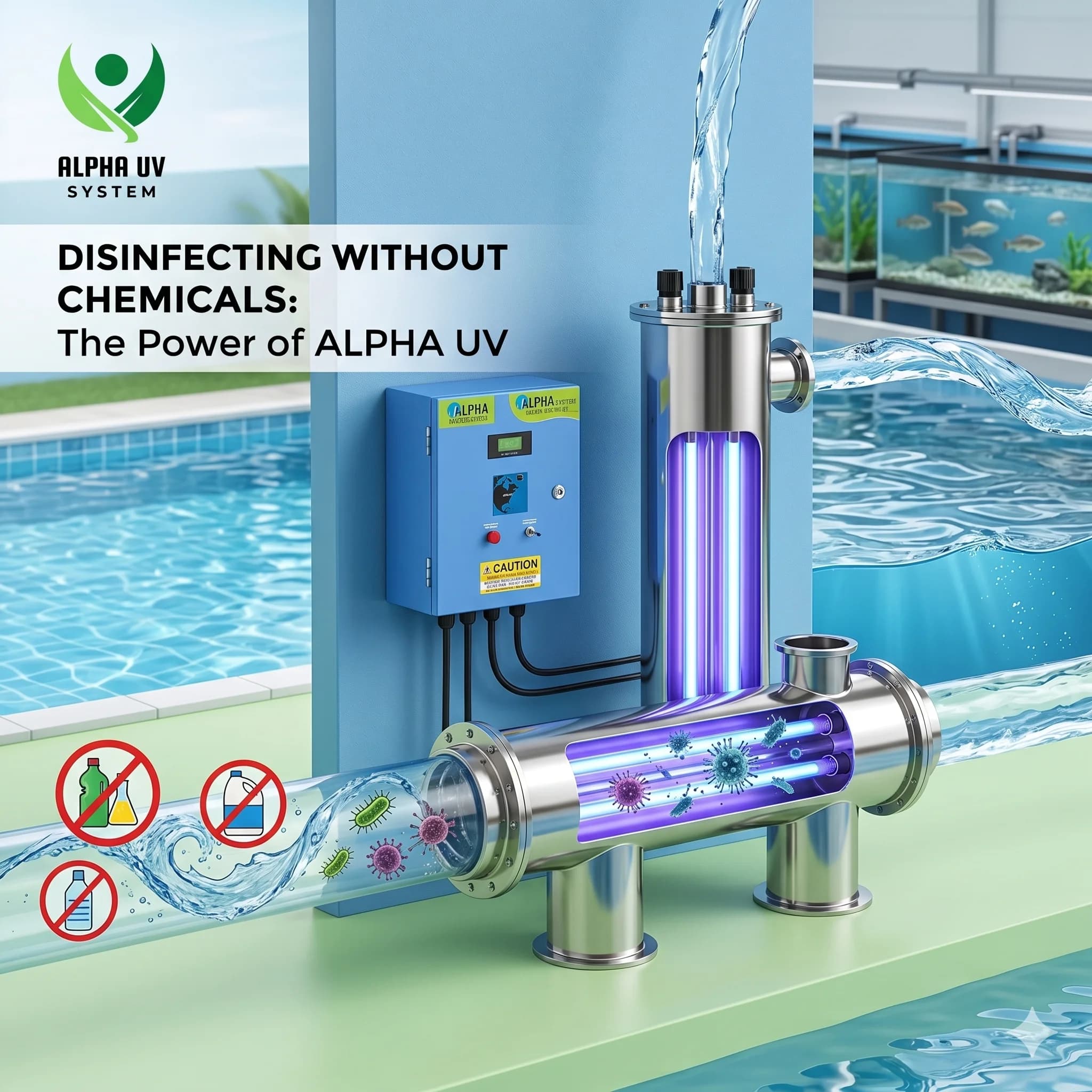
No. UV water systems do not need chemicals of any kind. The direct answer to the question — do UV water systems need chemicals — is an unambiguous no. A UV disinfection system operates entirely on electricity and UV-C light. The only two consumable items in the entire system are the electricity supply and an annual UV-C lamp replacement. No chlorine. No iodine. No sodium hypochlorite. No coagulants. No pH-adjustment acids or alkalis. No flocculants. The water entering a UV chamber exits that chamber chemically identical to how it entered — only the biological threat has been neutralised.
This is not a simplification. UV-C radiation at 254 nm works by penetrating the cell walls of bacteria, viruses, and protozoa and damaging their DNA or RNA at the molecular level. The organism cannot replicate, cannot cause infection, and cannot be revived. This inactivation process requires no chemical intermediary. The physics of photon absorption is the disinfection mechanism — no reagent, no reaction product, no chemical dosing system required.
For buyers evaluating chemical-free water disinfection in India, this single fact has significant downstream implications: no chemical procurement, no chemical storage compliance, no dosing pump maintenance, no residual testing, and no chemical disposal. The sections below explain exactly what UV does use, why the absence of chemicals matters industry by industry, and the one situation where a small amount of chlorine alongside UV is still warranted.
The Complete Consumables List for UV Disinfection Systems
Understanding do UV water systems need chemicals begins with an honest accounting of every input the system requires. The following table covers every consumable across the operational life of a standard UV disinfection unit:
| Consumable | Frequency | Purpose | Is It a Chemical? |
|---|---|---|---|
| Electricity | Continuous (6W–180W depending on system size) | Powers the UV-C lamp to emit germicidal radiation | No — electrical energy |
| UV-C lamp replacement | Annual (every 8,000–9,000 operating hours) | Restores UV output to rated germicidal intensity | No — physical component (low-pressure mercury vapour lamp) |
| 5-micron sediment pre-filter cartridge | Every 3–6 months (depends on source water turbidity) | Removes suspended solids that block UV-C penetration | No — physical filtration media |
| Quartz sleeve cleaning (citric acid wash) | Every 6–12 months in hard water areas | Removes mineral scale from quartz sleeve to restore UV transmission | Citric acid is used in maintenance — it is not dosed into treated water |
That is the complete list. There is no chlorine drum. There is no sodium hypochlorite tank. There is no dosing pump. There is no pH chemical storage cabinet. Chemical-free water disinfection through UV is not a marketing claim — it is a physical description of how the technology works.
The citric acid sleeve cleaning note is worth clarifying: the acid is used to soak the quartz sleeve outside the system during maintenance, then rinsed off completely before reinstallation. It is never dosed into the water being treated. UV water purification with no additives to the product water is accurate in every operational scenario.
Why Chemical-Free Matters: The Chemistry of Disinfection Byproducts
The reason chemical-free water disinfection in India is increasingly preferred is not aesthetic — it is toxicological. When chlorine is added to water containing natural organic matter (NOM), it reacts to form a class of compounds called disinfection byproducts (DBPs). The three principal DBP groups are:
Trihalomethanes (THMs)
THMs — chloroform, bromodichloromethane, dibromochloromethane, and bromoform — form when chlorine reacts with humic acids and fulvic acids present in all surface water and most groundwater. The International Agency for Research on Cancer (IARC) classifies bromodichloromethane as a Group 2A probable human carcinogen. Chloroform is a Group 2B possible carcinogen. WHO guideline value for total THMs is 0.3 mg/L. BIS IS 10500:2012 specifies a total THM limit of 0.1 mg/L for packaged drinking water. Long-term THM exposure has been associated in epidemiological studies with increased risk of bladder cancer and adverse reproductive outcomes.
Haloacetic Acids (HAAs)
HAAs — dichloroacetic acid (DCA), trichloroacetic acid (TCA), and five related compounds — are the second major DBP class. DCA is classified as a Group 2A probable carcinogen by IARC. Regulatory limits vary: USEPA sets a maximum contaminant level of 0.060 mg/L for HAA5. Indian regulations are still developing specific HAA limits, but food-grade and pharmaceutical-grade water specifications increasingly reference international benchmarks.
Bromate
Bromate forms when ozone is applied to water containing bromide ions — the same mechanism applies when chlorine dioxide or hypochlorite contacts bromide-rich groundwater. WHO guideline value for bromate is 0.01 mg/L. Bromate is a Group 2B possible human carcinogen and poses specific concerns in aquifer water from coastal or volcanic regions where bromide occurs naturally.
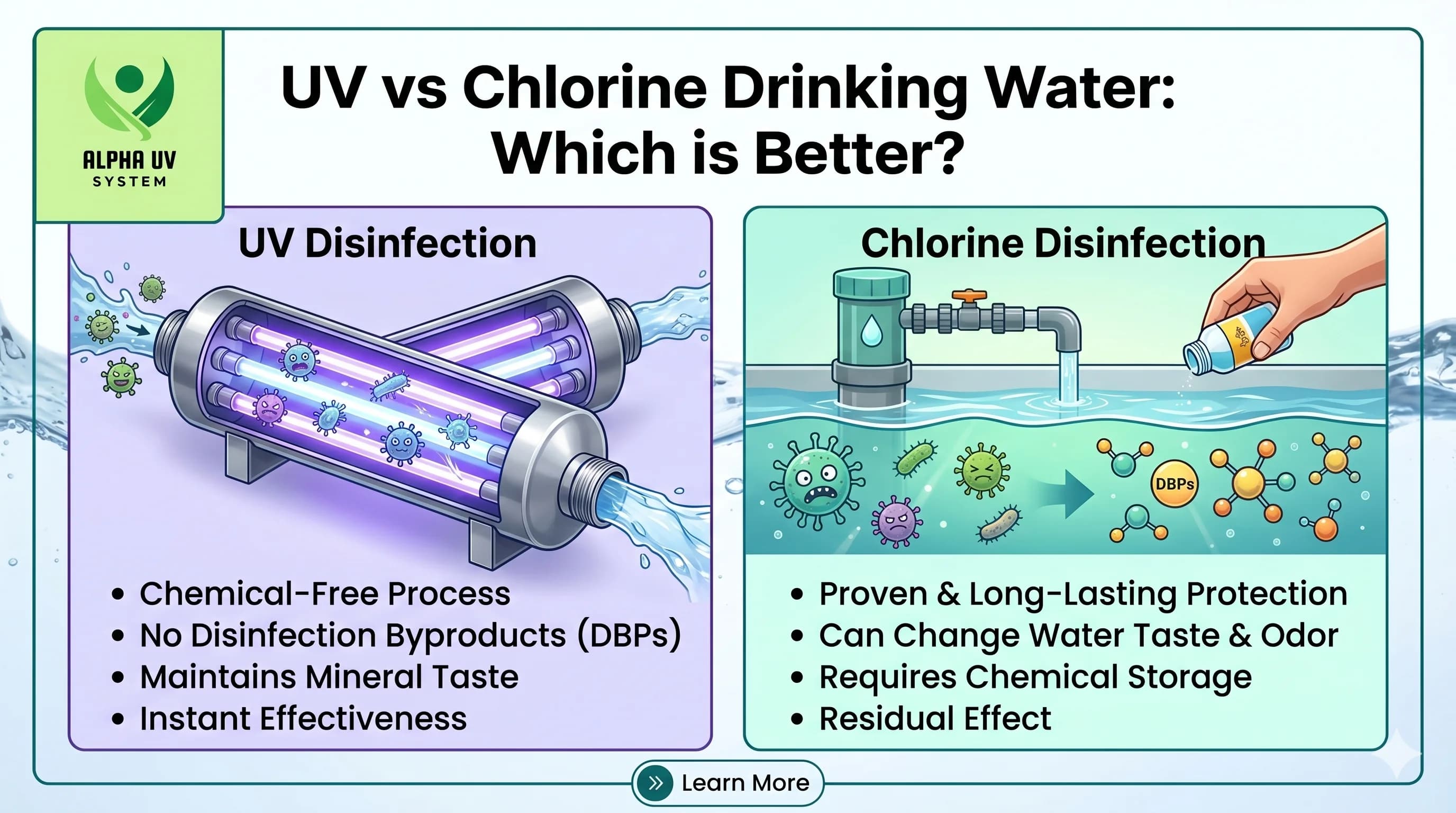
UV disinfection produces none of these compounds. UV adds no chemical to the water, so no chemical can react with NOM to form DBPs. UV disinfection byproducts in clean drinking water are effectively zero — the only photoproducts documented at germicidal doses involve trace photolysis of nitrate to nitrite (at extremely high doses above 1,000 mJ/cm² not used in practice) and minor photodegradation of certain pharmaceuticals that is irrelevant to drinking water safety. At operational germicidal doses of 40–100 mJ/cm², the treated water's chemistry is unchanged.
Chlorination: What Chemicals Are Needed and Their Risks
To fairly answer do UV water systems need chemicals, it is useful to contrast with chlorination — what chlorine-based disinfection actually requires as a chemical input system:
Sodium Hypochlorite (Liquid Bleach, 10–12% NaOCl)
Liquid sodium hypochlorite is the most common chlorine disinfectant in Indian water treatment. It requires bulk storage tanks (typically 500L–2,000L for large applications), chemical-resistant dosing pumps, residual chlorine analysers, and trained operators for handling. Sodium hypochlorite degrades over time (losing 2–3% active chlorine per month at ambient storage temperatures in Indian summer conditions) and must be procured regularly. Storage in apartments and residential premises above certain quantities triggers local fire and safety regulations.
Bleaching Powder (Calcium Hypochlorite)
Bleaching powder (65% available chlorine as calcium hypochlorite) is widely used in smaller Indian municipalities and rural water schemes. It requires dry storage away from heat and organic materials — calcium hypochlorite is a strong oxidiser that presents fire and explosion risk when contaminated. Dosing requires manual preparation of stock solutions and introduces calcium into the water as a side-effect.
Chlorine Gas (for Large Waterworks)
Large municipal water treatment plants in India historically used pressurised chlorine gas cylinders. Chlorine gas at 1 ppm air concentration is immediately dangerous to life and health (IDLH). Central Pollution Control Board (CPCB) discharge standards specify a maximum of 0.2 mg/L residual chlorine in treated effluent discharged to surface water — meaning operators must either dose carefully to avoid over-chlorination or actively dechlorinate the discharge.
UV vs Chlorine vs RO: Chemical Requirements Comparison
| Parameter | UV Disinfection | Chlorination | RO (Reverse Osmosis) |
|---|---|---|---|
| Chemicals needed for treatment | None | Sodium hypochlorite / bleaching powder / chlorine gas | Antiscalant, biocide (membrane dosing), acid/alkali for CIP |
| Disinfection byproducts | None at germicidal doses | THMs, HAAs, chlorophenols | None from RO itself; pre-chlorination DBPs concentrate in permeate if not dechlorinated |
| Chemical storage requirements | None | Bulk hypochlorite storage tank; safety cabinet required | Antiscalant drum; acid/alkali containers for cleaning |
| Handling hazards | None (electrical safety only) | Corrosive liquid or oxidising solid; PPE mandatory | Antiscalant skin/eye irritant; acid CIP hazardous |
| Residual disinfection in pipe network | No residual (point-of-treatment only) | Yes — residual chlorine maintained in distribution | No residual; RO permeate is sterile but re-contamination possible |
| CPCB/BIS regulatory chemical limits | No UV-specific chemical limits in drinking water | THM limit 0.1 mg/L (IS 10500); residual Cl 0.2–0.5 mg/L in supply | Antiscalant residues governed by NSF/ANSI 60 certification |
| Operator chemical handling training | Not required | Required under Indian Factories Act for chemical handling | Required for CIP chemical handling |
UV water purification with no additives represents a fundamentally simpler operational profile than either chlorination or full RO systems. This is not a performance comparison — RO removes dissolved solids which UV cannot, and chlorination provides distribution-network residual protection which UV does not. The comparison above is specifically about chemical requirements, chemical storage, and chemical handling obligations.
Application-Specific Reasons Why Chemical-Free Disinfection Matters
| Application | Why Chemical-Free UV Is Preferred or Mandated | Key Regulation / Standard |
|---|---|---|
| Pharmaceutical PW/WFI | Chlorine residuals and THMs are unacceptable in water used for drug manufacturing, dissolution testing, or injections | Revised Schedule M 2025; IP 2022; WHO GMP |
| Food and beverage processing | Chlorine affects taste and colour of product water; THM limits apply to ingredient water | FSSAI Food Safety Standards; IS 14543 |
| Aquaculture (fish, shrimp hatcheries) | Chlorine is toxic to aquatic organisms at disinfection doses — chemical-free treatment is a biological necessity | MPEDA export quality standards; FSSAI aquaculture |
| Swimming pools | UV reduces chlorine dosing 60–80% by destroying chloramines; does not eliminate chlorine entirely | BIS pool water standards; FINA technical guidelines |
| Municipal drinking water | NGT pressure on residual chlorine in discharge; UV at intake reduces overall chlorine demand | CPCB discharge norms; NGT orders on DBPs |
| Residential drinking water | No chemical storage in domestic premises; no chlorine taste; safe for infants and immunocompromised users | BIS IS 10500:2012 drinking water standards |
Pharmaceutical Water — Schedule M 2025 and the Chlorine Prohibition
India's Revised Schedule M 2025 brought pharmaceutical GMP requirements into alignment with WHO and EU GMP. For Purified Water (PW) and Water for Injection (WFI) systems, the revised schedule mandates that the water system design must prevent introduction of chemical contaminants. In practice, this means chlorination of PW/WFI loops is not acceptable — any chlorine residual or disinfection byproduct in water used to dissolve active pharmaceutical ingredients or fill injection vials represents a critical quality defect. UV disinfection is the validated technology for continuous loop treatment in pharmaceutical water systems precisely because it adds nothing to the water. UV vs chlorine with no chemicals required is not a preference in pharma — it is a GMP requirement.
Food and Beverage — FSSAI, THM Limits, and Brewery Water
FSSAI Food Safety and Standards (Contaminants, Toxins, and Residues) Regulations specify limits for contaminants in food-grade water. THMs in ingredient water for beverages are regulated, and the flavour impact of chlorine on product quality is well-documented. Breweries are the most demanding case: even 0.1 mg/L free chlorine in brewing liquor produces chlorophenols at parts-per-billion concentrations that impart a medicinal off-flavour detectable by trained palates. UV disinfection of brewery water eliminates this risk entirely — chemical-free water disinfection in India's growing craft brewing segment is not optional, it is a quality imperative. The same logic applies to mineral water bottling plants, soft drink manufacturers, and dairy processors where ingredient water chemistry directly affects product specification.
Aquaculture — Chlorine Is Toxic to Fish at Disinfection Doses
The question do UV water systems need chemicals has a particularly clear answer in aquaculture: no, and any system that does use chemicals cannot be used. The 96-hour LC50 (lethal concentration for 50% of test animals) for free chlorine in freshwater fish is approximately 0.05–0.2 mg/L depending on species — concentrations orders of magnitude below the 0.5–2 mg/L typically dosed for waterborne pathogen inactivation. Shrimp and prawn larvae are even more sensitive. Hatcheries treating incoming seawater or freshwater supplies to prevent Vibrio, Aeromonas, and viral pathogens must use chemical-free disinfection. UV achieves 4-log (99.99%) reduction of Vibrio at 20–40 mJ/cm² with zero impact on the biological organisms being cultured. There is no chlorine-based alternative that achieves pathogen inactivation at doses safe for fish culture.
Swimming Pools — UV Reduces Chlorine, Does Not Eliminate It
Swimming pool UV is the one application where UV does not fully replace chemical disinfection — and transparency on this point is important. Pool water requires a residual disinfectant present in the water bulk at all times for bather safety, skin-contact sanitation, and regulatory compliance. UV does not provide residual protection. What UV does in pools is destroy combined chlorine (chloramines) — the compounds responsible for red eyes, chlorine odour, and respiratory irritation in pool environments — and inactivate chlorine-resistant protozoa including Cryptosporidium and Giardia, which require UV doses of 10 mJ/cm² for 3-log reduction. The practical outcome of UV in pools is a 60–80% reduction in chlorine dosing requirements, dramatically improved water quality and bather comfort, and reduced chlorine chemical procurement. This is not UV water purification with no additives — it is UV combined with minimised chlorine for an outcome neither technology achieves alone.
Municipal Water — NGT Pressure and Chlorine-in-Discharge Compliance
India's National Green Tribunal has issued multiple orders relating to chlorine levels in treated water discharge to rivers and water bodies. CPCB discharge standards specify a maximum of 0.2 mg/L residual chlorine in effluent. Municipal water treatment plants that chlorinate at the treatment stage must either dose very precisely or dechlorinate before discharge — both of which add operational complexity. Installing UV at raw water intake or at pre-distribution stages allows municipalities to reduce overall chlorine demand, lower DBP formation, and simplify discharge compliance. Chemical-free water disinfection in India's municipal context is gaining traction not only for public health reasons but for CPCB compliance cost reduction.
India-Specific Chemical Storage Challenges
Beyond the water chemistry arguments, chemical-free water disinfection in India has a practical infrastructure dimension that is often overlooked in technical comparisons. Storing sodium hypochlorite or calcium hypochlorite in Indian conditions presents regulatory and logistical challenges that UV simply does not have:
Maharashtra, Karnataka, and Delhi have regulations under the Petroleum Act and Explosives Act that classify calcium hypochlorite (oxidising solid) as a hazardous chemical above certain storage quantities. Apartment complex management committees and Residents Welfare Associations in Indian cities routinely refuse to permit chemical storage in basement plant rooms or rooftop tank areas. The liability implications of a hypochlorite spill in a residential complex — corrosive liquid reaching drainage, affecting children, or causing a fire risk — are substantial. UV systems have none of these storage concerns. The lamp is a sealed glass-and-metal component with no chemical release risk in normal storage or handling. This practical advantage of UV vs chlorine — no chemicals required in any form — is directly relevant to the Indian apartment, villa complex, and commercial building market where chlorination is technically feasible but operationally rejected by building management.
Pre-Treatment: Filtration Is Not Chemical Dosing
A common misconception when asking do UV water systems need chemicals is conflating pre-filtration with chemical dosing. UV systems require a 5-micron sediment pre-filter before the UV chamber. This is a physical requirement, not a chemical one. The reason is optical: suspended particles in water scatter UV-C radiation and can shield microorganisms from germicidal dose. A 5-micron filter removes the turbidity that would reduce UV transmission (UVT) in the water and compromise disinfection efficacy. The filter itself is a polypropylene or glass-fibre cartridge — no chemical release, no chemical reaction with the water passing through it.
If the source water has high organic content or colour, a multimedia filter or activated carbon filter may be added upstream of the UV unit. These are still physical/adsorptive treatment processes, not chemical dosing. UV water purification with no additives remains accurate across the full pre-treatment train in almost all residential and most industrial applications — pre-treatment components are physical barriers and adsorption media, not chemical injection points.
Carbon Filter and UV Combination: What Each Does
Many Indian municipal water consumers combine a carbon block filter with UV for point-of-use treatment. This combination addresses two distinct problems that UV alone does not solve:
The carbon block filter addresses chlorine taste and odour from municipal supply. Activated carbon adsorbs free chlorine, chloramines, and many organic compounds that cause taste complaints in municipal water. This is physical adsorption — the carbon filter contains no chemicals that dose into the water. It simply adsorbs objectionable compounds onto the carbon surface.
The UV unit addresses biological contamination — bacteria and viruses that may enter the supply post-treatment or through pipe biofilm in building plumbing. UV provides the final pathogen kill immediately before the tap.
Together, carbon plus UV provides chemical-free water disinfection alongside taste improvement. Neither component doses any chemical into the treated water. The combination is complete for domestic drinking water: carbon handles aesthetic quality and chlorine removal; UV handles pathogen inactivation. Chemical-free drinking water in India at the household level is achievable through this combination without any chemical input.
What UV Does Not Do Without Chemicals
An honest guide on do UV water systems need chemicals must acknowledge the technical limitation UV has in the absence of residual disinfection. UV is a point-of-treatment technology. Water treated by UV at a specific point in a distribution system — whether a municipal headworks, a building's pump room, or a hotel's water treatment room — is disinfected at that point. Water that then travels through hundreds of metres of pipes, storage tanks, and building plumbing can be re-contaminated by:
- Biofilm formation on pipe inner surfaces downstream of the UV unit
- Contamination entry through poorly sealed joints, rooftop tank ingress, or flushing events
- Cross-connections in complex plumbing networks
UV-C light does not travel through pipes. Treated water loses its disinfection the moment it leaves the UV chamber — there is no chemical residual to suppress post-treatment re-growth. This is the one technical scenario where the answer to do UV water systems need chemicals shifts from a simple no to a qualified "it depends on the distribution network length."
When You Still Need Some Chlorine Alongside UV
For large-scale distribution networks — township water supply systems, large hospital campuses, university campuses with extensive pipe networks, or municipal systems serving thousands of connections — UV at the treatment stage combined with a small residual chlorine dose for distribution is the optimal solution. This combination achieves:
- UV at the treatment point provides primary disinfection with zero DBP formation at the treatment stage
- A reduced chlorine dose — far lower than chlorination-only systems require — maintains distribution network hygiene
- Lower chlorine dose means lower THM and HAA formation in the distribution network
- CPCB discharge compliance is easier because the total chlorine dosed is minimised
This is not UV water purification with no additives at the system level — it is UV plus minimised chlorine for combined treatment and distribution assurance. For point-of-use residential systems, building water treatment, food processing plants, pharmaceutical utilities, and aquaculture systems with short pipe runs, UV alone without any chemical addition is both sufficient and optimal.
Chemical-Free UV for Homes: The Complete Picture
For the homeowner asking do UV water systems need chemicals — the answer at residential scale is clearly and completely no. A typical residential UV system in India processes 1–10 litres per minute, is installed at the kitchen tap or at the main supply inlet, and operates continuously or on-demand. The complete system profile is:
What you get: 99.99% bacterial and viral inactivation at the point of treatment; no chemical taste or odour added; no DBP formation; no chemical storage in the home; no monthly chemical procurement; no chemical dosing adjustment based on turbidity or temperature. Annual maintenance consists of one UV-C lamp replacement (the lamp, not any chemical) and a pre-filter cartridge change. Chemical-free drinking water in India at the household level is fully achievable with UV.
What you do not get: removal of dissolved salts, hardness, heavy metals, or TDS (these require RO); residual protection in long pipe runs within large apartment complexes (where biofilm in building mains can re-contaminate water before it reaches the tap — in which case a point-of-use unit at the kitchen tap, not at the incoming main, is the correct placement).
UV water systems' chemical-free operation is not conditional on home size or water volume. A 6W point-of-use UV unit and a 180W large-flow industrial UV reactor both operate on exactly the same chemical-free principle: electricity and a lamp, nothing else.
Total Chemical Cost of Alternatives vs UV: 3-Year Comparison
| Cost Item | UV System (10 LPM residential) | Chlorination System (equivalent flow) |
|---|---|---|
| Initial system cost | INR 8,000 – 25,000 | INR 15,000 – 40,000 (dosing pump + tank + analyser) |
| Chemical procurement — Year 1 | INR 0 | INR 3,000 – 8,000 (sodium hypochlorite) |
| Chemical procurement — Year 2 | INR 0 | INR 3,000 – 8,000 |
| Chemical procurement — Year 3 | INR 0 | INR 3,000 – 8,000 |
| Annual lamp replacement | INR 800 – 2,500 per year | N/A |
| Dosing pump maintenance | INR 0 | INR 1,500 – 4,000 per year (diaphragm, tubing, calibration) |
| Residual testing kits | INR 0 | INR 500 – 1,500 per year |
| Total 3-year operating cost (chemicals + maintenance) | INR 2,400 – 7,500 | INR 22,500 – 58,500 |
The 3-year chemical and maintenance cost advantage of UV over chlorination is clear even at residential scale. At industrial scale, where chlorine procurement, storage infrastructure, safety compliance, and dosing system maintenance are proportionally larger costs, the UV vs chlorine no chemicals advantage becomes even more significant. Chemical-free water disinfection in India is not only the simpler operational choice — it is frequently the lower total-cost-of-ownership choice when chemical procurement and handling costs are fully accounted for.
Environmental Benefit: No Chemical Manufacturing, Transport, or Disposal
UV water systems' chemical-free operation has a supply-chain environmental benefit that is rarely quantified. Sodium hypochlorite production is an energy-intensive chlor-alkali process. Transporting hazardous chemicals — hypochlorite in bulk tankers, calcium hypochlorite in drums — has fuel and spill-risk costs. Disposing of expired chemical stock and empty chemical containers generates hazardous waste. A UV system's environmental footprint is electricity consumption and the eventual disposal of a spent low-pressure mercury UV lamp (which requires proper lamp recycling, not general waste — but represents a far smaller hazardous waste volume than chemical disinfection programmes).
For industrial facilities pursuing ISO 14001 environmental management certification, or for food manufacturers documenting their chemical footprint for export market ESG reporting, UV water purification with no additives simplifies the chemical inventory significantly. No chlorine in the chemical inventory means no chlorine in the environmental aspect register, no chemical spill emergency response plan for chlorine, and no chlorine in the product water chemical contaminant risk assessment.
Frequently Asked Questions
Does a UV water system need any chemicals to work?
No. UV water systems need only electricity and an annual UV-C lamp replacement. No chemicals are required at any stage — not for the disinfection process, not for system preparation, not for ongoing operation. The complete answer to do UV water systems need chemicals is no: UV-C radiation at 254 nm is the sole disinfection agent, requiring no chemical intermediary. This applies equally to residential under-sink units and large industrial flow reactors.
Does UV treatment remove chlorine from municipal water?
At standard germicidal doses of 40–100 mJ/cm², UV does not meaningfully photolyse the chlorine in municipal supply water. Very high UV doses (above 500 mJ/cm², far beyond germicidal application) can photodegrade hypochlorite, but this is not a practical water treatment application. To remove chlorine taste from municipal water, a carbon block pre-filter before the UV unit is the correct solution — activated carbon adsorbs free chlorine by physical adsorption, not by any chemical dosing. The combination of carbon filter plus UV provides both chlorine taste removal and pathogen inactivation in chemical-free drinking water supply at the point of use.
Is UV water safe to use without any residual disinfectant in the pipes after the unit?
For point-of-use installation directly at or just before the tap, yes — UV provides treatment immediately before consumption, and no significant re-contamination occurs in the short distance between UV unit and tap outlet. This is the standard configuration for residential, food-service, and laboratory installations. For UV installed at a building header with long pipe runs to individual taps, the lack of residual protection means biofilm in building plumbing can be an issue — the correct solution in this case is point-of-use UV at the individual tap rather than centralised UV at the header, preserving the chemical-free advantage while eliminating the distribution re-contamination risk.
Does the pre-filter before a UV system use chemicals?
No. The 5-micron sediment pre-filter required before a UV chamber is a physical filtration cartridge — typically polypropylene spun fibre or pleated polyester. It physically blocks suspended particles above 5 microns from entering the UV chamber, protecting UV transmission and preventing pathogen shielding. No chemical is released into the water. Carbon block pre-filters, sometimes added for chlorine taste removal, work by physical adsorption — again, no chemical dosing. The entire pre-treatment train for a UV system can be, and typically is, entirely chemical-free.
Can UV completely replace chlorine in a swimming pool?
No — and this is the one application where the answer to do UV water systems need chemicals requires a nuance. Swimming pools require a residual disinfectant in the water at all times for bather safety and regulatory compliance in India. UV destroys chloramines (improving water quality and reducing odour) and inactivates Cryptosporidium and Giardia (which are chlorine-resistant), but UV provides no residual protection in the pool volume between UV passes. The correct design is UV plus a reduced chlorine residual of approximately 0.3–0.5 mg/L free chlorine — a 60–80% reduction from chlorine-only pool operation. UV water purification with no additives is not the correct description for pool applications; "UV with minimised chlorine" is accurate.
Why is UV preferred over chlorination for pharmaceutical purified water in India?
Pharmaceutical Purified Water (PW) and Water for Injection (WFI) specifications under Revised Schedule M 2025, IP 2022, and WHO GMP Part 1 do not permit chlorine residuals or chemical disinfection byproducts. Any chlorine or THM contamination in water used to dissolve active pharmaceutical ingredients, prepare formulations, or fill injection containers is a critical quality defect that would trigger batch rejection and GMP non-compliance. UV disinfection is validated under all major pharmacopoeial standards precisely because it adds nothing to the water, produces no disinfection byproducts, and introduces no chemical variables into the drug manufacturing process. UV water systems with no chemical requirements are therefore not merely preferred in pharma — they are mandated by the quality standards.
Conclusion
The answer to do UV water systems need chemicals is consistently no across every application where UV is used as the primary or sole disinfection technology: residential drinking water, pharmaceutical PW/WFI systems, food and beverage process water, aquaculture, laboratory water, and commercial food-service. The only consumables a UV system requires are electricity and an annual lamp replacement. No chlorine, no sodium hypochlorite, no pH chemicals, no coagulants, no flocculants — nothing that alters the chemistry of the water being treated.
Chemical-free water disinfection in India matters because of disinfection byproduct health risks (THMs, HAAs, bromate), because chemical storage in Indian residential and commercial premises presents regulatory and practical challenges, because industries from pharma to aquaculture are mandated or biologically required to avoid chemical disinfectants, and because the 3-year total cost of UV operation is substantially lower than chlorination when chemical procurement and maintenance costs are included.
The only caveat is distribution-network scale: very large township or municipal distribution networks benefit from UV at the treatment stage combined with a minimised chlorine residual to protect water quality across hundreds of metres of distribution piping. For every other application — including the vast majority of industrial, commercial, and residential installations in India — UV water purification with no additives is complete, compliant, and cost-effective.
To specify the right UV system for your application — residential, food processing, pharmaceutical, aquaculture, or municipal — WhatsApp our team at +91 93183 05878 or call +91 95995 00580. We will recommend the correct flow rate, UV dose, and pre-treatment configuration for chemical-free disinfection at your site.
Standards, authorities & further reading
External references used to inform this guide. Regulations evolve — check the latest revision on each authority's site before compliance decisions.
Recommended UV Systems
Alpha UV System products for this application — powered by genuine Philips UV-C lamps.
UV System for Drinking Water
100 – 50,000 LPH
Chemical-free UV drinking water disinfection — from homes to municipalities
Residential UV Disinfection System
100 – 500 LPH
Safe drinking water for homes and villas — no chemicals, no taste change
Not sure which system suits your application? WhatsApp our engineers for a free recommendation →
Related solutions
See how Alpha UV System applies this to your industry or city.
Need a UV system?
Talk to our UV engineers — WhatsApp for a quote in 2 hours, or browse the full catalog on IndiaMART.