Quick Answer
Does UV water treatment leave residue?
No. UV water treatment leaves absolutely zero chemical residue in water. UV-C light is instantly absorbed by pathogen DNA and water molecules — it does not persist, accumulate, or alter the chemical composition of water. There are no by-products, no taste changes, and no health concerns from the UV process itself. If you are asking does UV water treatment leave residue of any kind — chemical, radiological, or biological — the answer is a definitive and scientifically unambiguous no.
How UV Disinfection Works
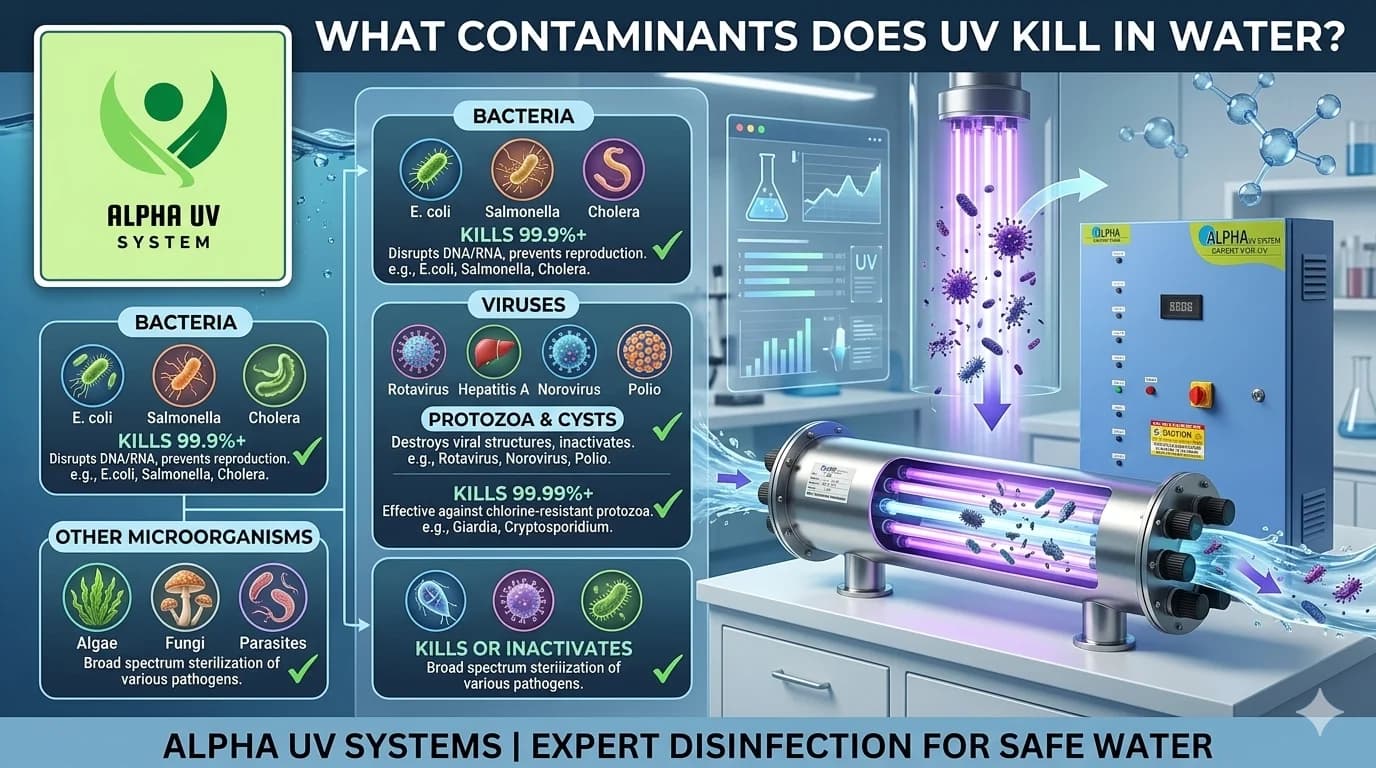
To answer the question does UV water treatment leave residue, you first need to understand what UV disinfection actually does inside a treatment chamber. A UV water system passes water through a sealed stainless steel chamber fitted with a Philips UV-C lamp emitting light at 254 nanometres wavelength. At this precise wavelength, UV-C photons are absorbed by the nucleic acids — the DNA and RNA — of bacteria, viruses, protozoa, and fungi suspended in the water.
The absorbed photon energy creates thymine dimers: cross-links in the pathogen's genetic code that permanently prevent the organism from replicating. A microorganism that cannot replicate cannot cause infection, regardless of whether it is physically removed from the water. This inactivation occurs within milliseconds as water flows past the lamp at the engineered contact distance.
The critical point for understanding does UV water treatment leave residue is what happens — and what does not happen — to the water itself during this process:
- UV-C photons at 254 nm are absorbed by pathogen DNA and RNA. They interact with microbial nucleic acids, not with water molecules in any way that alters water chemistry at germicidal treatment doses.
- Photons do not persist in water. UV-C is a form of light — once absorbed, it is gone. It does not dissolve in water, it does not accumulate, and it cannot be "stored" in a water molecule the way a dissolved chemical can.
- UV-C does not ionise water molecules or create significant reactive oxygen species at the standard treatment dose of 40 mJ/cm². No free radicals, no peroxide, no altered water chemistry at normal germicidal parameters.
- No chemical is added at any stage. The Philips TUV lamp emits UV-C photons — light — and nothing else enters the water stream. UV disinfection is a purely physical, photonic process.
This mechanistic understanding is the foundation for the answer to does UV water treatment leave residue: because no chemical enters the water and the photons are absorbed within the treatment chamber, there is nothing left behind.
What UV Does NOT Add to Water
When households, food businesses, and facility managers ask does UV water treatment leave residue, they are often specifically concerned about a list of substances they have heard about from chlorination or other treatment methods. The table below addresses every substance commonly associated with water disinfection.
| Substance | Added by UV Treatment? | Notes |
|---|---|---|
| Chlorine | No | UV disinfection is entirely chemical-free. No chlorine compound is used, added, or formed. |
| Trihalomethanes (THMs) | No | THMs only form when chlorine reacts with natural organic matter in water. No chlorine, no THMs. |
| Haloacetic Acids (HAAs) | No | HAAs are a chlorine disinfection by-product. UV produces no halogenated compounds of any kind. |
| Ozone | No | Ozone generation requires vacuum-UV wavelengths below 200 nm. Standard germicidal UV at 254 nm produces no ozone. |
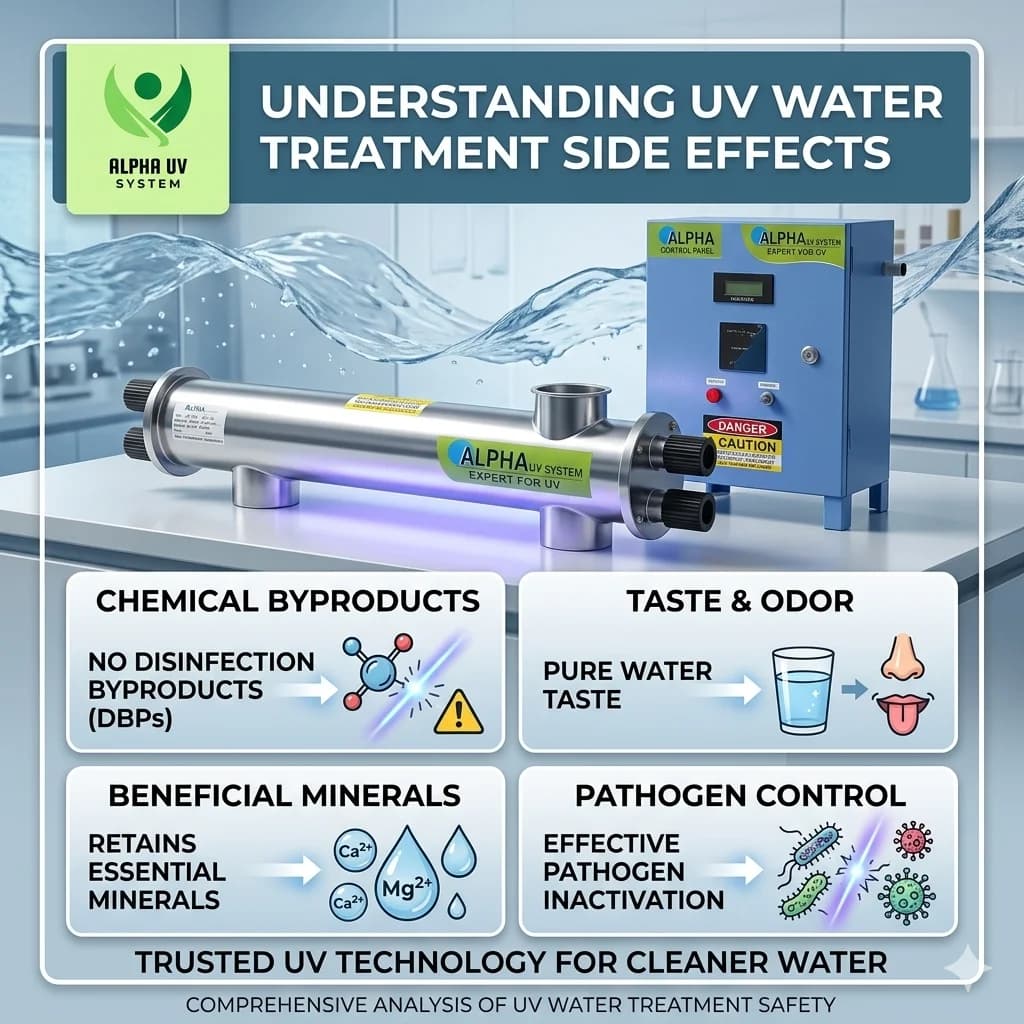
| Taste or odour compounds | No | UV-treated water is organoleptically identical to the source water. No chemical flavour is introduced. |
| UV-C radiation (in treated water) | No | UV-C is 100% absorbed inside the treatment chamber before water exits. The treated water carries no photons. |
| Mercury | No | Mercury is sealed inside the lamp's quartz glass envelope and never contacts water under normal operation. |
| Reactive oxygen species (ROS) | No | Not generated at the standard 254 nm, 40 mJ/cm² drinking water treatment dose. UV-AOP (advanced oxidation) is a separate industrial process operating at entirely different parameters. |
The answer to does UV water treatment leave residue of any of the above substances is no across every row — not because UV is merely "less harmful" than alternatives, but because the physical mechanism of UV disinfection categorically cannot introduce any of these substances into water.
Does UV-C Radiation Persist in Water?
This is the most specific form of the does UV water treatment leave residue question, and the answer is unambiguous: no, UV-C radiation does not persist in water.
UV-C at 254 nm has an extremely short penetration depth in water — it is measurably attenuated within fractions of a millimetre of water depth. Inside a UV treatment chamber, the lamp is positioned so that water flowing past it receives the required dose (typically 40 mJ/cm²) during the contact time the chamber is engineered to deliver. By the time water exits the chamber outlet, every photon emitted by the Philips UV-C lamp has been absorbed — by pathogen nucleic acids, by dissolved organic matter, by the water itself.
UV-C is a form of light. Light does not dissolve in water. It cannot accumulate in a storage tank. It cannot "charge" water the way a battery stores electrical energy. The moment the photon is absorbed, it ceases to exist as radiation. Water treated by UV is completely safe to drink the instant it exits the chamber — no waiting period, no flushing, no neutralisation step required.
This is a fundamental difference from chlorine disinfection, which requires a contact time of 30 minutes or more for the chemical to work, and which leaves a measurable residual (0.2–0.5 mg/L free chlorine) in the water after treatment. If you ask does UV water treatment leave residue in the same way chlorine does — the answer is no by definition, because UV is not a chemical and light cannot form a residual.
UV vs Chlorine: The Residue Comparison
Understanding does UV water treatment leave residue is most meaningful when placed alongside chlorination — the method it most commonly replaces in Indian homes, food businesses, and industrial facilities. The differences in residue profile between the two technologies are substantial.
| Property | UV Disinfection | Chlorine Disinfection |
|---|---|---|
| Chemical added to water | None | Chlorine gas or sodium hypochlorite solution |
| Disinfection by-products formed | None at standard dose | THMs, HAAs, chloramines, chlorophenols |
| Taste change in treated water | None — organoleptically neutral | Chlorine taste and odour detectable at 0.1 mg/L |
| Effect on pH | None | Slight decrease (hypochlorous acid addition) |
| Residual in distribution pipe or storage tank | None | Free chlorine residual 0.2–0.5 mg/L (BIS requirement for municipal supply) |
| Safe for infants (formula preparation) | Yes — no chemical residual risk | DBPs (THMs, HAAs) are a concern at infant body weight exposure levels |
| Safe for dialysis pre-treatment | Does not add any contaminant | Chlorine must be fully removed before dialysis water enters the RO stage |
| Carcinogen classification of by-products | None — no by-products formed | THMs: IARC Group 2B (possible human carcinogens) |
| Regulatory residual limit in India | No residual limit applicable — UV leaves no residual | BIS IS:10500: 0.2–1 mg/L free chlorine in distributed water |
The table above makes clear that does UV water treatment leave residue and does chlorination leave residue are not equivalent questions. Chlorine disinfection, by design, leaves a measurable chemical residual and, as an unavoidable consequence of its chemistry, produces disinfection by-products that are regulated precisely because of their health implications. UV leaves nothing.
Effect on Water Properties
Another way to frame the does UV water treatment leave residue question is to ask: does UV change any measurable property of the water? The answer across every parameter is no.
| Water Property | Before UV Treatment | After UV Treatment | Change? |
|---|---|---|---|
| pH | Source water value | Identical | No change |
| TDS (Total Dissolved Solids) | Source water value | Identical | No change |
| Hardness (calcium + magnesium) | Source water value | Identical | No change |
| Taste | Source water taste | Identical | No change |
| Odour | Source water odour | Identical | No change |
| Colour | Source water colour | Identical | No change |
| Mineral content (Ca, Mg, K, Na, etc.) | Source water value | Identical | No change |
| Dissolved oxygen | Source water value | Identical | No change |
This is the defining characteristic of UV disinfection: it is the only primary disinfection technology that changes nothing about water chemistry. RO removes 80–95% of dissolved minerals. Chlorination adds chemical residuals and generates by-products. Boiling removes dissolved oxygen and concentrates dissolved solids. UV does none of these things. The water that exits a UV system is chemically, physically, and organoleptically identical to the water that entered — the only difference is microbiological. Every pathogen capable of replication has been inactivated.
Mercury Lamp Safety: Does the Lamp Contaminate the Water?
A specific sub-question within does UV water treatment leave residue concerns the mercury inside the UV lamp. Low-pressure UV-C lamps — including the Philips TUV series used in Alpha UV System equipment — contain a small quantity of mercury sealed inside the lamp's glass envelope. Mercury vapour inside the lamp is what produces the UV-C emission at 254 nm when an electrical discharge is applied. This mercury never contacts the water under any normal operating condition.
The reason is the double-barrier design that is standard in all correctly manufactured UV systems:
- First barrier — the lamp glass envelope itself. The mercury is sealed inside the lamp's borosilicate or soft glass tube. The lamp glass is a hermetically sealed vessel. In normal operation, this seal is intact and impermeable.
- Second barrier — the quartz sleeve. The lamp sits inside a quartz sleeve — a separate sealed tube of UV-transmitting quartz glass — that is installed inside the stainless steel chamber. Water flows between the outer wall of the quartz sleeve and the chamber wall, never touching the lamp directly. Even if the lamp glass were compromised, the quartz sleeve provides a second containment barrier.
- Third barrier — the stainless steel chamber. The entire lamp-plus-sleeve assembly is enclosed inside a sealed 304 or 316L stainless steel pressure vessel. Any lamp or sleeve failure would be contained within the chamber.
In normal operation: zero mercury contact with water, zero mercury in treated water. Does UV water treatment leave residue in the form of mercury contamination? Under normal operating conditions, no. For lamp disposal at end of service life, the Philips UV-C lamp must be handled as e-waste per India's E-Waste (Management) Rules, 2022, which prohibits disposal in general municipal waste.
Safe Uses for UV-Treated Water
Because does UV water treatment leave residue has a definitive no answer, UV-treated water is appropriate for every application that requires pure, chemically unaltered water. The table below covers the most common use cases across residential, commercial, and industrial contexts in India.
| Application | Safe with UV-Treated Water? | Notes |
|---|---|---|
| Direct drinking | Yes | Recommended for all ages. No chemical residual risk at any consumption volume. |
| Infant formula preparation | Yes | No chemical residual risk at infant body weight. Minerals fully preserved. Follow WHO formula preparation guidance for boiling separately. |
| Cooking (all applications) | Yes | Heat does not retroactively affect UV treatment outcome. UV-treated water behaves identically to untreated water in all cooking chemistry. |
| Dialysis water (upstream of RO) | Yes | UV does not add contaminants. Dialysis water treatment trains use UV as one component of the multi-barrier system before final RO and endotoxin filtration. |
| Aquarium filling | Yes | No dechlorination step needed (unlike municipal supply). UV eliminates fish pathogens without adding harmful chemicals. |
| Hydroponics and horticulture | Yes | No chemical interference with nutrient solution chemistry. UV-treated irrigation water carries no disinfectant that would harm plant root microbiomes. |
| Food processing (FSSAI-regulated) | Yes | FSSAI accepts UV as a disinfection method for food-contact water. No chemical residual that could contaminate food products. |
| Hospital / pharmaceutical WFI (Water for Injection upstream) | Yes, with full pre-treatment train | UV is a standard step in pharmaceutical purified water systems meeting WHO GMP and Schedule M requirements. Meets pharmacopoeia requirements as one barrier in a multi-stage system. |
The breadth of these applications reflects the core advantage that drives the answer to does UV water treatment leave residue: because it adds nothing to water, UV-treated water is compatible with every downstream use that requires chemically unaltered, pathogen-free water.
When Can UV-Treated Water Become Unsafe?
Answering does UV water treatment leave residue honestly requires being equally clear about what UV does not do and where UV-treated water can become unsafe after treatment.
UV provides no ongoing protection after treatment. The moment water exits the UV chamber, there is no residual disinfectant in the water. If that water enters a contaminated storage tank, is stored in an open container, or passes through biofilm-coated pipes, it can become re-contaminated by environmental bacteria. This is the one practical limitation UV carries compared to chlorination, which leaves an active residual that suppresses re-growth for hours to days.
Biofilm in storage tanks and pipes is not addressed by UV. UV disinfects water as it flows through the chamber. It does not clean or disinfect the surfaces of the downstream storage tank, overhead tank, or pipework. Biofilm colonies established on tank walls before UV installation continue to grow and shed bacteria into UV-treated water after the system is installed.
Re-contamination from unclean containers is a real risk. UV-treated water stored in an open bucket, dirty container, or uncovered tank can be contaminated by airborne bacteria, insects, or contact with unclean hands within hours.
The practical recommendations that follow from this:
- Clean and disinfect your overhead tank and storage containers every six months.
- Install UV as close to the point of use as possible — ideally at the kitchen tap or building outlet rather than at the tank inlet.
- Store UV-treated water in clean, covered, food-grade stainless steel or HDPE containers.
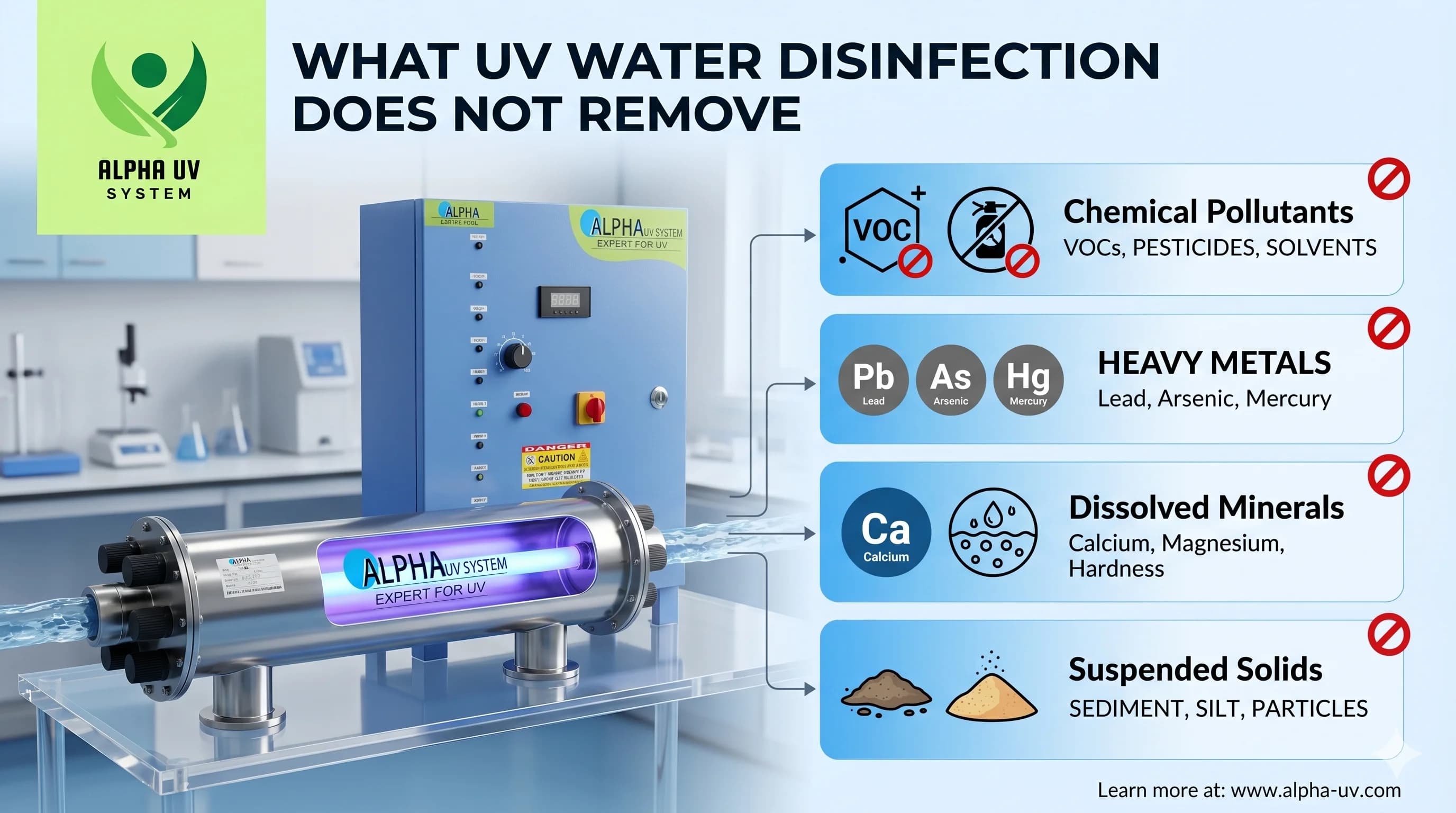
- Remember that UV removes biological threats but does not remove pre-existing chemical contamination — heavy metals, pesticides, or fluoride in the source water require dedicated pre-treatment filtration, not UV.
None of these limitations change the answer to does UV water treatment leave residue — they are limitations of UV's scope of action, not evidence that UV introduces anything harmful into water.
Frequently Asked Questions
Does UV water taste different?
No. UV-C light does not interact with the dissolved compounds that determine water taste at germicidal doses. The taste of UV-treated water is organoleptically identical to the source water. If you are switching from chlorinated municipal supply to a UV-only system, you are likely to notice a significant improvement in taste — this is because the chlorine and chlorinated taste compounds (which do have a strong flavour) are no longer present from the municipal dosing. UV did not improve the taste; it simply confirmed that no chemical residue of any kind affects the flavour of water treated this way.
Is it safe to drink UV-treated water immediately?
Yes — completely and without any waiting period. This is one of the practical advantages of UV over chlorine: chlorination requires a contact time of 30 minutes or more for the chemistry to work, and the water still carries a chlorine residual when consumed. UV disinfection occurs instantaneously as water passes through the chamber, and the treated water exits with no residual of any kind. Safe to drink the moment it comes out of the tap. No neutralisation, no waiting, no concern. There is no residual that requires time to dissipate — safe consumption is immediate.
Does the UV lamp emit any harmful radiation into the water?
No. The Philips TUV lamp emits UV-C at 254 nm inside a sealed stainless steel chamber. All UV-C is absorbed within the water and by pathogen DNA before the water exits the chamber outlet. UV-C is non-ionising radiation — it cannot make water radioactive, it cannot persist in water as a dissolved species, and it cannot exit the chamber with the treated water. The sealed design of the stainless steel UV chamber means that even a person standing directly next to the operating system is not exposed to any UV-C radiation during normal operation. UV-C radiation is not a substance that can remain dissolved in water — once absorbed inside the chamber, it is gone.
Can the mercury in UV lamps contaminate my water?
Under normal operating conditions, no. The mercury in a Philips UV-C lamp is sealed inside the lamp's glass envelope. The lamp sits inside a quartz sleeve, which itself sits inside the sealed stainless steel chamber. Two physical barriers — lamp glass and quartz sleeve — separate the mercury from the water at all times. In the extremely unlikely event of simultaneous lamp breakage and quartz sleeve failure (which would require physical damage to a pressure-bearing stainless steel vessel), the appropriate response is to immediately shut down the system, drain and flush the chamber, and replace all affected components before resuming operation. In routine daily use: mercury poses no contamination risk, and does UV water treatment leave residue of mercury in treated water is answered with a firm no.
Does UV treatment change the mineral content of water?
No. UV disinfection has zero effect on dissolved minerals. Calcium, magnesium, potassium, sodium, bicarbonates, fluoride, and every other dissolved ion passes through the UV chamber completely unchanged. The TDS reading before and after a UV system is identical to measurement precision. This is a key distinction from RO (reverse osmosis), which removes 80–95% of all dissolved minerals. For Indian households where borewell or municipal water TDS is within acceptable limits under BIS IS:10500 but microbial contamination is the concern, UV is the appropriate technology precisely because it eliminates the biological risk without altering mineral content. Does UV water treatment leave residue that removes or alters minerals? No — and the preservation of mineral content is one of UV's most valued characteristics for health-conscious consumers.
Is UV-treated water safe for babies and pregnant women?
Yes — and in both cases, UV-treated water is specifically preferable to chlorinated alternatives. For infants, WHO and UNICEF guidelines for infant formula preparation emphasise the need for chemically safe, pathogen-free water. UV water eliminates pathogens — including Cronobacter sakazakii, which can be lethal to neonates — while adding no chlorine, no disinfection by-products, and no chemical residual that could affect an infant at their low body weight. Minerals are fully preserved, maintaining the correct reconstitution chemistry for formula. For pregnant women, some research suggests associations between high THM exposure from chlorinated supply and adverse pregnancy outcomes. UV-treated water carries no THMs, no HAAs, and no chemical residual of any kind. Does UV water treatment leave residue that poses risk to pregnant women or babies? No — on the contrary, the complete absence of chemical residue is why UV is the preferred disinfection technology for these sensitive applications.
If you have a specific question about whether does UV water treatment leave residue for your application — infant formula, pharmaceutical water, food processing, dialysis pre-treatment, or residential drinking — our team will provide a written technical response within 24–48 hours.
WhatsApp Us About UV Water Treatment Residue and Safety
Standards, authorities & further reading
External references used to inform this guide. Regulations evolve — check the latest revision on each authority's site before compliance decisions.
Recommended UV Systems
Alpha UV System products for this application — powered by genuine Philips UV-C lamps.
UV System for Drinking Water
100 – 50,000 LPH
Chemical-free UV drinking water disinfection — from homes to municipalities
Residential UV Disinfection System
100 – 500 LPH
Safe drinking water for homes and villas — no chemicals, no taste change
Not sure which system suits your application? WhatsApp our engineers for a free recommendation →
Related solutions
See how Alpha UV System applies this to your industry or city.
Need a UV system?
Talk to our UV engineers — WhatsApp for a quote in 2 hours, or browse the full catalog on IndiaMART.