Quick Answer
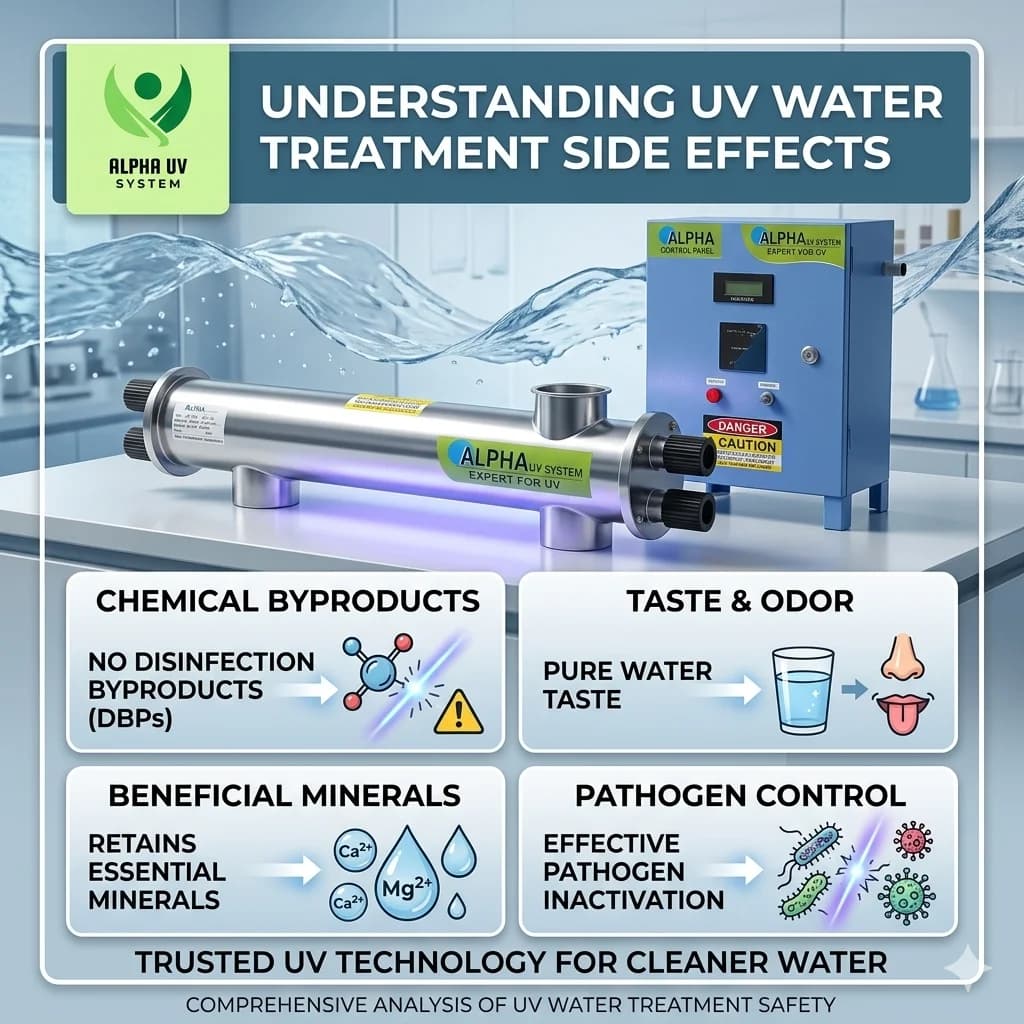
The side effects of UV water treatment on human health are: none. UV disinfection does not add any chemical to water, does not remove minerals, does not change pH or TDS, and produces no disinfection byproducts at drinking-water doses. The treated water is chemically identical to the source water — only the biological threat has been neutralised. This conclusion is supported by the WHO, BIS, USEPA, and over a century of documented use in municipal, pharmaceutical, and food-grade applications worldwide.
What UV Water Treatment Actually Does to Water
To understand the side effects of UV water treatment — or rather the complete absence of them — it helps to understand the photochemical mechanism at work inside a UV disinfection system.
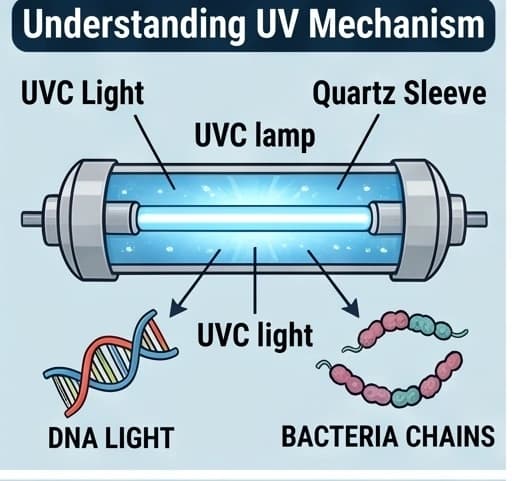
A UV water purifier passes water through a sealed stainless steel chamber fitted with a Philips UV-C lamp emitting light at 254 nanometres wavelength. At this specific wavelength, UV-C photons are absorbed by the nucleic acids (DNA and RNA) of microorganisms — bacteria, viruses, protozoa, and fungi. The absorbed energy creates thymine dimers in the pathogen's DNA, a structural deformation that permanently prevents the organism from replicating. An organism that cannot replicate cannot cause infection.
The critical point for understanding UV water purifier safety is what does not happen during this process. UV-C light interacts with microbial DNA. It does not interact meaningfully with water molecules themselves at germicidal doses. It does not strip minerals from solution. It does not introduce any reagent. It does not alter the ionic balance, the pH, or the total dissolved solids of the water. The water that exits the UV chamber is chemically identical to the water that entered — minus the viable pathogens.
This is what makes UV water treatment safe and fundamentally different from chemical disinfection. There is no residual agent to ingest, no reaction product to accumulate, and no trade-off between disinfection efficacy and water chemistry alteration. In practical terms, the side effects of UV water treatment on water chemistry are zero — a statement that cannot be made about any chemical disinfection method.
UV Water Treatment — What Changes vs What Stays the Same
The table below summarises every significant water quality parameter and what UV treatment does — or does not do — to each. This data is drawn from WHO, USEPA, and BIS technical guidance documents on UV disinfection health effects.
| Parameter | Before UV Treatment | After UV Treatment | Does UV Change It? |
|---|---|---|---|
| Bacteria (E. coli, Salmonella, etc.) | May be present | Inactivated (>99.99% at 40 mJ/cm²) | Yes — eliminated |
| Viruses (Rotavirus, Norovirus) | May be present | Inactivated at 40–100 mJ/cm² | Yes — eliminated |
| Protozoa (Giardia, Cryptosporidium) | May be present | Inactivated (chlorine-resistant; UV kills them) | Yes — eliminated |
| TDS (Total Dissolved Solids) | Source water level | Unchanged | No change |
| pH | Source water level | Unchanged | No change |
| Calcium and magnesium (hardness minerals) | Source water level | Unchanged | No change |
| Taste | Source water taste | Unchanged (or marginally fresher) | No change |
| Odour | Source water odour | Unchanged (biological odour removed) | No change to chemistry |
| Colour | Source water colour | Unchanged | No change |
| Chlorine residual | May be present (municipal supply) | Unchanged (UV does not add chlorine) | No change |
| Temperature | Ambient | Unchanged (negligible lamp heat transfer) | No change |
| Chemical disinfection byproducts (THMs, HAAs) | Not present (UV source) | Not formed | None generated |
What UV Does NOT Add to Water
One of the most important facts about UV disinfection health effects — and about the side effects of UV water treatment more broadly — is what the process categorically does not introduce. Many households in Delhi NCR, Mumbai, and Bangalore who switch from chlorine-dosed municipal supply to UV-purified water report a noticeable taste improvement — not because UV improves taste, but because it removes the chlorine dosing that was responsible for the chemical flavour.
UV water treatment adds none of the following to water:
- No chlorine or chlorine compounds — UV disinfection is a completely chlorine-free process. There are no trihalomethanes, haloacetic acids, or chlorophenols formed because there is no chlorine present to react with organic matter in the water.
- No chemical reagents of any kind — UV-C is light, not a chemical. The Philips TUV lamp emits UV-C photons; it does not release any material into the water stream.
- No UV-C residual in the treated water — UV-C radiation cannot persist in water. It is absorbed within fractions of a millimetre of water depth. Water exiting the UV chamber carries no UV-C whatsoever. UV water treatment safe practices confirm this: the treated water is safe the instant it leaves the chamber.
- No photoproducts from clean drinking water — At normal germicidal doses (40–100 mJ/cm²), UV-C treatment of clean water with low natural organic matter content produces no detectable chemical transformation products. This has been confirmed by independent analytical chemistry studies commissioned by WHO.
- No taste or odour compounds — Unlike chlorine (which adds a distinct taste) or ozone (which can add a metallic taste if overdosed), UV treatment is organoleptically neutral.
Disinfection Byproducts — UV vs Chlorination
The side effects of UV water treatment are best understood in comparative context. Chemical disinfection — particularly chlorination, the most widely used method for municipal supply across India — generates a well-documented family of disinfection byproducts (DBPs). These byproducts form when the disinfectant reacts with organic matter naturally present in water. UV disinfection does not involve any chemical reaction with water constituents and therefore generates no DBPs under normal operating conditions.
| Byproduct / Compound | Formed by UV? | Formed by Chlorination? | Health Concern | Indian Regulatory Limit (BIS IS:10500) |
|---|---|---|---|---|
| Trihalomethanes (THMs) — e.g., chloroform | No | Yes | Possible human carcinogen (IARC Group 2B); liver and kidney toxicity at high exposure | 0.1 mg/L (total THMs) |
| Haloacetic Acids (HAAs) — e.g., dichloroacetic acid | No | Yes | Animal carcinogen; reproductive toxicity concerns at chronic low-dose exposure | Not explicitly listed in IS:10500; WHO guideline 0.05 mg/L (DCAA) |
| Bromate | No | No (formed by ozone + bromide) | Possible carcinogen (IARC Group 2B); nephrotoxic at high doses | 0.01 mg/L |
| Chlorophenols (2-chlorophenol, 2,4-dichlorophenol) | No | Yes | Medicinal taste/odour; hepatotoxic at high concentrations; endocrine disruption concern | WHO: 0.0001 mg/L (taste threshold) |
| Chloramines (combined chlorine) | No | Yes (when ammonia present) | Bladder irritation; problematic for dialysis patients and those with G6PD deficiency | 3 mg/L (as Cl) |
| Nitrite (from UV + high nitrate water) | Trace only at doses >1,000 mJ/cm² | No | Methaemoglobinaemia risk in infants (only at doses 25× higher than drinking water disinfection dose) | 0.9 mg/L (IS:10500) |
| Chlorinated furanones (MX) | No | Yes | Potent mutagen in Ames test; rodent carcinogen; estimated to account for significant fraction of chlorination mutagenicity | Not regulated in IS:10500 (no safe level established) |
| Haloacetonitriles (HANs) | No | Yes | Cytotoxic and genotoxic in vitro; reproductive toxicity in animal studies | Not regulated in IS:10500 |
The comparison above is unambiguous: the side effects of UV water treatment in terms of disinfection byproduct formation are effectively zero. Chlorination — the default method for municipal supply in every major Indian city including Delhi NCR, Mumbai, and Bangalore — generates a substantial DBP burden that UV categorically avoids.
The Safety Record of UV Disinfection
UV water treatment safe practices and endorsements span over a century of documented municipal, industrial, and pharmaceutical use. The safety profile is not theoretical — it is empirically established across millions of installations on every continent. Regulatory bodies that have formally reviewed the side effects of UV water treatment have universally concluded that there are no adverse health effects attributable to correctly dosed UV disinfection.
- WHO Guidelines for Drinking Water Quality (4th Edition, 2017): Explicitly recommends UV-C disinfection at a minimum dose of 40 mJ/cm² as a primary disinfection method. The WHO notes no safety concerns regarding UV-treated water health for any population segment when the system is correctly sized and maintained.
- USEPA UV Disinfection Guidance Manual (2006, updated 2021): Forms the basis for UV dose requirements at municipal water treatment plants across the United States. Tens of millions of Americans consume UV-treated water daily under USEPA-approved frameworks.
- Bureau of Indian Standards (BIS) IS:10500:2012: Indian drinking water standard does not prohibit UV treatment and recognises it as an acceptable disinfection method. BIS-certified UV systems from manufacturers such as Alpha UV System meet Indian regulatory requirements for potable water treatment.
- Pharmaceutical manufacturing (WHO GMP, Schedule M): UV disinfection is mandatory in purified water loops for pharmaceutical manufacturing under WHO GMP and India's Schedule M revised norms. This is the highest standard of water safety — UV-treated water is literally used to manufacture injectable medicines.
- FSSAI (Food Safety and Standards Authority of India): FSSAI-regulated food businesses, bottled water plants, and packaged drinking water manufacturers use UV disinfection as a primary or final barrier treatment. FSSAI guidelines for packaged drinking water (IS:14543) permit UV as a disinfection step.
The Only Real UV Safety Risk: The Lamp, Not the Water
It is important to be precise about UV disinfection side effects because there is one genuine safety consideration — but it concerns the UV lamp during maintenance, not the treated water at any stage. When people ask about side effects of UV water treatment, they typically mean effects on the water consumers drink; on that question, the answer is an unambiguous none.
UV-C at 254 nm is an occupational hazard if a person is directly exposed to the unshielded lamp. Direct UV-C eye exposure causes photokeratitis — severe corneal inflammation producing intense pain, light sensitivity, and temporary vision impairment within 30–60 seconds of exposure. Skin exposure causes erythema (UV burn) similar to severe sunburn. These effects are temporary and self-limiting, but they are acutely uncomfortable.
Under normal system operation, there is no exposure risk whatsoever. The Philips TUV lamp operates inside a sealed stainless steel chamber with a quartz sleeve. UV-C cannot penetrate the steel housing. The risk exists only when the lamp is replaced while powered. The correct procedure — always specified in Alpha UV System documentation — is to switch off the power supply completely before opening the lamp access port.
UV System Safety — Risks and Controls
| Safety Concern | Who Is at Risk? | When Does It Occur? | How It Is Controlled |
|---|---|---|---|
| Direct UV-C eye exposure (photokeratitis) | Maintenance technician during lamp replacement only | Only if lamp is operated outside the chamber | Power-off interlock before opening lamp cap; UV-rated safety goggles for maintenance |
| UV-C skin exposure (erythema / UV burn) | Maintenance technician during lamp replacement only | Only if lamp is operated outside the chamber | Standard procedure: switch off power before opening; nitrile gloves for lamp handling (also prevents oil transfer to quartz) |
| Under-dose (inadequate UV dose reaching water) | All users — microbiological risk, not chemical | Lamp aging (>9,000 hours), fouled quartz sleeve, excess turbidity or colour | Annual lamp replacement (Philips TUV rated 9,000 hours); annual quartz sleeve cleaning; pre-filter for turbidity <1 NTU |
| Mercury (lamp breakage) | User — only if lamp physically breaks | Physical damage to lamp during incorrect handling | Quartz sleeve contains any breakage within the chamber; sealed stainless housing. Correct procedure for lamp disposal as per E-Waste Rules, 2022 (India) |
| Post-UV recontamination | All users — microbiological risk | UV adds no residual disinfectant; biofilm in downstream plumbing can recontaminate | Install UV as close to point of use as possible; food-grade SS or HDPE downstream piping; tank sanitation if UV is used for storage tank treatment |
| Electrical safety | Any user — standard electrical risk | Improper installation, water ingress to electrical components | IP-rated ballast enclosure; earthed installation; installed by qualified electrician per IS:732 |
Does UV-Treated Water Contain Radiation?
This is among the most common misconceptions that creates unwarranted concern about UV water purifier safety. The answer is an unambiguous no.
UV-C is electromagnetic radiation in the same category as visible light and infrared heat — it is non-ionising radiation. It carries insufficient energy per photon to ionise atoms or create free radicals in stable molecules. UV-C cannot induce radioactivity in any material, including water. The concept of "radioactive water" refers to water containing radioactive isotopes — a phenomenon caused by nuclear processes that UV treatment has no connection to whatsoever.
Furthermore, UV-C has extremely limited penetration depth in water. It is absorbed within the top fraction of a millimetre of water exposed to the lamp. The bulk of the water in the UV chamber does not even receive direct UV-C exposure — pathogen inactivation is achieved as water flows past the lamp at the engineered contact time and dose. Water exiting the UV chamber carries no UV-C radiation because all UV-C was absorbed within the chamber.
UV treated water health concerns based on radiation are entirely unfounded and contradict basic electromagnetic physics. The side effects of UV water treatment do not include — and cannot include — any form of radiation exposure to the water consumer.
Taste and Odour: Does UV Affect Water Taste?
UV treatment is organoleptically neutral — it neither adds nor subtracts taste or odour compounds from water. This makes it fundamentally different from chlorine disinfection, which adds a characteristic chemical taste that many consumers find objectionable.
Several Indian household surveys in cities including Delhi NCR, Pune, and Hyderabad have documented that switching from chlorinated municipal supply to UV-purified (non-chlorinated) water results in a perceived improvement in taste. This is not UV improving the taste — it is the removal of residual chlorine and chlorinated taste compounds from municipal supply that consumers experience as an improvement.
If UV-treated water from your system has an unusual taste, the cause is invariably in the source water chemistry, not the UV treatment itself:
- Iron or manganese content: metallic taste
- High TDS or hardness: flat or slightly bitter taste
- Sulphur compounds: rotten-egg odour
- Algal growth in the storage tank upstream of the UV system: musty or earthy odour
Each of these issues requires pre-treatment upstream of the UV system (sediment filter, iron filter, activated carbon) — but none of them are caused or worsened by UV treatment. UV disinfection side effects do not include any taste or odour changes. This is one of the most practically significant side effects of UV water treatment to understand: the water tastes exactly like the source water, minus any pathogen-related compounds.
Minerals and TDS: Does UV Demineralise Water?
No. This is a frequent point of confusion for households comparing UV purifiers with RO (reverse osmosis) systems. RO membranes physically filter the water and reject dissolved solids, reducing TDS by 80–95%. This demineralisation is what makes RO controversial in areas with already-low TDS groundwater — removing calcium and magnesium from water that consumers rely on as a dietary mineral source.
UV treatment does not touch dissolved minerals. Calcium, magnesium, potassium, sodium, bicarbonates, and every other dissolved ion passes through the UV chamber entirely unchanged. The TDS reading before and after a UV system is identical. UV water treatment safe operation preserves the full mineral profile of the source water.
For Indian households with borewell or tanker water where TDS is within acceptable limits (under 500 mg/L as per IS:10500) but microbial contamination is the primary concern, UV is the appropriate technology. It eliminates biological threats without altering the water's mineral content. Mineral preservation is among the most appreciated side effects of UV water treatment when compared with RO — or rather, the absence of the demineralisation side effect that RO creates.
UV and pH: Does UV Change pH?
UV treatment has no effect on water pH. pH is determined by the ionic composition of water — the balance of hydrogen and hydroxide ions, buffered by dissolved carbonates and bicarbonates. UV-C photons at germicidal doses do not dissociate water molecules at any meaningful rate and do not alter the carbonate buffering system. The pH of water entering and exiting a UV chamber is identical to measurement precision.
Claims that UV "alkalises" or "acidifies" water are scientifically baseless. If you observe a pH change in UV-treated water, the cause is in water storage, piping material, or source water variation — not the UV treatment. pH neutrality is another confirmed aspect of the side effects of UV water treatment profile: there are none on this parameter.
Special Populations Safety Assessment
Understanding UV treated water health implications for vulnerable populations is particularly important in India, where municipal water quality is inconsistent and households with infants, elderly members, or individuals with medical conditions need reliable guidance. The question "are there side effects of UV water treatment for my specific condition?" is one of the most common questions our team receives, and the answer for every population below is either "none" or "actually recommended."
Pregnant Women
UV-treated water is entirely appropriate for pregnant women. There is no mechanism by which UV treatment could harm maternal or foetal health. In fact, the chlorine-free nature of UV-treated water is often preferable during pregnancy — some research suggests high THM exposure from chlorinated water may be associated with adverse pregnancy outcomes (though evidence remains inconclusive). The side effects of UV water treatment for pregnant women are zero; if anything, avoiding chlorination byproducts by switching to UV is a positive step.
Infants and Formula Preparation
WHO and UNICEF guidelines for infant formula preparation specify that water should be disinfected to eliminate pathogens such as Cronobacter sakazakii (formerly Enterobacter sakazakii) that can be lethal to neonates. UV disinfection at 40 mJ/cm² achieves this. UV-treated water for infant formula preparation is endorsed because it is chemical-free — no chlorine, no byproducts — and does not alter the mineral profile of the water, preserving the correct mineral balance for formula reconstitution.
Immunocompromised Patients (Oncology, Transplant)
UV disinfection is specifically recommended — not merely permitted — for immunocompromised patients. The reason is that UV is highly effective against Cryptosporidium and Giardia, protozoan parasites that are chlorine-resistant and pose severe risk to patients undergoing chemotherapy, post-transplant immunosuppression, or advanced HIV treatment. NABH hospital accreditation standards recognise UV as an acceptable technology for immunocompromised patient water supply in Indian hospital settings.
Dialysis Patients
Dialysis water has the most stringent purity requirements of any application — stricter than injectable pharmaceutical water in some parameters. UV is used as one component of dialysis water treatment trains in NABH-accredited hospitals. However, UV alone is not sufficient for dialysis water — it forms part of a multi-barrier system that also includes RO and endotoxin filtration. The UV component carries no risk; the concern for dialysis patients is ensuring the complete treatment train meets AAMI/ANSI standards for water used in renal replacement therapy.
Elderly Individuals
Elderly individuals with reduced immune function benefit from UV-treated water for the same reason as immunocompromised patients. There are no contraindications for elderly water consumers. The preservation of minerals in UV-treated water is an advantage for elderly individuals who may rely on water as a supplemental source of calcium and magnesium. For this population, the side effects of UV water treatment are not only absent but its benefits — higher pathogen kill, no chemical addition, mineral retention — are particularly relevant.
UV Water Safety for Special Populations
| Population | Specific Concern | UV Water Status | Relevant Standard / Guideline |
|---|---|---|---|
| Pregnant women | THM exposure from chlorinated supply; pathogen risk | Safe — no chemical byproducts; full pathogen elimination | WHO GDWQ 4th Ed.; ICMR Dietary Guidelines |
| Infants (formula preparation) | Cronobacter sakazakii; nitrate; chlorine taste | Safe — UV eliminates pathogens; no chlorine; minerals preserved | WHO/UNICEF Infant Feeding Guidelines; FSSAI |
| Immunocompromised (oncology, transplant) | Cryptosporidium, Giardia (chlorine-resistant) | Recommended — UV is uniquely effective against chlorine-resistant protozoa | NABH Hospital Accreditation Standards; WHO |
| Dialysis patients | Ultra-high purity required; endotoxin limits | UV as part of multi-barrier system — not standalone | AAMI/ANSI 13959; NABH hospital water standards |
| Elderly individuals | Reduced immune function; mineral intake | Safe — minerals preserved; pathogen risk eliminated | ICMR Nutritional Requirements for Elderly; WHO |
| G6PD deficiency | Sensitivity to oxidative stress; chloramine concern | Safe — no oxidising chemicals added by UV treatment | WHO Haematology; Indian G6PD prevalence data (ICMR) |
UV vs Chlorine vs RO: Which Has the Fewest Side Effects?
When Indian households and businesses compare water treatment options, the side effects profile of each technology is a legitimate evaluation criterion. The comparison below focuses on documented side effects of UV water treatment versus the alternatives — not on disinfection efficacy, which UV achieves as effectively as either alternative for its target pathogens.
| Side Effect Type | UV Treatment | Chlorination | RO (Reverse Osmosis) |
|---|---|---|---|
| Chemical addition to water | None | Chlorine residual | None |
| Disinfection byproducts (THMs, HAAs) | Not formed | Formed — regulated under IS:10500 | Not formed (filtration, not chemical) |
| Mineral removal / demineralisation | None | None | 80–95% mineral removal; low-TDS water concerns for nutrition |
| Taste / odour alteration | None | Chemical/chlorine taste; chlorophenol odour possible | Flat taste due to mineral removal |
| pH alteration | None | Slight decrease (hypochlorous acid) | Slight decrease (CO₂ concentration effect) |
| TDS change | None | Marginal increase (chloride addition) | Major reduction (80–95%) |
| Water waste | Zero | Zero | 3–4 litres rejected per litre produced (standard RO) |
| Protozoan (Cryptosporidium) efficacy | Effective (DNA damage mechanism) | Ineffective (Cryptosporidium chlorine-resistant) | Effective (physical removal by membrane) |
Common Misconceptions About UV Water Side Effects
Several persistent myths circulate in Indian household discussions — on social media, in water purifier sales contexts, and in community forums — about the side effects of UV water treatment. Each is addressed below with the scientific basis for clarity.
| Myth | Fact | Science Basis |
|---|---|---|
| "UV-treated water becomes radioactive." | UV-C is non-ionising light. It cannot induce radioactivity in water or any other material. | Basic electromagnetic physics; WHO GDWQ 4th Ed. Chapter 9 |
| "UV removes important minerals from water." | UV has no effect on dissolved minerals. TDS is identical before and after UV treatment. | UV-C only interacts with nucleic acids and aromatic compounds at germicidal doses; not with inorganic ions |
| "UV water tastes different or is less healthy." | UV does not change taste. UV-treated water is at minimum equivalent, and often preferable in taste (no chlorine), to chemically disinfected water. | Organoleptic studies; USEPA UV Disinfection Guidance Manual |
| "Dead bacteria stay in the water and cause illness." | UV inactivates bacteria — they are no longer viable or infectious. Inactivated bacterial cells in trace quantities pose no health risk to healthy individuals and are indistinguishable from natural organic matter. | WHO GDWQ; CDC drinking water safety guidance |
| "UV water is harmful for people with kidney disease." | There is no mechanism by which UV water causes kidney harm. Dialysis patients have specific ultra-pure water requirements, but drinking UV-treated water is entirely safe for kidney patients. | KDIGO (Kidney Disease Improving Global Outcomes) guidelines; no toxicological basis for UV water causing kidney harm |
| "UV kills good bacteria in water that the body needs." | Drinking water does not contain "beneficial bacteria" — it should contain no live bacteria at all per IS:10500. The human gut microbiome is established through diet and environment, not through drinking water microbial content. | BIS IS:10500 (zero coliforms in drinking water); human microbiome research (NIH Human Microbiome Project) |
Long-Term Safety: Longitudinal Evidence
The question of whether long-term UV treated water health effects exist — or whether the side effects of UV water treatment accumulate over years of daily consumption — has been addressed through decades of epidemiological observation in populations consuming UV-treated municipal water. Cities including Zurich, Vienna, Amsterdam, and Seattle have used UV as a primary disinfection step in their municipal water supply for decades. Large-scale epidemiological studies in these cities have not identified any health outcome attributable to UV water consumption.
In pharmaceutical manufacturing — perhaps the most demanding application — purified water produced using UV disinfection as part of the treatment train is used daily in the production of injectable medicines, parenteral nutrition fluids, and ophthalmic solutions. The pharmacovigilance data accumulated from pharmaceutical water systems over 50+ years of global use contains no signal of any UV-related health effect from the water itself.
FSSAI-regulated packaged drinking water plants in India, pharmaceutical water systems in CDSCO-licensed manufacturing facilities, and NABH-accredited hospitals across Delhi NCR, Mumbai, and Bangalore all operate UV disinfection systems continuously. The collective operational experience spans hundreds of millions of litres of UV-treated water consumed by Indian populations — with no documented adverse health effects attributable to UV disinfection of the water.
This is the strongest possible evidence base: not just laboratory studies, but a century of real-world population-scale use with no adverse signal. When evaluated against this body of evidence, the side effects of UV water treatment on human health are, by any scientific standard, nonexistent.
Frequently Asked Questions
Is UV-treated water safe to drink every day?
Yes, completely and without qualification. UV-treated water is the standard for pharmaceutical purified water used to manufacture injectable medicines — the highest daily safety standard that exists in water treatment. There is no evidence from any population study, clinical review, or regulatory body that daily long-term consumption of UV-treated water causes any adverse health effect. The WHO, BIS, and USEPA all endorse UV as a safe primary disinfection method for drinking water. UV water treatment safe practices simply require annual lamp replacement and pre-filtration for turbid water; the treated water itself requires no additional safety precaution for daily drinking. The side effects of UV water treatment on daily consumers are zero — this is the scientific consensus across all major health and regulatory bodies.
Does UV treatment create any harmful byproducts in water?
At all doses used for drinking water disinfection (40–100 mJ/cm²), UV treatment produces no detectable harmful byproducts in clean water. This has been formally evaluated by the WHO, which found no byproduct concern at normal germicidal UV doses. At extreme laboratory doses above 1,000 mJ/cm² with specific water chemistry, trace nitrite formation is theoretically possible — but this is 10–25 times higher than any dose used in practice. The side effects of UV water treatment in terms of disinfection byproduct formation are effectively zero, which is precisely why UV is preferred over chlorination in applications where byproduct formation is unacceptable — pharmaceutical manufacturing, infant formula, immunocompromised patient care.
Does UV-treated water taste different?
No. UV-C light does not interact with the dissolved compounds responsible for water taste at germicidal doses. UV water purifier safety includes no taste or odour alteration. If you are switching from chlorinated municipal supply to UV-only treatment, you may notice a significant improvement in taste — this is because the chlorine and chlorinated compounds (which do have a strong taste) are no longer present, not because UV improved the taste. If your UV-treated water has an unusual taste, the cause is in the source water chemistry (iron, TDS, sulphur, algal metabolites from storage tanks) and requires investigation of the source water and pre-filtration, not the UV system.
Can UV make water radioactive?
No. This is physically impossible. UV-C is non-ionising electromagnetic radiation — the same category as visible light and infrared heat. It does not carry sufficient energy per photon to ionise atoms or induce nuclear reactions of any kind. Radioactivity is a nuclear phenomenon caused by unstable isotopes undergoing decay — it has no connection to UV light exposure. UV-C is entirely absorbed within the water in the treatment chamber and exits with the water in no form whatsoever. UV disinfection health effects do not include and cannot include any form of radioactive contamination.
Is UV water safe for infants and babies?
Yes — UV-treated water is specifically recommended for infant formula preparation by WHO and UNICEF. The reasons are: (1) UV eliminates pathogens including Cronobacter sakazakii which is lethal to neonates; (2) UV adds no chlorine or chemical residual that could affect infant health at their low body weight; (3) UV preserves the mineral content of water, which is important for correct formula reconstitution ratios; (4) UV produces no disinfection byproducts that might pose any risk at infant exposure levels. For formula-fed infants in Indian households where water quality is variable — particularly in Delhi NCR, Mumbai, and Bangalore where municipal supply chlorination is inconsistent — UV treatment followed by boiling (for formula preparation per WHO guidance) provides comprehensive protection.
Can UV water cause cancer?
No. There is no biological mechanism, epidemiological evidence, or toxicological finding that links consumption of UV-treated water to any form of cancer. The irony is the reverse: chlorinated water — the alternative — generates trihalomethanes (THMs) classified as possible human carcinogens by IARC (Group 2B), and this is precisely why regulatory agencies worldwide set maximum THM limits in drinking water and why UV is increasingly preferred in high-quality water systems. UV-treated water is the standard in pharmaceutical manufacturing — used daily in the production of medicines for oncology patients — which is the clearest practical evidence that the side effects of UV water treatment do not include any carcinogenic risk. If anything, choosing UV over chlorination reduces your exposure to the disinfection byproducts that do carry a carcinogenicity concern.
If you have specific questions about UV water purifier safety for your household, FSSAI-regulated food business, pharmaceutical facility, or NABH hospital, our team will give you honest technical guidance based on your water source and application within 24–48 hours.
WhatsApp Us About UV Water Safety
Standards, authorities & further reading
External references used to inform this guide. Regulations evolve — check the latest revision on each authority's site before compliance decisions.
Recommended UV Systems
Alpha UV System products for this application — powered by genuine Philips UV-C lamps.
UV System for Drinking Water
100 – 50,000 LPH
Chemical-free UV drinking water disinfection — from homes to municipalities
Residential UV Disinfection System
100 – 500 LPH
Safe drinking water for homes and villas — no chemicals, no taste change
Not sure which system suits your application? WhatsApp our engineers for a free recommendation →
Related solutions
See how Alpha UV System applies this to your industry or city.
Need a UV system?
Talk to our UV engineers — WhatsApp for a quote in 2 hours, or browse the full catalog on IndiaMART.