Quick Answer — What Is a UV Water Treatment System?
A UV water treatment system is a physical disinfection device that exposes flowing water to UV-C light at 254 nanometres inside a stainless steel chamber. At the correct UV dose — 40 mJ/cm² or higher — it inactivates bacteria, viruses, and protozoa with 99.99% efficiency and no chemical addition. In India, a UV water treatment system is the preferred point-of-use and point-of-entry disinfection technology wherever the source water has acceptable TDS and chemical quality but carries biological contamination risk from infrastructure gaps or seasonal flooding.
Key facts before you read further:
- UV-C light does not add anything to water — no chlorine taste, no byproducts, no residual.
- Disinfection happens in milliseconds; the water does not need to sit or contact chemicals.
- UV does not remove dissolved solids, heavy metals, or hardness — it is a disinfection technology, not a purification technology.
- Correct sizing requires knowing the peak flow rate and the UV Transmittance (UVT) of the source water — not just the daily demand.
- In India, drinking water UV systems must comply with BIS IS 10500:2012 microbiological limits; food-processing and pharma applications follow FSSAI and Schedule M 2025 respectively.
The sections below cover everything a buyer, plant engineer, or procurement manager needs to specify, select, and maintain a UV water treatment system in India correctly.
The Science: How a UV Water Treatment System Works
UV-C Photons and the 254 nm Absorption Peak
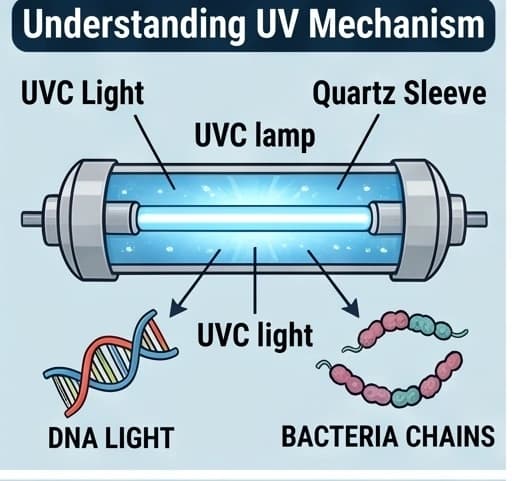
The electromagnetic spectrum between 200 nm and 280 nm is classified as UV-C. At 254 nanometres, DNA and RNA in microbial cells absorb UV-C energy with peak efficiency. Low-pressure mercury UV-C lamps emit approximately 85–90% of their output at exactly 254 nm, which is why they remain the standard lamp technology for a UV water treatment system used in drinking water and food applications worldwide.
Medium-pressure lamps emit a broader polychromatic spectrum (200–400 nm), achieving a faster dose rate and some photolysis of chloramines. They are used in high-flow municipal applications where footprint is constrained. For most Indian industrial, commercial, and institutional UV systems, low-pressure lamps offer the best energy efficiency and operating cost.
DNA Thymine Dimers — Why Pathogens Cannot Recover
When UV-C photons strike a microbial cell, they cause adjacent thymine bases on the DNA strand to bond together, forming thymine-thymine cyclobutane dimers (also called thymine dimers or pyrimidine dimers). These crosslinks prevent the DNA replication machinery from reading the genetic code. The organism cannot reproduce and cannot cause infection — it is described as "inactivated" rather than "killed" because the physical cell may remain intact.
Critically, this inactivation is irreversible under normal water distribution conditions. Some UV-sensitive organisms possess photolyase enzymes that can repair UV-induced damage if re-exposed to visible light (a process called photoreactivation). Maintaining water in dark distribution pipework after a UV water treatment system prevents photoreactivation and is standard practice in well-designed installations.
Log Reduction Explained Simply
Disinfection efficacy is expressed in log reductions — a logarithmic measure of pathogen inactivation:
- 1-log = 90% reduction (1 in 10 survive)
- 2-log = 99% reduction (1 in 100 survive)
- 3-log = 99.9% reduction (1 in 1,000 survive)
- 4-log = 99.99% reduction (1 in 10,000 survive)
- 6-log = 99.9999% reduction (used in pharmaceutical water for injection)
The WHO standard of 40 mJ/cm² delivers 4-log inactivation for E. coli and most waterborne bacteria. Indian drinking water regulations under BIS IS 10500:2012 require zero colony-forming units per 100 mL in the treated effluent — achievable at 40 mJ/cm² for typical source waters with UVT above 75%.
Key Engineering Parameters for a UV Water Treatment System
Selecting the correct UV water treatment system requires understanding four interdependent engineering parameters. Misspecifying any one of them results in either under-dosing (disinfection failure) or over-engineering (wasted capital and operating cost).
| Parameter | Unit | Typical Range | Formula / Notes |
|---|---|---|---|
| UV Dose (D) | mJ/cm² | 16–400 | D = I × t (Intensity × Exposure time) |
| UV Intensity (I) | mW/cm² | 5–150 | Depends on lamp output, sleeve transmission, and chamber geometry |
| Exposure Time (t) | seconds | 0.5–30 | t = Chamber volume (mL) ÷ Flow rate (mL/s) |
| UV Transmittance (UVT) | % at 254 nm | 55–98% | Measured with UV spectrophotometer; 75% minimum recommended for drinking water UV |
| Flow Rate (Q) | LPH or m³/h | 100–5,00,000 | Must be peak instantaneous flow, not daily average |
| Lamp Output (P) | W (UV-C) | 8–320 | Philips TUV lamps rated at ±5% output consistency across 9,000-hour life |
The design dose for a UV water treatment system in India should account for lamp ageing (output at end of rated life) and the actual UVT of the source water — not the UVT of pure tap water. A conservative Indian specification targets 40 mJ/cm² at end-of-lamp-life, at minimum UVT, at peak flow rate. Systems not tested at all three worst-case conditions together are underspecified.
Complete Pathogen Efficacy Table
Different pathogens require different UV doses for inactivation. The table below covers fifteen waterborne pathogens relevant to India, with the UV dose required for 4-log inactivation, a comparison to chlorine (Ct value in mg·min/L), and the disease burden in the Indian context.
| Pathogen | Type | UV Dose for 4-log (mJ/cm²) | Chlorine Ct for 4-log (mg·min/L) | Disease Relevance in India |
|---|---|---|---|---|
| Escherichia coli | Bacterium | 16 | 0.08 | Major cause of traveller's diarrhoea and infant mortality |
| Salmonella typhi | Bacterium | 22 | 0.15 | Typhoid fever — endemic across Bihar, UP, Odisha |
| Vibrio cholerae | Bacterium | 14 | 0.04 | Cholera — monsoon outbreaks in Mumbai, Kolkata, Chennai |
| Shigella dysenteriae | Bacterium | 18 | 0.08 | Bacillary dysentery — high incidence in dense urban areas |
| Pseudomonas aeruginosa | Bacterium | 22 | 30+ | Hospital-acquired infections; critical in pharma water systems |
| Legionella pneumophila | Bacterium | 36 | 20 | Cooling tower risk in commercial buildings, Pune and Bengaluru IT parks |
| Hepatitis A Virus | Virus | 40 | 2 | Waterborne hepatitis A — annual outbreaks, Karnataka, AP |
| Rotavirus | Virus | 36 | 8 | Leading cause of childhood diarrhoea mortality in India |
| Norovirus (Calicivirus) | Virus | 39 | 12 | Outbreak risk in schools and canteens, Maharashtra |
| Adenovirus | Virus | 97 | High | Requires medium-pressure or multi-pass UV; chlorine-resistant strains documented |
| Giardia lamblia (cysts) | Protozoan | 22 | 200+ | Giardiasis — common in borewell-dependent households, Rajasthan |
| Cryptosporidium parvum (oocysts) | Protozoan | 10 | 7,200+ | Effectively immune to chlorine; UV is the only reliable disinfectant |
| Entamoeba histolytica | Protozoan | 75 | 480 | Amoebic dysentery — prevalent across Tier 2 and Tier 3 cities |
| Cyclospora cayetanensis | Protozoan | 20 | High | Traveller's diarrhoea; documented in Delhi and Bengaluru outbreaks |
| MS2 Coliphage (surrogate virus) | Virus surrogate | 186 | High | Used as worst-case virus validation surrogate in WHO UV validation protocols |
Key takeaway: Chlorine cannot reliably inactivate Cryptosporidium at any practical dose level. A UV water treatment system operating at 40 mJ/cm² achieves 4-log Cryptosporidium inactivation, which is the primary reason WHO, US EPA, and Indian CPCB guidelines endorse UV as the preferred alternative or complement to chlorination for surface water treatment.
UV vs Chlorine vs RO vs Boiling — When to Use Each
Choosing the right disinfection technology depends on the nature of the contamination, the application scale, regulatory requirements, and total cost of ownership. The decision table below covers the four most common options for drinking water treatment in India. Ozonation has been excluded as it is not commonly deployed for point-of-use applications in India.
| Criterion | UV Disinfection | Chlorination | Reverse Osmosis (RO) | Boiling |
|---|---|---|---|---|
| Bacteria inactivation | Excellent (4-log at 40 mJ/cm²) | Excellent (with adequate Ct) | Good (physical removal) | Excellent (100°C) |
| Virus inactivation | Excellent (most viruses at 40 mJ/cm²) | Good (poor for adenovirus) | Moderate (depends on membrane integrity) | Excellent |
| Cryptosporidium | Excellent (10 mJ/cm² for 4-log) | Ineffective at practical doses | Good (if membrane intact) | Excellent |
| Dissolved salts / TDS | No effect | No effect | Removes 90–99% | No effect (concentrates salts) |
| Heavy metals | No effect | No effect | Removes 85–99% | No effect |
| Chemical byproducts | None | THMs, HAAs (carcinogenic at high doses) | None | None (but concentrates fluoride) |
| Taste / odour impact | None | Chlorine taste/odour | Neutral to slightly flat | Flat, loses dissolved O₂ |
| Water wastage | Zero | Zero | 40–60% reject water | Zero (but energy wastage) |
| Scalability (industrial) | Excellent (100 to 5,00,000 LPH) | Excellent | Limited above 10,000 LPH (cost) | Not practical above 100 LPH |
| Annual operating cost (1,000 LPH) | Low (lamp + power) | Low (chemical cost) | High (membrane + reject water) | Very high (fuel/electricity) |
| Best for India when | Municipal or borewell water with biological contamination; TDS < 500 ppm | Distribution networks needing residual protection | High TDS borewell water (>500 ppm); fluoride or arsenic areas | Emergency or off-grid use only |
For most Indian cities — Delhi, Bengaluru, Mumbai, Hyderabad, Pune, Chennai, Ahmedabad — where municipal water is chemically treated but carries post-treatment biological contamination risk from ageing pipework, a UV water treatment system in India is the optimal point-of-entry or point-of-use solution. It addresses the actual risk without the cost and waste of RO.
Capacity Sizing Guide for India
The most common sizing error in Indian UV system procurement is using daily demand instead of peak instantaneous flow rate. A UV system must handle the highest flow rate that will occur at any moment — not average hourly or daily consumption. The table below provides typical demand profiles and recommended UV system capacities.
| Application Type | Daily Demand | Peak Flow Rate (LPH) | Recommended UV System | Compliance Reference |
|---|---|---|---|---|
| Single household (4–6 persons) | 200–400 L/day | 100–300 LPH | Residential UV (100–300 LPH) | BIS IS 10500:2012 |
| Apartment block (20–50 flats) | 4,000–10,000 L/day | 1,500–3,000 LPH | Commercial UV (2,000–3,000 LPH) | BIS IS 10500:2012 |
| Restaurant / hotel kitchen | 1,000–6,000 L/day | 500–3,000 LPH | Commercial UV (1,000–3,000 LPH) | FSSAI Food Safety |
| School / college (500 students) | 5,000–7,500 L/day | 2,000–4,000 LPH | Commercial UV (3,000–5,000 LPH) | BIS IS 10500:2012 |
| Hospital (50–100 beds) | 20,000–40,000 L/day | 5,000–10,000 LPH | Industrial UV (SS316L) 10,000 LPH | Schedule M 2025 |
| Food & beverage plant | 50,000–2,00,000 L/day | 10,000–50,000 LPH | Industrial UV (multi-lamp, SS316L) | FSSAI / HACCP |
| Pharmaceutical (WFI loop) | 10,000–50,000 L/day | 3,000–15,000 LPH | Industrial UV (SS316L, validated) | Schedule M 2025 / WHO GMP |
| STP effluent (1 MLD plant) | 10,00,000 L/day | 45,000–55,000 LPH | STP/ETP UV (open channel or pressure) | CPCB effluent standards |
| Community supply (5,000 population) | 5,00,000 L/day | 40,000–60,000 LPH | Municipal UV (50,000 LPH) | BIS IS 10500:2012, CPCB |
| Municipal supply (50,000 population) | 50,00,000 L/day | 3,00,000–5,00,000 LPH | Municipal UV (multi-unit bank) | BIS IS 10500:2012, CPCB |
Pre-Treatment Requirements
A UV water treatment system works by transmitting UV-C light through water. Anything that blocks, absorbs, or scatters UV-C light reduces the dose delivered to pathogens. Pre-treatment ensures the source water reaches the UV chamber with sufficient UV Transmittance.
UVT Guide: When Pre-Treatment Is Mandatory
| Source Water Condition | Typical UVT at 254 nm | Pre-Treatment Required | Recommended Pre-Filter |
|---|---|---|---|
| Clean municipal supply (Delhi, Bengaluru) | 85–98% | Optional (5 micron sediment) | 5 micron PP cartridge |
| Municipal supply with seasonal turbidity | 70–85% | Recommended | 10 micron + 5 micron dual cartridge |
| Borewell water, iron < 0.3 mg/L | 75–88% | Recommended (sediment) | Sand filter + 5 micron |
| Borewell water, iron 0.3–1.0 mg/L | 55–75% | Mandatory | Iron removal filter + 5 micron |
| Borewell water, iron > 1.0 mg/L | < 55% | Mandatory (UV may not be viable alone) | Aeration + green sand filter + 5 micron |
| Surface water (river, pond) | 30–65% | Mandatory | Clarification + multi-media + 1 micron |
| STP effluent (secondary treated) | 50–70% | Mandatory (tertiary polishing) | Multimedia + 25 micron before UV |
| RO permeate | 96–99% | Not required | None (RO output is ideal for UV) |
Turbidity limit: The source water entering a UV-C disinfection system must have turbidity below 1 NTU for drinking water applications (BIS IS 10500:2012 limit). Above 5 NTU, suspended particles shield pathogens from UV-C light, and disinfection efficacy cannot be guaranteed regardless of lamp output. A UV sensor/alarm on the outlet detects UVT drops and alerts operators before a dosing failure occurs.
Iron and manganese: Iron above 0.3 mg/L and manganese above 0.05 mg/L strongly absorb UV-C at 254 nm. Both elements also foul the quartz sleeve over time, reducing UV transmission through the sleeve. In cities like Kolkata, Bhubaneswar, and parts of Jharkhand where groundwater iron is elevated, an iron removal system upstream is not optional — it is a prerequisite for reliable UV water treatment.
System Components Deep-Dive
Lamp Types
The UV lamp is the single most important component in any UV water treatment system in India. Two lamp categories dominate the market:
Low-pressure mercury UV-C lamps emit monochromatic output at 254 nm — the DNA absorption peak. They convert approximately 35–38% of electrical input to UV-C output, making them the most energy-efficient option. Rated life is 9,000–12,000 hours with stable, predictable output decline. Philips TUV lamps in this category maintain ±5% output consistency over their rated life — critical for applications requiring dose documentation.
Medium-pressure UV-C lamps emit polychromatic UV across 200–400 nm. They deliver very high intensity (10–100× low-pressure lamps) and are used where compact chamber design is needed at very high flow rates. They consume more energy and generate more heat. They are the correct choice for large municipal installations (above 1,00,000 LPH) where footprint is constrained.
Unbranded Chinese OEM lamps are widely available in India at 30–50% lower initial cost. However, they typically offer 4,000–6,000 hour rated life, ±25–40% output variation, and no certified UV output data. For applications where dose documentation is required — pharmaceutical, food & beverage, municipal — OEM lamps cannot provide the measurement traceability required for regulatory compliance.
Quartz Sleeve vs PTFE Sleeve
The lamp is sealed inside a sleeve that separates it from flowing water. Two sleeve materials are used:
Fused quartz sleeves transmit UV-C at 90–95% efficiency and are the standard for drinking water and industrial applications. They must be cleaned periodically (fouling by iron, calcium, and biofilm reduces transmission) and replaced if cracked. Thermal shock — caused by turning on a lamp while immersed in cold water — is the primary cause of quartz sleeve failure in Indian installations, particularly in winter months.
PTFE (Teflon) sleeves are used in pharmaceutical and aggressive chemical applications where quartz fouling risk is high or chemical resistance is required. PTFE transmits UV-C at approximately 80% efficiency — lower than quartz — but is chemically inert and does not crack under thermal shock. Schedule M 2025 pharmaceutical applications typically specify PTFE sleeves.
SS304 vs SS316L Chambers
The reactor chamber material determines corrosion resistance and regulatory compliance:
SS304 chambers are suitable for municipal water, commercial drinking water, and STP/ETP applications. They offer adequate corrosion resistance for most Indian water qualities at a lower material cost.
SS316L chambers are required for pharmaceutical WFI loops, food and beverage processing lines, and any application involving frequent chemical sanitisation (CIP/SIP cycles). The addition of molybdenum in 316L provides resistance to chloride pitting — critical in coastal Indian cities such as Mumbai, Chennai, Visakhapatnam, and Kochi, where water chloride levels are elevated.
Ballast, UV Sensor, and Alarm System
The electronic ballast (driver) regulates the current supplied to the UV lamp. A quality ballast maintains constant lamp output regardless of mains voltage fluctuations — important in Indian installations where voltage can vary by ±15% or more. Electronic ballasts also include end-of-life lamp indicators and fault diagnostics.
A UV intensity sensor mounted in the chamber wall continuously monitors real-time UV-C intensity at 254 nm. When intensity drops below the set-point dose threshold — due to lamp ageing, sleeve fouling, or source water UVT decline — the sensor triggers an alarm and, in critical applications, activates a solenoid valve to halt flow. This closed-loop monitoring is the defining feature of a professionally engineered UV water treatment system versus a commodity UV steriliser.
Maintenance Schedule and Costs
Maintenance requirements for a UV water treatment system are substantially lower than for chemical dosing systems, but they are not zero. The two most common failures in Indian installations are lamp non-replacement past rated life and sleeve fouling from iron-rich borewell water.
Recommended Annual Maintenance Schedule
| Maintenance Task | Interval | Consequence If Skipped |
|---|---|---|
| UV lamp replacement | 9,000 hours (~12–18 months continuous) | Dose falls below 40 mJ/cm² — disinfection failure without alarm trigger |
| Quartz sleeve cleaning | Every 6 months (iron-rich water: every 3 months) | Sleeve fouling reduces UV transmission by 10–40% |
| O-ring inspection and replacement | Annually (or at lamp change) | Water ingress into lamp socket — lamp failure, electrical hazard |
| UV sensor calibration | Annually | False readings — under-dosing without alarm |
| Pre-filter cartridge replacement | Every 3–6 months (site-dependent) | Elevated turbidity reduces UV dose effectiveness |
| Inlet/outlet valve function check | Annually | Solenoid valve failure — flow continues during alarm condition |
3-Year Maintenance Cost Comparison: Philips Lamp vs Chinese OEM Lamp
| Cost Element | Philips TUV Lamp (3-year period) | Chinese OEM Lamp (3-year period) |
|---|---|---|
| Lamp replacements required | 2 (at 9,000 h each, continuous use) | 4–5 (at 4,000–5,000 h each) |
| Lamp unit cost (indicative) | Higher initial cost per lamp | 30–50% lower per lamp |
| Total lamp cost over 3 years | Lower (fewer replacements) | Higher (more frequent replacements) |
| Dose consistency | ±5% — dose documentation possible | ±25–40% — dose cannot be reliably documented |
| Regulatory compliance (pharma/F&B) | Yes — certified UV output data available | No — no traceable certification |
| Risk of disinfection failure | Low (predictable decline curve) | Moderate to high (unpredictable output) |
| Certificate of Authenticity | Yes (provided with each lamp) | Not available |
| Quartz sleeve fouling rate | Standard (predictable) | Higher (thermal variation causes early fouling) |
Regulatory Standards in India for UV Water Treatment
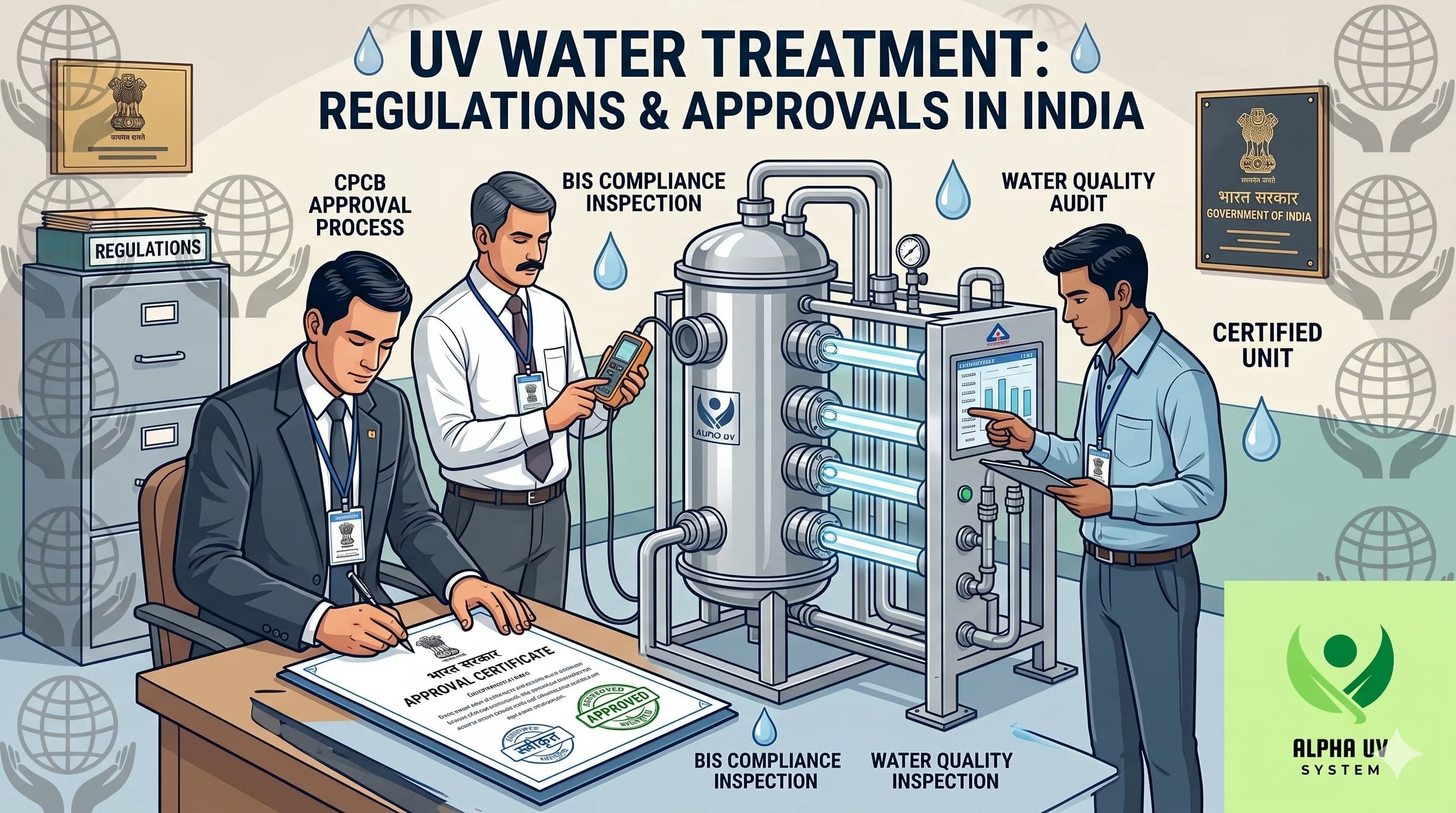
A UV water treatment system in India must comply with multiple overlapping regulatory frameworks depending on the application. Buyers and procurement teams need to verify which standards apply before specifying a system.
BIS IS 10500:2012 — Drinking Water Quality
The Bureau of Indian Standards specification IS 10500:2012 sets the microbiological limits for packaged drinking water and treated municipal supply in India. The critical limit is zero total coliforms and zero faecal coliforms per 100 mL in treated water. A correctly sized and maintained UV water treatment system operating at 40 mJ/cm² consistently meets this standard for source waters with UVT above 75%.
CPCB Effluent Discharge Norms
The Central Pollution Control Board (CPCB) sets effluent discharge norms for STP and ETP outputs. For STP effluent entering surface water bodies, the faecal coliform limit is 1,000 MPN per 100 mL. For effluent used in agriculture or groundwater recharge, the limit is 200 MPN per 100 mL. A UV-C disinfection system at the tertiary treatment stage of an STP is the standard technology used across Indian cities including Noida, Gurugram, Hyderabad, and Pune to meet CPCB discharge norms.
FSSAI Food Safety Standards
The Food Safety and Standards Authority of India (FSSAI) mandates zero coliforms in drinking water used in food processing under the Food Safety and Standards (Food Products Standards and Food Additives) Regulations. Food and beverage manufacturers, ice cream plants, packaged water companies, and restaurants operating under FSSAI licences must demonstrate that water used in product preparation meets microbiological standards. A documented UV water treatment system with UV sensor logging provides the audit trail required for FSSAI inspections.
Schedule M 2025 — Pharmaceutical GMP
The revised Schedule M 2025 under the Drugs and Cosmetics Act tightens pharmaceutical manufacturing water quality requirements in India, aligning closely with WHO GMP guidelines. Pharmaceutical-grade UV systems must use validated lamps, must have UV intensity monitoring with alarm and flow-stop functionality, must be constructed in SS316L, and must provide batch records of UV dose delivered. Alpha UV System supplies Schedule M 2025 compliant industrial UV water treatment systems for pharmaceutical clients across Baddi (Himachal Pradesh), Haridwar (Uttarakhand), and Pune (Maharashtra).
WHO Guidelines for Drinking Water Quality
The World Health Organization's Guidelines for Drinking-water Quality (4th edition) recommend a minimum UV dose of 40 mJ/cm² for drinking water disinfection, with validation under worst-case conditions (end-of-lamp-life, minimum UVT, maximum flow rate). WHO guidelines also specify that UV systems used in public water supply must have validated performance data — not just manufacturer claims. This requirement makes third-party validated UV systems the standard for municipal procurement in India.
Applications by Sector in India
| Sector | Typical Capacity Range | Key Compliance | Alpha UV System Product |
|---|---|---|---|
| Residential (homes, villas) | 100–500 LPH | BIS IS 10500:2012 | Residential UV Series |
| Housing societies / RWAs | 1,000–10,000 LPH | BIS IS 10500:2012 | Commercial UV Series |
| Hospitality (hotels, resorts) | 2,000–20,000 LPH | FSSAI, local municipal | Commercial UV Series |
| Educational institutions | 1,000–10,000 LPH | BIS IS 10500:2012 | Commercial UV Series |
| Food and beverage manufacturing | 5,000–50,000 LPH | FSSAI, HACCP, ISO 22000 | Industrial UV Series (SS316L) |
| Pharmaceutical / API manufacturing | 1,000–20,000 LPH | Schedule M 2025, WHO GMP | Industrial UV Series (SS316L, validated) |
| Hospitals and healthcare | 5,000–50,000 LPH | Schedule M 2025, NABH | Industrial UV Series (SS316L) |
| STP / ETP tertiary treatment | 20,000–5,00,000 LPH | CPCB effluent norms | STP/ETP UV Series |
| Municipal drinking water | 50,000–5,00,000 LPH | BIS IS 10500:2012, CPCB | Municipal UV Series (MSME registered) |
| Defence / cantonments | 10,000–1,00,000 LPH | BIS IS 10500:2012, MES specs | Industrial UV Series |
Alpha UV System has supplied UV water treatment systems to clients across Delhi NCR (Greater Noida, Noida, Gurgaon), Mumbai, Pune, Bengaluru, Hyderabad, Chennai, Kolkata, Ahmedabad, Jaipur, Lucknow, Chandigarh, Bhopal, and Kochi — covering every major Indian industrial and municipal geography.
How Alpha UV System Designs UV Water Treatment Systems
Alpha UV System is an MSME Udyam-registered UV disinfection equipment manufacturer based in Greater Noida, Uttar Pradesh. The engineering team brings IIT-trained technical expertise to system design, with a manufacturing approach that prioritises documentation, component traceability, and long-term performance over initial price.
Engineering Approach
Every UV water treatment system India order begins with a source water analysis requirement. Before recommending a capacity or configuration, the team requests UVT measurements (or advises on-site measurement), source water quality reports, and peak flow rate data. This prevents the most common sizing mistakes that result in chronic disinfection failures.
All drinking water, commercial, and pharmaceutical systems use genuine Philips TUV UV-C lamps — supplied with Certificates of Authenticity and traceable to Philips Signify distribution records. This is particularly important for FSSAI and Schedule M 2025 audits, where component traceability is reviewed.
STP and ETP systems use Philips UV-C lamps selected for their rated output at the operating wavelength and flow conditions of the specific installation. Chamber hydraulics are validated to avoid short-circuiting (where some water passes through the chamber without receiving the full UV dose) — a common failure in low-cost UV systems with poor inlet/outlet geometry.
Documentation and Compliance Support
Alpha UV System provides the following documentation with every industrial and municipal UV water treatment system in India:
- UV dose calculation sheet (site-specific: flow rate, UVT, lamp output, end-of-life safety factor)
- P&ID (Piping and Instrumentation Diagram)
- Operation and Maintenance Manual
- Lamp Certificate of Authenticity (Philips)
- Material Test Certificates for SS304/SS316L chamber
- Installation qualification (IQ) and operational qualification (OQ) support for pharmaceutical clients
- CPCB-format performance data for STP/ETP regulatory submissions
Service and AMC coverage includes Delhi NCR (24–48 hour response), and scheduled field service visits for clients in Bengaluru, Mumbai, Pune, Hyderabad, and Ahmedabad through regional service partners.
Frequently Asked Questions
Does a UV water treatment system kill all pathogens at 40 mJ/cm²?
At 40 mJ/cm², a correctly designed UV water treatment system achieves 4-log (99.99%) inactivation of E. coli, Salmonella, Vibrio cholerae, Rotavirus, Hepatitis A Virus, Giardia cysts, and Cryptosporidium oocysts — the pathogens responsible for the overwhelming majority of waterborne disease in India. Adenovirus requires a higher dose (97 mJ/cm² for 4-log). For installations with documented adenovirus risk, a higher design dose or medium-pressure lamp may be specified. For Indian municipal drinking water applications, 40 mJ/cm² meets all BIS IS 10500:2012 and WHO requirements.
Does UV remove TDS, hardness, or chemical contaminants?
No. A UV water treatment system is a disinfection technology, not a purification technology. It inactivates biological contaminants but has no effect on dissolved salts, total dissolved solids (TDS), hardness, heavy metals, nitrates, fluoride, or chemical contamination. If your source water has TDS above 500 ppm, elevated fluoride (common in Rajasthan, Telangana, Andhra Pradesh), elevated arsenic (common in West Bengal, Bihar, UP), or iron above 0.3 mg/L, the UV water treatment system must be combined with appropriate pre-treatment or a complementary RO system.
How much electricity does a UV water treatment system consume?
Low-pressure UV lamps are highly energy-efficient. A 16W lamp treats 1,000 LPH, consuming 0.016 kWh per hour of operation — equivalent to approximately 0.016 units of electricity per hour at Indian tariff rates, or less than Rs. 1.50 per hour at Rs. 8/unit. A 1,000 LPH residential or small commercial UV water treatment system in India operating 8 hours per day consumes approximately 47 kWh per year — one of the lowest energy footprints of any water treatment technology at equivalent flow rates.
How often does the UV lamp need to be replaced in Indian conditions?
Philips TUV low-pressure UV-C lamps are rated for 9,000 hours of continuous operation. In an installation running 8 hours per day, this equates to approximately 37 months (about 3 years). In continuous 24-hour industrial operation, lamp life is approximately 12–13 months. The lamp's output declines gradually over its life — the end-of-life indicator or UV sensor alarm will signal when output has fallen below the design dose threshold. In Indian borewell water installations with iron above 0.3 mg/L, quartz sleeve fouling can artificially reduce measured UV intensity and should be addressed by cleaning the sleeve before attributing the reading to lamp degradation.
Is water treated by a UV water treatment system safe to drink immediately?
Yes. Water exits a correctly operating UV water treatment system immediately safe for drinking — there is no contact time requirement, no residual chemical, and no need to store the water before use. However, UV-treated water does not carry a disinfection residual. If the treated water is stored in a tank or distributed through a long pipework network, biological re-contamination is possible through post-treatment ingress. For applications with long distribution runs, a small residual chlorine dose downstream of the UV chamber provides ongoing protection in the network — this is standard practice in municipal UV water treatment design in India.
Should I install UV with RO, or is UV alone sufficient?
The answer depends on your source water quality. If your municipal supply has TDS below 500 ppm, no significant heavy metal contamination, and acceptable chemical parameters — but carries biological contamination risk from ageing pipework — a standalone UV water treatment system India is sufficient and more cost-effective than RO+UV. RO wastes 40–60% of input water and removes beneficial minerals unnecessarily if the only concern is biological contamination. If your source is borewell water with high TDS, fluoride, nitrates, or heavy metals, RO is required for chemical quality, and a UV polishing stage on the RO permeate ensures biological safety. Alpha UV System can assess your source water data and recommend the correct configuration — UV alone, UV with pre-treatment, or UV as post-RO polishing.
Conclusion
A UV water treatment system is the most effective, chemically clean, and water-efficient method for biological disinfection available in India today. At 40 mJ/cm² with Philips TUV UV-C lamps, a correctly engineered system delivers 4-log inactivation of all major waterborne pathogens — including Cryptosporidium and Rotavirus, which chlorination cannot reliably address — with zero chemical addition, zero water wastage, and a well-documented maintenance requirement of one lamp replacement every 12–37 months depending on operating hours.
The key to a reliable UV water treatment system in India is correct specification: knowing your source water UVT, sizing for peak flow rate (not daily average), ensuring pre-treatment when iron or turbidity is elevated, and using lamps with certified UV output data when regulatory compliance requires dose documentation.
Alpha UV System manufactures UV water treatment systems in India from 100 LPH residential units to 5,00,000 LPH municipal and industrial systems — all built with genuine Philips UV-C lamps, SS304 or SS316L chambers, and full compliance documentation for BIS IS 10500:2012, CPCB, FSSAI, and Schedule M 2025 requirements. If you are specifying a drinking water UV system, an industrial UV water treatment line, or a municipal water treatment plant UV stage, the Alpha UV System engineering team can provide a site-specific UV dose calculation, capacity recommendation, and quotation within 48 hours.
Contact Alpha UV System — or call 9599500580 — to discuss your UV water filter India requirement and receive a technical proposal backed by IIT-trained engineering.
Standards, authorities & further reading
External references used to inform this guide. Regulations evolve — check the latest revision on each authority's site before compliance decisions.
Recommended UV Systems
Alpha UV System products for this application — powered by genuine Philips UV-C lamps.
Commercial UV Water Purification System
500 – 5,000 LPH
HACCP-compliant UV water purification for hotels, restaurants, and offices
Industrial UV Water Treatment System
5,000 – 50,000 LPH
Schedule M 2025 and HACCP compliant UV for pharma, food & beverage, and process water
Not sure which system suits your application? WhatsApp our engineers for a free recommendation →
Related solutions
See how Alpha UV System applies this to your industry or city.
Need a UV system?
Talk to our UV engineers — WhatsApp for a quote in 2 hours, or browse the full catalog on IndiaMART.