Quick Answer
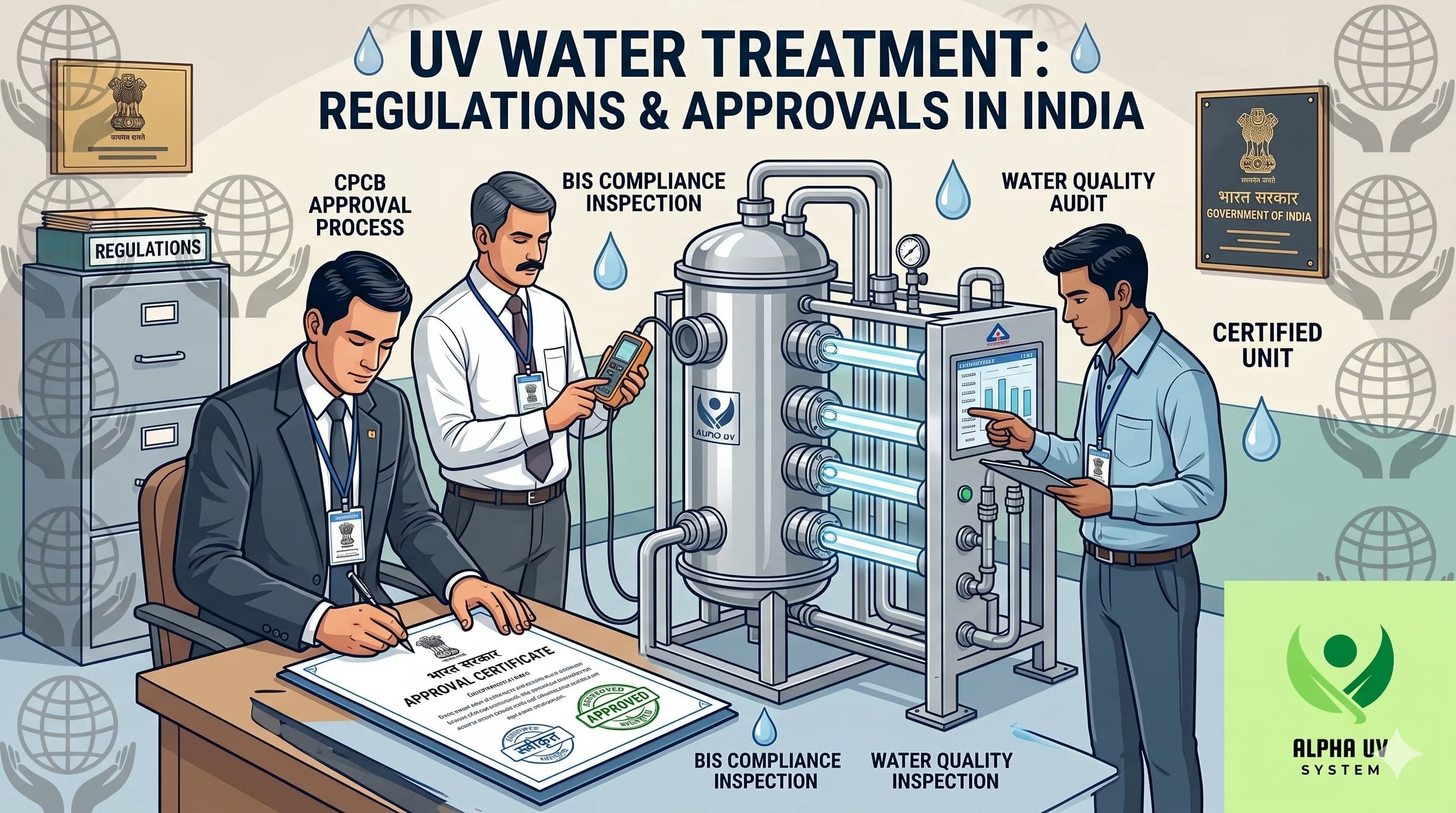
UV water treatment is fully approved and recommended in India by FSSAI (food businesses), BIS IS 10500:2012 (drinking water standard), CPHEEO Manual (municipal water treatment), CPCB (wastewater/STP effluent), and Schedule M 2025 CDSCO (pharmaceutical water). Internationally, UV is validated by WHO, USEPA, EU Drinking Water Directive, and DVGW. No Indian regulation prohibits UV — and several actively recommend it over chlorination for specific applications.
Overview: India's UV Regulatory Framework
UV water treatment approved India regulations span every significant water-use sector in the country. Whether you operate a food business, a pharmaceutical plant, a municipal water utility, or a commercial sewage treatment plant, a clear regulatory basis exists for choosing UV disinfection. No Indian law prohibits UV — on the contrary, five major regulatory bodies explicitly accept or actively recommend it.
Three facts frame this landscape:
- No Indian regulation prohibits UV as a water disinfection method — the legal baseline is permissive across every sector
- Multiple regulators recommend UV over chlorination for specific pathogens, particularly protozoan parasites such as Cryptosporidium and Giardia that resist chlorination at practical doses
- BIS IS 14962:2018 exists as India's dedicated product certification standard for UV systems — a benchmark that confirms the technology is mainstream enough to warrant its own independent standard
The table below maps every major Indian regulatory body to its relevant standard, UV status, and sector coverage.
| Regulatory Body | Relevant Standard / Guideline | UV Status | Sector |
|---|---|---|---|
| BIS (Bureau of Indian Standards) | IS 10500:2012 | UV permitted as disinfection method | Drinking water quality |
| BIS | IS 14962:2018 | Certification standard for UV systems | UV system manufacturers |
| FSSAI | Schedule 4 (water treatment) | UV explicitly listed as approved method | Food and beverage businesses |
| CPHEEO | Manual on Water Supply | UV recommended for Cryptosporidium control | Municipal water treatment |
| CPCB | STP / ETP norms | UV accepted for tertiary disinfection | Wastewater treatment |
| CDSCO / MoHFW | Schedule M 2025 (GMP) | UV accepted for pharmaceutical water | Pharma manufacturing |
BIS Standards for UV Water Treatment
The Bureau of Indian Standards provides the foundational framework for UV water treatment in India through two complementary standards — one defining drinking water quality outcomes and one defining UV system performance requirements. Understanding both is essential for anyone specifying or purchasing a UV system for regulated use in India.
IS 10500:2012 — Drinking Water Specification
BIS IS 10500:2012 is India's primary specification for drinking water quality. It defines acceptable limits for physical, chemical, and microbiological parameters. For microbiological parameters, the standard requires total coliform to be absent in 95% of samples in treated piped water, and E. coli to be absent in any 100 mL sample.
UV disinfection is an accepted treatment method under IS 10500:2012 for achieving these microbiological limits. A correctly sized UV system delivering 40 mJ/cm2 at rated flow meets the standard's microbiological requirements without producing trihalomethanes or other disinfection by-products that chlorination introduces.
IS 14962:2018 — UV Water Treatment Systems
IS 14962:2018 is the product certification standard specifically for UV water treatment systems in India. Manufacturers must satisfy this standard to carry the BIS certification mark. For buyers, the IS 14962 mark is the primary quality verification to check before purchasing. It certifies:
- UV dose validation: the system must deliver a minimum of 40 mJ/cm2 at the rated flow rate under independently tested conditions
- Chamber materials: wetted parts must be food-safe and UV-stable — typically SS 316L stainless steel
- Lamp specifications: lamp type, UV-C output, and replacement intervals documented by the manufacturer
- Performance at rated flow: dose delivery validated at the maximum claimed flow rate, not only at low-flow conditions where any system performs better
IS 14962 certification removes the guesswork about whether a system delivers the dose it claims. Independent testing is materially different from a manufacturer's self-declared specification — a distinction that matters during FSSAI or CPCB compliance audits.
FSSAI Regulations for UV in Food Businesses
FSSAI's position on UV is among the clearest of all Indian regulators. The Food Safety and Standards Regulations make UV disinfection directly applicable to every Food Business Operator (FBO) in the country. Any business preparing, processing, or serving food must provide potable water — and UV is an explicitly approved method for achieving that requirement.
Schedule 4 — Water Used in Food Processing
Schedule 4 of the FSSAI Food Safety and Standards Regulations specifies that water used in food processing must be potable, meeting microbiological and chemical standards equivalent to BIS IS 10500:2012. UV disinfection is listed as an approved treatment method within Schedule 4. A food business installing a UV system and documenting its operation satisfies the water treatment component of FSSAI compliance.
For HACCP-based food safety plans, UV fits naturally as a Critical Control Point (CCP) for water. The critical limit is measurable — UV-C intensity in mW/cm2 — and inline UV-C intensity monitoring provides a continuously verified monitoring mechanism. A Philips UV-C lamp change log and intensity monitoring records together provide an auditable trail for FSSAI inspectors.
| Sector | FSSAI Regulation | UV Role | Documentation Required |
|---|---|---|---|
| Bottled water | IS 14543 | Primary disinfection | BIS IS 14962 certificate, lamp change log |
| Restaurants | Schedule 4 | Water for food preparation | System certificate, maintenance log |
| Dairy processing | Specific dairy regulations | Process water treatment | Installation record, test report |
| Ice manufacturing | IS 4453 | Water before freezing | System spec sheet, monthly lamp check |
| Beverage industry | IS 2346 | Process water | Monthly water quality test, UV log |
For FSSAI audit readiness, a UV system equipped with a Philips UV-C lamp, an inline UV-C intensity monitor, and a maintained lamp replacement log represents the standard configuration that satisfies water treatment documentation across all FSSAI-regulated food sectors.
Schedule M 2025 — Pharmaceutical Water Systems
Revised Schedule M, notified in 2023 and mandatory from 2025, sets GMP requirements for pharmaceutical manufacturing under the Drugs and Cosmetics Act. It is administered by CDSCO (Central Drugs Standard Control Organisation) under the Ministry of Health and Family Welfare.
Schedule M 2025 requires pharmaceutical water to meet Indian Pharmacopoeia (IP), British Pharmacopoeia (BP), or USP specifications. The two principal water grades are Purified Water (PW) for non-sterile manufacturing and equipment cleaning, and Water for Injection (WFI) for sterile product manufacturing with a bioburden limit of 10 CFU/100 mL.
UV disinfection at 254 nm is accepted for bioburden control in both PW and WFI systems. UV units are typically installed at the return of the storage and distribution loop to prevent biofilm accumulation — the primary cause of pharmaceutical water system failures during CDSCO inspections. Schedule M 2025 requires all critical equipment to be formally qualified. For UV systems this means:
- IQ (Installation Qualification): documentation that the UV system is installed per specification, covering materials, connections, and initial instrument calibration
- OQ (Operational Qualification): documented evidence that the system operates within specified parameters — UV-C intensity within validated range, flow rate at specification, alarms functional
- PQ (Performance Qualification): documented evidence that the system consistently produces water meeting pharmacopoeial bioburden specifications under production conditions
- Calibrated UV-C intensity monitoring: with records retained per Schedule M data integrity requirements
- Change control for lamp replacement: Philips TUV lamp replacement must be documented under the site's change control procedure
Pharmaceutical UV systems must use SS 316L wetted components and quartz sleeves. UV-C sensors require calibration at defined intervals using traceable calibration standards.
CPHEEO Guidelines — Municipal Water Treatment
The Central Public Health and Environmental Engineering Organisation (CPHEEO) is the technical arm of the Ministry of Housing and Urban Affairs for water and sanitation. The CPHEEO Manual on Water Supply and Treatment is the primary technical reference for Indian municipal water engineers and forms the basis for most state-level water authority specifications.
CPHEEO recommends UV as primary disinfection for water supplies vulnerable to Cryptosporidium and Giardia — protozoan pathogens that resist chlorination at practical doses but are readily inactivated by UV at 40 mJ/cm2. This reflects growing recognition that surface water and groundwater in India increasingly carry protozoan contamination that chlorine alone cannot reliably address.
CPHEEO endorses a combined treatment approach: UV as the primary pathogen inactivation step, followed by low-dose chlorine for distribution system coverage. This combination reduces total chlorine dose, lowering trihalomethane (THM) formation in the distribution network while maintaining a measurable residual at the consumer tap.
Indian municipalities that have adopted UV include Kerala Water Authority facilities, Tamil Nadu water utility installations, and Delhi Jal Board pilot systems. For new infrastructure, UV is increasingly specified in tenders under AMRUT, Jal Jeevan Mission, and Smart Cities Mission — confirming that UV water treatment approved India regulations now covers mainstream municipal applications, not just experimental pilots.
CPCB Norms — STP and ETP Effluent Disinfection
The Central Pollution Control Board (CPCB) regulates effluent discharge standards for sewage treatment plants (STPs) and effluent treatment plants (ETPs) across India. State Pollution Control Boards implement and enforce these norms at the state level.
CPCB's Class A recycled water reuse standard requires total coliform below 10 MPN/100 mL and E. coli to be undetectable. These microbiological targets make UV the standard final treatment step for STPs treating wastewater for land irrigation, toilet flushing, or cooling tower make-up water in residential complexes, commercial buildings, and industrial facilities.
UV offers specific advantages over chlorination for STP applications:
- No chlorine odour in recycled water: recycled water for garden irrigation or toilet flushing must be odour-free — chlorination residuals create complaints and practical non-compliance with reuse norms
- No trihalomethane formation: UV produces no disinfection by-products, relevant when recycled water contacts building occupants in irrigation or cleaning end uses
- Continuous compliance documentation: UV dose is continuously monitored and logged, providing CPCB and SPCB inspectors with instrumentally verified records
UV is now routinely specified as tertiary disinfection in STPs for residential apartment complexes, commercial parks, hotel complexes, and industrial facilities across India. State-level bylaws in Maharashtra, Karnataka, Tamil Nadu, and Delhi increasingly mandate STP UV disinfection for new developments above a specified occupancy threshold.
International Standards Recognised in India
Indian regulators and buyers increasingly reference international validation standards when specifying UV systems, particularly for pharmaceutical export, food export, and high-specification municipal applications. These international standards complement the Indian regulatory framework and are especially relevant for manufacturers with export obligations.
| Standard | Issuing Body | What It Validates | India Relevance |
|---|---|---|---|
| USEPA UV Disinfection Guidance Manual | US EPA | Dose validation protocol, reactor testing | Accepted by Indian pharma and export food companies |
| DVGW W294 | German Technical Association | UV reactor validation for drinking water | Highest global standard; EU-export companies |
| ONORM M 5873 | Austrian Standards | UV system validation | European suppliers entering India |
| EU Drinking Water Directive 2020/2184 | European Commission | UV as approved treatment | Reference for EU-export Indian food companies |
| WHO Guidelines for Drinking Water Quality | WHO | UV accepted for primary disinfection at 40 mJ/cm2 | Underpins all Indian standards; referenced in CPHEEO Manual |
For Indian food manufacturers exporting to EU or US markets, a DVGW W294-validated or USEPA-compliant UV system provides internationally recognised documentation of process water disinfection quality. This directly satisfies EU FSMS audits and US FDA FSMA preventive control assessments — addressing a common audit finding for Indian food exporters in a single step.
What Regulatory Compliance Means for Indian Businesses
Understanding how approvals translate into sector-specific requirements helps businesses build a defensible, audit-ready compliance position across food, pharma, hospitality, healthcare, and real estate sectors.
Hotels and hospitality: FSSAI FBO licences require potable water for all food and beverage preparation. UV treatment with a Philips UV-C lamp and documented intensity monitoring satisfies FSSAI audit requirements and local health department drinking water inspections.
Hospitals: NABH (National Accreditation Board for Hospitals and Healthcare Providers) standards include specific requirements for hospital water safety. UV is recognised by NABH for hospital drinking water supply, dialysis water pre-treatment, and water supply to immunocompromised patient areas. Lamp change records and UV system maintenance logs must be part of infection control documentation for NABH accreditation.
Schools, colleges, and hostels: UGC and CBSE campus drinking water guidance recommends water meeting BIS IS 10500:2012 microbiological standards. UV treatment is the standard method in school and college drinking water systems across India, and state-level boarding school regulations in Maharashtra, Tamil Nadu, and Kerala specifically reference treated drinking water as a campus health requirement.
Pharmaceutical manufacturers: Schedule M 2025 compliance requires a documented, qualified UV system — not simply an installed unit. CDSCO inspectors verify IQ/OQ/PQ documentation, calibrated intensity monitoring records, and change control records for Philips TUV lamp replacement. Manufacturers exporting to US FDA or EU EMA-regulated markets must additionally document UV systems to USP or EP purified water specifications.
Export food companies: A DVGW W294-validated or USEPA-compliant UV system on process water provides internationally recognised disinfection documentation, satisfying both EU FSMS audits and US FDA FSMA assessments.
Housing societies: Residential complexes in Maharashtra, Karnataka, Tamil Nadu, and Uttar Pradesh must demonstrate water treatment compliance under state RERA norms. UV for apartment drinking water supply combined with STP UV disinfection for recycled water gives committees documented compliance for both potable water and wastewater reuse.
Frequently Asked Questions
Is UV water treatment legally approved in India?
Yes. UV water treatment approved India regulations cover every major sector simultaneously. BIS IS 10500:2012 recognises UV as a permitted drinking water disinfection method. FSSAI Schedule 4 explicitly lists UV as an approved treatment for food businesses. CPCB accepts UV for STP and ETP tertiary disinfection. Schedule M 2025 accepts UV for pharmaceutical water systems. No Indian legislation prohibits UV — on the contrary, multiple regulators actively recommend it for applications where chlorine is technically insufficient, such as Cryptosporidium-vulnerable water supplies.
Do I need BIS IS 14962 certification for my restaurant UV system?
FSSAI does not legally mandate IS 14962 certification for restaurant UV systems. However, IS 14962 is the most reliable verification that a system actually delivers 40 mJ/cm2, based on independent testing rather than manufacturer self-declaration. In practice, FSSAI auditors are more likely to accept a UV compliance claim supported by an IS 14962-certified system. For new installations — particularly licensed food businesses in higher-risk categories such as catering and cloud kitchens — IS 14962-certified systems represent the most defensible compliance position.
Does Schedule M 2025 require UV for pharmaceutical water?
Schedule M 2025 does not mandate UV as the sole disinfection method for pharmaceutical water systems. However, UV is the accepted and widely used method for bioburden control in pharmaceutical water loops because it adds no chemicals, produces no by-products, and is continuously monitorable with calibrated sensors. Most Schedule M-compliant pharmaceutical water systems in India include UV as a standard component. CDSCO inspectors routinely review UV system IQ/OQ/PQ documentation and UV-C intensity monitoring logs during Schedule M GMP inspections.
Is UV disinfection accepted by FSSAI for bottled water production?
Yes. Bottled water production in India is governed by BIS IS 14543, which specifies UV disinfection as an accepted final disinfection method before bottling. FSSAI's licensing of bottled water units as a high-risk food category requires compliance with IS 14543, making UV a standard technology in BIS-compliant bottled water plants. Required documentation includes the BIS IS 14962 certificate for the UV system, a Philips UV-C lamp change log with dates, and periodic water quality test reports from an NABL-accredited laboratory.
Can a municipal water plant switch to UV without regulatory approval?
A municipal plant introducing UV treatment must satisfy the relevant State Water Supply Department and State PCB that the system meets CPHEEO Manual specifications and achieves IS 10500:2012 microbiological outcomes. CPHEEO explicitly recognises UV for municipal use, so no new regulatory approval of the technology itself is required — UV is already within the approved technology set for Indian municipal water treatment. The practical requirement is a validated dose specification at the plant's rated throughput, with documentation submitted to the state authority as part of the infrastructure modification approval.
What documentation should I keep for UV system compliance audits?
A comprehensive UV compliance file for any regulated sector should include: (1) system installation certificate with model number, rated flow, and UV dose specification; (2) BIS IS 14962 certificate where applicable; (3) Philips UV-C lamp specification sheet and replacement log with dates; (4) UV-C intensity monitoring records — continuous log or periodic readings depending on sector requirements; (5) periodic microbiological water quality test reports from an NABL-accredited laboratory; and (6) sector-specific records such as HACCP CCP records for FSSAI, IQ/OQ/PQ qualification documents for Schedule M, or CPCB discharge monitoring records for STP and ETP compliance. For FSSAI audits, a 12-month rolling log is generally sufficient. For Schedule M pharmaceutical audits, data retention follows the specific requirements in Schedule M 2025. Proactively maintaining this file means UV water treatment approved India regulations remains not just a compliance claim but a documented, inspectable fact.
Need a UV System That Meets FSSAI, BIS, or Schedule M Compliance?
Alpha UV System supplies UV water treatment systems with full compliance documentation for FSSAI, BIS IS 14962, Schedule M 2025, and CPCB norms. Our team will confirm the applicable standard and required documentation for your sector and respond within 24–48 hours.
WhatsApp Us for Compliance GuidanceRecommended UV Systems
Alpha UV System products for this application — powered by genuine Philips UV-C lamps.
Commercial UV Water Purification System
500 – 5,000 LPH
HACCP-compliant UV water purification for hotels, restaurants, and offices
Industrial UV Water Treatment System
5,000 – 50,000 LPH
Schedule M 2025 and HACCP compliant UV for pharma, food & beverage, and process water
Not sure which system suits your application? WhatsApp our engineers for a free recommendation →
Related solutions
See how Alpha UV System applies this to your industry or city.
Need a UV system?
Talk to our UV engineers — WhatsApp for a quote in 2 hours, or browse the full catalog on IndiaMART.