Quick Answer: What Is a UV Disinfection System for Water Treatment?
A UV disinfection system for water treatment is a device that exposes flowing water to UV-C light at 254 nm, destroying the DNA of bacteria, viruses, and protozoa so they cannot reproduce or cause disease. The process adds nothing to the water — no chemicals, no taste, no odour — and produces zero wastewater. It is the only disinfection method that inactivates Cryptosporidium at a practical dose, making it essential for drinking water safety in India where surface water and borewell contamination are common.
How a UV Disinfection System for Water Treatment Works
Understanding the physics behind a UV disinfection system for water treatment helps you evaluate any product on the market honestly. The mechanism is straightforward but the engineering tolerances are tight.
The 254 nm Wavelength and Why It Matters
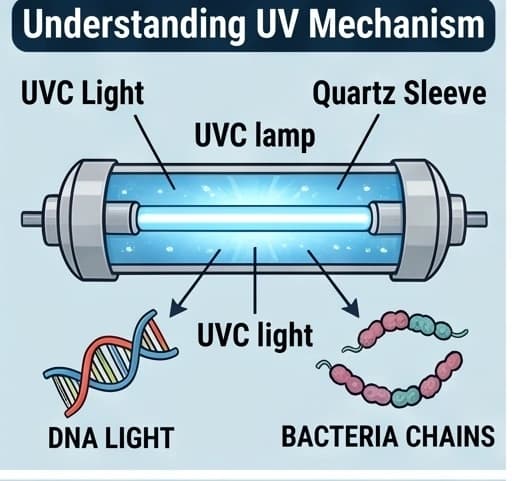
Ultraviolet light spans 100–400 nm. The germicidal window — the range at which nucleic acids (DNA and RNA) absorb UV most efficiently — is 200–280 nm, with a sharp peak at 253.7 nm. A low-pressure mercury UV-C lamp emits approximately 85% of its energy at exactly 253.7 nm, which rounds to 254 nm in published specifications. This alignment between lamp output and biological absorption is why low-pressure Philips TUV lamps remain the industry benchmark for UV-C water treatment.
DNA Damage: How UV-C Kills Pathogens
When UV-C photons at 254 nm penetrate a microbial cell, they are absorbed by the adenine and thymine bases in the organism's DNA. This causes adjacent thymine bases to bond together, forming thymine dimers. These dimers block the enzyme machinery that copies DNA during cell replication. A bacterium or virus that cannot replicate is described as "inactivated" — it may still be physically present in the water but it cannot colonise a host, cannot cause infection, and cannot cause disease. This is the defining mechanism of ultraviolet water purification: not destruction but inactivation.
UV Dose and Log Reduction
Efficacy is expressed as UV dose, measured in millijoules per square centimetre (mJ/cm²), and as log reduction (the number of decimal places by which the pathogen population is reduced):
- 2-log reduction = 99% inactivation (1 in 100 survives)
- 4-log reduction = 99.99% inactivation (1 in 10,000 survives)
- 6-log reduction = 99.9999% inactivation (pharmaceutical and reuse applications)
The standard drinking water design dose in India and internationally is 40 mJ/cm², which achieves greater than 4-log reduction for all primary bacterial and viral pathogens. Pharmaceutical WFI applications typically specify 90–100 mJ/cm², and municipal STP reuse applications may specify up to 120 mJ/cm².
Dose is a product of lamp intensity (irradiance, in mW/cm²) and contact time (seconds). A well-engineered UV disinfection system for water treatment controls both variables precisely: lamp intensity is managed by ballast electronics and lamp quality, and contact time is controlled by chamber hydraulics designed to minimise short-circuiting flow paths.
What Pathogens a UV Disinfection System Kills
The following table shows the UV dose required to achieve 4-log inactivation of the pathogens most relevant to water disinfection in India, along with the disease each pathogen causes.
| Pathogen | Type | Disease | Dose for 4-log (mJ/cm²) | Chlorine-resistant? |
|---|---|---|---|---|
| E. coli | Bacterium | Diarrhoea, UTI | 6 | No |
| Vibrio cholerae | Bacterium | Cholera | 8 | No |
| Salmonella typhi | Bacterium | Typhoid | 10 | No |
| Legionella pneumophila | Bacterium | Legionnaires' disease | 12 | Partially |
| Rotavirus | Virus | Gastroenteritis (children) | 18 | No |
| Hepatitis A virus | Virus | Hepatitis A | 21 | No |
| Giardia lamblia | Protozoan cyst | Giardiasis | 22 | Yes |
| Cryptosporidium parvum | Protozoan oocyst | Cryptosporidiosis | 10 | Yes — highly |
Source: USEPA UV Disinfection Guidance Manual (2006); WHO Guidelines for Drinking-Water Quality. Doses are for 4-log inactivation in clear water (UVT >95%).
The last row is particularly important for waterborne disease prevention in India: Cryptosporidium oocysts are highly resistant to chlorine at any practical dose but are inactivated by UV at just 10 mJ/cm² — well within the standard 40 mJ/cm² design dose of any reputable UV disinfection system for water treatment.
What a UV Disinfection System Does NOT Remove
A UV system is a disinfection device, not a filtration or purification device. It addresses microbial contamination only. If your water has chemical contamination, UV alone is insufficient.
| Contaminant | Does UV Remove It? | Correct Treatment |
|---|---|---|
| TDS / total dissolved solids | No | RO membrane |
| Hardness (calcium, magnesium) | No | Softener or RO |
| Iron / manganese | No | Iron removal filter (pre-treatment) |
| Arsenic | No | Coagulation + RO or activated alumina |
| Fluoride | No | Activated alumina or RO |
| Nitrates | No | RO or ion exchange |
| Pesticides / herbicides | No | Activated carbon + RO |
| Heavy metals (lead, chromium) | No | RO or activated carbon |
This is why a well-designed UV water sterilization installation in India almost always includes pre-filters. Municipal water with acceptable TDS but seasonal bacterial spikes is a good candidate for a standalone UV system. Borewell water with high iron or TDS above 500 mg/L needs pre-treatment before the UV stage — covered in detail below.
UV vs Chlorine vs RO vs Boiling — Comparison Table
When evaluating a UV disinfection system for water treatment, buyers typically compare it against the three alternatives most common in India: chlorination, reverse osmosis, and boiling. Each has a different efficacy profile, operating cost structure, and practical fit.
| Parameter | UV System | Chlorination | RO | Boiling |
|---|---|---|---|---|
| Kills bacteria | Yes (>4-log) | Yes | Mostly | Yes |
| Kills Cryptosporidium | Yes | No | Partial (size exclusion) | Yes |
| Removes dissolved chemicals | No | No | Yes (95%+) | No |
| Alters taste / odour | No | Yes (chlorine taste) | Improves taste | Slight flat taste |
| Wastewater generated | None | None | 25–40% reject water | None |
| Scalable to high flow rates | Yes (100–5,00,000 LPH) | Yes | Yes, but costly | No (<50 LPH practical) |
The most effective approach for most Indian applications — particularly where borewell or municipal water with seasonal coliform spikes is the source — is a UV disinfection system for water treatment paired with a 5-micron sediment pre-filter and, where TDS is elevated, an upstream RO membrane. UV then handles the post-RO microbial polishing without the taste penalty of chlorination and without generating additional reject water.
How to Choose the Right UV System Capacity
Capacity of a UV disinfection system for water treatment is rated in litres per hour (LPH) at the design dose (typically 40 mJ/cm²). The critical design variable is peak instantaneous flow rate, not average daily consumption — because a system dosed at 40 mJ/cm² at its rated flow rate delivers less dose at higher flow rates.
Sizing Formula
Use this formula for any application:
Required LPH = Peak simultaneous demand (LPM) × 60
Where peak LPM = (simultaneous outlets) × (average flow per outlet in LPM)
Add a 20–25% safety margin to account for lamp ageing (UV output declines over lamp life) and water quality variation (UV transmittance drops when turbidity or colour increases).
Application Capacity Reference Table
| Application | Typical Peak Flow (LPM) | Recommended UV System (LPH) | Notes |
|---|---|---|---|
| Residential (1 family, 4 persons) | 3–5 | 300–500 | Single bathroom, kitchen |
| Apartment complex (50 flats) | 20–30 | 1,500–2,000 | Central tank treatment |
| Restaurant / cloud kitchen | 8–15 | 500–1,000 | FSSAI HACCP compliance |
| Hotel (100 rooms) | 60–100 | 5,000–7,000 | Including laundry and kitchen |
| Pharmaceutical (WFI loop) | Varies | 1,000–20,000 | Schedule M 2025 / WHO GMP; 90 mJ/cm² |
| STP tertiary (CPCB reuse) | 500–5,000 | 30,000–3,00,000 | CPCB effluent norms; 100 mJ/cm² |
| Municipal water supply | >5,000 | >3,00,000 | BIS IS 10500:2012; custom design |
Key Components of a UV Disinfection System for Water Treatment
Every commercial-grade UV disinfection system for water treatment contains five core components. Understanding what each does — and what quality looks like — allows you to evaluate competing products on engineering merit rather than price alone.
1. UV-C Lamp
The lamp is the heart of the system. Low-pressure mercury lamps emit 253.7 nm UV-C and are rated for 9,000 hours (approximately 12–18 months of continuous operation). Alpha UV System uses genuine Philips TUV lamps exclusively. Lamp output degrades over time — a lamp at 9,000 hours delivers approximately 70% of its initial UV output, which is why the 9,000-hour replacement schedule is the engineering standard, not a sales recommendation.
2. Quartz Sleeve
The quartz sleeve is a transparent tube that surrounds the UV-C lamp, separating it from the water flow while allowing UV-C transmission. Quartz is used — not glass — because standard borosilicate glass blocks UV-C below 280 nm. High-purity synthetic quartz maintains >90% UV-C transmittance. Scale deposits from hard water accumulate on the outer surface of the sleeve over time, reducing effective UV dose. Annual cleaning with dilute acid solution removes these deposits.
3. Stainless Steel Chamber
The treatment chamber houses the quartz sleeve and lamp, and directs water flow around the sleeve for maximum UV exposure. Food-grade SS 304 is standard for drinking water; SS 316L is specified for pharmaceutical and food and beverage applications where chemical resistance and surface finish (Ra < 0.8 micron for pharmaceutical) are required. Chamber hydraulics matter: a poorly designed chamber allows short-circuiting — where some water moves through so quickly that it receives insufficient UV dose.
4. Electronic Ballast
The ballast is the power control unit that starts and regulates the UV-C lamp. Electronic ballasts (as opposed to older magnetic ballasts) provide stable power output regardless of mains voltage fluctuations — important in India where supply voltage can vary by ±10%. A quality ballast also incorporates lamp-failure alerts and hour-meter functions to track lamp life against the 9,000-hour replacement interval.
5. UV Intensity Sensor (UVI Monitor)
A UV sensor measures the actual UV irradiance at the chamber wall in real time. This is the only component that can confirm the system is delivering the design dose — a lamp can be operating and generating visible light while delivering insufficient germicidal UV-C due to ageing, sleeve fouling, or water quality change. For pharmaceutical, STP, and municipal applications, a UVI monitor with 4–20 mA output and alarm relay is mandatory. For food and beverage, FSSAI HACCP documentation increasingly requires it. For drinking water in apartments and commercial premises, it is best practice.
Pre-Treatment Requirements for UV Disinfection
A UV disinfection system for water treatment only works when the water reaching it is optically clear. UV-C photons are absorbed and scattered by suspended particles and dissolved colour compounds — if particles shield pathogens or absorb UV energy, the effective dose at the pathogen level is lower than the design dose, and disinfection fails.
UVT, Turbidity, and TSS
| Parameter | Unit | Minimum Required | Ideal |
|---|---|---|---|
| UV transmittance (UVT) at 254 nm | % per 10 cm | 75% | >85% |
| Turbidity | NTU | <5 | <1 |
| Total suspended solids (TSS) | mg/L | <10 | <5 |
| Iron (dissolved) | mg/L | <0.3 | <0.1 |
| Manganese (dissolved) | mg/L | <0.05 | <0.02 |
India Borewell Context
Borewell water is the primary drinking water source for a significant portion of India's non-municipal population — particularly in UP, Bihar, Rajasthan, and parts of Karnataka and Andhra Pradesh. Borewell water typically presents elevated iron (0.5–5 mg/L in many zones), moderate turbidity, and high seasonal bacterial load. This combination means a standalone UV water sterilization system will be insufficient and can fail silently — the lamp operates, the ballast shows no alarm, but iron deposits on the quartz sleeve reduce UV dose below the required threshold.
The correct pre-treatment sequence for Indian borewell water before a UV disinfection system is:
- Aeration or iron removal filter (if iron > 0.3 mg/L) — oxidises dissolved iron to particulate form for removal
- Sand filter or multimedia filter — removes suspended solids and turbidity to below 5 NTU
- 5-micron cartridge filter (polypropylene) — final sediment guard before the UV chamber
- UV disinfection system — now operating with optically clear water, delivering reliable germicidal dose
Never install a UV system directly on raw borewell water without pre-treatment. Alpha UV System designs complete pre-treatment sequences as part of our engineering packages — contact us with your water quality report for a pre-treatment recommendation.
Maintenance Guide for UV Disinfection Systems
A UV disinfection system for water treatment is the lowest-maintenance disinfection technology available — but "low maintenance" is not "zero maintenance." The schedule below covers all required maintenance actions with indicative costs at 2026 rates for India.
Lamp Replacement — Every 9,000 Hours
At continuous operation (24/7), 9,000 hours equals approximately 12.5 months. For systems operating 16 hours/day, replacement falls at approximately 18–19 months. Replace the Philips UV-C lamp at this interval regardless of whether visible light output appears normal — UV-C output declines significantly before visible light output does, and a lamp that looks bright may be delivering only 60% of its rated germicidal dose.
Alpha UV System dispatches genuine Philips TUV replacement lamps from our Greater Noida facility. Lamp replacement takes 10–15 minutes and requires no special tools beyond a screwdriver.
Indicative 2026 cost: Philips TUV replacement lamp — Rs. 800–2,500 depending on wattage (11W residential to 95W industrial). Annual Maintenance Contracts (AMC) covering lamp, sleeve inspection, and O-ring are available.
Quartz Sleeve Cleaning — Annually
Remove the quartz sleeve annually and clean with a dilute citric acid solution (2–5%) or a proprietary sleeve cleaner. Scale deposits from hard water — common in Delhi NCR, Rajasthan, and much of north India — reduce UV-C transmission through the sleeve. A visibly yellowed or cloudy sleeve can reduce effective UV dose by 20–40%.
Indicative 2026 cost: Sleeve replacement if cleaning is insufficient — Rs. 400–1,200. Citric acid cleaning solution — Rs. 50–100 per cleaning.
O-Ring Inspection — Annually
The O-rings seal the quartz sleeve end-caps. Inspect annually; replace if the rubber shows hardening, cracking, or deformation. A failed O-ring causes a water leak around the lamp end-cap — visible as a slow drip that can damage the ballast. O-rings are low-cost consumables (Rs. 20–80 each) but the cost of ballast replacement due to water ingress is substantial.
Maintenance Summary Table
| Task | Interval | Time Required | Approx. Cost (2026) |
|---|---|---|---|
| UV-C lamp replacement (Philips TUV) | 9,000 hrs (~12–18 mo.) | 15 min | Rs. 800–2,500 |
| Quartz sleeve cleaning | Annual | 20–30 min | Rs. 50–100 |
| O-ring inspection / replacement | Annual | 10 min | Rs. 20–80 |
| Pre-filter cartridge replacement | 3–6 months | 5–10 min | Rs. 100–300 |
| UVI sensor calibration check | Annual (pharma/STP) | 1–2 hours | Service visit |
UV System Applications in India — Sector Reference Table
The UV disinfection system for water treatment is used across every major sector of the Indian economy where water safety and microbial compliance are required. The following table maps sector to typical capacity range and the primary compliance standard applicable.
| Sector | Typical UV Capacity | Primary Compliance Standard | Key Requirement |
|---|---|---|---|
| Residential / housing societies | 300–5,000 LPH | BIS IS 10500:2012 | Zero coliforms in potable water |
| Hotels and hospitality | 2,000–10,000 LPH | FSSAI / HACCP | Documented process log, no THMs |
| Food and beverage manufacturing | 5,000–50,000 LPH | FSSAI / BIS | Process water microbial limits |
| Pharmaceutical manufacturing | 1,000–20,000 LPH | Schedule M 2025 / WHO GMP | WFI / purified water; 90 mJ/cm² |
| Sewage treatment plants (STP) | 30,000–3,00,000 LPH | CPCB effluent norms | Faecal coliform <100 MPN/100 mL |
| Municipal water supply (ULBs) | >3,00,000 LPH | BIS IS 10500 / Jal Jeevan Mission | Population-scale disinfection |
| Swimming pools | 10,000–50,000 LPH | FINA guidelines / local authority | Crypto control; chloramine reduction |
| Dairy and beverage (CIP rinse) | 5,000–30,000 LPH | FSSAI / FSSC 22000 | Chemical-free final rinse water |
India's waterborne disease prevention burden is significant: the National Centre for Disease Control (NCDC) reports waterborne diseases — including typhoid, cholera, hepatitis A, and acute diarrhoeal disease — as among the top public health priorities across all states. The shift from chlorination to UV-C water treatment in municipal and institutional applications reflects both efficacy advantages (Cryptosporidium, viral coverage) and the absence of regulated disinfection byproducts.
How to Evaluate a UV Disinfection System Supplier
The quality gap between a well-engineered UV disinfection system for water treatment and a poorly made substitute is invisible to the eye — the same stainless cylinder, the same glowing lamp, but one delivers 40 mJ/cm² reliably and the other delivers 18 mJ/cm² at best. Evaluating a supplier on engineering capability rather than price protects your installation.
Lamp Source and Authenticity
Ask for the lamp brand, part number, and proof of purchase from an authorised distributor. Philips TUV lamps (manufactured by Signify, the renamed Philips lighting division) are the global benchmark for UV-C water treatment lamps. Counterfeit and grey-market lamps with Philips-style packaging are common in India. An authorised Philips UV-C lamp supplier will have documentation — ask to see it. Alpha UV System is an authorised Philips UV-C lamp dealer and can provide Signify distribution documentation on request.
Engineering Credentials and Design Documentation
A reputable supplier of a UV disinfection system for water treatment should be able to provide: (a) bioassay validation data or third-party test reports confirming the dose delivered at rated flow, (b) hydraulic design rationale for the chamber, and (c) technical data sheets for the lamp, sleeve, and ballast. Suppliers staffed by IIT-trained engineers with water treatment industry backgrounds can produce these documents and explain the design choices behind them. A supplier who quotes on price alone and cannot produce test documentation is supplying a disinfection device of unknown efficacy.
After-Sales Service and Parts Availability
A UV-C lamp requires replacement every 9,000 hours. A supplier who cannot guarantee genuine Philips TUV lamp availability within 24–48 hours creates a compliance and safety gap at your installation. Evaluate: stock location, lead time for spare parts, AMC structure, and whether service engineers are available in your region with a guaranteed response window. Alpha UV System provides 24–48 hour response across India for spare parts dispatch from Greater Noida, with regional service coverage across north, west, and south India.
Frequently Asked Questions
Is UV-treated water safe to drink directly?
Yes — water treated by a properly functioning UV disinfection system for water treatment at 40 mJ/cm² is safe to drink directly. UV-C inactivates all primary bacterial, viral, and protozoan pathogens without adding any chemical residue. The treated water is chemically identical to the input water; only its microbiological content has changed. No by-products are created, no taste is imparted, and no additional treatment is required for microbial safety after UV treatment.
What happens if the power goes out during UV treatment?
When power is interrupted, a UV disinfection system stops operating. Water that passes through the chamber during a power outage (or immediately after restart, before the lamp reaches operating temperature) does not receive the design UV dose. For critical applications — pharmaceutical, food processing, and municipal — an interlock valve is installed that closes the outlet during lamp warm-up and opens only after the UVI sensor confirms the design dose is being delivered. For residential and commercial installations, a simple precaution is to avoid drawing water for 30–60 seconds after power restoration to allow the lamp to stabilise.
Can I use a UV system directly on borewell water?
Not safely in most cases. Borewell water in India commonly contains dissolved iron, high turbidity, and suspended clay particles that reduce UV transmittance and shield pathogens from UV-C exposure. The correct approach is to install a pre-treatment train — iron removal filter, sand filter, and 5-micron cartridge filter — before the UV system. With proper pre-treatment, ultraviolet water purification works effectively on borewell water and provides reliable microbial safety without the chemical handling challenges of chlorination.
How often do I need to replace the UV lamp?
Replace the UV-C lamp every 9,000 operating hours — approximately every 12–18 months depending on whether the system runs continuously or part-time. Do not rely on the lamp visibly glowing as a sign that it is working: UV-C output declines faster than visible light output. A lamp at 10,000 hours may appear lit but deliver only 55–65% of its rated UV-C output. Most quality ballasts include an hour meter or lamp-life alarm specifically to address this. Genuine Philips TUV replacement lamps maintain output within specification across the 9,000-hour rated life.
Should I choose UV or RO for my home?
It depends on what is wrong with your water. If your municipal or borewell water has acceptable TDS (below 300–400 mg/L) and hardness but seasonal bacterial contamination — a UV disinfection system is the correct choice. It costs less, wastes no water, and preserves beneficial minerals. If your water has high TDS, elevated hardness, or dissolved chemical contamination (arsenic, fluoride, nitrates), RO is required — and a UV polishing stage after the RO membrane is best practice to address any post-membrane microbial risk. Get your water tested first: a basic water quality report (Rs. 500–1,500 from NABL-accredited labs) will tell you which parameters need treatment.
Can I do UV system maintenance myself?
Lamp replacement, quartz sleeve cleaning, and O-ring inspection are all tasks a technically competent end user can perform with basic tools and the manufacturer's maintenance guide. The process involves switching off the system, allowing the lamp to cool (15–20 minutes), draining the chamber, and replacing the specified components. For pharmaceutical, municipal, and food-grade systems where regulatory documentation is required, a qualified service engineer must conduct and certify maintenance. Alpha UV System provides AMC options covering both self-service (parts supplied) and full-service (engineer visit) arrangements depending on application requirements.
Conclusion: Choosing a UV Disinfection System for Water Treatment
A UV disinfection system for water treatment is the most efficient, chemically clean, and scalable disinfection technology available for Indian water conditions. It handles the full spectrum of microbial risk — bacteria, viruses, Cryptosporidium, Giardia — at a design dose of 40 mJ/cm², without adding chemicals, without generating wastewater, and without altering the taste or mineral content of the water.
The keys to a reliable installation are: correct pre-treatment (especially for borewell water), accurate capacity sizing based on peak flow rather than average consumption, genuine Philips TUV lamps from an authorised supplier, and a documented maintenance schedule anchored to the 9,000-hour lamp replacement interval.
Alpha UV System manufactures UV disinfection systems from 100 LPH residential units to 5,00,000 LPH municipal systems at our Greater Noida facility. Our IIT-trained engineering team sizes every system to the application, provides full pre-treatment design, and backs installations with genuine Philips spare parts and 24–48 hour response across India.
Send us your water quality report and flow requirement — we will provide a free engineering recommendation within one business day. Or browse our UV disinfection system range to see capacity, specifications, and compliance documentation for every product.
Standards, authorities & further reading
External references used to inform this guide. Regulations evolve — check the latest revision on each authority's site before compliance decisions.
Recommended UV Systems
Alpha UV System products for this application — powered by genuine Philips UV-C lamps.
Commercial UV Water Purification System
500 – 5,000 LPH
HACCP-compliant UV water purification for hotels, restaurants, and offices
Industrial UV Water Treatment System
5,000 – 50,000 LPH
Schedule M 2025 and HACCP compliant UV for pharma, food & beverage, and process water
Not sure which system suits your application? WhatsApp our engineers for a free recommendation →
Related solutions
See how Alpha UV System applies this to your industry or city.
Need a UV system?
Talk to our UV engineers — WhatsApp for a quote in 2 hours, or browse the full catalog on IndiaMART.