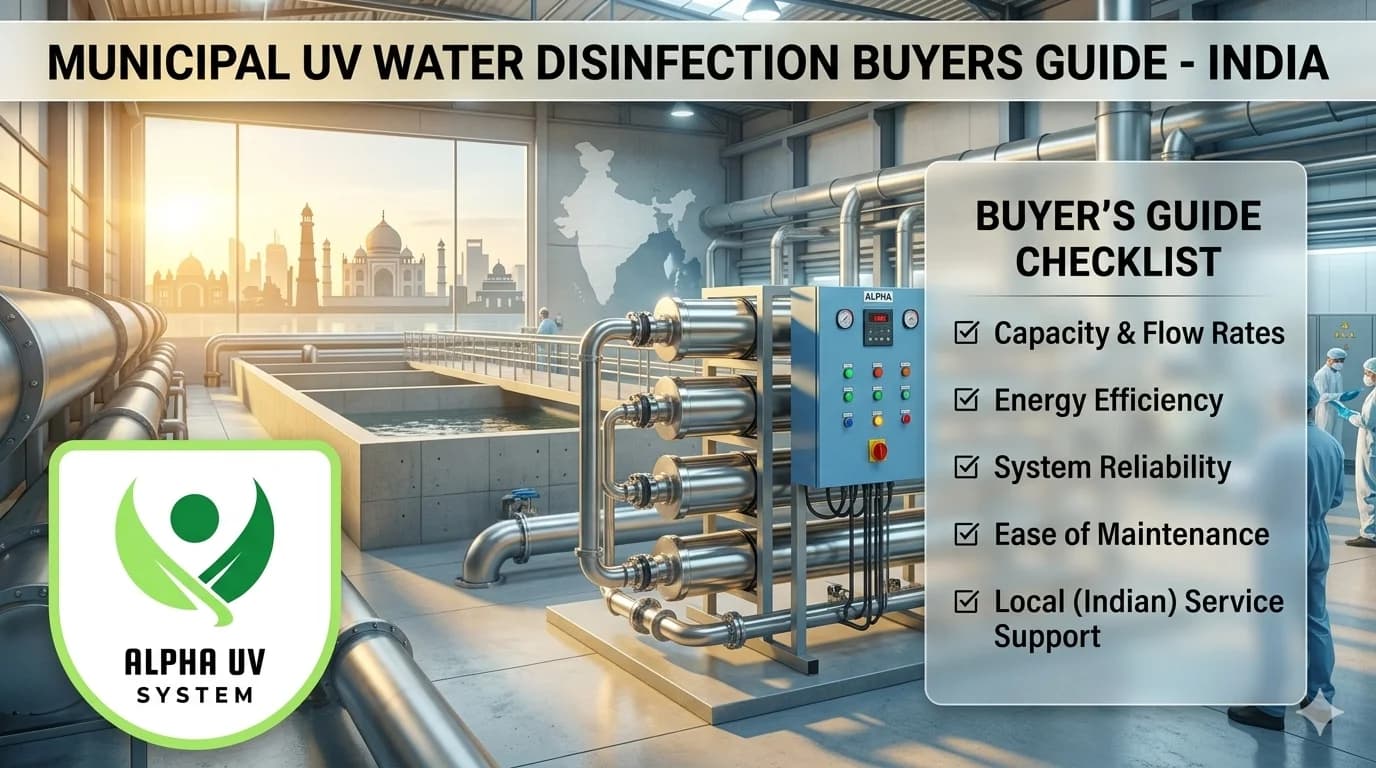
Quick Answer: What Do Indian Municipalities Need to Know About UV Water Disinfection?
Municipal UV water disinfection India deployments require a minimum delivered UV dose of 40 mJ/cm² to satisfy BIS IS 10500:2012's zero-detectable-E. coli standard. Systems must be sized using CPHEEO per-capita supply rates, designed for worst-case seasonal UVT of the source water, and specified in line with BIS IS 17446 for government tender compliance. Open-channel UV is preferred for plants above 2 MLD; closed-vessel UV is cost-effective for smaller municipal supply points including gram panchayat installations funded under Jal Jeevan Mission. Alpha UV System manufactures both configurations, holds ISO 9001:2015, CE, and BIS IS 17446-aligned documentation, and is MSME Udyam registered for government procurement preference.
India's Municipal Water Disinfection Landscape 2026
The Jal Jeevan Mission (JJM), with its mandate of Har Ghar Jal — functional household tap connections for every rural household — has created the largest single pipeline of municipal UV water disinfection India has ever seen. With over 14 crore household tap connections commissioned across rural India by early 2026, the programme has placed gram panchayat bodies, block-level water supply authorities, and state PHE departments directly in the role of UV system procurers and operators at scale.
Alongside JJM, the National Green Tribunal has issued progressive directives requiring municipalities to reduce chlorine residuals in final treated water and to eliminate hazardous chemical storage from residential zones. These twin regulatory pressures — JJM's coverage mandate and NGT's chemical reduction push — have together accelerated the adoption of municipal UV water disinfection India-wide in ways that would not have been predicted even five years ago.
In states like Uttar Pradesh, Haryana, Punjab, and Delhi NCR, state-level PHE departments have begun incorporating UV disinfection as a primary or supplementary treatment step in new water supply schemes from the ground up, rather than retrofitting UV into chlorination-era infrastructure. This shift creates both an opportunity and a procurement challenge: UV water treatment municipality India buyers are often evaluating this technology for the first time, without the institutional knowledge built up over decades of chlorine procurement.
This guide provides the technical framework and procurement checklist that municipal procurement officers and their engineering teams need to evaluate, specify, and procure municipal UV water disinfection in India correctly.
Applicable Standards for Municipal UV Disinfection in India
Municipal UV water treatment municipality India systems must be designed and documented against the following standards:
| Standard | Issuing Body | What It Specifies | Relevance to UV |
|---|---|---|---|
| BIS IS 10500:2012 | Bureau of Indian Standards | Drinking water quality — microbiological, physical, chemical limits | E. coli absent; total coliform <1 MPN/100ml. UV at 40 mJ/cm² consistently achieves this target. |
| BIS IS 17446 | Bureau of Indian Standards | UV water disinfection equipment — performance, construction, testing | Government UV water tender India specifications increasingly mandate IS 17446 compliance. Defines minimum dose, sensor requirements, materials. |
| CPHEEO Manual on Water Supply | Central Public Health and Environmental Engineering Organisation | Design manual for municipal water supply systems — per-capita supply, treatment process design | CPHEEO UV system guidance specifies 40 mJ/cm² minimum dose, open-channel design principles, and per-capita supply rates for sizing. |
| WHO Guidelines for Drinking-water Quality (4th ed.) | World Health Organization | International reference standard for drinking water quality | Referenced in JJM documentation and export-facing projects. Specifies 40 mJ/cm² as reference UV dose for drinking water. |
Municipal UV: Primary vs Supplementary Disinfection
One of the most important decisions in municipal UV water disinfection India design is whether the UV system will function as primary disinfection (sole disinfection treatment) or supplementary disinfection (UV followed by low-level chlorine residual for distribution system protection).
UV as primary disinfection is appropriate where: the distribution system is short (gram panchayat supply within a compact village); the pipe network is new and in good condition; sampling points at the tap can be regularly tested; and end-point storage tanks are covered and hygienic. In these conditions, UV-treated water at 40 mJ/cm² meets BIS IS 10500 microbiological requirements without any chlorine addition.
UV as supplementary disinfection (UV + chlorine residual) is appropriate where: the distribution network is long or aging; storage reservoirs introduce a re-contamination risk; or the state water quality monitoring programme requires a measurable chlorine residual at the tap. In this configuration, UV handles the primary inactivation load — achieving >4-log coliform reduction — while a much lower chlorine dose (0.2–0.5 mg/L residual versus the typical 1–2 mg/L in chlorination-only systems) maintains a residual through the distribution network.
The UV + low-chlorine configuration addresses NGT concerns about chlorination byproducts while preserving the residual protection that long distribution networks require. It is the configuration most commonly recommended by CPHEEO for UV water treatment municipality India systems supplying piped networks with storage above 500 m³.
Sizing Formula and Worked Examples for Municipal UV Systems
CPHEEO UV system sizing begins with design population and per-capita supply rate. The base formula for municipal UV water disinfection India systems is:
Design flow rate (LPH) = Design population × Per-capita supply (LPCD) ÷ Daily supply hours
A 20% peak factor should be applied to the calculated flow rate to determine the UV system nameplate capacity — the UV system must handle peak hourly flow without dose compromise. The worked examples below use CPHEEO per-capita supply rates:
| Settlement Type | Design Population | LPCD (CPHEEO) | Daily Demand (m³/day) | Base LPH (16h supply) | +20% Peak Factor | Specify System Size |
|---|---|---|---|---|---|---|
| Gram panchayat (rural) | 3,000 | 70 | 210 | 13,125 | 15,750 | 18,000 LPH |
| Large gram panchayat | 7,500 | 70 | 525 | 32,812 | 39,375 | 40,000 LPH |
| Census town / small NP | 20,000 | 100 | 2,000 | 1,25,000 | 1,50,000 | 1.5 MLD |
| Municipal council (class C) | 60,000 | 135 | 8,100 | 5,06,250 | 6,07,500 | 6 MLD (open channel) |
| Municipal council (class B) | 1,50,000 | 150 | 22,500 | 14,06,250 | 16,87,500 | 17 MLD (open channel) |
After calculating the flow rate, UV dose design requires a measured UVT value from the site's source water after pre-treatment. The lamp configuration is then specified by the supplier to achieve 40 mJ/cm² at the calculated peak flow and measured UVT. Insist on a dose calculation report — not just a catalogue model number — from any supplier responding to a government UV water tender India.
UVT of Source Water: Seasonal Variation Guide
UV transmittance (UVT) is the percentage of UV-C light that passes through a 1 cm water sample. Low UVT means the water absorbs more UV before it reaches target microorganisms, requiring more lamp power to achieve the same disinfection dose. For BIS IS 10500 UV disinfection India applications, UVT measurement is not optional — it determines the entire lamp sizing of the system.
Source water UVT varies significantly by season, particularly for surface water sources that receive monsoon-season runoff. The UV system must be sized for the worst-case (lowest) seasonal UVT, not the annual average:
| Source Water Type | Typical UVT Range | Worst-Case (Design) UVT | Notes for Indian Municipal Systems |
|---|---|---|---|
| Deep confined groundwater | 88–96% | 88% | Stable year-round. Iron/manganese can reduce UVT — check for dissolved metals. |
| Shallow groundwater / open well | 72–90% | 70% | Monsoon infiltration can cause significant UVT dips. Test in September. |
| River water (post clarification) | 55–82% | 52% | High seasonal turbidity variation. Size UV for post-monsoon worst-case UVT. |
| Reservoir / canal water (post clarification) | 62–85% | 58% | Algal blooms in summer can reduce UVT. Coagulation quality is key variable. |
| Blended groundwater + surface water | 65–88% | 62% | Blending ratio varies seasonally — size for lowest anticipated blend UVT. |
Municipal UV water disinfection India systems receiving surface water should have UVT samples tested at minimum twice per year (pre-monsoon and post-monsoon) and the system should be sized for the lower of the two readings, less a 5% safety margin.
Open-Channel UV vs Closed-Vessel for Indian Municipal Applications
The choice between open channel UV municipal and closed-vessel UV is one of the most consequential design decisions for a municipal UV water disinfection India project. The decision table below summarises the key parameters:
| Parameter | Open-Channel UV | Closed-Vessel UV |
|---|---|---|
| Typical flow range | 2 MLD and above | 10,000 LPH to 2 MLD |
| Civil works required | Concrete open channel integration — substantial civil scope | Inline pipe connection — minimal civil works |
| Operating pressure | Gravity flow — no pump head penalty | System pressure drop 0.3–0.8 bar depending on size |
| Maintenance access | Lamps removed from above without dewatering — excellent for large arrays | Vessel decommissioned for lamp removal — manageable at smaller scale |
| Expandability | Modular lamp rack addition as population grows — excellent | Parallel vessel addition feasible but requires additional pipe manifolding |
| Installation complexity | Higher — channel integration and hydraulic design required | Lower — standard pipe flanges, fast commissioning |
| Capital cost | Higher equipment cost but lower pump energy over life | Lower equipment cost; pump energy cost over time |
| JJM gram panchayat suitability | Not typically appropriate at gram panchayat scale | Primary choice for JJM Jal Jeevan Mission UV gram panchayat supply points |
For most Jal Jeevan Mission UV supply points serving populations below 10,000, a closed-vessel UV system in the 15,000–75,000 LPH range is the appropriate and cost-effective choice. Open channel UV municipal systems are reserved for block-level treatment plants and larger municipal schemes where gravity flow infrastructure already exists.
Design Considerations for Indian Municipal Water Sources
Municipal UV water disinfection India faces source water conditions that are significantly more challenging than the clear, well-controlled groundwater typical in European or North American UV applications. Engineers designing CPHEEO UV systems for Indian conditions must account for:
Surface water turbidity and monsoon conditions. River and canal-fed treatment plants in UP, Haryana, and Punjab experience turbidity spikes of 500–5,000 NTU during monsoon season. UV systems must be preceded by adequate coagulation, sedimentation, and filtration to reduce turbidity below 1 NTU before UV — a standard CPHEEO UV system design requirement. Failure to meet pre-UV water quality standards is the most common cause of UV system underperformance in Indian municipal applications.
Iron and manganese in groundwater. Many JJM Jal Jeevan Mission UV supply schemes draw on groundwater with elevated iron (0.5–5 mg/L) and manganese (0.1–0.5 mg/L). Both absorb UV-C radiation and foul quartz sleeves rapidly. Iron removal (aeration + filtration) must precede the UV system, and sleeve-cleaning mechanisms (automatic or manual wiper systems) must be specified where iron or manganese is present.
Seasonal demand variation. Summer peak demand in north Indian towns can reach 130–140% of average day demand, driven by irrigation, heat, and school break patterns. CPHEEO UV system sizing must incorporate a peak-day factor — standard practice is to size the UV system for peak hour flow, not average day flow.
Power supply reliability. Gram panchayat supply points in rural UP, Haryana, and Punjab often face 8–12 hour power cuts. Municipal UV water disinfection India systems for these locations require either diesel generator backup capability or automatic shutdown with UV-alarm to prevent untreated water from passing through a non-operational lamp array. Alpha UV System's municipal controllers include UV intensity alarm and automatic flow shutoff when UV sensor reading drops below the alarm threshold.
Government Procurement Process for Municipal UV Systems
Government UV water tender India procurement follows state PHE department or urban local body (ULB) tendering procedures, typically under the GeM framework or open tender as applicable. Key procurement process considerations for municipal UV water disinfection India:
MSME Udyam preference. Alpha UV System is MSME Udyam registered. The Government of India's Public Procurement Policy for MSMEs mandates purchase preference for MSME suppliers in government procurement — typically a 15–20% price preference and reservation in certain categories. Procurement officers should verify supplier MSME Udyam registration status when evaluating government UV water tender India responses.
BIS IS 17446 compliance. An increasing number of state PHE departments are specifying BIS IS 17446 compliance as a mandatory technical qualifier in government UV water tender India documents. Suppliers unable to provide BIS IS 17446 documentation should be excluded from technical evaluation.
Make in India preference. JJM procurement guidelines include Make in India preferences. Verify that the UV system proposed is manufactured in India — not imported and re-labelled.
Complete documentation package. For government tender compliance, suppliers must provide: BIS IS 17446 compliance documentation, ISO 9001:2015 certificate, CE marking certificate where applicable, Philips lamp certificates of authenticity, UV dose calculation report for the specified flow and UVT, and references from comparable municipal UV water disinfection India installations.
Tender Specification Checklist for Municipal Procurement Officers
Procurement officers drafting government UV water tender India specifications for municipal UV water disinfection India systems should include the following parameters. The checklist below also indicates whether Alpha UV System meets each requirement:
| Specification Parameter | Recommended Specification Value | Alpha UV System Compliance |
|---|---|---|
| Minimum UV dose at rated flow | 40 mJ/cm² at design UVT | Yes — dose calculation report provided with every quotation |
| UV lamp make | Philips or equivalent with certified UV output data | Yes — Philips UV-C lamps with COA provided |
| Chamber material | SS316L stainless steel | Yes — SS316 standard; SS316L available |
| Quartz sleeve material | UV-grade fused quartz (>90% UV-C transmission) | Yes |
| UV intensity monitoring | Continuous UV sensor with 4–20mA output and alarm relay | Yes — sensor + controller standard |
| UV sensor alarm and flow shutoff | Automatic flow shutoff or alarm when UV intensity drops below setpoint | Yes — included in municipal controller package |
| Electrical safety | IP65 controller enclosure; MCB protection on each lamp circuit | Yes |
| BIS compliance | BIS IS 17446 — mandatory for government UV water tender India | Yes — IS 17446 documentation provided |
| Quality management | ISO 9001:2015 certificate | Yes — current certificate |
| MSME status | MSME Udyam registered preferred | Yes — MSME Udyam registered |
| Spare parts commitment | Lamps and quartz sleeves available within 48 hours of request | Yes — 48-hour dispatch commitment |
| Warranty | Minimum 12 months from commissioning on system components | Yes — 12-month standard warranty |
Supplier Evaluation Guide: 7 Questions for Municipal UV Tenders
Municipal procurement officers evaluating government UV water tender India responses for municipal UV water disinfection India systems should require clear, documented answers to the following seven questions before awarding any contract:
- Can you provide a UV dose calculation report for our specified flow rate and source water UVT? This document, not a catalogue specification, is the only reliable basis for evaluating whether a UV system will achieve BIS IS 10500 compliance at your plant. Any supplier unable to provide a site-specific dose calculation report should be excluded from technical evaluation.
- What UV lamp manufacturer do you use, and can you provide lamp certificates of authenticity? Demand Philips or equivalent with COA serial numbers traceable to manufacturer. Chinese OEM lamps without COA documentation are a compliance and audit risk for government UV water tender India contracts.
- Is your system compliant with BIS IS 17446, and can you provide the compliance documentation? BIS IS 17446 is increasingly mandatory in CPHEEO UV system specifications. Verify the documentation is for the exact model proposed, not a generic company letter.
- Do you hold ISO 9001:2015 certification, and is it current? ISO 9001 is a standard government tender technical qualification. Verify the certificate validity date and the scope of certification (manufacturing of UV systems).
- Can you provide references from comparable municipal UV water disinfection India installations? Ask for plant name, flow rate, commissioning date, and a contact for verification. References from residential or industrial applications are not substitutes for municipal references at comparable scale.
- What is your spare parts supply commitment for lamps and quartz sleeves? Lamp and quartz sleeve availability within 48 hours of order is the minimum acceptable commitment for a municipal supply scheme. Confirm this in writing in the supply agreement.
- Are you MSME Udyam registered, and can you provide your Udyam Registration Certificate? MSME Udyam registration enables government procurement preference. Verify the registration is current and covers UV system manufacturing.
Capital Cost Guide for Municipal UV Systems in India
Capital costs for municipal UV water disinfection India systems vary by capacity, configuration (closed-vessel vs open channel UV municipal), and lamp technology. The ranges below are indicative 2026 supply-only prices from an MSME manufacturer; project costs including civil works, electrical installation, and commissioning will be higher:
| System Capacity | Configuration | Indicative Capital Cost (Supply Only) | Typical Application |
|---|---|---|---|
| 18,000–25,000 LPH | Closed-vessel | INR 1.8–2.8 lakh | JJM gram panchayat, village supply point |
| 40,000–75,000 LPH | Closed-vessel | INR 3.5–5.5 lakh | Large gram panchayat, small census town |
| 1–2 MLD | Closed-vessel (parallel) | INR 7–12 lakh | Census town, small nagar panchayat |
| 2–5 MLD | Open-channel or closed-vessel parallel | INR 14–28 lakh | Municipal council class C, sub-district HQ |
| 5–15 MLD | Open channel UV municipal | INR 30–70 lakh | Municipal council class B/A, district town |
These capital cost ranges assume Philips UV-C lamps, SS316 construction, and UV intensity monitoring with alarm relay. Systems with automatic sleeve-cleaning (for high-iron groundwater applications) add 15–25% to equipment cost but significantly extend quartz sleeve life and reduce maintenance intervention frequency.
Operating Cost Analysis for Municipal UV Disinfection
Annual operating costs for municipal UV water disinfection India systems are driven by three components: electricity, lamp replacement, and maintenance. At municipal scale, all three are highly predictable — a significant operational advantage over chlorine dosing systems where chemical costs vary with procurement cycles and effluent quality.
Electricity. UV system power consumption is proportional to installed lamp wattage. For a well-designed system, energy consumption runs at approximately 8–15 Wh per cubic metre of treated water, depending on UVT and dose. At INR 8–9/kWh (typical state electricity tariff for water supply applications), electricity cost for municipal UV water disinfection India runs at INR 65–135 per MLD per day — or approximately INR 24,000–49,000 per MLD per year.
Lamp replacement. Philips UV-C lamps specified for municipal UV water disinfection India applications have a rated life of 16,000 hours — approximately 2 years at continuous 24-hour operation. At gram panchayat supply (16 hours/day), lamp life extends to approximately 2.7 years. Lamp replacement cost per MLD per year, inclusive of Philips lamps and quartz sleeves (replaced every second lamp cycle), runs at approximately INR 18,000–35,000 per MLD.
Maintenance. Annual maintenance for a municipal UV system includes: sensor calibration, controller inspection, quartz sleeve inspection and cleaning, and electrical connection check. An AMC contract with Alpha UV System covers all scheduled maintenance visits plus 48-hour dispatch of replacement lamps and quartz sleeves for unscheduled failures. AMC rates for municipal UV water disinfection India systems run at 8–12% of equipment supply cost per year.
Total operating cost comparison: well-operated municipal UV water disinfection India costs INR 42,000–84,000 per MLD per year in energy and consumables — typically 40–60% less than sodium hypochlorite dosing at equivalent flow rate when total chemical, dosing equipment maintenance, and compliance documentation costs are included.
Case Studies: Municipal UV Installations by Alpha UV System
UP Township Water Supply STP
A 45,000-population township in western Uttar Pradesh required UV disinfection for its 3 MLD treated water supply scheme. Source water is drawn from a shallow alluvial aquifer with post-monsoon iron levels of 1.2 mg/L and measured UVT of 74%. Alpha UV System designed a closed-vessel UV disinfection system at 2,00,000 LPH capacity with automatic quartz sleeve wipers — necessary given the iron content — and Philips UV-C lamps configured for 48 mJ/cm² at the 74% design UVT. Post-installation coliform testing confirmed zero E. coli detectable in 100 ml samples across all sampling points for six consecutive months post-commissioning. The township authority now uses this installation as the benchmark specification for their remaining two water supply zones.
Delhi NCR Gram Panchayat Water Supply
Under Jal Jeevan Mission UV supply funding, a gram panchayat authority in the Delhi NCR belt procured UV disinfection for three village supply points serving a combined population of approximately 9,000 households. Alpha UV System supplied three 25,000 LPH closed-vessel municipal UV water disinfection units — one per supply point — with individual UV intensity monitoring and controller panels for independent operation. The systems were commissioned within six weeks of purchase order, and the gram panchayat received complete BIS IS 17446 compliance documentation for its JJM programme audit file. All three systems have operated continuously for 14 months with zero microbiological compliance failures.
Haryana Institutional Water Supply
A government educational institution in Haryana with a campus population of approximately 3,500 required UV disinfection for its municipal groundwater supply connection. Source water UVT measured at 81%. Alpha UV System supplied a 20,000 LPH closed-vessel municipal UV water disinfection India unit with wall-mounted controller and RS-485 building management system integration — enabling remote UV intensity monitoring from the campus operations centre. The installation was completed within the institution's government procurement framework with MSME Udyam registered supplier status providing procurement preference documentation.
Spare Parts and AMC for Municipal UV Systems
Municipal water supply cannot tolerate extended UV system downtime. A municipal UV water disinfection India system that is offline for lamp or sleeve replacement is either passing untreated water or has shut off supply — neither is acceptable in a Jal Jeevan Mission context. Alpha UV System's commitment to municipal customers on spare parts availability:
- 48-hour lamp dispatch: Philips UV-C replacement lamps dispatched within 48 hours of order receipt for all Alpha UV System municipal UV installations across India.
- Quartz sleeve availability: Matched quartz sleeves for all Alpha UV System municipal models maintained in stock at our Greater Noida facility.
- AMC coverage: Annual maintenance contracts for municipal UV water disinfection India systems include scheduled biannual maintenance visits, UV sensor calibration, controller firmware updates, and 48-hour emergency lamp dispatch. AMC contracts issued in government-tender-compatible formats for PHE department and ULB procurement files.
- Controller and electrical support: Controller faults diagnosed remotely in most cases. On-site attendance within 48 hours for NCR and UP/Haryana/Punjab locations for hardware faults not resolvable remotely.
FAQ: Municipal UV Water Disinfection India
Is BIS IS 17446 mandatory for all government UV water tenders in India?
BIS IS 17446 is not yet universally mandatory across all state PHE departments, but it is increasingly specified as a mandatory technical qualifier in government UV water tender India documents issued by progressive state PHE departments — particularly in UP, Haryana, and Delhi. Procurement officers are advised to include IS 17446 compliance as a mandatory technical disqualifier in all new UV water tender India specifications, as it is the only Indian Bureau of Indian Standards instrument that specifically governs UV water disinfection equipment quality and performance.
How does MSME preference work in a government UV water tender India?
Under the Government of India's Public Procurement Policy for MSMEs, MSME Udyam registered suppliers receive purchase preference in government procurement. In practice, this means a qualifying MSME supplier is preferred over a non-MSME supplier whose quoted price is within a defined margin. Procurement officers should verify MSME Udyam registration of responding suppliers and document this in the technical evaluation file for audit purposes. Alpha UV System is MSME Udyam registered and can provide its Udyam Registration Certificate with any government UV water tender India response.
At what flow rate should a municipal plant switch from closed-vessel to open-channel UV?
The practical threshold for open channel UV municipal systems is approximately 2 MLD, though site-specific factors can shift this in either direction. Below 2 MLD, closed-vessel UV in parallel configuration is generally more cost-effective and simpler to integrate into existing plant layouts. Above 2 MLD — particularly at existing plants with gravity-flow treated water channels — open-channel UV provides maintenance, expandability, and operating cost advantages that offset the higher initial civil works cost. For CPHEEO UV system design at the 1.5–3 MLD boundary, a detailed site assessment is required before specifying configuration.
What UVT is required for BIS IS 10500 UV disinfection compliance?
BIS IS 10500:2012 does not specify a UVT requirement — it specifies an output water quality standard (E. coli absent; total coliform <1 MPN/100ml). The UV dose required to achieve this standard (40 mJ/cm²) can be achieved at any UVT provided the UV system is correctly sized for that UVT. There is no UVT below which BIS IS 10500 UV disinfection compliance is impossible — but at very low UVT (below 50%), the lamp count required to achieve 40 mJ/cm² at municipal flow rates increases substantially, making UV less economical than alternative disinfection approaches. For most municipal UV water disinfection India source waters (UVT above 60% post clarification), UV is technically and economically viable.
Can Jal Jeevan Mission UV funding be used to procure UV disinfection equipment from an MSME manufacturer?
Yes. JJM Jal Jeevan Mission UV procurement guidelines encourage Make in India and MSME supplier preference. State implementing agencies (SIAs) and gram panchayat level water supply committees can procure UV disinfection equipment through their state PHE department tendering process or through district-level procurement as applicable to their state's JJM implementation framework. Alpha UV System's MSME Udyam registration, BIS IS 17446 documentation, and ISO 9001 certification make it eligible for JJM procurement across all states.
Should a Jal Jeevan Mission UV supply scheme use UV alone or UV + chlorine residual?
For JJM Jal Jeevan Mission UV supply points serving compact villages with short distribution networks and covered overhead storage tanks, UV-only disinfection is appropriate and meets BIS IS 10500:2012 microbiological standards. For schemes with distribution networks longer than 2–3 km, or with aging pipe infrastructure that carries re-contamination risk, the CPHEEO UV system recommended approach is UV as primary disinfection followed by a low-level chlorine residual (0.2 mg/L) maintained through the distribution system. This combined approach dramatically reduces chemical usage versus chlorination-only while maintaining the residual protection that long network distribution requires.
What UV dose is required for BIS IS 10500 compliant municipal drinking water disinfection?
BIS IS 10500:2012 requires zero E. coli per 100 ml and total coliform less than 1 MPN/100 ml. A UV dose of 40 mJ/cm² at the rated flow rate meets this standard for clear water (UVT ≥85%). For turbid or coloured water (UVT 60–85%), systems are sized at 48–60 mJ/cm² to maintain the safety margin across seasonal UVT variation. CPHEEO UV system design guidelines specify 40 mJ/cm² minimum dose calculated at the design flow rate and minimum source water UVT condition.
Is UV water treatment cheaper than chlorination for Indian municipal water supply?
For most municipal applications, UV has lower operating cost than sodium hypochlorite dosing over a 5-year period. Annual UV operating cost (electricity + Philips lamp replacement + AMC) runs at INR 42,000–84,000 per MLD. Sodium hypochlorite dosing at equivalent flow rates costs INR 85,000–1,50,000 per MLD annually including chemical procurement, storage, and dosing equipment maintenance. UV also eliminates chemical storage infrastructure, operator handling hazards, and the disinfection byproduct compliance costs that increasingly apply to large municipal chlorination schemes.
What documentation does a Jal Jeevan Mission UV system require under BIS IS 17446?
BIS IS 17446:2022 governs UV reactor performance, lamp quality, and UV intensity sensor standards for Indian municipal drinking water systems. Documentation required for JJM procurement includes: reactor performance certificate showing validated UV dose at rated flow and UVT; lamp specification confirming Philips or equivalent certified UV-C lamp model; UV intensity sensor calibration certificate from NABL-accredited laboratory; and installation commissioning report with on-site performance verification. Alpha UV System provides complete IS 17446 documentation as a standard deliverable for all municipal UV supply.
AMRUT 2.0 and Smart City UV Projects — Reference Framework
Under the Atal Mission for Rejuvenation and Urban Transformation (AMRUT 2.0), urban local bodies (ULBs) across India are procuring UV disinfection systems as part of water supply improvement projects funded through state government water missions and the central AMRUT grant framework. UV disinfection is explicitly specified in AMRUT 2.0 DPR (Detailed Project Report) guidelines as an acceptable end-of-line disinfection technology for piped drinking water supply schemes in urban areas, alongside chlorination, where residual disinfectant is not required or is undesirable.
Under the Smart Cities Mission (SCM), UV disinfection systems have been procured for water ATMs, tertiary water supply at Smart City command centres, and institutional water supply at Smart City-developed civic infrastructure. UV systems procured under SCM are expected to comply with BIS IS 17446 lamp and reactor performance standards and BIS IS 10500:2012 treated water quality specifications.
Documentation Required for AMRUT / Smart City UV Procurement
- Reactor performance certificate — validated UV dose at rated flow rate and specified minimum UVT (typically 85%)
- BIS IS 17446 compliance — lamp specification, UV intensity sensor calibration (NABL-accredited lab), reactor material (SS316L or equivalent)
- MSME Udyam registration — required for MSME purchase preference under government procurement rules
- ISO 9001:2015 quality certification — standard requirement in AMRUT DPR technical bid qualification
- Commissioning and O&M manual — required for AMC planning and AMRUT audit compliance
- Make-in-India preference — Class I local supplier status under Public Procurement (Preference to Make in India) Order 2017
Alpha UV System is MSME Udyam registered, ISO 9001:2015 certified, BIS IS 17446 documented, and qualifies as a Class I local supplier under the Make in India preference order. We supply complete DPR technical packages — dose calculation reports, reactor performance certificates, NABL sensor calibration certificates — for AMRUT 2.0 and Smart City Mission UV tenders.
Which UV vendors have AMRUT or Smart City Mission project references in India?
UV disinfection system suppliers for AMRUT 2.0 and Smart Cities Mission projects must hold MSME Udyam registration, ISO 9001:2015 certification, and BIS IS 17446 documentation — these are standard qualification requirements in government UV water tender specifications. Alpha UV System is MSME Udyam registered, ISO 9001:2015 certified, BIS IS 17446 documented, and qualifies as a Class I local supplier under the Make in India preference order. We supply complete technical documentation packages for government UV tender submissions: reactor performance certificates, CPHEEO dose calculation reports, NABL-accredited UV intensity sensor calibration certificates, and commissioning reports — the standard deliverable set required for AMRUT 2.0 DPR compliance and Smart City Mission UV procurement.
Conclusion: Procuring Municipal UV Water Disinfection in India
Municipal UV water disinfection India is now a well-established technology with a clear regulatory basis, proven supplier ecosystem, and demonstrated performance across JJM gram panchayat supply points, municipal councils, and institutional water supply schemes in UP, Delhi NCR, Haryana, Punjab, and across India. The key success factors in municipal UV procurement are: correct UVT-based sizing rather than catalogue selection; specification of BIS IS 17446 compliance and Philips UV-C lamp documentation in government UV water tender India documents; configuration choice (open channel UV municipal versus closed-vessel) matched to plant flow rate and civil infrastructure; and long-term supplier commitment to 48-hour spare parts dispatch and AMC coverage.
Alpha UV System manufactures both open-channel and closed-vessel municipal UV water disinfection systems from 18,000 LPH to multi-MLD scale. We are MSME Udyam registered, ISO 9001:2015 certified, CE marked, and BIS IS 17446 documented. Our IIT-trained engineering team provides site-specific CPHEEO UV system dose calculations — not catalogue selections — for every municipal enquiry.
For a detailed proposal on your municipality's UV system requirement — including dose calculation report, BIS IS 10500 compliance documentation, and government tender technical package — visit our municipal UV application page or send your plant details to our team.
Recommended UV Systems
Alpha UV System products for this application — powered by genuine Philips UV-C lamps.
Commercial UV Water Purification System
500 – 5,000 LPH
HACCP-compliant UV water purification for hotels, restaurants, and offices
Industrial UV Water Treatment System
5,000 – 50,000 LPH
Schedule M 2025 and HACCP compliant UV for pharma, food & beverage, and process water
Not sure which system suits your application? WhatsApp our engineers for a free recommendation →
Related solutions
See how Alpha UV System applies this to your industry or city.
Need a UV system?
Talk to our UV engineers — WhatsApp for a quote in 2 hours, or browse the full catalog on IndiaMART.