Quick Answer
Water disinfection is the reduction of pathogenic microorganisms (bacteria, viruses, protozoa) in water to levels that pose no risk to human health or industrial process integrity. The four principal water disinfection methods used in India are: (1) UV disinfection — the industrial and commercial standard, effective against all pathogens including Cryptosporidium, no chemicals required, no residual, lowest operating cost for industrial applications; (2) chlorination — effective against bacteria and most viruses, provides distribution residual, but forms carcinogenic trihalomethanes and cannot inactivate Cryptosporidium at practical doses; (3) boiling — effective at household scale, impractical for volumes above 500 LPH, energy-intensive, provides no protection against post-boiling recontamination; (4) membrane filtration (UF/RO) — removes particles and microorganisms physically, but does not inactivate viruses and requires UV as a downstream disinfection step. In India, water disinfection is regulated under BIS IS 10500 (potable water), CPCB General Discharge Standards (STP/ETP effluent), FSSAI Schedule IV (food and beverage process water), Schedule M (pharmaceutical water), and NABH (hospital water safety). UV disinfection meets all of these standards without chemical addition and is the technology used by Indian manufacturers, hospitals, food processors, and municipal water treatment plants that require continuous, documented, chemical-free disinfection.
Why Water Disinfection Matters in India
India's waterborne disease burden is among the highest in the world. Diarrhoeal diseases — primarily caused by waterborne pathogens — account for an estimated 13% of all deaths in children under five in India (WHO data). For industrial operations, waterborne contamination creates product quality failures, regulatory compliance breaches, recall events, and operational shutdowns that cost orders of magnitude more than the water treatment system that would have prevented them.
The core problem is that water from any natural source — groundwater, river water, municipal supply — carries a microbial load that varies seasonally, geographically, and with upstream land use. Municipal supply water in India meets BIS IS 10500 standards at the treatment plant, but the distribution network — ageing pipes, intermittent pressure causing backflow, open storage tanks, last-mile connections — recontaminates the water before it reaches the tap. A 2023 survey by ICMR across 16 Indian cities found that 30–65% of tap water samples exceeded BIS IS 10500 total coliform limits. For industrial users, this means municipal supply is not a reliable disinfection guarantee — an additional point-of-use disinfection system is required.
Water Disinfection Methods: Complete Comparison
1. UV (Ultraviolet) Disinfection
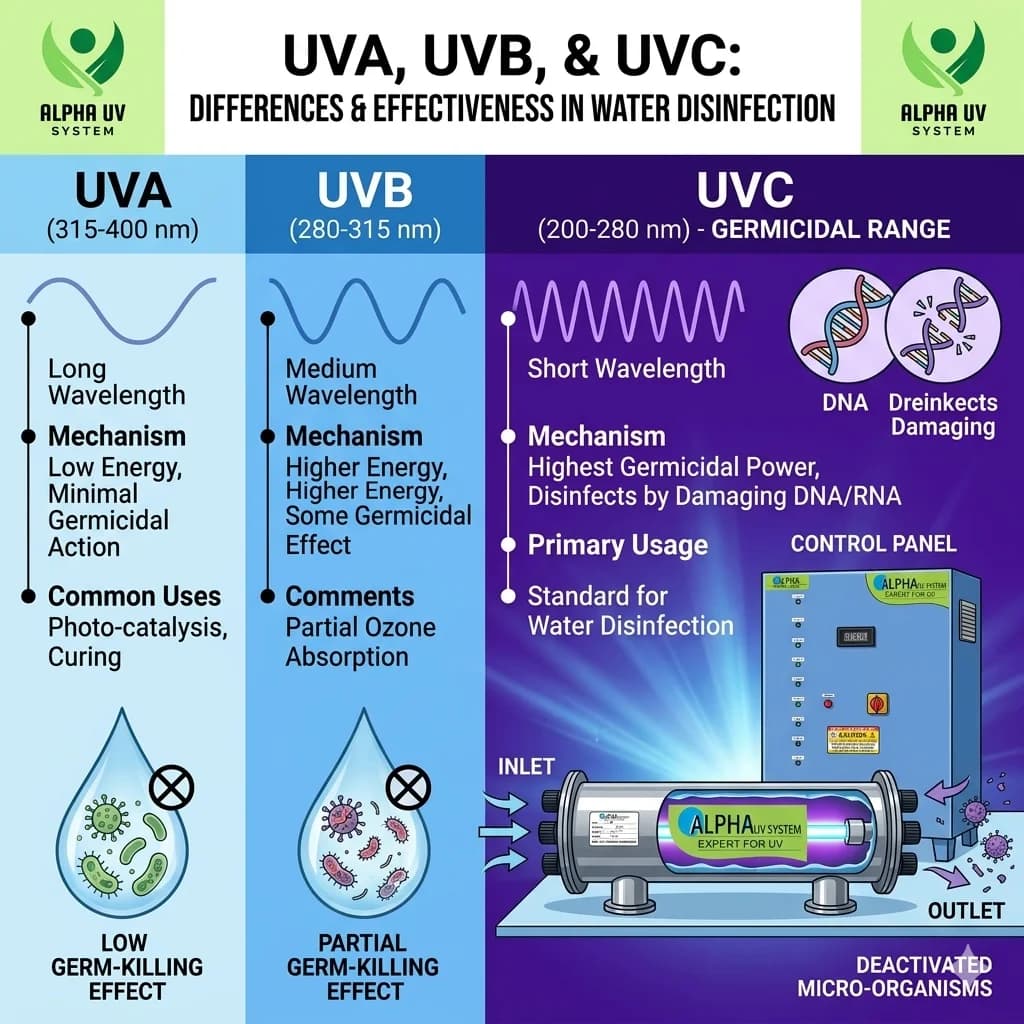
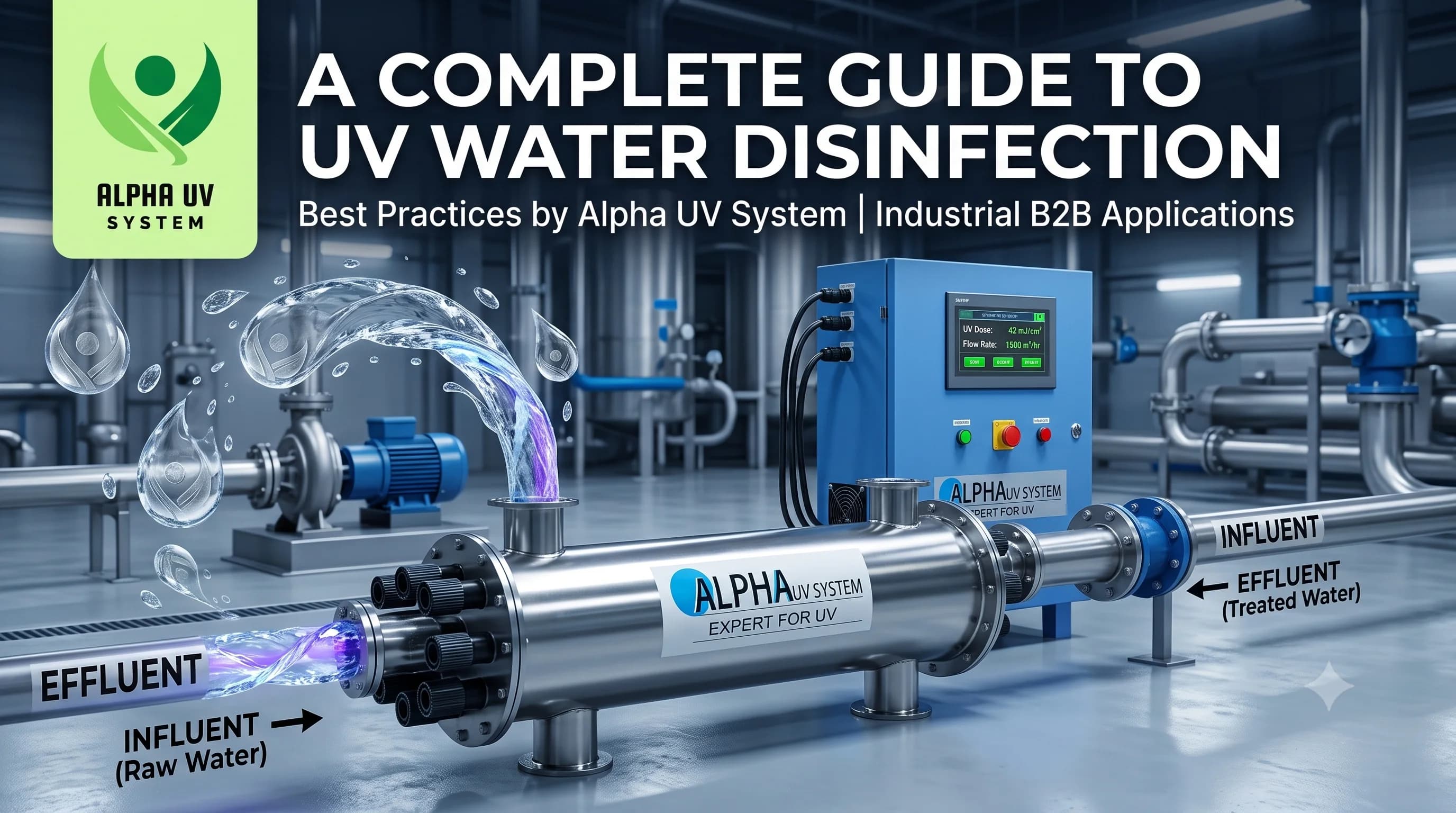
UV disinfection at 254 nm wavelength disrupts the DNA of microorganisms, preventing reproduction. It is effective against bacteria (E. coli, Salmonella, Listeria, Legionella, Campylobacter), viruses (norovirus, hepatitis A, adenovirus, rotavirus), and protozoa (Cryptosporidium parvum, Giardia lamblia — both completely resistant to chlorine). A UV dose of 40 mJ/cm² achieves ≥4-log (99.99%) reduction of bacteria and viruses; 10 mJ/cm² achieves 3-log reduction of Cryptosporidium.
Advantages for Indian industrial applications: No chemical addition, no disinfection byproducts, no taste or odour impact, no regulatory discharge risk from residual disinfectant, continuous automated monitoring with alarm relay, lowest operating cost for flows above 500 LPH, effective against chlorine-resistant protozoa.
Limitations: No distribution residual — cannot protect water that sits in pipes or tanks after the reactor. Pre-filtration to ≤1 NTU turbidity required. Not effective as sole treatment for highly turbid or coloured water without pre-treatment.
2. Chlorination (Sodium Hypochlorite / Chlorine Gas)
Chlorination is the most widely used water disinfection method globally and in India. Free chlorine (as hypochlorous acid HOCl) inactivates bacteria and viruses through oxidation of cell membranes and enzymes. The CT concept (concentration × time, mg·min/L) governs chlorine disinfection — a CT of 0.5–3.0 mg·min/L achieves 99.9% E. coli inactivation. Chlorine maintains a residual in distribution systems, providing ongoing protection against recontamination.
Disadvantages in Indian industrial contexts: Chlorine reacts with natural organic matter in water (humic acids, fulvic acids, from soil runoff) to form trihalomethanes (THMs) and haloacetic acids (HAAs) — carcinogenic compounds regulated under BIS IS 10500 (THM limit: 0.2 mg/L). At residual concentrations above 0.2 mg/L, chlorine imparts detectable taste and odour — unacceptable in food and beverage process water. Chlorine cannot inactivate Cryptosporidium and Giardia at practical concentrations. Chloramine (used as an alternative to free chlorine in some Indian utilities for longer distribution residual) is even less effective against viruses and protozoa, and reacts with bromine in source water to form bromate. Chemical storage and handling create safety, CPCB compliance, and overboard discharge risks.
3. Boiling
Boiling water at 100°C for 1 minute (FSSAI/WHO recommendation) kills all pathogenic bacteria, viruses, and protozoa including Cryptosporidium. It is effective, requires no chemicals or equipment, and is universally understood. However, boiling is impractical for industrial water treatment at any scale above household use:
- Energy cost: boiling 1,000 litres of water requires approximately 115 kWh of electrical energy — at ₹7–9/kWh, this is ₹800–1,000 per 1,000 litres, compared to ₹0.20–0.80 per 1,000 litres for UV disinfection
- Boiling removes dissolved oxygen, giving water a flat taste — unacceptable for beverages and brewing applications
- Boiling does not protect against post-boiling recontamination in the storage or distribution system
- Boiling cannot be monitored continuously — it provides no alarm or documentation output for regulatory compliance
4. Membrane Filtration (UF / RO)
Ultrafiltration (UF) membranes at 0.01–0.1 micron pore size physically remove bacteria and protozoa (and large viruses) by size exclusion. Reverse osmosis (RO) membranes at 0.0001 micron remove virtually all microorganisms, dissolved salts, and organic molecules. Neither UF nor RO is a complete disinfection system on its own:
- UF does not reliably remove small viruses (norovirus 27 nm, hepatitis A 28 nm — smaller than UF pores at integrity test conditions)
- Both UF and RO permeate systems are susceptible to microbial regrowth in storage tanks and distribution loops — low-nutrient, low-TDS water with no disinfection residual creates ideal biofilm growth conditions
- Membrane integrity failures (pinhole defects, o-ring damage, chemical degradation) allow pathogen passage without visual indication
For these reasons, UV disinfection is always installed downstream of UF or RO membranes in systems where microbial safety must be guaranteed — pharmaceutical water systems, hospital water, food and beverage process water. The membrane removes turbidity and particles that would interfere with UV dose delivery; UV then inactivates any remaining or regrowth pathogens.
Water Disinfection Methods: India Industrial Comparison
| Factor | UV Disinfection | Chlorination | Boiling | UF/RO Membrane |
|---|---|---|---|---|
| E. coli inactivation | ✅ 4-log at 40 mJ/cm² | ✅ 4-log at CT 3 mg·min/L | ✅ Complete at 100°C | ✅ Physical removal |
| Cryptosporidium | ✅ 3-log at 10 mJ/cm² | ❌ Resistant | ✅ Complete at 100°C | ✅ UF removes; RO removes |
| Virus inactivation | ✅ 4-log at 40–100 mJ/cm² | ✅ (with adequate CT) | ✅ Complete | ⚠️ UF — partial; RO — good |
| Disinfection byproducts | None | THMs, HAAs (carcinogenic) | None | None |
| Chemical residual risk | None | Overboard discharge risk | None | None |
| Taste / odour impact | None | Detectable above 0.2 mg/L | Flat (O₂ removed) | None |
| Distribution residual | No | Yes — key advantage | No | No |
| Continuous monitoring | UV intensity — automated | Residual analyser needed | Not possible | Pressure differential |
| Operating cost (per 1,000 L) | ₹0.20–0.80 | ₹1.50–4.00 | ₹800–1,000 | ₹8–25 (energy + membrane) |
| Capital cost (500 LPH) | ₹35,000–75,000 | ₹50,000–1,50,000 (dosing system) | Nil (stove/LPG) or high (steam boiler) | ₹2,00,000–8,00,000 |
| FSSAI HACCP compliance | ✅ CCP monitoring documentation | Partial (residual testing needed) | ❌ Not documentable | ✅ Integrity testing |
Water Disinfection Standards in India
BIS IS 10500 — Potable Water
The Indian Standard for potable water quality. Microbiological requirements: zero E. coli per 100 ml (mandatory), zero total coliforms per 100 ml (mandatory). UV disinfection at 40 mJ/cm² reliably meets this standard for pre-filtered water with UVT above 75%.
CPCB Discharge Standards
CPCB General Standards for effluent discharge specify fecal coliform ≤1,000 MPN/100 ml for surface water discharge and ≤200 MPN/100 ml for irrigation reuse. UV disinfection at 40–80 mJ/cm² applied to secondary-treated STP effluent consistently achieves these standards without chemical addition or discharge risk.
FSSAI Water Quality Standards
FSSAI Schedule IV requires all water in contact with food or food processing surfaces to meet BIS IS 10500 at the point of contact. The food safety significance is that bacterial contamination via process water is a direct food safety hazard — UV disinfection provides the CCP monitoring documentation (continuous UV intensity log) that FSSAI auditors accept as evidence of control.
WHO Guidelines for Drinking Water Quality
WHO GDWQ (4th edition) specifies UV as an approved primary disinfection technology for drinking water, with a minimum validated dose of 40 mJ/cm² for 4-log E. coli reduction. WHO identifies UV disinfection as the preferred technology for eliminating Cryptosporidium from drinking water where surface water sources are used.
Which Water Disinfection Method for Your Application
| Application | Recommended primary method | Notes |
|---|---|---|
| Drinking water — household | Boiling (low volume) or UV point-of-use | UV preferred above 100 LPH |
| Drinking water — municipal / institutional | UV primary + low chlorine residual | CPHEEO standard for WTPs |
| Food and beverage process water | UV after carbon filtration | FSSAI HACCP CCP requirement |
| Dairy process water | UV — no chlorine taste risk | Listeria and Salmonella targets |
| Brewery process water | UV — no chlorophenol formation | Chlorine incompatible with brewing |
| Hospital water | UV at building entry + point-of-use | NABH WSP requirement |
| Pharmaceutical purified water | UV after RO + on distribution loop | Schedule M / USP compliance |
| STP effluent — discharge | UV replacing chlorine | CPCB — no THMs, no aquatic toxicity |
| Swimming pool water | UV + reduced chlorine | Cryptosporidium + chloramine control |
| Cooling tower water | UV + biocide reduction | Legionella control — ASHRAE 188 |
Water Disinfection Systems from Alpha UV System
Alpha UV System manufactures UV water disinfection systems for all the applications in this guide — from 100 LPH point-of-use units to 5,00,000 LPH municipal water treatment channel arrays. Our engineering team provides water quality assessment, pre-treatment specification, UV system sizing, and regulatory compliance documentation for FSSAI, CPCB, NABH, BIS IS 10500, and Schedule M audits.
IIT-trained engineers. Philips UV-C lamps. SS316L construction with material certificates. MSME Udyam registered Indian manufacturer. 24–48 hour NCR response. Nationwide project support.
Contact us to discuss your water disinfection requirement: WhatsApp +91 93183 05878 or call +91 95995 00580.
Related guides: UV disinfection systems — complete buyer's guide | UV vs chlorine for drinking water | Is UV disinfection effective against bacteria and viruses? | What contaminants does UV kill in water?
Recommended UV Systems
Alpha UV System products for this application — powered by genuine Philips UV-C lamps.
Commercial UV Water Purification System
500 – 5,000 LPH
HACCP-compliant UV water purification for hotels, restaurants, and offices
Industrial UV Water Treatment System
5,000 – 50,000 LPH
Schedule M 2025 and HACCP compliant UV for pharma, food & beverage, and process water
Not sure which system suits your application? WhatsApp our engineers for a free recommendation →
Related solutions
See how Alpha UV System applies this to your industry or city.
Need a UV system?
Talk to our UV engineers — WhatsApp for a quote in 2 hours, or browse the full catalog on IndiaMART.