Quick Answer: What Water Contaminants Does UV Kill?
UV kills biological contaminants only.
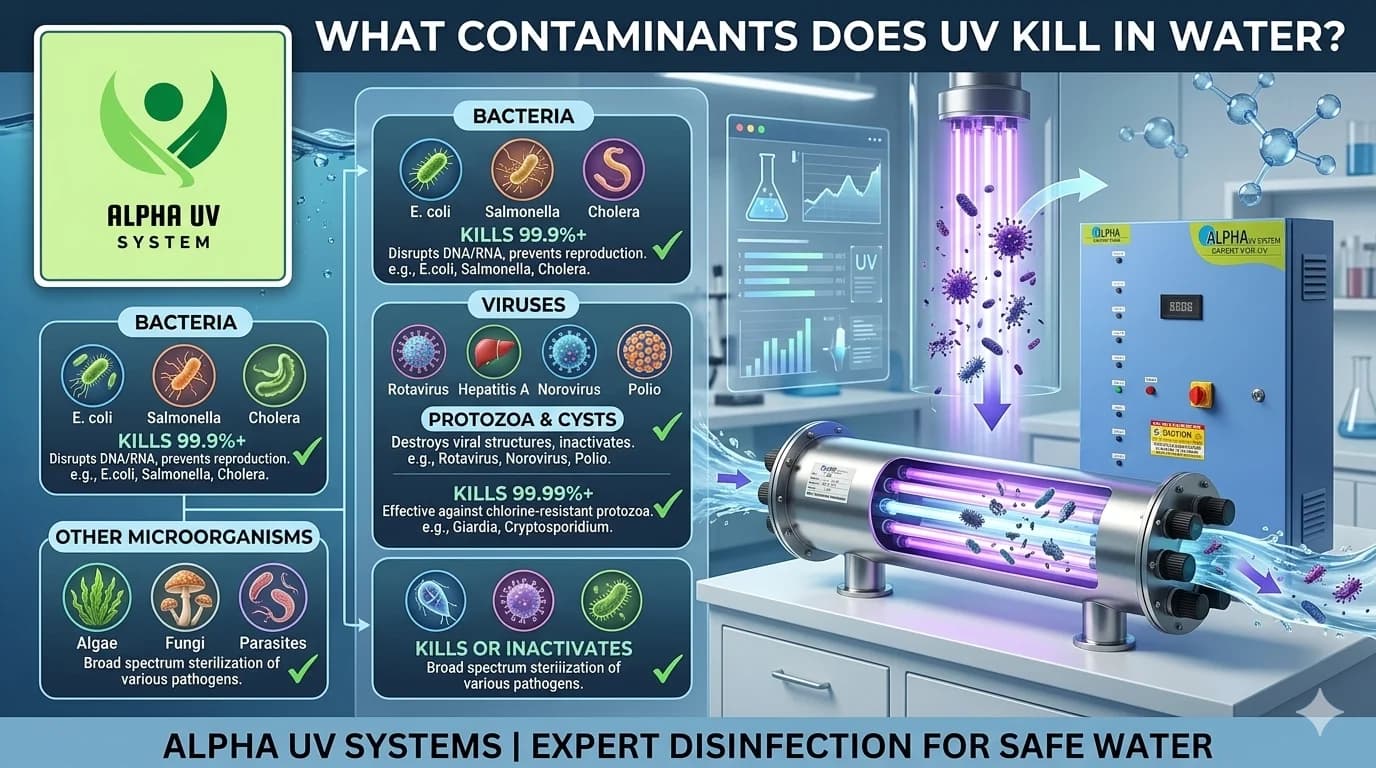
At the standard WHO dose of 40 mJ/cm², UV-C light at 254 nm kills or inactivates all known waterborne bacteria, viruses, and protozoa — including cholera, typhoid, E. coli, Rotavirus, Hepatitis A, Cryptosporidium, and Giardia.
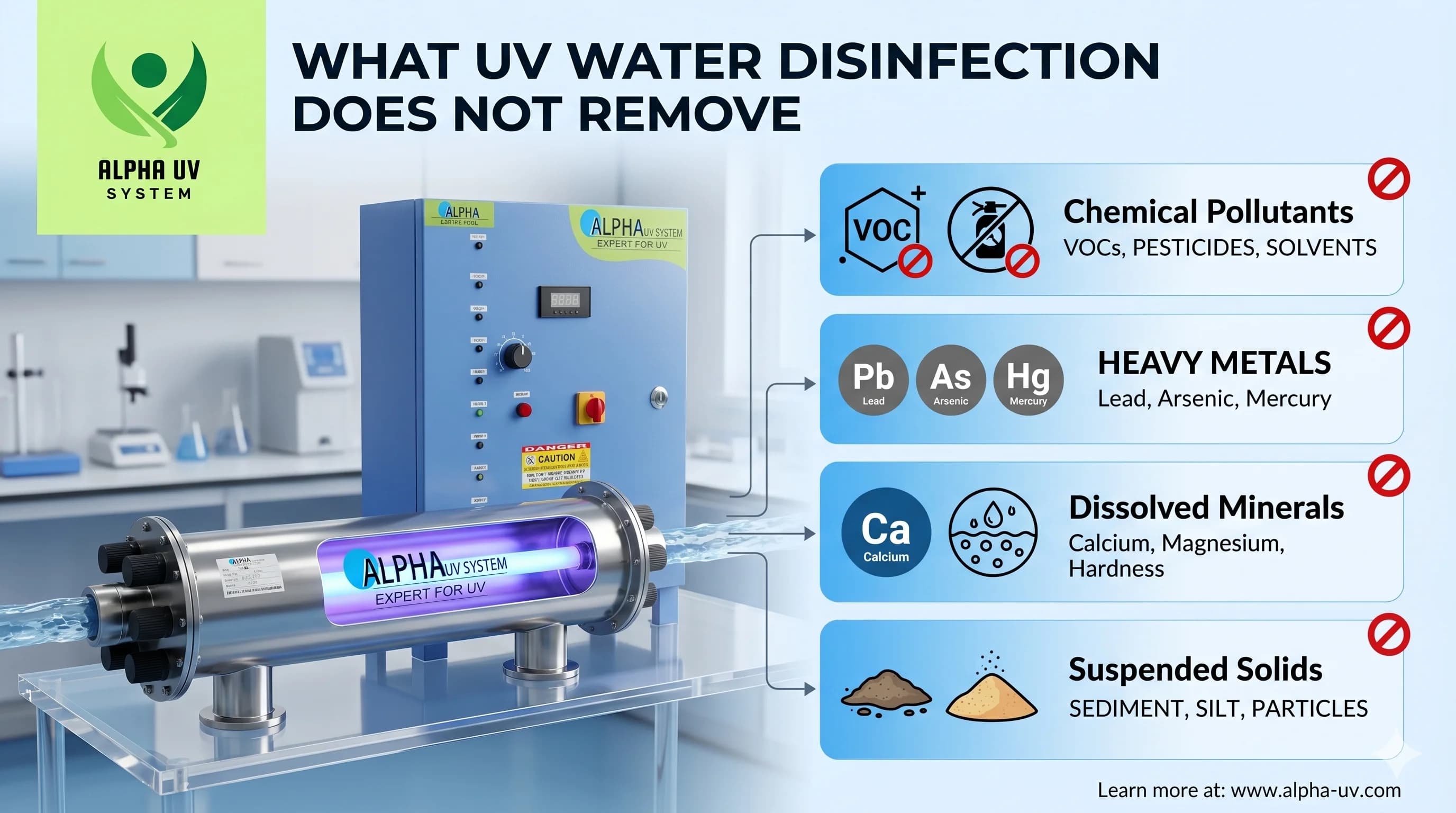
UV has zero effect on: heavy metals, dissolved minerals, pesticides, nitrates, fluoride, pharmaceutical residues, cyanotoxins, or total dissolved solids (TDS). For those, a separate treatment train (RO, activated carbon, greensand) is required alongside UV.
This page provides the complete UV water contaminant kill list, with log-reduction data for Indian waterborne disease pathogens, and is the definitive reference for understanding what a UV water purifier removes — and what it cannot.
The Critical Distinction: Biological vs Chemical Contaminants
Understanding what water contaminants does UV kill starts with a single principle: UV-C radiation works by damaging nucleic acids (DNA and RNA). When UV-C photons at 254 nm strike a microorganism's genetic material, they form thymine dimers — cross-links between adjacent DNA bases that prevent the cell from replicating. An organism that cannot replicate cannot cause infection, even if it remains physically present in the treated water. This is the mechanism behind the UV disinfection pathogen list: it is entirely biological.
Chemical contaminants — pesticides, nitrates, fluoride, arsenic, lead — have no nucleic acids. UV photons pass through or around dissolved chemical molecules without chemically altering them in any meaningful way at the doses used in water treatment. What does UV remove from water, therefore, is a strictly biological answer. Understanding this boundary prevents costly mistakes: a plant manager who installs UV assuming it will reduce arsenic, or a household that stops using RO believing UV will handle fluoride, is making a dangerous error.
The UV water contaminant kill list is deep and comprehensive on the biological side and completely empty on the chemical side. Both facts matter equally.
Complete List: What UV Does Kill and Inactivate
The full UV disinfection pathogen list comprises four categories of biological organisms: bacteria, viruses, protozoa and parasites, and moulds and fungi. What UV kills bacteria across all waterborne pathogenic species is well-established in peer-reviewed literature dating back to the 1970s, with modern standardised testing codified under DVGW W 294, ÖNORM M 5873, and NSF/ANSI 55. The data in every table below is drawn from those validated testing frameworks.
Bacteria Killed by UV at 40 mJ/cm²
Every waterborne pathogenic bacterium of significance in Indian water treatment is inactivated at or well below 40 mJ/cm². The table below covers the UV kills what bacteria list for the pathogens most relevant to drinking water, food processing water, and industrial process water in India.
| Bacterium | Disease Caused | UV Log Reduction at 40 mJ/cm² | Indian Disease Relevance | Notes |
|---|---|---|---|---|
| Escherichia coli (E. coli) | Gastroenteritis, HUS | 4.5-log (99.997%) | Very high — primary indicator in Indian groundwater | Standard regulatory indicator organism; BIS 10500 limit: 0 MPN/100 mL |
| Salmonella typhi | Typhoid fever | 4-log (99.99%) | Very high — endemic in UP, Bihar, MP, Rajasthan | India reports ~500,000 typhoid cases annually; waterborne route dominant |
| Vibrio cholerae | Cholera | 3-log at 6–8 mJ/cm²; 4-log at 40 mJ/cm² | High — monsoon outbreak pathogen across coastal and flood-prone states | Exceptionally UV-sensitive; 40 mJ/cm² is far above minimum required |
| Shigella dysenteriae | Bacillary dysentery | 4-log (99.99%) | High — common in flood-affected areas of Assam, Odisha | UV kills what bacteria cause dysentery with comfortable margin |
| Legionella pneumophila | Legionnaire's disease | 3-log (99.9%) | Medium — emerging concern in hospital HVAC and cooling towers | Biofilm attachment in hot water systems reduces UV access — pre-filtration essential |
| Listeria monocytogenes | Listeriosis | 3.5-log (99.97%) | Medium — food processing water; dairy plants in Punjab, Haryana | FSSAI food safety requires Listeria-free process water |
| Campylobacter jejuni | Bacterial gastroenteritis | >4-log (very UV-sensitive) | Medium — poultry processing water; underreported in India | Global leading cause of bacterial gastroenteritis; inactivated well below 40 mJ/cm² |
| Yersinia enterocolitica | Yersiniosis | 4-log (99.99%) | Low–medium — cold chain water; pork products | Grows at 4°C; relevant in refrigerated food plant water circuits |
| Pseudomonas aeruginosa | HAI, wound and UTI | 3-log (99.9%) | High — hospital water systems; NABH compliance requirement | Biofilm former; planktonic cells killed by UV; biofilm requires pipe hygiene separately |
| Staphylococcus aureus | Skin, systemic infections | 3.5-log (99.97%) | Medium — hospital and pharma grade water | MRSA strains equally UV-sensitive — see antibiotic resistance section below |
| Klebsiella pneumoniae | Pneumonia, UTI | 3.5-log at 40 mJ/cm² | High — healthcare-associated infections; hospital water | NDM-1 carbapenem-resistant strains present in Indian rivers; UV still effective |
| Brucella spp. | Brucellosis | 4-log (99.99%) | Medium — dairy plant water; cattle farming states | Critical in dairy water treatment for FSSAI Grade A compliance |
| Aeromonas hydrophila | Gastroenteritis, wound | >4-log (very UV-sensitive) | Medium — surface water intakes; fish processing plants | Common in Indian freshwater; inactivated well below 40 mJ/cm² |
| Salmonella spp. (non-typhi) | Salmonellosis | 4-log (99.99%) | High — poultry and egg processing water | FSSAI and export audit requirement for food plant process water |
| Total coliform (indicator) | Faecal contamination indicator | 4–5 log | Universal — BIS 10500 regulatory limit is 0 MPN/100 mL | UV routinely achieves BIS 10500 drinking water standard |
Viruses Inactivated by UV at 40 mJ/cm²
What does UV remove from water on the viral side is equally comprehensive for most waterborne viruses. Viruses with single-stranded RNA genomes are generally the most UV-sensitive; double-stranded DNA viruses can be more resistant. The UV disinfection pathogen list for viruses includes all major enteric viruses, with one important exception that practitioners must understand.
| Virus | Disease | UV Dose for 4-log Inactivation | UV Sensitivity | Indian Context |
|---|---|---|---|---|
| Rotavirus | Childhood diarrhoea | ~40 mJ/cm² | High (dsRNA genome) | Leading cause of under-5 diarrhoeal mortality in India; WHO priority pathogen |
| Hepatitis A virus (HAV) | Hepatitis A | ~40 mJ/cm² (3.7-log at 40) | Moderate–high | India is high-endemicity country; waterborne outbreaks in peri-urban clusters |
| Norovirus (via MNV-1 surrogate) | Viral gastroenteritis | ~40 mJ/cm² (3-log) | Moderate | Underdiagnosed in India; major concern for food processing and cruise/hospitality water |
| Poliovirus (types 1, 2, 3) | Poliomyelitis | ~60 mJ/cm² for 4-log; 3-log at 40 | Moderate | India certified polio-free (2014); UV relevant for surveillance water and outbreak risk |
| Enterovirus | Hand-foot-mouth, meningitis | ~40 mJ/cm² (3-log) | Moderate | Seasonal spikes in children; waterborne route confirmed in Indian literature |
| SARS-CoV-2 | COVID-19 | <10 mJ/cm² for 3-log | Very high (ssRNA) | Waterborne transmission secondary; UV highly effective as precaution |
| Influenza virus | Influenza | <10 mJ/cm² | Very high | Air UV application; waterborne route minor but relevant in food plant rinse water |
| Adenovirus (exception) | Respiratory, conjunctivitis, GI | 80–200 mJ/cm² for 4-log | Low (dsDNA; photorepair) | Standard 40 mJ/cm² systems provide only ~2-log kill; medium-pressure UV or dose increase needed |
The adenovirus exception is important for regulatory compliance. In jurisdictions or applications where 4-log virus reduction is required (US EPA LT2, USEPA GWUDI), a medium-pressure UV lamp or dose above 80 mJ/cm² must be specified. The Philips TUV medium-pressure range is designed precisely for this requirement.
Protozoa and Parasites — UV vs Chlorine Kill Comparison
The UV water contaminant kill list reaches its most decisive advantage over chlorine in the protozoa category. Cryptosporidium oocysts and Giardia cysts are encapsulated in hard shells that make them essentially immune to chlorine at any dose practical for municipal or point-of-use treatment. UV disrupts their DNA without needing to penetrate the cyst wall — making UV the only reliable single-pass treatment for these parasites. This is what UV water purifier removes that chlorination cannot.
| Organism | UV Dose for 3-log Kill | Chlorine CT for 3-log Kill | Practical Chlorine at STP Dose? | Indian Waterborne Disease Relevance |
|---|---|---|---|---|
| Cryptosporidium parvum | 3–5 mJ/cm² | >7,200 mg·min/L | No — completely chlorine-resistant at practical doses | High — increasingly detected in Indian waterways; responsible for treatment-resistant diarrhoea in immunocompromised patients |
| Giardia lamblia | 5–10 mJ/cm² | >150 mg·min/L | No — chlorine-resistant at practical doses | High — giardiasis highly prevalent in North India; river and well water contamination common |
| Cyclospora cayetanensis | ~10 mJ/cm² (estimated) | Not established; presumed resistant | Likely no | Medium — emerging in immunocompromised patients; seasonal monsoon spikes |
| Acanthamoeba castellanii | 40+ mJ/cm² | Resistant in cyst form | No | Low–medium — contact lens water; hospital water; corneal infection risk |
| Toxoplasma gondii oocysts | 40 mJ/cm² (significant reduction) | Very high; impractical | No | Low — cat-related waterborne source; immunocompromised patient concern |
For Indian surface water intakes — rivers, lakes, open wells — Cryptosporidium and Giardia contamination is routinely found in CPCB water quality monitoring data. A UV system at 40 mJ/cm² provides a treatment margin far exceeding what is needed for both parasites. This is the primary reason UV is specified in combination with filtration at municipal water treatment plants and hospital water systems.
Moulds, Algae, and Other Biological Contaminants
Beyond the three primary pathogen categories, what does UV remove from water also encompasses fungal and algal organisms. This part of the UV disinfection pathogen list is relevant for food processing plants, pharmaceutical water, and surface water treatment where biological fouling is a concern.
| Organism | UV Sensitivity | Dose for Kill | Application Where Relevant | Notes |
|---|---|---|---|---|
| Aspergillus niger spores | Moderate | 100–200 mJ/cm² for high log reduction | Pharmaceutical water; cleanroom rinse water | Spores more resistant than vegetative cells; high-dose UV or medium-pressure lamp specified |
| Candida albicans | Moderate–high | 40 mJ/cm² | Hospital water; dialysis water | Fungal water contamination concern in immunocompromised wards; NABH-relevant |
| Chlorella spp. (algae) | High | 40–60 mJ/cm² | Surface water intake; cooling tower water | Cell kill does not remove algal metabolites — separate carbon treatment needed |
| Microcystis aeruginosa (cyanobacteria) | High for cells | 40–100 mJ/cm² for cells; toxins NOT removed | Lake and reservoir intakes; CPCB compliance | Critical caveat: cell lysis by UV releases intracellular microcystin — must combine with activated carbon |
| Penicillium spp. | Moderate | 80–150 mJ/cm² for spores | Food plant rinse water; brewery water | Spoilage mould; relevant in tropical climates with high ambient humidity |
Complete List: What UV Does NOT Kill or Remove
The UV water disinfection "does not remove" list is as important as the kill list. A complete understanding of what water contaminants does UV kill requires knowing the hard boundary. UV is biological treatment only. Dissolved molecules, suspended non-living particles, and chemical species are entirely unaffected.
| Contaminant Type | Specific Examples | UV Effect | Correct Treatment | Indian States Where Relevant |
|---|---|---|---|---|
| Arsenic | As(III), As(V) | None | Coagulation-filtration, RO, iron co-precipitation | West Bengal, Bihar, Assam, Jharkhand — WHO limit 10 µg/L regularly exceeded |
| Fluoride | Dissolved fluoride ion | None | RO, activated alumina defluoridation, Nalgonda process | Rajasthan, Gujarat, AP, Telangana — endemic fluorosis districts; BIS limit 1.0 mg/L |
| Nitrates | NO₃⁻ from agricultural runoff | None | RO, ion exchange, biological denitrification | Punjab, Haryana, MP — high fertiliser use areas; methemoglobinaemia in infants |
| Lead | Pb²⁺ from old plumbing | None | RO, cation exchange, KDF media | Urban India — galvanised iron/lead-solder plumbing in buildings pre-1990 |
| Iron and Manganese | Dissolved Fe²⁺, Mn²⁺ | None (high dissolved iron damages UV lamp by fouling quartz) | Aeration + greensand filter or oxidation filtration; must remove before UV | West Bengal, Odisha, Chhattisgarh — high iron borewell water common |
| TDS / Dissolved salts | Chlorides, sulphates, sodium | None | RO membrane filtration | Coastal states, arid states — high TDS groundwater; BIS 500 mg/L drinking limit |
| Hardness | Ca²⁺, Mg²⁺ bicarbonates | None (scale can form on quartz sleeve) | Water softener (ion exchange), RO; quartz sleeve cleaning schedule if hard water | Rajasthan, UP, Gujarat — hard water common; above 300 mg/L affects UV lamp efficiency |
| Pesticides | Endosulfan, chlorpyrifos, DDT, malathion | None at standard doses; some photodegradation at very high doses not practical in water treatment | Activated carbon (GAC), RO | Agricultural states — Punjab, Haryana, AP; well water near farms |
| Pharmaceutical residues | Antibiotics, hormones, NSAIDs | None | Advanced oxidation (UV/H₂O₂), activated carbon, nanofiltration | Hyderabad bulk drug cluster; CETP discharge into rivers — emerging contaminant concern |
| Cyanotoxins | Microcystin-LR, anatoxin, cylindrospermopsin | None — UV cannot degrade dissolved cyanotoxins | Activated carbon (powdered or granular); UV/H₂O₂ at very high doses | Hussain Sagar lake (Hyderabad), Powai lake (Mumbai); eutrophic reservoirs nationwide |
| Chlorine and DBPs | Free chlorine, THMs, HAAs | UV at 254 nm does photolyse some free chlorine; DBPs not removed | Activated carbon, aeration | Chlorinated municipal water — post-chlorination point-of-use concern |
| Sediment and turbidity | Sand, silt, suspended clay | None — particles are not removed; high turbidity blocks UV penetration and protects pathogens | Multi-media filter, cartridge filter; always pre-treat before UV | Monsoon season across India — turbidity spikes in all surface intakes |
| Chromium (VI) | Hexavalent chromium from industrial effluent | None | Chemical reduction + precipitation; RO for residual | Industrial corridors — Ludhiana, Vapi, Kanpur tannery belt |
| Mercury and Cadmium | Hg²⁺, Cd²⁺ | None | RO, chelation, activated carbon for Hg | Electronic waste recycling zones; chlor-alkali plant discharge zones |
| Biofilm (established) | Organisms embedded in pipe-wall biofilm matrix | None — UV only acts on planktonic organisms passing through the chamber | Chlorination, pipe cleaning, physical scrubbing, silver-impregnated media | All distribution systems; hospital piped water networks |
Pathogen Priority for Indian Water: UV Protection Status
India's waterborne disease burden is shaped by monsoon hydrology, rapid urbanisation outrunning sewage infrastructure, and a large proportion of the population dependent on groundwater of variable quality. The pathogens most relevant to what water contaminants does UV kill in the Indian context are Rotavirus, typhoid, cholera, Hepatitis A, and Cryptosporidium — all of which are effectively handled at 40 mJ/cm².
| Pathogen | Disease | Indian Prevalence | UV Kills at 40 mJ/cm²? | Additional Notes |
|---|---|---|---|---|
| Rotavirus | Severe childhood diarrhoea | Very high — estimated 78,000 under-5 deaths/year (pre-vaccine era); remains leading cause of hospitalised diarrhoea | Yes — 4-log at 40 mJ/cm² | Vaccination now available; UV protects against vaccine-mismatched strains |
| Salmonella typhi (Typhoid) | Enteric fever | Very high — India accounts for ~26% of global typhoid burden; endemic in most states | Yes — 4-log at 40 mJ/cm² | Drug-resistant strains (XDR typhoid) emerging; UV efficacy unaffected by antibiotic resistance |
| Vibrio cholerae (Cholera) | Cholera | High — seasonal monsoon outbreaks; major flood-event risk in Bihar, Odisha, West Bengal | Yes — 4-log at 40 mJ/cm² (requires only 6–8 mJ/cm² for 3-log) | Fastest-acting UV kill; extreme sensitivity to UV-C |
| Hepatitis A virus | Hepatitis A | High — India hyperendemic; adults in urban areas increasingly susceptible due to improved sanitation paradox | Yes — 3.7-log at 40 mJ/cm² | Foodservice water treatment critical; restaurant and school water systems |
| Cryptosporidium parvum | Cryptosporidiosis | Medium–high and rising — detected in Indian rivers by CPCB; HIV-positive patients at highest risk | Yes — 5-log at 40 mJ/cm² (only 3–5 mJ/cm² needed for 3-log) | Completely chlorine-resistant; UV is the treatment of choice |
| E. coli (ETEC) | Traveller's diarrhoea, community gastroenteritis | Very high — most common bacterial pathogen in Indian drinking water surveys | Yes — 4.5-log at 40 mJ/cm² | Primary BIS 10500 indicator; UV routinely achieves regulatory standard |
| Giardia lamblia | Giardiasis | High — highly prevalent in North India; children and travellers most affected | Yes — 3-log at 5–10 mJ/cm²; 5-log at 40 mJ/cm² | Chlorine-resistant; UV significantly outperforms chlorination |
| Adenovirus | Respiratory and GI infection | Medium — seasonal; waterborne route secondary | Partial — 2-log at 40 mJ/cm²; 4-log requires 80–200 mJ/cm² | Specify medium-pressure Philips TUV lamp or elevated dose if adenovirus is a design criterion |
Biofilm: The Critical Caveat in UV Disinfection
When assessing what water contaminants does UV kill, the biofilm limitation is the most practically important caveat. UV disinfection is a flow-through process: water passes through the UV chamber, and planktonic (free-swimming) microorganisms in the water column are exposed to UV-C and inactivated. Organisms embedded in biofilm — a structured community of bacteria enclosed in an extracellular polymer matrix attached to pipe walls, fittings, and storage tank surfaces — are physically shielded from UV photons.
This means UV does not eliminate the biological reservoir in distribution piping downstream of the UV unit. Biofilm organisms can continuously shed planktonic cells back into the treated water flow. In practice, this is managed by:
- Placing the UV unit at the point of final use (point-of-entry or point-of-use) rather than upstream in a long distribution run
- Maintaining a low-level residual disinfectant (chlorine) in distribution pipes where re-growth is a concern — with UV added at the final point to eliminate chlorine-resistant pathogens
- Regular pipe and tank sanitisation schedules
- Ensuring UV system installation complies with NABH water safety plan requirements for hospitals
Cyanotoxins: UV Cannot Destroy Microcystin
Cyanobacterial (blue-green algae) blooms are a growing concern in Indian lakes and reservoirs, particularly in eutrophic water bodies receiving agricultural run-off. The UV water contaminant kill list includes cyanobacterial cells — UV-C at 40–100 mJ/cm² will inactivate Microcystis, Anabaena, and Oscillatoria cells. However, this creates a critical secondary risk: when UV radiation lyses cyanobacterial cells, the intracellular cyanotoxins (primarily microcystin-LR, but also anatoxin-a and cylindrospermopsin) are released into the water. These dissolved toxins are not destroyed by UV at practical treatment doses.
For water sourced from lakes or reservoirs with known cyanobacterial bloom history, the correct treatment sequence is: coagulation-flocculation to remove algal cells intact (avoiding lysis) → sedimentation → rapid sand filtration → powdered or granular activated carbon for toxin adsorption → UV for pathogen inactivation. UV alone on bloom-affected source water is insufficient and potentially counterproductive.
Antibiotic-Resistant Bacteria: UV Still Works
One of the most important practical points for Indian water treatment in 2026 is the question of antibiotic-resistant bacteria. India has among the highest rates of antibiotic resistance in the world, including New Delhi Metallo-beta-lactamase (NDM-1) carrying organisms in river water, MRSA in healthcare settings, and extended-spectrum beta-lactamase (ESBL) producing E. coli and Klebsiella in groundwater near hospitals and farms.
UV remains fully effective against all antibiotic-resistant bacteria. This is because UV-C works by damaging DNA — the same mechanism regardless of whether the bacterium carries resistance genes. Antibiotic resistance is a biochemical mechanism (enzyme production, efflux pumps, modified binding sites) that does not protect the organism from photochemical DNA damage. MRSA, NDM-1 Klebsiella, XDR Salmonella typhi — all are inactivated at the same UV doses as their susceptible counterparts. UV disinfection efficacy is not diminished by antibiotic resistance, and this is a clinically significant advantage that will only grow in importance as resistance prevalence increases.
Frequently Asked Questions
Does UV kill cholera bacteria in water?
Yes. Vibrio cholerae, the bacterium responsible for cholera, is among the most UV-sensitive waterborne pathogens known. A 3-log reduction (99.9%) is achieved at approximately 6–8 mJ/cm² — a fraction of the 40 mJ/cm² standard dose. At 40 mJ/cm², cholera bacteria are effectively eliminated from water. This makes UV particularly valuable in flood-affected and monsoon-season water treatment, where cholera outbreak risk is highest in India. A UV system operating at the correct dose provides a decisive barrier against waterborne cholera transmission.
Does UV kill typhoid bacteria?
Yes. Salmonella typhi, the causative agent of typhoid fever, is inactivated at 4-log (99.99%) at 40 mJ/cm². India accounts for roughly a quarter of the global typhoid burden, and the primary transmission route is contaminated drinking water. A UV system delivering 40 mJ/cm² at peak flow provides reliable protection against typhoid in drinking water. Importantly, UV efficacy is not reduced by drug-resistant strains — including the XDR (extensively drug-resistant) typhoid strains that have emerged in recent years — because UV disrupts the bacterial DNA irrespective of antibiotic resistance mechanisms.
Does UV remove E. coli from water?
UV inactivates E. coli at 4.5-log (99.997%) at 40 mJ/cm². Technically, the dead E. coli cells remain physically present in the water as non-culturable, non-infectious particles — UV does not filter them out. However, standard water quality tests that measure live coliform bacteria (MPN method, membrane filtration) will return results of less than 1 MPN/100 mL after adequate UV treatment of water with a normal E. coli load. UV achieves the BIS 10500 drinking water standard of 0 total coliform per 100 mL when the system is correctly sized for the flow rate.
Can UV treat water with cyanobacterial (algae) blooms?
UV can inactivate cyanobacterial cells, but applying UV directly to bloom-affected water creates a serious problem: UV-induced cell lysis releases intracellular cyanotoxins (microcystin-LR, anatoxin) into the water, and UV cannot destroy these dissolved toxins at practical doses. For water sourced from a cyanobacterial bloom-affected reservoir or lake, the correct approach is to remove intact algal cells upstream via coagulation and filtration, adsorb released toxins using activated carbon, and then apply UV for final pathogen inactivation. UV alone is not a safe treatment for cyanotoxin-contaminated water.
Does UV kill antibiotic-resistant bacteria like MRSA?
Yes. UV-C kills MRSA, NDM-1 carrying organisms, XDR typhoid bacteria, and all other antibiotic-resistant strains at the same dose as their susceptible counterparts. Antibiotic resistance mechanisms — beta-lactamase production, efflux pumps, altered penicillin-binding proteins — offer no protection against photochemical DNA damage from UV-C at 254 nm. This is one of the most clinically important properties of UV disinfection in India's current public health environment, where antibiotic resistance in waterborne bacteria is a rapidly growing concern detected in rivers, groundwater, and hospital water systems alike.
Does UV kill all viruses in water including Adenovirus?
UV kills the vast majority of waterborne viruses at 40 mJ/cm², but Adenovirus is the well-documented exception. Adenovirus has a double-stranded DNA genome and possesses photorepair enzymes (photoreactivation and dark repair) that allow it to repair UV-induced DNA damage more efficiently than other viruses. At 40 mJ/cm², a standard UV system achieves approximately 2-log (99%) Adenovirus reduction — adequate for most applications but below the 4-log standard used for regulatory compliance in high-risk settings. For applications requiring 4-log virus reduction including Adenovirus, a medium-pressure UV lamp (such as the Philips TUV medium-pressure range) or a higher dose above 80 mJ/cm² is required. For typical drinking water and food processing applications in India where the primary viral concern is Rotavirus and Hepatitis A, standard 40 mJ/cm² low-pressure UV systems are appropriate.
Not sure whether UV alone covers your water quality issues, or whether you need UV combined with RO, activated carbon, or pre-filtration? WhatsApp our team with your water quality test report — we will assess what treatment combination your application requires and recommend the correct UV dose and system configuration.
Standards, authorities & further reading
External references used to inform this guide. Regulations evolve — check the latest revision on each authority's site before compliance decisions.
Recommended UV Systems
Alpha UV System products for this application — powered by genuine Philips UV-C lamps.
UV System for Drinking Water
100 – 50,000 LPH
Chemical-free UV drinking water disinfection — from homes to municipalities
Residential UV Disinfection System
100 – 500 LPH
Safe drinking water for homes and villas — no chemicals, no taste change
Not sure which system suits your application? WhatsApp our engineers for a free recommendation →
Need a UV system?
Talk to our UV engineers — WhatsApp for a quote in 2 hours, or browse the full catalog on IndiaMART.