Quick Answer
UV vs chlorine drinking water — which is better?
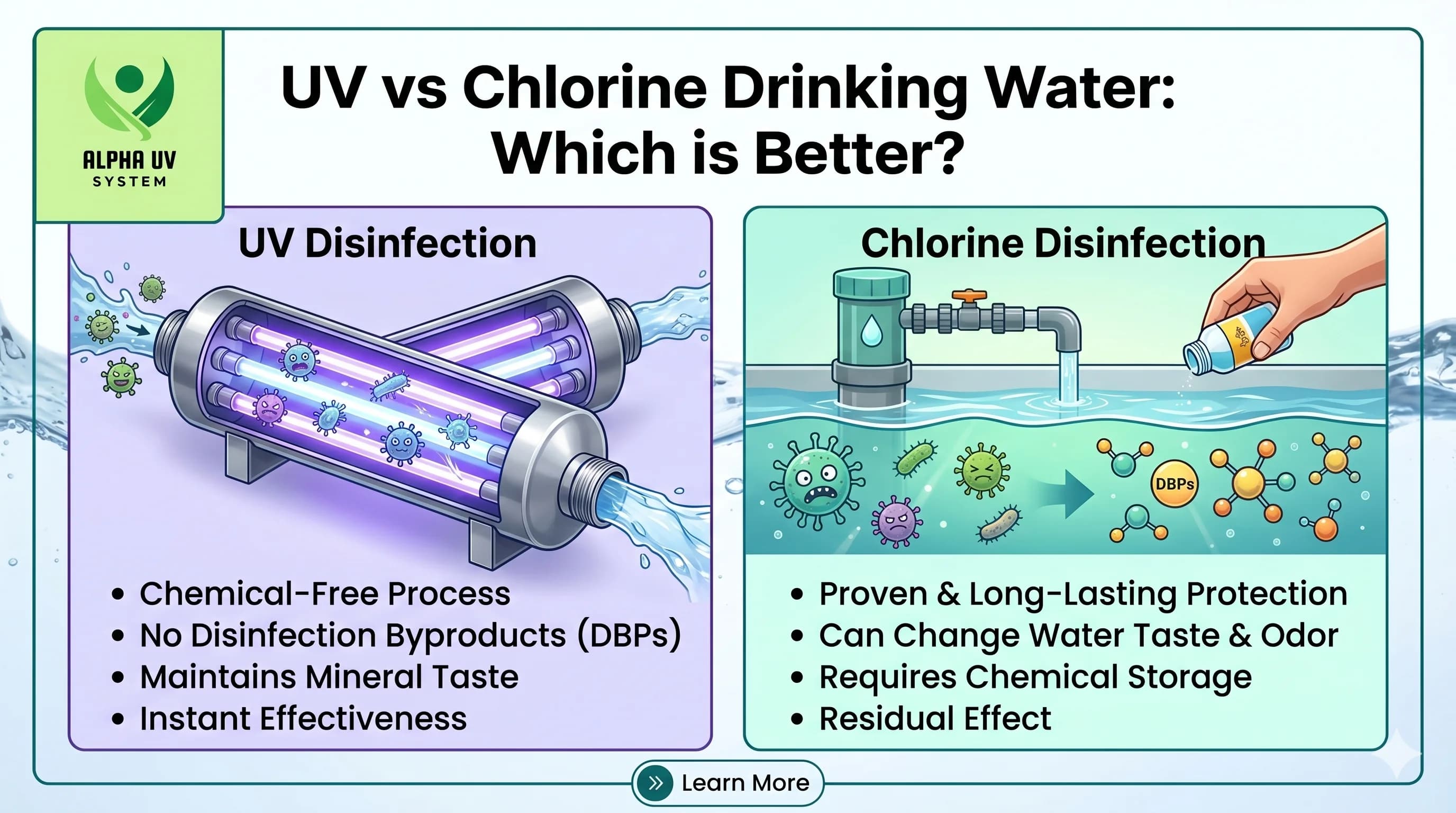
For drinking water at the point of use — your home tap, kitchen under-sink unit, or building treatment plant — UV is better than chlorine for five specific reasons:
- UV kills Cryptosporidium and Giardia at doses as low as 3–10 mJ/cm². Chlorine at any practical drinking water concentration has zero effect on these two parasites, which are the most common triggers of waterborne disease outbreaks across India.
- UV produces zero disinfection byproducts (DBPs). Chlorine reacts with organic matter in water to form trihalomethanes (THMs) and haloacetic acids (HAAs) — compounds classified by IARC as probable human carcinogens.
- UV adds no taste or odour. Chlorinated drinking water is detectable by smell and taste even at 0.2 mg/L, affecting food preparation and consumer acceptance.
- UV requires no chemical storage or dosing management. A Philips UV-C lamp system runs on electricity alone — annual lamp replacement is the only routine task.
- UV is safer in a home environment. Storing sodium hypochlorite or calcium hypochlorite in an apartment creates chemical hazard risk that a UV system eliminates entirely.
Chlorine retains one genuine advantage: it provides a residual that protects water as it travels through municipal distribution pipes. For a home tap or building rooftop tank, that advantage does not apply.
How Each Method Kills Pathogens
How UV Disinfection Works
UV-C light at 254 nm is absorbed by the nucleic acids (DNA and RNA) inside bacteria, viruses, and protozoan cysts. The photochemical reaction creates thymine dimers — cross-links in the pathogen's genetic code that block replication. A microorganism that cannot replicate cannot cause infection, regardless of whether it is physically removed from the water. The inactivation happens in milliseconds as water passes through the UV chamber. No chemistry occurs: the water entering and leaving the chamber is chemically identical. This is the core reason the UV vs chlorine drinking water which is better question resolves so strongly in favour of UV for point-of-use treatment — nothing is added, nothing harmful is created.
How Chlorine Disinfection Works
Chlorine — added as sodium hypochlorite (liquid bleach), calcium hypochlorite (powder), or chlorine gas in large plants — dissolves in water to form hypochlorous acid (HOCl). HOCl is a powerful oxidant that disrupts pathogen cell membranes, denatures proteins, and halts enzyme activity. It is highly effective against most bacteria at 0.2–0.5 mg/L with 30 minutes of contact time, and moderately effective against enteric viruses at similar doses. The critical weakness: HOCl reacts with naturally occurring organic compounds — humic acids from soil decomposition, algal metabolites, agricultural runoff residues — to form trihalomethanes (THMs: chloroform, bromodichloromethane, dibromochloromethane, bromoform) and haloacetic acids (HAAs: monochloroacetic acid, dichloroacetic acid, trichloroacetic acid, and brominated analogues). These are the disinfection byproducts that drive the UV disinfection vs chlorination drinking water debate toward UV for every residential and food-service application.
Data Table 1: UV vs Chlorine — Pathogen Kill Performance
The following data is drawn from the WHO Guidelines for Drinking Water Quality (4th edition), USEPA Ultraviolet Disinfection Guidance Manual, and NSF/ANSI 55 Class A certification parameters. UV doses are delivered dose (not installed dose); chlorine values assume CT at pH 7.0 and 20°C.
| Pathogen | UV Dose (mJ/cm²) for 3-log | UV Log Reduction at 40 mJ/cm² | Chlorine Dose (mg/L) | Chlorine Contact Time (min) | Winner |
|---|---|---|---|---|---|
| E. coli O157:H7 | 6 | >4-log | 0.2 | 30 | Equivalent |
| Salmonella typhi | 10 | 4-log | 0.5 | 60 | UV |
| Cryptosporidium parvum | 3 | >3-log | No practical dose | Resistant | UV (decisive) |
| Giardia lamblia | 10 | 3-log | 2.5 | 60+ | UV |
| Norovirus (GII) | 39 | 3-log | 0.5 | 30 | Comparable |
| Adenovirus (types 2, 41) | 200 | 1.5-log at 40 mJ/cm² | 0.5 | 30 | Chlorine |
| Hepatitis A virus | 40 | 3-log | 0.5 | 45 | Comparable |
| Rotavirus | 36 | 3-log | 0.2 | 30 | Comparable |
| Legionella pneumophila | 5 | >4-log | 1.0 | 60 | UV |
| Vibrio cholerae (Cholera) | 8 | >4-log | 0.2 | 30 | Equivalent |
The two rows that matter most for households in Delhi, UP, Punjab, Haryana, and other states where surface water is used in municipal supply are Cryptosporidium and Giardia. These protozoan cysts form thick oocyst walls that chlorine cannot penetrate at any dose that is safe for human consumption. UV destroys them at doses far below the 40 mJ/cm² standard output of even an entry-level NSF 55 Class A system. When asking UV vs chlorine drinking water which is better, this single fact — chlorine's total failure against Cryptosporidium — is often the deciding factor.
Disinfection Byproducts: The Most Important Difference for Indian Households
Every litre of water that Delhi Jal Board, BWSSB (Bangalore), Chennai Metrowater, or Mumbai's BMC supplies to residents has been chlorinated. The residual chlorine in that water (typically 0.2–0.5 mg/L at the point of supply) continues to react with organic matter in your building's overhead tank, your internal plumbing, and your storage containers. The result is an ongoing accumulation of THMs and HAAs that you then consume.
CPCB (Central Pollution Control Board) surveillance and academic studies of Indian municipal water quality have found THM concentrations ranging from 15 to 220 micrograms per litre in distributed water, varying by source water quality, seasonal organic load, and chlorine dosing practice. BIS IS 10500:2012 sets a THM limit of 200 micrograms per litre — a standard that is met in most cities on average but exceeded in spot samples during monsoon season when organic load in source water peaks. WHO's guideline for total THMs is 100 micrograms per litre.
A point-of-use UV system that operates after a carbon block pre-filter eliminates both the pathogens and the THMs in one pass. UV alone does not remove THMs — it requires carbon pre-filtration for that step. The combination of carbon + UV is the recommended chlorine-free drinking water solution for Indian municipal supply households.
Data Table 2: Disinfection Byproducts — UV vs Chlorine
| Byproduct | Formed by UV? | Formed by Chlorine? | IARC Classification | Indian Regulatory Status (BIS IS 10500) |
|---|---|---|---|---|
| Trihalomethanes (THMs — total) | No | Yes | Group 2A–2B (chloroform: 2B) | Maximum 200 µg/L |
| Haloacetic Acids (HAAs) | No | Yes | Group 2B (dichloroacetic acid) | Not separately listed; covered under pesticide residues |
| Chlorophenols (2-chlorophenol, 2,4-dichlorophenol) | No | Yes (from phenols in source water) | Group 2B | No specific limit; covered under phenolic compounds 1 µg/L |
| Chloramines (combined chlorine) | No | Yes (when nitrogen compounds present) | Not classified; irritant | Monochloramine: 3 mg/L (as Cl₂) |
| Chlorite / Chlorate | No | Yes (from sodium hypochlorite degradation) | Not classified; haematotoxic | Chlorite: 0.7 mg/L (WHO guideline; not yet in IS 10500:2012) |
| Bromate | No | No (ozonation byproduct — not applicable here) | Group 2A | 10 µg/L (WHO guideline) |
| UV photoproducts (nitrite from nitrate, trace aldehydes) | Trace under very high dose | No | Not classified at drinking water UV doses | Not regulated; not formed at standard 40 mJ/cm² |
| Chloroform (trichloromethane) | No | Yes (dominant THM species) | Group 2B | Included in THM total limit of 200 µg/L |
The clear finding from this table: in the UV vs chlorine safety comparison, UV produces no regulated byproducts at the doses used for drinking water disinfection (40–100 mJ/cm²). Chlorination produces multiple IARC-classified compounds as an unavoidable consequence of the chemistry involved.
Taste and Odour: What Families Actually Notice
The smell of chlorine in tap water is one of the most common complaints received by municipal water utilities across India. What consumers detect is primarily chloramines — compounds formed when free chlorine reacts with ammonia and organic nitrogen in water. The human nose can detect chloramines at concentrations as low as 0.1 mg/L. At 0.5 mg/L (a typical residual in distributed water), most people find the taste and smell objectionable, especially in hot beverages, cooked rice, and drinking water.
UV treatment has zero effect on taste or odour. The water entering the UV chamber and the water exiting it are organoleptically identical. For food service — restaurants, cloud kitchens, hotels, food manufacturing — this is not merely a comfort issue but a product quality imperative. Bread, dal, tea, and coffee prepared with UV-purified chlorine-free drinking water taste measurably different from the same recipes prepared with chlorinated tap water. This is the everyday lived dimension of the UV disinfection vs chlorination drinking water comparison that laboratory data tables do not capture.
If the municipal supply arriving at your building already contains free chlorine, a UV water purifier vs chlorine approach of carbon pre-filtration followed by UV removes both the taste compounds and the pathogens — including the chlorine-resistant ones that the municipal treatment step missed.
Residual Disinfection: The One Area Where Chlorine Leads
Chlorine's genuine, defensible advantage over UV is the residual it leaves in water. Free chlorine at 0.2 mg/L persists for hours to days in a closed storage tank or distribution pipe, continuing to kill bacteria that enter through leaks, cross-connections, or condensation. In a municipal network serving millions of households through hundreds of kilometres of ageing pipes — many of them cast-iron mains in cities like Delhi or Chennai — that residual is not optional. Without it, water that leaves a treatment plant disinfected can arrive at the tap with significant bacterial contamination from the distribution system itself.
UV provides no residual at all. Once water passes through the UV chamber, there is no ongoing protection against re-contamination. If the disinfected water is stored in a dirty container, kept for 24 hours, or conveyed through contaminated pipes, it can become unsafe again.
For a home, however, the residual argument collapses. A UV system installed at the kitchen tap or at the outlet of a clean stainless-steel overhead tank provides disinfected water that is consumed immediately or stored in a covered glass/stainless container for a few hours. Re-contamination in that scenario is not a realistic risk. The UV point-of-use advantage — zero chemistry, zero DBPs, zero taste change — completely outweighs the residual benefit that is irrelevant at the consumption point.
Operating Simplicity: UV vs Chlorine in Practice
When Indian facility managers, housing society RWAs, and homeowners compare UV vs chlorine for daily operation, the gap in operational complexity is stark. Chlorination requires active management: procurement of a hazardous chemical, calibrated dosing, ongoing residual testing, and trained personnel. UV requires a working power connection and a calendar reminder for the annual lamp change.
Data Table 3: Operational Complexity — UV vs Chlorine
| Operational Task | UV System | Chlorination System |
|---|---|---|
| Chemical procurement and storage | None required | Monthly procurement of sodium hypochlorite or calcium hypochlorite; locked chemical store required |
| Dosing calibration | Not applicable — dose is fixed by lamp output and flow rate | Dosing pump calibration required every 1–3 months; overdose risk |
| Residual testing | Not required — UV leaves no residual to test | Daily or weekly DPD colorimetric test mandatory; results logged |
| Routine maintenance | Annual Philips UV-C lamp replacement (15–30 min); quartz sleeve cleaning every 6 months | Dosing pump servicing, injector cleaning, tank inspection every 1–3 months |
| Safety training requirement | None beyond basic electrical safety | Chemical handling training, PPE (gloves, eye protection), MSDS awareness |
| Compliance records | Lamp replacement log; UVT test log if required by local authority | Chemical purchase records, dosing logs, residual test logs, incident reports |
| Operator skill level required | Minimal — indicator light signals lamp failure | Trained operator; mismanagement causes either under-disinfection or DBP excess |
| Consequence of power failure | No disinfection — alarm activates; UV better than chlorine here as failure is immediately visible | Dosing pump stops — residual depletes within hours; failure may go undetected |
Cost Comparison: Capital and 5-Year TCO
The UV water purifier vs chlorine cost comparison requires looking beyond purchase price to true 5-year total cost of ownership (TCO). For an Indian household processing 200–400 litres per day, the numbers are as follows. These figures represent mid-market pricing in 2026 for the Indian market; actual costs vary by city, flow rate, and supplier.
Data Table 4: 5-Year Total Cost of Ownership — UV vs Chlorine (Home Scale)
| Cost Item | UV System (INR) | Chlorination System (INR) | 5-Year Total — UV (INR) | 5-Year Total — Chlorine (INR) |
|---|---|---|---|---|
| Equipment purchase / installation | 12,000–22,000 | 4,000–8,000 (dosing pump + tank injector) | 12,000–22,000 | 4,000–8,000 |
| Annual lamp replacement (Philips UV-C) | 3,500–5,500 per year | Not applicable | 17,500–27,500 | — |
| Chemical cost (sodium hypochlorite) | Not applicable | 800–1,800 per year | — | 4,000–9,000 |
| Residual testing kits / DPD tablets | Not applicable | 500–1,000 per year | — | 2,500–5,000 |
| Dosing pump servicing | Not applicable | 1,000–2,000 per year | — | 5,000–10,000 |
| Pre-filter (sediment — shared requirement) | 2,000–4,000 + 1,000/yr consumables | 2,000–4,000 + 1,000/yr consumables | 7,000–9,000 | 7,000–9,000 |
| Electricity (UV: 16–30W; dosing pump: 5–15W) | 300–500 per year | 150–300 per year | 1,500–2,500 | 750–1,500 |
| 5-Year Total (approximate) | — | — | 38,000–61,000 | 23,250–42,500 |
UV carries a higher 5-year TCO at home scale — primarily due to the cost of Philips UV-C lamp replacement. The question is whether the additional cost buys meaningful value. Given that UV better than chlorine performance on Cryptosporidium, Giardia, DBP elimination, and taste is well-established, most Indian households that have experienced a waterborne illness episode in the family find the premium justified. For large-scale installations (apartment complexes, industrial facilities) the per-litre cost gap narrows considerably as fixed costs are distributed across higher throughput.
Safety: Chlorine Storage in Indian Homes vs UV
Sodium hypochlorite (5–12% concentration, as sold for water treatment) is a corrosive oxidising agent. Spills on skin or eyes cause chemical burns. Mixing with acidic cleaners — toilet descalers, vinegar, certain bathroom sprays — releases chlorine gas, which is acutely toxic at concentrations above 1 ppm. In the confined spaces typical of Indian apartments, an accidental chlorine gas release from a storeroom or kitchen cabinet can cause serious respiratory injury.
UV systems store nothing hazardous. The lamp itself contains a small amount of mercury (in low-pressure mercury-vapour lamps) — a consideration for disposal, not for operational safety. Some manufacturers now offer mercury-free UV-C LED systems, though Philips UV-C lamp technology remains the performance benchmark for residential and commercial applications in India.
Data Table 5: Safety Comparison — UV vs Chlorine
| Safety Factor | UV System | Chlorination System | Indian Household Context |
|---|---|---|---|
| Chemical storage hazard | None | Corrosive liquid; requires locked, ventilated storage | Most apartments have no dedicated chemical store |
| Accidental ingestion risk | None (no chemical added to water) | Overdose causes acute hypochlorite toxicity | Dosing errors in manual systems are common |
| Chemical burn / splash risk | None | Skin/eye burns from hypochlorite concentrate | Requires PPE that most households do not stock |
| Gas release risk | None | Chlorine gas if mixed with acid; toxic above 1 ppm | Indian bathrooms frequently contain acidic descalers |
| Child safety | Lamp is sealed inside chamber; no child access risk | Chemical bottles accessible; child poisoning risk | NCPCR reports chemical ingestion among under-5s |
| Long-term health (DBPs) | No carcinogenic byproducts at standard doses | THMs and HAAs with IARC Group 2A/2B classification | Indian municipal water already contains THMs; additional chlorination adds to cumulative exposure |
| UV radiation exposure (operator) | UV-C is contained inside sealed chamber; no operator exposure | Not applicable | Sealed quartz sleeve design prevents any UV-C leakage |
| Lamp disposal | Mercury-containing lamp requires e-waste disposal (annual) | Plastic containers, chemical residues require careful disposal | UV lamp disposal is a one-off annual task vs ongoing chemical waste |
When Chlorine Is Still the Right Choice
A fair UV vs chlorine drinking water which is better comparison requires acknowledging the scenarios where chlorine remains the technically superior option:
Municipal and regional distribution networks. For a water utility serving a city of 2 million people through a pipe network installed over several decades — with cross-connections, pressure fluctuations, and ageing cast-iron mains — a chlorine residual of 0.2 mg/L is the only practical way to prevent post-treatment contamination before water reaches the tap. UV at a central treatment plant cannot protect the distribution network from re-contamination that happens 40 kilometres downstream.
Emergency and off-grid disinfection. In flood relief operations, earthquake response, or rural camps where electricity is unavailable or unreliable, chlorine tablets (NaDCC, sodium dichloroisocyanurate) provide immediate, portable disinfection capacity. UV systems require a stable power supply and an operational UV chamber that cannot be deployed in the field.
Adenovirus as the specific target pathogen. At a standard delivered UV dose of 40 mJ/cm², adenovirus types 2 and 41 achieve only approximately 1.5-log inactivation. Full 3-log inactivation requires doses above 200 mJ/cm² — beyond what most residential and light commercial UV systems deliver. Chlorine at 0.5 mg/L with 30 minutes contact time achieves 3-log adenovirus reduction. In settings where adenovirus is epidemiologically significant (swimming pools, paediatric care facilities), chlorine or a high-dose UV system is required.
Very high turbidity source water. UV transmittance (UVT) below 40% makes UV treatment impractical — the lamp must be positioned so close to the water that flow rate drops to unusable levels. For water with NTU above 5 and UVT below 50%, coagulation-flocculation-sedimentation followed by chlorination may be the more practical treatment train until pre-treatment can be installed.
The Winning Combination: UV + Minimal Chlorine Residual
The UV disinfection vs chlorination drinking water debate has a practical resolution in large-scale water treatment: use both, each for what it does best. Most advanced municipal water treatment plants globally now use UV as the primary disinfection step — because UV kills Cryptosporidium, Giardia, and the full range of bacterial and viral pathogens without forming THMs or HAAs — followed by a low-dose chlorine residual (0.1–0.2 mg/L, far below DBP-generating concentrations) applied purely to protect the distribution network.
This UV-plus-residual approach is explicitly described in the CPHEEO (Central Public Health and Environmental Engineering Organisation) Manual on Water Supply and Treatment, which is the primary technical reference for Indian municipal water utilities. The approach is also recognised in the WHO Water Safety Planning framework as a best-practice combination for large treatment plants.
For an apartment complex or industrial facility with its own water treatment plant, the same combination applies: UV at the main treatment point eliminates the full pathogen load, and a very low-dose chlorine residual applied to the overhead tank prevents biofilm growth inside the tank itself. The result is UV better than chlorine performance at the treatment stage with chlorine's network protection advantage retained at minimal dose.
What This Means for Indian Homes
The practical implications of the UV vs chlorine drinking water which is better question differ depending on your water source in India. Three scenarios cover the vast majority of Indian households:
Municipal supply (Delhi, Mumbai, Bangalore, Chennai, Hyderabad, and similar cities). Your water arrives chlorinated — typically 0.2–0.5 mg/L free chlorine, sometimes higher after monsoon season when utilities increase chlorine dose to manage elevated organic load. The municipal chlorine has already done its job in the distribution network. At your tap, you want to: (1) remove the chlorine and its byproducts that are now present in the water; (2) kill any Cryptosporidium, Giardia, or bacteria that survived municipal treatment or entered through your building's plumbing and tank. Solution: carbon block pre-filter (removes chlorine, THMs, taste) + UV (kills remaining pathogens). This combination delivers genuine chlorine-free drinking water at the point of use.
Borewell water (common in UP, Punjab, Haryana, Rajasthan, and peri-urban areas). Borewell water is unchlorinated — it carries whatever microbial load exists at the aquifer level, which can include E. coli from septic tank leakage, Giardia cysts, and coliform bacteria. Pre-treatment for iron and manganese (common in north Indian borewell water) is essential before UV — iron above 0.3 mg/L reduces UVT and cuts UV dose delivery. The treatment train: sediment filter → iron removal → UV. No chlorination required for a well-maintained UV water purifier system at this scale.
Both sources (tanker supply during shortages + municipal or borewell as primary). Water tankers in Indian cities are a high-risk source — no treatment standard applies to commercial tanker water, microbiological quality is inconsistent, and turbidity varies widely. A UV system handling tanker water should be preceded by a 5-micron sediment filter and ideally a 20-micron pre-filter. In this scenario, UV is far safer than chlorine because dosing chlorine to unknown-quality tanker water risks either under-disinfection (if organic load is high and chlorine demand exceeds dose) or over-disinfection (excess chlorine and THM formation).
Data Table 6: Best Disinfection Approach by Indian Water Source Type
| Water Source | Main Microbial Concern | Recommended Primary Treatment | UV Role | Chlorine Role |
|---|---|---|---|---|
| Delhi Jal Board / municipal supply | Cryptosporidium breakthrough; THMs from existing chlorination; re-contamination in building tank | Carbon block + UV at point of use | Primary pathogen kill; handles chlorine-resistant parasites | Already present from utility; carbon removes it at tap |
| Borewell (UP / Punjab / Haryana) | E. coli from septic leakage; coliform bacteria; iron and manganese | Sediment → iron removal → UV | Primary and sole disinfection — no chlorine addition needed | Not recommended; adds chemical management complexity |
| Municipal surface water supply (Mumbai / Chennai / Bangalore) | Seasonal Cryptosporidium and Giardia during monsoon; THMs from high organic load in source water | Carbon + UV at kitchen tap | Kills chlorine-resistant pathogens; protects against re-contamination post-tank | Already dosed by utility; no additional household chlorination needed |
| Commercial water tanker (urban supplement) | Unknown — E. coli, total coliforms, variable turbidity | 5-micron sediment + UV | Primary disinfection; handles variable microbial load without chemical adjustment | Not recommended — dose calibration impractical for variable-quality source |
| Apartment complex overhead tank (any source) | Biofilm accumulation; E. coli and Pseudomonas re-growth in tank; Legionella in warm water | UV at tank outlet + periodic tank cleaning | Kills re-growth pathogens at tank outlet; handles Legionella | Optional low-dose residual (0.1 mg/L) inside tank only, not for drinking |
| Rural groundwater / hand pump (Bihar / Jharkhand / Odisha) | Arsenic (chemical, not microbial); E. coli; fluoride in some zones | Arsenic removal + UV; solar UV system if grid unreliable | Handles microbial load; does not address arsenic — separate removal step mandatory | Low-cost emergency option; NaDCC tablets where UV power unavailable |
Frequently Asked Questions
Does UV remove chlorine from water?
Standard UV-C lamps operating at 254 nm do not remove dissolved chlorine from water at the doses used for residential disinfection. At very high UV doses (above 500 mJ/cm², used in industrial UV-AOP systems), some photolytic chlorine degradation occurs — but this is not what home or commercial UV water purifiers deliver. To remove chlorine and its byproducts (THMs, HAAs, chlorophenols, taste compounds) from municipal drinking water, a granular activated carbon (GAC) filter or carbon block pre-filter must be installed upstream of the UV unit. The carbon removes chlorine; the UV then kills any pathogens that remain. Together, the pair delivers true chlorine-free drinking water from a municipal supply — better than either technology alone in the UV vs chlorine drinking water which is better context.
Is chlorinated water safe to run through a UV system?
Yes, completely. Municipal residual chlorine at 0.2–0.5 mg/L does not damage quartz sleeves, UV lamps, or any component of a standard UV reactor. In fact, some UV-advanced oxidation systems deliberately combine UV with free chlorine at elevated concentrations to generate hydroxyl radicals for micropollutant destruction — this is an industrial application at doses and chlorine levels far above residential use. For a home UV unit receiving normal municipal tap water, the chlorine present is entirely harmless to the equipment. The UV system will still deliver its full rated dose at 40 mJ/cm² regardless of the chlorine content of the incoming water.
Which is better for borewell water — UV or chlorine?
UV is better for borewell water used for drinking, provided appropriate pre-treatment is in place. Borewell water in north India commonly contains iron above 1 mg/L, which reduces UV transmittance and lowers delivered UV dose if not removed. The correct treatment sequence is: 5-micron sediment cartridge filter → iron removal system (pressure sand filter or greensand filter) → UV disinfection unit. With this pre-treatment chain, UV delivers complete inactivation of E. coli, coliforms, Giardia, and other borewell-associated pathogens without any chemical addition. Chlorination of borewell water at the household level introduces the same DBP and taste problems as municipal chlorination, with the added complication that the chlorine demand of iron-rich borewell water is unpredictable and difficult to dose correctly without laboratory testing.
Does WHO recommend UV or chlorine for home drinking water?
The WHO Guidelines for Drinking Water Quality (4th Edition, 2017, with 2022 addendum) recognise UV disinfection as an effective point-of-use water treatment method with a minimum delivered dose of 40 mJ/cm² for clear water (UVT above 75%). WHO specifically identifies UV as the preferred technology for inactivating Cryptosporidium and Giardia at household and community scale. For distribution systems, WHO continues to recommend chlorine residual maintenance. WHO's Water Safety Plan framework explicitly recommends UV for point-of-use treatment in settings where chlorine DBPs are a concern — which describes almost every Indian household on municipal supply. The UV vs chlorine drinking water which is better answer in WHO guidance is clearly UV at the consumption point.
Can UV disinfect water without any chlorine addition?
Yes. UV is an independent, complete disinfection technology. It does not require chlorine pre-treatment, post-treatment, or any chemical whatsoever. For water with UVT above 75% and turbidity below 1 NTU — which describes well-maintained filtered borewell or pre-filtered municipal water — a UV system operating at 40 mJ/cm² achieves at minimum 4-log reduction of bacteria, 3-log reduction of Giardia, and 3-log reduction of Cryptosporidium. These reductions meet or exceed the WHO target pathogen log reductions for drinking water. UV alone is sufficient for primary disinfection at the point of use. Chlorine addition is only needed if distribution network residual protection is required — which it is not in a home application.
What about Cryptosporidium — does chlorine kill it?
No. Cryptosporidium parvum oocysts are completely resistant to chlorine at any concentration that is safe for human consumption in drinking water. At the chlorine doses used in municipal treatment (0.2–2 mg/L), Cryptosporidium oocysts experience essentially zero inactivation. Achieving even 1-log (90%) inactivation of Cryptosporidium with free chlorine requires CT values (concentration in mg/L multiplied by contact time in minutes) above 7,200 at pH 7 and 25°C — which corresponds to 72 mg/L for 100 minutes, or 7.2 mg/L for 1,000 minutes. Neither concentration is safe to drink. UV at 3 mJ/cm² achieves 3-log (99.9%) Cryptosporidium inactivation. At the standard 40 mJ/cm² dose, the reduction exceeds 3-log. This specific chlorine vs UV comparison — total chlorine failure vs effortless UV kill — is the single most important technical fact in the UV vs chlorine drinking water which is better debate for Indian households, where Cryptosporidiosis and Giardiasis are endemic.
If you are unsure whether UV or chlorine disinfection is the right primary treatment for your home, borewell, apartment complex, or food business — share your water source, flow rate, and existing water quality test reports with our team for a written recommendation within 24–48 hours.
WhatsApp our team at +91 95995 00580 — describe your water source and we will recommend the right approach for your situation.
Standards, authorities & further reading
External references used to inform this guide. Regulations evolve — check the latest revision on each authority's site before compliance decisions.
Recommended UV Systems
Alpha UV System products for this application — powered by genuine Philips UV-C lamps.
UV System for Drinking Water
100 – 50,000 LPH
Chemical-free UV drinking water disinfection — from homes to municipalities
Residential UV Disinfection System
100 – 500 LPH
Safe drinking water for homes and villas — no chemicals, no taste change
Not sure which system suits your application? WhatsApp our engineers for a free recommendation →
Related solutions
See how Alpha UV System applies this to your industry or city.
Need a UV system?
Talk to our UV engineers — WhatsApp for a quote in 2 hours, or browse the full catalog on IndiaMART.