Quick Answer
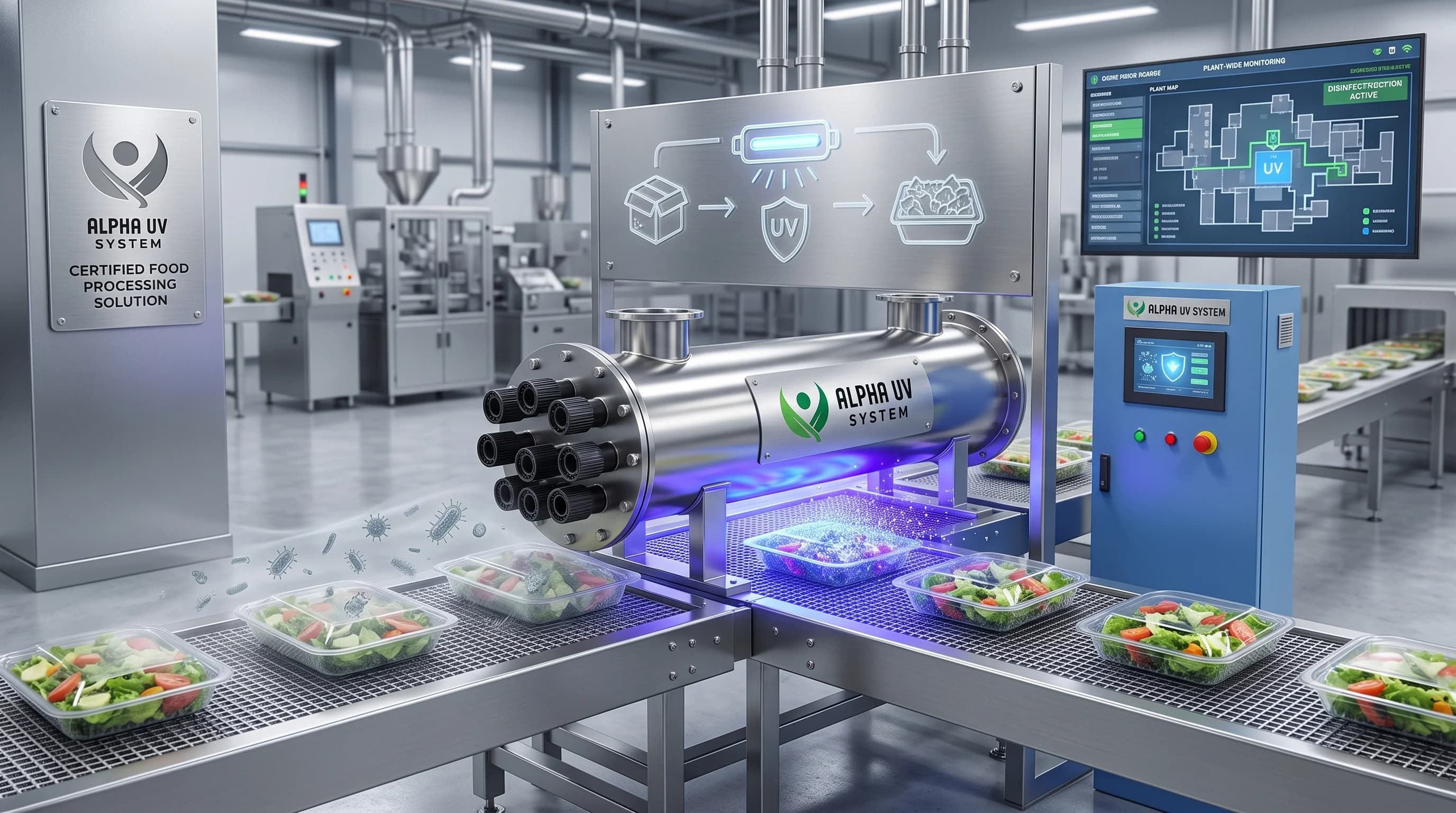
UV-C surface disinfection for food processing conveyors uses germicidal ultraviolet light at 254 nm to inactivate bacteria, viruses, and mould spores on conveyor belt surfaces, food product surfaces, and packaging materials — without water, heat, or chemical contact. A UV tunnel (an enclosure containing UV-C lamps positioned above and below the conveyor belt) delivers a surface UV dose of 40–200 mJ/cm² to product and belt surfaces passing through the tunnel. At 40 mJ/cm², 3-log (99.9%) reduction of Listeria monocytogenes, Salmonella, and E. coli on flat surfaces is achievable; at 100–200 mJ/cm², 4-log reduction is achievable on smooth product surfaces. UV conveyor disinfection is used in Indian food processing for: fresh produce lines (leafy vegetables, cut fruits), ready-to-eat (RTE) food packaging, dairy product packaging, bakery product conveyors, and meat processing lines where post-cook product cross-contamination is a FSSAI HACCP Critical Control Point. Unlike chemical spray disinfection (quaternary ammonium, peracetic acid), UV conveyor disinfection leaves no chemical residual on food surfaces, requires no rinse, produces no effluent, and generates no chlorinated disinfection byproducts in the product environment. The UV intensity sensor output serves as the FSSAI HACCP CCP monitoring record for each production shift.
UV Surface Disinfection vs UV Water Disinfection — Key Differences
UV-C surface disinfection for conveyors is the same germicidal wavelength (254 nm) as UV water treatment — but the application geometry, dose delivery method, and engineering constraints are entirely different:
| Parameter | UV water disinfection | UV conveyor surface disinfection |
|---|---|---|
| Medium treated | Water flowing through a closed reactor | Surfaces (belt, product, packaging) passing under UV lamps |
| UV dose delivery | mJ/cm² = intensity (mW/cm²) × residence time (sec) | mJ/cm² = intensity at surface × exposure time (belt speed sets time) |
| Turbidity/UV transmittance | Water UVT limits dose penetration | Surface reflectivity, roughness, and biofilm thickness limit surface dose penetration |
| Design standard | NSF 55 / DVGW W294 (validated dose in flowing water) | No dedicated Indian standard — FSSAI HACCP validation at commissioning |
| Reactor type | Closed SS316L pressure vessel | Open UV tunnel (SS316L or aluminium reflector housing) over conveyor belt |
| Lamp orientation | Parallel to water flow axis, inside reactor | Perpendicular to belt travel, suspended above and/or below belt |
| Key design variable | Flow rate determines residence time and dose | Belt speed determines exposure time and dose |
UV Dose Requirements for Food Surface Disinfection
Surface UV dose delivery is more complex than water UV dose delivery because: (1) surfaces are not transparent to UV — dose penetrates only the outer layer of microbial contamination, with shadowing by product topography reducing dose on recessed surfaces; (2) dry surfaces are more susceptible to UV than wet surfaces in some organism groups (wet biofilm can reflect and scatter UV); and (3) food product surfaces have irregular geometries that create shadow zones not reached by the UV source.
UV Dose for Common Food Pathogens on Surfaces
| Target organism | Surface UV dose for 2-log (99%) reduction | Surface UV dose for 3-log (99.9%) reduction | Food application relevance |
|---|---|---|---|
| Listeria monocytogenes | 15–25 mJ/cm² | 40–60 mJ/cm² | RTE foods, dairy, deli meats — primary target |
| Salmonella Typhimurium | 10–20 mJ/cm² | 30–50 mJ/cm² | Poultry, eggs, fresh produce |
| Escherichia coli O157:H7 | 8–15 mJ/cm² | 25–40 mJ/cm² | Ground meat, fresh vegetables, dairy |
| Staphylococcus aureus | 20–35 mJ/cm² | 60–80 mJ/cm² | Dairy, bakery, RTE foods |
| Aspergillus niger (spores) | 100–200 mJ/cm² | 250–400 mJ/cm² | Bakery, spice processing — high dose required |
| Yeast (Saccharomyces, Candida) | 10–20 mJ/cm² | 30–50 mJ/cm² | Bakery, beverage, dairy |
Note: Surface UV doses required are significantly higher than water UV doses for equivalent log reductions because organisms on surfaces are partially protected by food matrix, biofilm, and surface topography that absorb and scatter UV before it reaches the pathogen. Product surfaces with high surface roughness (cut vegetable surfaces, textured packaging) require higher UV doses than smooth surfaces (film packaging, stainless steel belt) for the same log reduction.
UV Tunnel Design for Food Processing Conveyors
Tunnel Construction
A UV conveyor disinfection tunnel consists of:
- Enclosure: SS316L or anodised aluminium housing enclosing the UV lamps, with UV-reflective internal surface (polished aluminium or PTFE-coated reflectors that increase effective UV intensity at the product surface by redirecting scattered UV back to the target)
- UV lamps: Low-pressure UV-C lamps (254 nm) or amalgam LPHO lamps mounted perpendicular to the belt travel direction, spaced 50–150 mm apart, positioned 50–300 mm above the product surface depending on dose requirement and belt speed
- UV sensor: Calibrated UV intensity sensor mounted at the product plane level, providing real-time UV irradiance (mW/cm²) reading to the control panel
- Safety interlocks: UV-opaque curtains at tunnel entry and exit, with microswitch interlocks that disable the lamps if the curtain is breached — preventing operator UV-C eye and skin exposure
- Control panel: IP65-rated panel with lamp on/off, belt speed display, UV intensity readout, alarm relay (lamp failure or low intensity), and USB/Modbus data log output
Dose Calculation from Belt Speed and Lamp Intensity
Surface UV dose (mJ/cm²) = UV irradiance at product surface (mW/cm²) × exposure time (seconds)
Exposure time = lamp array length (cm) ÷ belt speed (cm/sec)
Example: 40 mJ/cm² target dose, lamp array length 60 cm, UV irradiance at product surface 25 mW/cm²:
- Required exposure time = 40 mJ/cm² ÷ 25 mW/cm² = 1.6 seconds
- Maximum belt speed = 60 cm ÷ 1.6 sec = 37.5 cm/sec = 22.5 m/min
For the production line to run at higher belt speeds, either the lamp array must be longer (to increase exposure time at higher speed) or lamp intensity must be increased (to deliver higher dose in shorter time). Alpha UV System's UV tunnel design engineers calculate the lamp array length, lamp count, and minimum belt speed for each conveyor disinfection application.
UV Conveyor Disinfection Applications in Indian Food Processing
Fresh Produce — Leafy Vegetables, Cut Fruits, Salad Ingredients
UV disinfection tunnels for fresh produce reduce surface bioburden on leafy vegetables (spinach, lettuce, coriander, mint), cut fruits (sliced mango, papaya, melon), and packaged salad ingredients before cold chain dispatch. The UV dose is applied to product surfaces after washing (if applicable) and before packaging — reducing the initial surface bacterial count that would otherwise multiply during cold chain storage. UV-treated fresh produce has an extended shelf life compared to conventionally processed produce because the lower starting bacterial count allows more time before shelf-life limits are reached.
Ready-to-Eat Foods and Deli Products
Listeria monocytogenes post-cook contamination in RTE foods (cooked meats, cheese, deli products) is the most significant food safety hazard in Indian RTE manufacturing. FSSAI and Codex Alimentarius identify post-process Listeria contamination as a CCP in RTE food HACCP plans. UV disinfection tunnels positioned on the packaging conveyor (before modified atmosphere packaging sealing) reduce Listeria on product surfaces by 2–3 log after the cook step.
Dairy Product Packaging Surfaces
Packaging material for dairy products (HDPE milk pouches, tetra pack, yogurt cups, cheese wraps) can carry surface contamination from storage and handling that is introduced into the product environment during filling. UV disinfection of packaging material surfaces at the packaging line entry — film material passing under a UV tunnel before the filling machine — reduces surface bioburden on packaging by 2–4 log before it contacts the product.
Bakery and Confectionery Conveyors
Bakery products are heat-treated during baking, but post-bake cooling, slicing, and packaging conveyors can re-contaminate the product surface with mould spores, yeast, and Staphylococcus from the production environment and handling equipment. UV disinfection of bakery cooling conveyor surfaces and packaging areas reduces the post-bake contamination that limits bread and cake shelf life in warm Indian ambient conditions.
FSSAI HACCP Integration for UV Conveyor Disinfection
UV conveyor disinfection can be integrated into FSSAI HACCP plans as a Critical Control Point (CCP) for surface contamination control at the conveyor/packaging stage. HACCP documentation for UV conveyor disinfection:
- Hazard identified: Listeria monocytogenes / Salmonella contamination of product surface at packaging conveyor
- Critical limit: Minimum UV irradiance at product surface (mW/cm²) × maximum belt speed (m/min) = minimum dose (mJ/cm²) for 2-log Listeria reduction
- Monitoring: Continuous UV intensity reading (mW/cm²) from calibrated sensor + belt speed encoder → dose calculation displayed on control panel; UV intensity log (1-minute intervals) exported to HACCP record system
- Corrective action: UV intensity alarm → stop belt → check lamp status, clean sensor window, verify lamp output; restart only after UV intensity confirms dose delivery
- Verification: Quarterly ATP swab testing or direct microbiological testing of conveyor surface before and after UV tunnel to verify log reduction claim
UV Conveyor Disinfection Systems from Alpha UV System
Alpha UV System designs and manufactures UV-C surface disinfection tunnels for food processing conveyor applications across India. Our UV tunnel systems are built in SS316L with Philips UV-C lamps, IP65-rated control panels, UV intensity sensors with continuous monitoring, and safety interlock systems. We provide FSSAI HACCP documentation, commissioning validation at rated belt speed and UV dose, and maintenance contracts with lamp replacement supply.
Applications: fresh produce, RTE foods, dairy packaging, bakery, meat and poultry processing, bottled water cap disinfection, and pharmaceutical packaging line surface disinfection. Custom tunnel dimensions for existing conveyor line retrofits and new production line specifications.
IIT-trained engineers. MSME Udyam registered manufacturer. 24–48 hour NCR response for site surveys and commissioning.
Contact us for UV conveyor disinfection system specifications: WhatsApp +91 93183 05878 or call +91 95995 00580.
Related guides: UV water treatment for food and beverage industry | UV filtration for food process water | UV disinfection systems — complete buyer's guide
Recommended UV Systems
Alpha UV System products for this application — powered by genuine Philips UV-C lamps.
Commercial UV Water Purification System
500 – 5,000 LPH
HACCP-compliant UV water purification for hotels, restaurants, and offices
Industrial UV Water Treatment System
5,000 – 50,000 LPH
Schedule M 2025 and HACCP compliant UV for pharma, food & beverage, and process water
Not sure which system suits your application? WhatsApp our engineers for a free recommendation →
Related solutions
See how Alpha UV System applies this to your industry or city.
Need a UV system?
Talk to our UV engineers — WhatsApp for a quote in 2 hours, or browse the full catalog on IndiaMART.